

You have run the same marathon build three times, hit your mileage, nailed your workouts, and still crossed the line at the same finish time.
At some point steady, progressive training stops moving the needle.
Functional overreaching is the deliberate way out of that rut, and it is one of the most misunderstood tools in endurance training.
Done right, a short block of concentrated overload followed by real recovery pushes your fitness above where it sat before.
Done wrong, the same block digs a hole you spend weeks climbing out of.
The gap between a breakthrough and a wrecked season often comes down to a single variable: how long you recover after the hard block.
Here is what you will learn:
- What functional overreaching actually is and how it builds fitness
- How functional overreaching differs from its non-functional cousin
- The symptoms that tell you which side of the line you are on
- Where overreaching ends and overtraining begins
- How elite coaches program planned overload
- How to run a safe dig cycle in your own training
What Is Functional Overreaching?
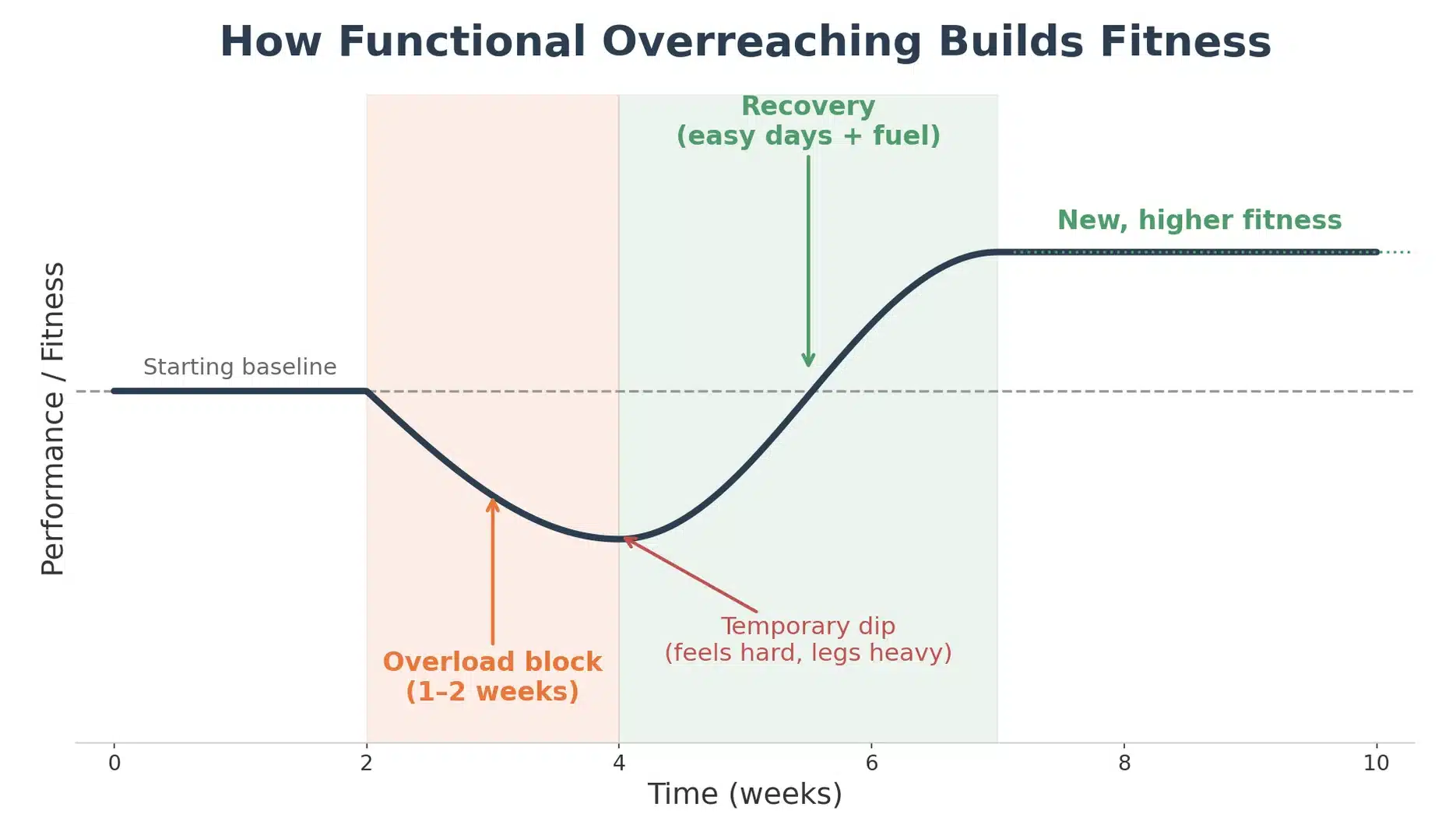
Functional overreaching is a planned, short-term spike in training load that causes a temporary dip in performance, followed by a rebound to a higher level than before.
Your body adapts to hard training through a process called supercompensation.
After a hard block, performance drops during recovery, then climbs above your old baseline once you are rested.
Progressive training relies on repeating that cycle in small doses over months.
Experienced runners eventually hit a ceiling where predictable, steady stress stops producing new gains.
One controlled trial found that 12 straight days of maximal training followed by 6 days of rest raised peak power output, while the group that trained the same volume with rest days built in saw no change.

The overload group felt worse during the hard days and their performance sagged.
After six days of recovery, they jumped past a level the evenly-spaced group never reached.
That rebound is functional overreaching in a single sentence: short overload, real recovery, higher fitness.
Functional vs. Non-Functional Overreaching: What Is the Difference?
The difference between functional and non-functional overreaching is not the training. It is the recovery timeline and the outcome.
Functional overreaching produces a performance dip that lasts days to about two weeks, and then you come back stronger.
Non-functional overreaching produces the same dip, but recovery stretches into weeks and no rebound arrives.
According to the joint consensus statement from the European College of Sport Science and the American College of Sports Medicine, functional overreaching restores and improves performance within days to weeks, while non-functional overreaching stalls performance for weeks with no gain above baseline.
Both start the same way, with a runner training beyond their normal load on purpose.
The fork appears afterward, and it is decided almost entirely by how well you recover.
Functional overreaching is a two-week detour that ends in a fitness jump.
Non-functional overreaching is a multi-week setback that ends where you started, or lower.
This is why the recovery block is not optional padding after the hard work.
It is the half of the equation that turns overload into adaptation instead of exhaustion.
RunnersConnect Bonus
Download your FREE Marathon Recovery Schedule for Runners.
It’s a PDF showing how to recover correctly in the 3 weeks post marathon, plus our cross training guide with over 20 sample workouts for the most common cross training types
What Are the Symptoms of Overreaching?
The symptoms of overreaching are easy to feel but hard to interpret, because early functional overreaching looks a lot like the start of trouble.
During a deliberate overload block you should expect heavy legs, higher perceived effort at normal paces, and short-lived drops in workout quality.
Those signs are procedural. They tell you the stimulus is big enough to matter.
The warning signs sit one layer deeper and point toward the non-functional side.
- Resting heart rate: a morning reading more than about 10 beats above your normal average, holding for several days
- Sleep: broken or shortened sleep lasting more than three nights
- Mood: irritability, flatness, or loss of desire to train beyond ordinary tiredness
- Illness: a lingering cold, sore throat, or run-down feeling that will not clear
The consensus research links non-functional overreaching to exactly this cluster: prolonged fatigue, sleep disturbance, elevated resting heart rate, illness, and psychological stress.
One or two rough days inside a hard block is normal, but a stack of deeper symptoms that keeps building is your cue to stop the block and recover.
The practical rule is direction, not any single reading.
Fatigue that plateaus and then lifts with rest is functional. Fatigue that keeps climbing no matter how easy you run is not.
Overreaching vs. Overtraining: Where Is the Line?
Overreaching and overtraining sit on the same spectrum, separated by how long the performance loss lasts.
Overreaching, functional or not, is measured in days to weeks.
Overtraining syndrome is measured in months.
The consensus definition treats overtraining syndrome as an extreme form of non-functional overreaching, with a performance drop lasting more than two months and usually a trigger beyond training load alone.
Think of it as three stops on one road.
Functional overreaching is the productive detour you plan for.
Non-functional overreaching is the wrong turn you can still recover from in a few weeks.
Overtraining syndrome is being lost for months.
Most runners never reach overtraining syndrome, because it usually takes repeated non-functional episodes plus outside stress like poor sleep, under-fueling, or life load.
Learning to read the line between training hard and overtraining is what keeps a planned block on the productive side.
The goal is to visit functional overreaching on purpose and leave before it curdles into anything worse.
How Do Elite Coaches Use Planned Overreaching?
Elite coaches use planned overreaching as a scheduled event, not a mood, placing concentrated overload weeks out from a goal race and guarding the recovery just as carefully.
In a study of high-performance strength coaches, planned overreaching typically ran 7 to 14 days and was placed 5 to 8 weeks before competition, timed so the rebound landed on race day.
One coach described the aim as ramping load to the edge of what an athlete can absorb, then pulling back into recovery only once the stimulus is clearly enough.
Jerry Schumacher’s Medium Dig Cycle
Jerry Schumacher, head coach of the Bowerman Track Club, builds around a principle his athletes summarize as strength being speed for distance runners.
Rather than layering intensity onto easy volume, his runners hold consistently high mileage with few extended down periods.
His medium dig cycle is a 2 to 3 week stretch where volume and intensity both rise by roughly 20 to 30 percent.
Athletes run frequent doubles and stack threshold work alongside track repetition, and they report feeling beaten up at paces they normally handle with ease.
The safeguard is what follows: mandatory recovery after every dig cycle, monitored closely, so overload never drifts into non-functional territory.
Renato Canova’s Special Block
Renato Canova has coached more sub-2:05 marathoners than any coach in history, and his special block is the most aggressive planned overload in marathon training.
A special block pairs two demanding sessions in one day, morning and afternoon, with total volume reaching 45 to 50 kilometers.
Athletes keep carbohydrate low between the two sessions, pushing the body to burn fat efficiently while glycogen is depleted.
Canova reverses the usual order by starting at marathon pace and extending how long that speed can be held, rather than adding speed to slow volume later.
He places special blocks about 9, 6, and 3 weeks out, leaving room for the adaptation to surface before the start line.
How Long Should an Overreaching Block Last?
An overreaching block should last long enough to force adaptation and short enough to recover from inside two weeks.
For most everyday marathoners, that means a tighter window than the elite examples suggest.
- High mileage (70+ miles per week): 2 to 3 week blocks are manageable
- Moderate mileage (50 to 70 miles per week): cap the concentrated overload at 1 to 2 weeks
Push much longer and the risk of tipping from functional into non-functional overreaching rises sharply.
Recovery is the non-negotiable other half, and fuel decides which outcome you get.
In a study of runners in intensified training, those eating 8.5 grams of carbohydrate per kilogram of body weight per day held their performance and mood, while those eating 5.4 grams per kilogram slowed and showed overreaching symptoms.
If you are going to dig a hole with training, you need the carbohydrate to climb back out.
Sleep is the other lever, and it does its heaviest lifting during and right after the block.
A simple check keeps you honest, the two-day rule: take two easy days after the block, then test with a harder session on day three.
Hit your paces and feel strong, and recovery is on track. Struggle badly at normal effort, and you need more easy days before you load again.
How Can You Safely Try a Dig Cycle?
You can run a safe dig cycle by keeping the overload modest, the timing deliberate, and the recovery aggressive.
Start with the calendar.
Roughly 10 to 12 weeks before your goal race, pick a 10 to 14 day window where work and life stress are low.
Then raise the load in a controlled way rather than all at once.
- Volume: add 20 to 25 percent to your normal week, so 60 miles becomes about 72 to 75
- Quality: add one extra session, or extend your existing workouts by 15 to 20 percent
- Expect: heavier legs and higher effort at easy paces, which is the point, not a problem
Abort the block early if you see illness symptoms, a resting heart rate more than 10 beats above normal, mood disturbance beyond training fatigue, or sleep disruption past three nights.
A single-session version of Canova’s idea works well for non-elite runners.
Try a 3-mile easy warm-up, 6 miles progressing from marathon pace plus 30 seconds down to marathon pace, then 5x1km at 10K effort with 400m jog recovery, and a 2-mile cool-down.
For reference, that finishing 10K effort is roughly 6:52 per mile or 4:16 per kilometer for a 45-minute 10K runner, adjusted to your own paces.
When the block ends, cut volume by 40 to 50 percent for a full week and run easy only.
Prioritize sleep, raise your carbohydrate intake, and skip workouts entirely during that week.
Test with a tempo run or a few marathon-pace miles about 8 to 10 days after the block.
If those paces come at lower effort than before, supercompensation is doing its job and you can return to normal training.
Is Planned Overreaching Worth the Risk?
Planned overreaching is worth the risk for the experienced runner who has genuinely run out of road on steady progression, and a poor bet for everyone else.
The upside is real, since a well-run block can deliver in two to three weeks what months of conventional training could not.
The margin is also thin, and the same research community still debates whether forcing overreaching beats simply training hard within your recovery capacity.
A review of functional overreaching in endurance athletes notes that some athletes who overreach show dampened adaptations compared with those who complete the same training with fuller recovery between sessions.
Coaches like Schumacher and Canova keep using the tool because, with precise monitoring, the payoff justifies the gamble.
If you have built your mileage, sharpened your workouts, practiced race-specific efforts, and still stalled, a modest dig cycle may be the new stimulus your body is waiting for.
The runners who break through are rarely the ones who train hardest.
They are the ones who load hard on purpose and then recover hard enough to climb out stronger than they went in.