

You line up for your first tempo run, the plan says half-marathon effort, and you have no clue what that’s supposed to feel like.
So you stare at your watch, pick a number, and either blow up after 10 minutes or coast so easy the workout does nothing for you.
Head out with a running club or open a training article and the jargon comes fast: threshold, VO2max, steady state, aerobic. You can look up what each word means and still have no idea what it feels like at mile 3 with your heart pounding.
Learning to run by feel fixes all of that. It’s a skill that pays off whether you started running last month or you have 20 years and a dozen marathons behind you.
When you know what an effort should feel like, you can hold it on a hot day, up a hill, or on 5 hours of sleep, the moments when the pace on your watch stops meaning anything.
Every pace you train has a fingerprint you can learn: a way it sits in your breathing, your legs, and how much you can say out loud. Once you can read those signals, you stop guessing and start hitting the right effort on demand.
You’ll learn:
- What easy, steady, tempo, and VO2max efforts feel like in your legs and your lungs
- How to read effort with the talk test, your breathing rhythm, and a 1 to 10 scale
- About what pace each effort maps to, so you can check your feel against the clock
Why run by feel instead of by your watch?
Your GPS watch shows a single pace, and that pace lies the moment conditions change.
Run 8:30/mi (5:17/km) on a cool morning and it feels controlled. Run that same pace in 85-degree heat and the effort turns into a hard workout you never planned.
Effort never lies. Your breathing and your legs answer to the real cost of the run, and they keep answering honestly long after the pace on your wrist has stopped telling the truth.
That is the skill that keeps experienced runners out of trouble, since forcing a goal pace on a bad day is how you dig a hole you can’t climb out of. Hand the decision to the numbers on your Garmin and you end up overtrained on the days your legs needed a break.
Run by feel and you also learn to adjust on the fly, dialing the effort back on a windy out-and-back or a course full of hills without panicking about the split on your wrist.
Pace and heart rate also lag behind what your body is doing. Your effort jumps the instant you hit a climb, but the numbers on your wrist take 20 to 30 seconds to catch up, and by then you’ve already run the hill too hard.
On a hot day, a hilly course, or a rough night of sleep, the same pace costs more effort, so train the effort and let the pace fall where it falls.
How do you measure effort when you run?
You’ve got three ways to read effort, and none of them need a screen.
You can rate the effort on a 1 to 10 scale, check how many words you can speak, or count the rhythm of your breathing against your footsteps. Use all three together at first, and within a few weeks you’ll feel the gears without thinking about them.
What is the 1 to 10 effort scale (RPE)?
Rating of perceived exertion, or RPE, asks a simple question: on a scale of 1 to 10, how hard does this feel right now?
The idea traces back to the psychologist Gunnar Borg, who found that a runner’s own rating of effort matches up closely with heart rate and other markers of how hard the body is working.
A 1 is standing still and a 10 is a flat-out sprint you could hold for a few seconds, so every training pace lives somewhere on that ladder. Once you know where each workout sits, the number in your head replaces the number on your wrist.
The scale travels well too, since a 6 out of 10 feels like a 6 whether you’re at altitude, into a headwind, or halfway through a heat wave.
How does the talk test work?
The talk test measures effort by how much you can say out loud while you run.
Speak a few full sentences without gasping and you’re running easy, get down to a short phrase and you’re at threshold, manage only a word or two and you’re near your limit.
It works because talking and breathing pull from the same air, so more effort leaves you fewer words to spare. The talk test has been used for years as a practical stand-in for your ventilatory threshold, the effort where your breathing rate steps up sharply.
Try it on your next run by reading a road sign out loud or answering a training partner, and let the ease or strain of the words tell you where your effort sits.
The talk test needs no gear at all, just your own breath and a sentence to try, which makes it the fastest way to check yourself mid-run.
How should your breathing rhythm change with effort?
Your breathing falls into a rhythm with your footsteps, and that rhythm tightens as the effort builds.
On easy runs you settle into a 3:3 pattern, breathing in for 3 footfalls and out for 3, which draws in about 30 breaths a minute.
Pick the effort up to steady or tempo work and you shift to 2:2, in for 2 steps and out for 2, closer to 45 breaths a minute. By the time you’re running hard intervals, breathing drops to 2:1 or 1:1 and pushes past 60 breaths a minute, your lungs pulling in every bit of oxygen they can.
You can practice these breathing rhythms on your next few runs until they set the pace for you.
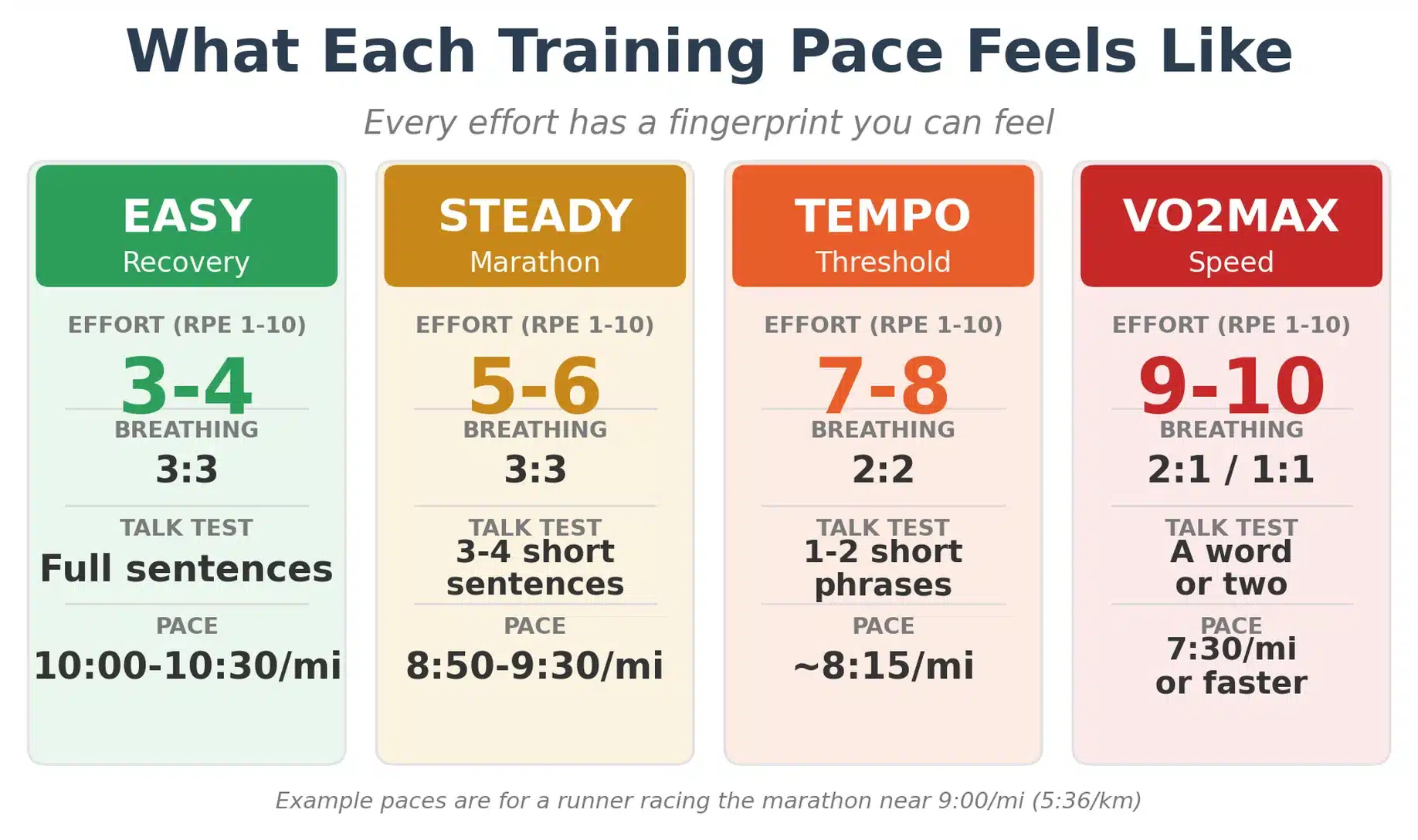
What should easy and recovery pace feel like?
Easy should feel easy. It should feel almost too slow, like you’re deliberately holding yourself back the whole way.
You can breathe through your nose, hold a full conversation, and finish the run feeling you could go again, which puts the effort at a 3 or 4 out of 10. Your breathing sits at a relaxed 3:3, your legs feel light instead of loaded, and nothing about the run demands your attention.
On a true recovery day, keep the effort below your normal easy runs and treat any urge to push as a signal to back off. The whole point is to move blood through tired muscles without adding fatigue on top of yesterday’s hard session.
Most of your weekly mileage belongs here. Run 60 to 90 seconds a mile slower than your marathon pace, or around 10:00 to 10:30/mi (6:13 to 6:32/km) if you race the marathon near 9:00/mi (5:36/km).
Easy running is your foundation. It builds your aerobic base, the engine that supplies more than 85% of the energy you burn in races from the 5k right up to the marathon.
Gentle mileage protects you too. It lets your tendons and connective tissue adapt to the training load without the repeated pounding that hard, fast sessions load onto them week after week.
If you can’t say a full sentence without pausing for breath, you’re running your easy days too hard, and that is the most common mistake in endurance training.
RunnersConnect Bonus
Download your FREE Long Run and Aerobic Pacing Calculator now.
Need help converting your race times to your optimal easy and long run pace? Download our FREE calculator and we’ll do the math for you.
What should steady state or marathon pace feel like?
Steady sits right in the middle. It’s the classic “comfortably hard” effort, a pace you could hold for a full hour if a race asked you to, working but never straining.
You should be able to speak 3 or 4 short sentences, but reciting a poem is out of reach, which puts the effort around a 5 or 6 out of 10. Your breathing settles into that same 3:3 rhythm and your legs work, though the pace still feels controlled and repeatable.
From a pacing standpoint, steady runs sit between 10 seconds a mile faster than your current marathon pace and 30 seconds slower, so a 9:00/mi (5:36/km) marathoner runs them around 8:50 to 9:30/mi (5:29 to 5:54/km).
Steady work pays off. Run it often enough and you develop your aerobic threshold, the quickest effort you can hold while your muscles still get all the oxygen they need and burn mostly fat for fuel.
That makes steady work the bread and butter of marathon training, since race day asks you to hold this exact controlled effort for hours.
If you can quote whole paragraphs while you run, you’re going too easy for a steady effort, and if you can barely get a word out, you’ve drifted up into tempo.
How fast should tempo or threshold pace feel?
Tempo is where control meets discomfort. It’s a hard but steady effort you could hold for about 20 to 40 minutes if a race demanded it of you.
You should be able to force out 1 or 2 short phrases and no more, which puts it at a 7 or 8 out of 10. Your breathing shifts to a 2:2 rhythm and holds there, steady and deliberate, right at the edge of comfortable.
Push much past that edge and the effort stops being a tempo, because you tip into anaerobic work your body can’t sustain for long. Ease off too far and you drop back toward steady, which leaves the workout too soft to move the needle.
Tempo running trains your lactate threshold, the effort where lactate starts to build up faster than your body can clear it.
The gain compounds. Train it week after week and your threshold shifts to a faster pace than before, so you cover more ground at race effort before lactate builds up and forces you to slow down.
Hold tempo where you can force out 1 or 2 words but never a full sentence, and you’ve found the effort that makes the workout pay off.
What should VO2max or speed pace feel like?
This effort is unmistakable. VO2max pace is where running stops feeling controlled and turns into a flat-out fight for air that you can only hold for a couple of minutes at a time.
By the middle of a hard interval you can’t talk at all, your breathing is ragged, and the effort sits at a 9 or 10 out of 10. Breathing drops to a 2:1 or 1:1 rhythm as your lungs pull in everything they can, and your form gets tested because the pace is so quick.
You run these at 5k pace or faster, which for a 9:00/mi (5:36/km) marathoner means intervals around 7:30/mi (4:40/km) or quicker, often as 400s, 800s, or mile repeats.
The trap here is starting too fast. Open a session of 12 x 400 meters at a pace you could repeat 12 times, holding rep 1 at the same effort you want on rep 12.
The point of the pain is oxygen: VO2max is the most oxygen your body can take in and use, and training at this effort lifts that ceiling over a season of work. The speed also sharpens your running form, and that efficiency carries over to every easy and steady mile you log.
Start a VO2max session under control, because if you can’t finish the last rep at the same effort as the first, you went out too hard.
How do the training paces compare at a glance?
The table below lines up every effort side by side, from your easiest recovery jog to a flat-out interval.
| Effort | What it feels like | RPE (1-10) | Breathing | Talk test | Example pace* |
|---|---|---|---|---|---|
| Easy / recovery | Relaxed, conversational, could go again | 3-4 | 3:3 | Full sentences, even a nose breath | 10:00-10:30/mi (6:13-6:32/km) |
| Steady / marathon | Comfortably hard but controlled | 5-6 | 3:3 | 3-4 short sentences | 8:50-9:30/mi (5:29-5:54/km) |
| Tempo / threshold | Hard but repeatable | 7-8 | 2:2 | 1-2 short phrases | ~8:15/mi (5:08/km) |
| VO2max / speed | Near maximal, breathing ragged | 9-10 | 2:1 or 1:1 | A word or two, then nothing | 7:30/mi (4:40/km) or faster |
Example paces are for a runner racing the marathon near 9:00/mi (5:36/km), so scale them to your own fitness before you head out.
How do you train yourself to pace by feel?
Start by running a few workouts you already know at their target pace, then pay attention to what that effort feels like.
Notice your breathing rhythm, count how many words you can speak, and give the effort a number from 1 to 10. Check your watch after each rep to confirm your feel, and keep your eyes off it while you run.
Over time you’ll catch yourself predicting the split before you look, and that is the sign your internal gauge is calibrated.
You don’t have to bury the watch in a drawer. Record your runs and study your splits afterward, but let feel set the effort while you’re moving and the pace will take care of itself.
Do this for 3 or 4 weeks and the guessing drops away, because you’ve built a sense of effort that travels with you to any race, any weather, and any course.
Put in the calibration work now. You’ll carry that judgment into every season of running ahead, through every race, hilly course, and rough-weather day you run into.




7 Responses
Great article Jeff – I have a question related to the last part of the post regarding how workouts should feel…I understand (or at least I think I do) how hot conditions or hills can impact what the “right” pace is for a given workout, but I am still a little unsure as to how to deal with when your body feels tired but nothing external really changes the workout expectations…I am talking about the days where you’re just kind of dragging – maybe it’s a lack of sleep, or extra stress in non-running life, or maybe just a relatively tough stretch of training – when your body feels tired, or hitting your target paces is tougher than it usually is or should be, does that mean back off? To be a little more specific – let’s say you usually run tempo at 7:00 pace, but on your first mile you’re laboring more than you should be to hit 7:00 (using talk test or breathing rhythm mentioned above) – do you re-adjust your paces at this point and run 7:20 for the rest of the tempo, or do you push it harder than usual for a tempo effort to still run 7:00 (again, assuming heat / hills / wind is not a factor)? If this becomes a chronic issue, I know/suspect it’s probably fatigue or perhaps over-training, so my question is more about one-off days than a series of bad workouts…although your perspective on both cases would certainly be welcomed 🙂
…And I guess your other article titled “What to do when a workout isn’t going well” (referenced above as “bad training days”) kind of answers my question…so I guess the answer seems to be either slow the pace or just scrap the workout? Does that mean it never makes sense to kind of just muscle through it?
Hey Brent, great question and glad you stumbled onto the other article that helps answer it a bit. One thing I forgot to mention about running workouts by feel is that it is a great way to judge if you’re over doing it or not fully recovered between sessions.
To answer your second question, I think it comes down to where you’re at in the training cycle and your training history.
If it’s early in the segment and you’re still trying to build up the fitness, pushing through is what you want to do – even if that means you’re working much harder than you should. As you get close to the actual race, the workouts should be more in-line with the proper effort. Of course, some hard track sessions as you get close to the race are meant to be all-out effort, so it works out either way.
The second issue is your training experience and history. If you’ve suffered from overtraining before or you know that digging deep causes you to miss a weeks worth of workouts, it’s better to stop. A lot of this just comes with more and more experience running and learning your body.
Hope that helped.
That was very helpful – thanks a lot Jeff!
Hi, I am running with the free half marathon plan under 2:15 from runkeeper (and I love it), however the plan recommended pace feels too slow (I always end up running much faster than prescribed).
After reading this article I tried the speaking and step counting test and my steady pace and tempo pace are faster than what is in my plan. So, my question is: Is it okay to keep running by how I feel it or should I force myself to slow it down and follow the pace in the plan?
Thank you.
You’re probably already fitter than 2:15. Getting your paces right is important. I’d do a test to see what your fitness is and then you can target a more accurate goal. Here’s a webinar we’re doing on this: http://www.tradewithpat.com/personal-coaching-signup/
Thanks for the reply Jeff. I looked on your webinar, and read a couple of articles and did some experimenting.
I found that my steady run based on breathing 3:3 is in the range 8:30 to 9:00 min/mile. My tempo run was within 7:30 to 8:00 mile/min (breathing 2:2). That corresponds nicely with numbers that I got from your Long run pace calculator (the Race Predictor numbers) after putting in time from one of my recent workouts (8km – 38:40).
Here comes the hard part – I am trying to adjust my training properly to what I found and I’d like to clarify a few more things:
1. Do I understand it right that slow run is not the same as steady run?
2. Your calculator gives me the a) Race prediction pace and b) Long run pace. If I use the calculated pace from a) my test run pace matches the above article recommendations for steady and tempo run pace, but not with b) because it is slower. So that leads me to believe that I should take the race predictor as my goal pace, is that correct? Then, what for is the Long run pace?
3. I am thinking to adjust my pace according to what I found and keep running with the Sub 2:15 half marathon plan. What do you think about that?
Thanks a lot.