

You’ve probably been told to keep most of your runs aerobic.
The advice rarely comes with an explanation of what the word means or how to tell if you’re doing it.
Aerobic running is running slowly enough that your muscles make nearly all of their energy with oxygen, which is an effort where you can still talk in full sentences.
It matters more than the easy pace suggests, because even a 1,500 m race gets roughly 80% of its energy from your aerobic system.
In this article, you’ll learn:
- What an aerobic run is and how it differs from anaerobic running
- How much of a track race or a 5K comes from your aerobic system
- Why easy running makes you faster at race pace
- A simple way to check you’re running aerobically, plus how much of your week should be easy
What Does Aerobic Running Mean?
Aerobic means “with oxygen.”
An aerobic run is one where your muscles get nearly all of their energy by burning fat and carbohydrate with the oxygen your heart and lungs deliver.
That burning happens inside your mitochondria, the small structures in each muscle fiber that turn fuel and oxygen into ATP, the molecule your muscles use to contract.
A 2001 review of the energy systems describes the aerobic system as having an enormous capacity but a limited rate.
It can keep supplying energy for a long time, but it can’t supply it as fast as your anaerobic pathways.
As you speed up, your muscles need ATP faster than oxygen can be delivered and used, so your anaerobic pathways supply a growing share of the ATP.
The point where that share starts climbing quickly is your first ventilatory threshold, and it’s where your breathing rate starts rising out of proportion to your pace.
An aerobic run is any run done below your first ventilatory threshold, which is the easy, conversational effort of most of your training week.
What Is the Difference Between Aerobic and Anaerobic Running?
Anaerobic running relies more on energy your muscles can make without oxygen, by breaking down stored phosphocreatine and splitting carbohydrate through glycolysis.
Those anaerobic pathways can supply ATP much faster than your aerobic system, but the total amount they can release in one hard effort is small.
That’s why you can sprint flat out for 20 seconds but can’t hold that speed for a full lap of the track.
Your body doesn’t use one system and then switch to the other.
Both systems supply energy during almost every run, and the mix shifts with how fast and how long you’re running.
A 2026 review of 102 studies found that in an all-out effort, your aerobic and anaerobic systems contribute equally at about 79 seconds, and any longer effort gets most of its energy aerobically.

So any all-out race that takes you longer than about 79 seconds is mostly aerobic, which covers every race from the 800 m up.
For more on how each system responds to different workouts, read this breakdown of aerobic vs. anaerobic training.
How Much of Your Race Is Aerobic?
Even short track races get most of their energy from your aerobic system.
In a study of highly trained track athletes, the 200 m was 29% aerobic and the 400 m was 43% aerobic.
The 800 m reached 66%, and the 1,500 m reached 84%.
When researchers timed trained runners on a real track, the 1,500 m was 77% aerobic for the men and 86% for the women.
In the same study, the 3,000 m was 86% aerobic for the men and 94% for the women.
A 5K, 10K, half marathon or marathon lasts much longer than either of those races, so its aerobic share is higher still.
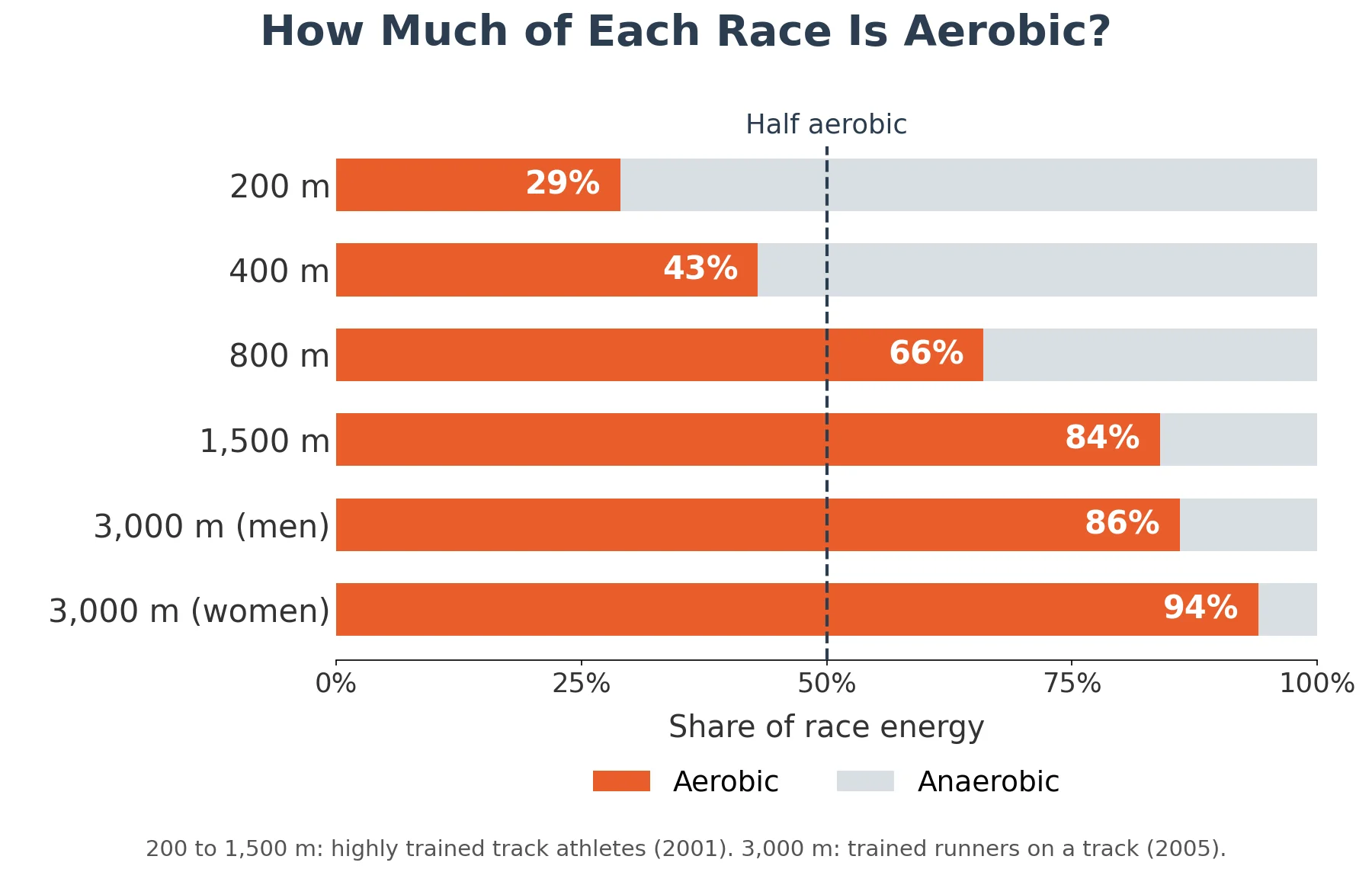
Every race from the 800 m up gets most of its energy from your aerobic system.
The fitness that decides your 5K or marathon time is mostly aerobic fitness, and easy running is how you build most of it.
Why Does Aerobic Running Make You Faster?
Regular endurance running builds the parts of your muscles that make aerobic energy.
A classic review of endurance training concluded that regular endurance exercise increases the number of mitochondria in your muscle fibers and how much oxygen they can use.
With more mitochondria, your muscles burn more fat, use their glycogen and blood glucose more slowly, and produce less lactate at the same pace.
As a result, a pace that used to feel hard takes less effort, and you have more carbohydrate left for the last few miles of a race.
In a 5-month trial, runners who did about 80% of their training at an easy aerobic effort cut 157 seconds off a 10.4 km race, while runners who did 67% easy cut 122 seconds.
Both groups spent the same share of their training at a hard effort, about 8%.
The first group shifted about 13% of its training from moderate to easy running, and those runners improved by about 35 seconds more.
How Do You Know If You’re Running Aerobically?
The simplest check is whether you can talk.
In a 2004 study, the point where speaking first became difficult during a treadmill test matched the ventilatory threshold almost exactly.
When speech was no longer comfortable, the effort was consistently above the threshold.
So on an easy run, say a full sentence out loud, such as what you plan to eat for dinner and who you’re eating with.
If you can say it without stopping for a breath, you’re running aerobically, and if you have to break it up to breathe, slow down.
A 2014 review found the talk test gives consistent results whether people are walking, jogging or cycling, which means you can use it on any run without a watch.
RunnersConnect Bonus
Download your FREE Long Run and Aerobic Pacing Calculator now.
Need help converting your race times to your optimal easy and long run pace? Download our FREE calculator and we’ll do the math for you.
Which Runs in Your Week Are Aerobic?
Most of the runs in a typical training week should be done at an aerobic effort, but a few are meant to go above it.
Training studies usually split effort into 3 zones: below the first threshold, between the first and second thresholds, and above the second threshold.
Here’s where the common types of run usually fall.
- Easy and recovery runs: Below your first threshold, so you can talk the whole way. These make up most of your weekly time.
- Long runs: Mostly below your first threshold, unless you add race-pace segments near the end.
- Tempo and threshold runs: Between your first and second thresholds. You can say a few words, but not a full sentence.
- Intervals and hill repeats: Above your second threshold, where talking stops and your anaerobic system supplies more of the energy than it does on an easy run.
- Strides: Bursts of 15 to 20 seconds, short enough that most of the energy for each one comes from your anaerobic system.
Most of the energy for tempo runs and for intervals lasting more than about 79 seconds still comes from your aerobic system.
Keep tempo-effort running to a small share of your week, since the runners in the 5-month trial above improved most when they swapped moderate running for easy running.
If a run is supposed to be easy and you can’t say a full sentence, it has turned into a moderate run.
How Much of Your Running Should Be Aerobic?
Aim for about 80% of your weekly running time at an easy aerobic effort, with the rest split between moderate and hard sessions.
A study of junior skiers who compete nationally in cross-country found that about 75% of their endurance sessions were done below the first threshold.
The researchers noted the same pattern in elite athletes across several endurance sports.
A 10-week trial in recreational runners tested a mostly easy plan on the 10K.
The runners who did about 77% of their training easy improved their 10K time by 5.0%.
The runners who did only 46% of their training easy improved by 3.6%.
The researchers couldn’t rule out chance for the 1.4-point difference between the groups, but among the runners who followed each plan most closely, the easy-heavy group improved more.
Together with the 5-month trial, this suggests you get more from making most of your runs easy than from running them at a moderate, in-between effort.
If you find yourself running your easy days at a moderate effort, this guide on how fast your easy runs should be shows how to set the pace.
Here’s a recap of the key numbers on aerobic running.
| Question | Answer |
|---|---|
| What is aerobic running? | Running below your first ventilatory threshold, where your muscles make nearly all their energy with oxygen |
| When does an all-out effort become mostly aerobic? | After about 79 seconds |
| How aerobic is a 1,500 m race? | 77% to 86% in trained runners |
| How aerobic is a 3,000 m race? | 86% for men, 94% for women in trained runners |
| How do you check you’re running aerobically? | You can say a full sentence without stopping to breathe |
| How much of your week should be easy? | About 80% of your running time |




13 Responses
I currently run around a 1830 5k, i redshirted cross country season (im in college) and was injured and did NO running last semester. I ran a 17:09 in high school and its frustrating because im so out of shape. How much aerobic base running should i do per week to get me in good standing to start getting faster?
That’s a great question, Mark. It’s hard to get too specific without knowing your full training history, but I would look to spend about 2 months focusing on aerobic development. Many college athletes do this over the summer period when they don’t have to worry about racing for the team. If given the opportunity, you would want to slowly build your mileage about 5-10 miles per week from it’s current volume (taking a step back every 4th week) while having one longer run (about 20% your weekly mileage) and one aerobic threshold session (roughly marathon pace). The second month, you could add in traditional tempo runs with the aerobic threshold runs. That would definitely build up the base you need. I hope that helps.
I have one question, i can give you all the details you need to anwser it if possible.
Sure. Message me at jeff [at] runnersconnect.net and let me know your question along with the details.
Jeff, great post here. I’ve seen other charts that have a similar theme (this one here is a good one: http://www.runnersworld.com/race-training/owners-manual-hard-vs-easy), but it makes more sense that males and females would have different energy system distributions. My question was where you got this chart. Can you post the original source, I’d love to read the article and maybe get some details on the methodology of how they arrived at those numbers. Thanks!
-Fran Cusick
Hi Fran, unfortunately I wrote this article in 2009/2010 and I can’t remember the source. Pretty poor form on my part not citing it, but I wasn’t quite as saavy back then. If I dig it up, I’ll definitely post here.
I used to run consistent 17-18 minute 5k’s but when it started track season my 3000 was a 10:34 and 1500 a 4:50 now this year my 5k times are high 19’s low 20’s any advice?
Hello, Coach Jeff, I really love your site. I am fascinated/obsessed with the idea of aerobic development. Can you tell me what is meant, exactly, by “in the marathon and half marathon, the aerobic contribution is close to 99% for both men and women.” Does that mean 99% of the race is under the anaerobic threshold? Does it mean that 99% of the race is done NOT in oxygen debt? Does that mean training at marathon pace would be considered aerobic runs? I get this concept confused with aerobic threshold, which, I believe, is about 20 heart rate beats per minute less than anaerobic threshold. I guess my main question is- can you define the difference between “99%” aerobic” versus aerobic threshold (Phil Maffetone, Joe Friel)? Thanks for any information you can provide.
great website Jeff really appreciate the time you have put into this, i have been running on and off for 2 years but the last 6 months or so i have been progressively picking it up. I’m in my late 20’s currently racing 5k every weekend around low 18’s trying to break sub 18. typical week would include about 30 miles and look something like this-
mon – intervals 12 x 400 or 6 x 800 or 5 x 1000 etc.. once a week total miles 6 with w/u c/d
tue – rest/ weights
wed – 5 miles easy
thur – 5 miles tempo
fri – rest / core
sat – 5 k race 6 miles total with wu/cd
sun – 10 miles easy.
sum weeks may vary but always include my interval and my race. last few months i have dropped the 5k race and raced some longer tougher cross country’s.
my last interval session i did 6 x 1000 with 400 jog recovery all between 3:33 and 3:35 pace didn’t feel i had gone 100% on any.
3:33 would be a 17:45 5K so why am i only running between 18:15/30ish every week, i’m i being inpatient? i’m i racing to much? and i’m i not puting enough aerobic miles in?
sorry for the long post and all the questions just seem to be hitting a brick wall at the minute.
Thank you for all the information you presented about running. I read two of the articles. To tell you about my situation, i am a 3000 meters runner. I have the record of 12:00, but it was for last year. I have done many aerobic and anaerobic exercises during this past year, but haven’t taken any new record struggles in order to clear the newer time. I guess the new record would be around 11:30. Could you please let me know how i can prepare better for a race which will take place in one month from now? the attendees of the race are close to me, so they are not so hard to be competed, but after winning that race i will have a closer race with more professional runners, so I should be prepared.
Besides, i just wanted to know if i am doing the appropriate training? i mean according to my age which is 30 (i am male) ,i don’t know if i can make it any better or can i compete with professional runners if i train as they do? I just wish to clear my vision and i am confident that i can accept not being able to do so.
On this statistics are these going off the average of what age?
Hi Dakota, these numbers work for everyone! Regardless of age, the energy source of aerobic/anaerobic contributions are the same. It is based off you as an individual (although slightly different for male vs. female). Hope that helps 🙂
I’ve just come across a number of your articles that have answered questions I’ve had bugging me in my head for a long time! I am still a little confused though..
I’m coming to the conclusion that I must be running too fast or anaerobically in the majority of my runs. (I habitually tend to run a variety of between 4k – 12k ‘s 3 or 4 times during a normal week, and have done for the past three years).
I usually wear a heart rate monitor, and am very aware of heart rate zones and subsequent training zones. (I’m 24, so using the 220-age formula I take it that 196 is my MHR. For the majority of my runs, even though they don’t feel too taxing and I can sustain the pace for a while, my heart rate will usually be in the 170s, often 180s. If a hill is involved it easily gets to the 190s, The park run 5k can see if raise over 200bpm (which obviously feels like hard work!!) But still sustainable for the duration of the race. So this is the bit I’m confused on.. it would seem that my heart rate monitor and the rules would seem to think I was on the brink of some sort of cardiac event the majority of the time!! Well no, but it would certainly suggest I was working way too hard, and anaerobically for too much of the time. But if anaerobic is deemed unsustainable due to lactic acid build up etc, how can I maintain running at these really high heart rates? Is the formula either not accurate for some people, or am I genuinely doing the old ticked a hell of a lot of damage always running in these zones, despite feeling great and really enjoying the runs (not 190-200bpm) but certainly at 170s, 180s I feel fine!
I’m coming to the conclusion that even though I don’t understand this, the answer is to tone it back for the majority of my running. Today I tried a much slower pace (it felt painfully slow just piddling along!) and kept my heart rate at approx 150. It definitely felt very comfortable, and not really getting me out of breath much. But became more enjoyable as I started to accept this new pace! Am I right in hoping that if I ensure the majority of my running is kept in this zone, with perhaps one speed/interval session a week, then with time I can start to move back up to the pacing I prefer to be at, but without the heart rate monitor thinking I’m about to keel over?
And have I been working ‘anaerobically’ but somehow sustaining it for a long period, or is my aerobic zone not correlating with the traditional heart rate zones?
Sorry this is a very long question, I have been going round in circles with this query for over two years, and your articles have finally helped to answer a lot of it!
Thank you!