

Coaches have yelled “quick feet” at tired runners for decades, usually on the last lap, when your stride starts to stretch out into a long, loping gait.
Your running speed comes from 2 numbers multiplied together: how long each step is and how many steps you take per minute.
Researchers have now run dozens of studies on the second number, because changing it also changes how much load your hips and knees absorb on every step.
In this article, you’ll learn:
- The difference between stride frequency, step rate, and cadence
- How stride length and stride frequency combine to set your pace
- What a 5% or 10% faster step rate does to the load on your knees and hips
- Whether quicker steps lower your injury risk
- Why beginners often pick a stride frequency below their most efficient one
- How to measure your stride frequency and raise it without wrecking your form
What Is Stride Frequency in Running?
Stride frequency is how many strides you take per minute of running, and runners and watches use it interchangeably with step rate and cadence.
The terms trip people up because a stride and a step are technically different. A step runs from one foot landing to the other foot landing, and a stride is 2 steps, from one foot landing to that same foot landing again.
That means 85 strides per minute and 170 steps per minute describe the same runner.
This article uses steps per minute, the unit most running watches show, and converts any study that reported strides.
In one of the studies below, new runners chose about 156 steps per minute and trained runners about 169, and your own number rises as you speed up. If you want to see where your height puts you in that range, our guide to running cadence by height breaks it down.
How Do Stride Length and Stride Frequency Make You Faster?
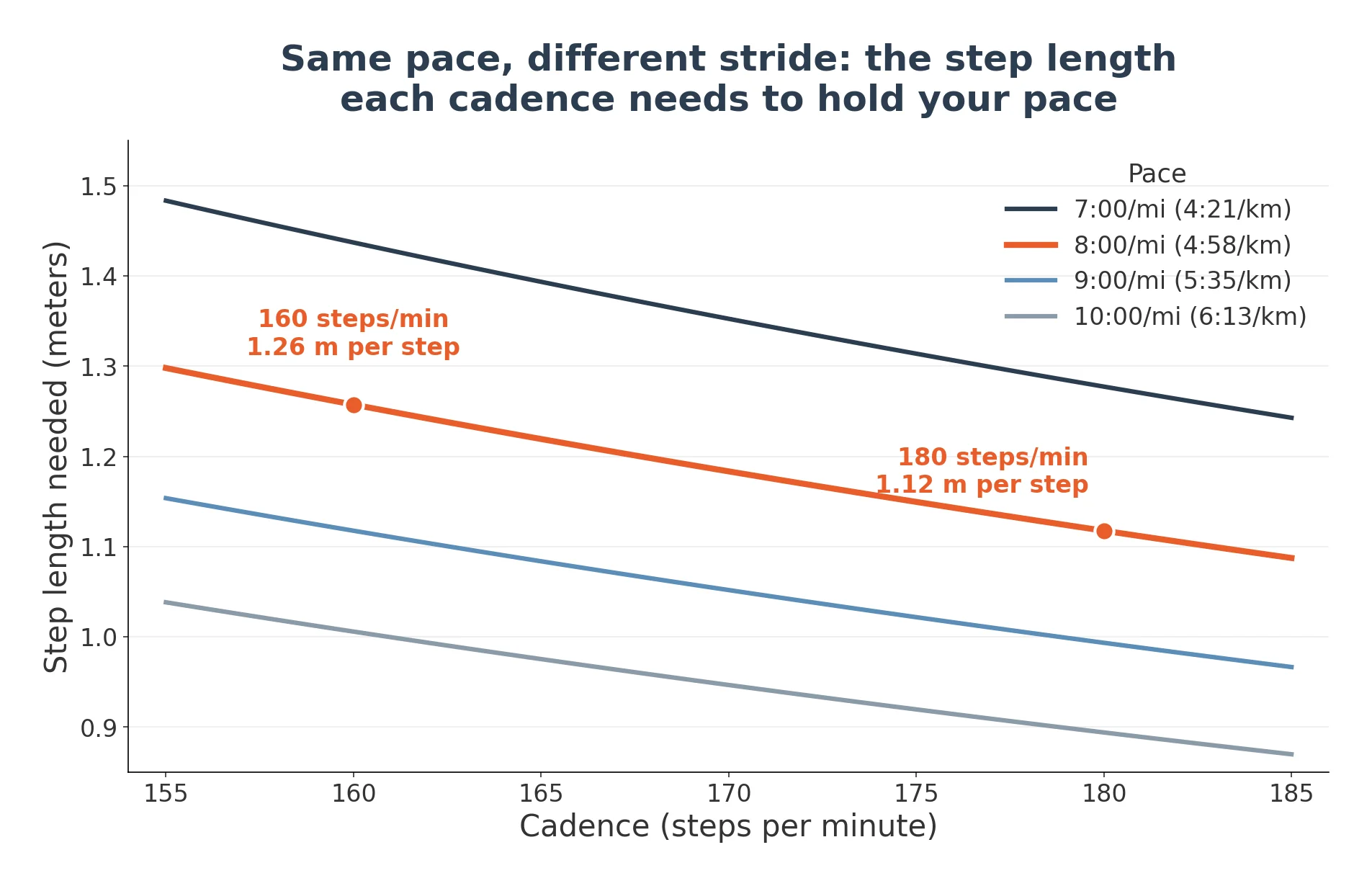
Your pace is your step length multiplied by your step rate, so you can only speed up by covering more ground per step, taking more steps per minute, or both.
As an example, 8:00/mi (4:58/km) pace is 3.35 meters per second.
At 160 steps per minute, each step has to cover about 1.26 meters to hold that pace. Bump your rate to 180 steps per minute and each step only needs to cover about 1.12 meters.
At distance-running speeds, you get most of your extra speed from covering more ground with each step. A 2012 study modeled the leg muscles of runners from a slow jog to an all-out sprint.
Up to 7 meters per second, about 3:50/mi (2:23/km), those runners sped up mainly by lengthening their stride.
Your calf muscles produce most of that extra step length. The more force they push into the ground, the more time you spend in the air and the more ground each step covers.
Only above 7 meters per second, well into sprinting, did the runners shift to swinging their legs through faster.
Up to about 3:50/mi (2:23/km), runners speed up mainly by pushing harder into the ground to lengthen each stride.
At an easy pace, the case for changing your stride frequency rests on how it loads your knees and hips.
RunnersConnect Bonus
Download your FREE Guide to Minimalist Running.
Giving you an easy to follow, printable guidelines for how to adjust your training, slowly add-in barefoot running, and the exact strength routine you need to get your feet healthy and strong!
What Happens to Your Knees and Hips When You Take Quicker Steps?
Taking quicker steps at the same pace shortens each step, which lowers the load your knees and hips have to absorb every time your foot lands.
Research has shown that a 5% faster step rate cuts the energy your knee absorbs on landing, and a 10% faster rate cuts hip loading too.

The 45 runners in that study also rose and fell less with each step, and their knee bent less on landing. Dropping step rate 10% below their natural rhythm raised the load at the hip, knee, and ankle.
The same research group went on to estimate the force on the kneecap. In 30 healthy runners, a 10% faster step rate cut peak force between the kneecap and thigh bone by 14%.
That matters if you’ve had runner’s knee, because that joint is where the pain comes from.
A larger analysis backs up the direction of these changes. A 2022 review of 37 studies concluded that raising step rate lowered or didn’t change the forces measured at the ankle, knee, and hip.
Lowering step rate did the reverse, raising those forces or leaving them unchanged.
Does a Higher Stride Frequency Prevent Running Injuries?
Raising your stride frequency lowers the impact measures linked to injury, but no large trial has yet shown that raising it prevents injuries.
The link between impact and injury has firmed up since the early studies, which only looked back at runners who had already been hurt. A 2016 study followed 249 female runners forward in time after measuring how fast force built up when each foot landed.
The women who went on to get a medically diagnosed injury had higher loading rates than the women who never got hurt. Runners above the study’s cutoff for loading rate had 2.72 times the odds of a diagnosed injury.
Raising your step rate lowers that loading rate, and the change sticks. A randomized trial of 30 runners with high impact forces cued them to raise their step rate by 7.5% during 8 outdoor runs with a wireless sensor.
The runners raised their step rate by 8.6%, and their peak loading rate dropped by 17.9%.
The work their knee muscles did to absorb each landing dropped by 21.1% per kilometer, and both changes were still in place a month later.
A 5% to 10% increase in step rate is enough to lower knee loading, and the runners in that trial still held it a month after 8 sessions.
The injury evidence itself is thin. The 2022 review found only 2 studies that measured injury outcomes, and both were in runners with kneecap pain.
Those runners reported less pain and scored higher on questionnaires about daily knee use at 4 and 12 weeks after raising their step rate.
That means a quicker cadence is worth trying if you’ve had kneecap pain, and it lowers the loading rate tied to injury in the 249-runner study.
Is Your Natural Stride Frequency Already the Most Efficient?
Experienced runners tend to settle close to their most efficient stride frequency on their own, while newer runners tend to pick one that’s lower than their optimum.
Stride length follows the same rule. A 1982 study of 10 runners varied their stride length up to 20% of leg length above and below their natural stride and measured their oxygen use each time.
The runners’ own stride used almost exactly the least oxygen, only 0.2 milliliters per kilogram per minute more than their true optimum.
New runners don’t get as close.
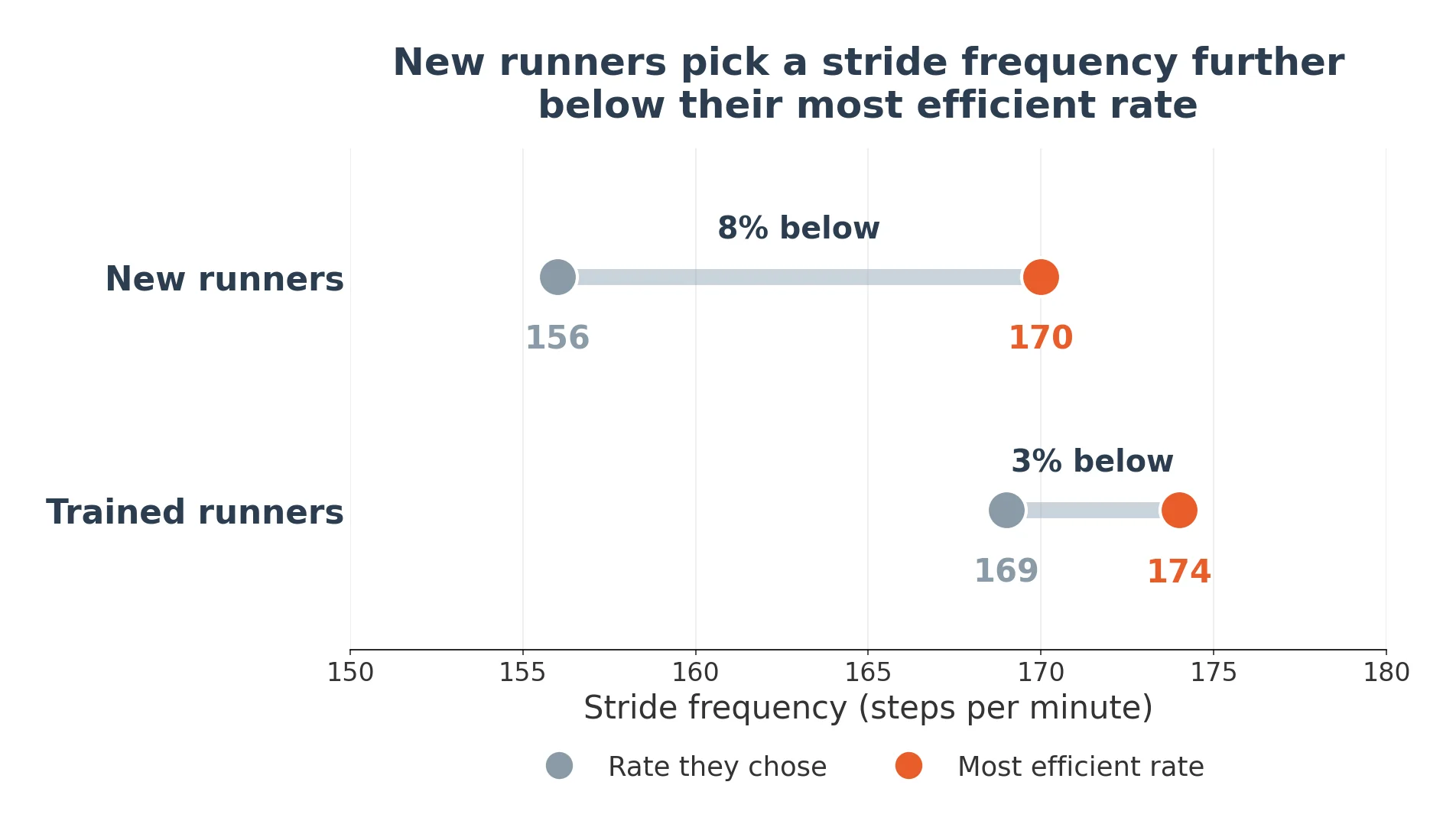
A 2014 study found that new runners chose a stride frequency about 8% below their most efficient rate, while trained runners chose one about 3% below theirs.
The researchers ran 10 novices and 10 trained runners at 7 different stride frequencies set by a metronome and found the rate where each runner used the least oxygen.
The trained runners chose about 169 steps per minute, against a most efficient rate of about 174 steps per minute. The novices chose about 156 steps per minute, against a most efficient rate of about 170 steps per minute.
That means a newer runner has more room to gain from a small cadence increase, while an experienced runner is already close to the best rate for their body.
Raising your cadence can also feel awkward in the short term. The 2022 review found very limited evidence that runners rated their effort higher right after they increased their step rate.
How Do You Measure and Increase Your Stride Frequency?
Check your current step rate on an easy run first, then raise it by 5% to 10% using a metronome or music as the cue.
If your watch doesn’t show cadence, count every time your right foot lands for 30 seconds at your normal easy pace. Multiply that count by 4 to get steps per minute.
Use these steps to change it:
- Set a target 5% to 10% above your current rate. If you run 160 steps per minute, aim for 168 to 176. Going from 168 to 180 steps per minute is a 7% change, inside the range the studies tested.
- Use a beat to cue it. Set a metronome app, or a playlist with a matching beat, to your target rate and match your footfalls to it.
- Start with short blocks. Hold the new rhythm for 3 to 5 minutes inside an easy run, then return to your normal rate and repeat.
- Keep your pace the same. Let each step cover less ground so your speed stays the same.
- Stop when it feels automatic. Once you hold the new rate without the beat, drop the cue and check your watch now and then.
A 2026 review of 20 studies and 483 runners found that step rate training over several sessions raised step rate by about 12 steps per minute, whichever type of cue the runners used.
Aim for a 5% to 10% increase in stride frequency, even if that leaves you short of the popular 180 steps per minute target.
For drills and form cues that help the new rhythm stick, see our guide on how to increase your running turnover.
Here’s a summary of what the research shows about stride frequency:
| Question | What the research shows | What to do |
|---|---|---|
| How do distance runners speed up? | Mostly by lengthening their stride, up to about 3:50/mi (2:23/km) | Build leg strength to push harder into the ground |
| What does a quicker step rate do to your joints? | +10% cut peak kneecap force by 14% and reduced hip and knee loading | Try +5% to +10% if you’ve had knee pain |
| Does impact matter for injury? | Runners above the loading-rate cutoff had 2.72 times the odds of a diagnosed injury | Lower your loading rate with quicker, shorter steps |
| Can you keep a new step rate? | +8.6% held a month after 8 sessions | Practice with a beat, then drop the cue |
| Is your natural rate efficient? | Novices ran 8% below their optimum, trained runners 3% | Newer runners have the most to gain |




4 Responses
While doing my workout yesterday, I decided to count my strides and was surprised by the number I was hitting while doing the speed portion. During my warm up and cool down, I was consistently counting 43…not bad. I played around and was able to hit 45 by shortening up the stride by a hair. During the interval (6:18 pace), however, I was consistently hitting 50! The first time I counted I though maybe I had made a mistake but sure enough, 50 it was. This works out to 20 strides per minute over the “optimal” rate which also translates to 3600 extra strides for a 3hr marathon finish. I focused on lengthening my stride and managed to bring it down to 48 but it took quite a bit of effort. My legs didn’t want to stretch out that far and I’m thinking it may have something to do with my inflexibility. Stretching has always been my main weakness.
Now I’m wondering, am I using more energy than I should be by running such a high number of strides? Surly this can’t be good. Should I focus on lengthening my stride in order to achieve the optimal 180?
Thanks for any input.
Cheers…
That’s actually not too uncommon. As far as efficiency, the research says that your “preferred” stride frequency is the most efficient. Now, whether you could adapt to a lower stride frequency over time and become accustomed to it (and ultimately MORE efficient) is still an open question. I should point out that it isn’t necessarily BAD to be over 180–indeed, elite sprinters have stride frequencies of over 200 when they are running a 10-second 100m! Some people also just naturally take short, choppy strides. There’s no real scientific evidence for this being undesirable, but from a coaching perspective, it just means that when you have to run fast, you’ll mostly be lengthening your stride instead of quickening your stride frequency. So I wouldn’t worry about it TOO much! My brother is a pretty good runner himself and is consistently counts 47 or 48.
Thanks for the info John! When I was trying to increase my stride length, it felt awkward and my feet were pounding harder when hitting the ground. I will continue to experiment and see if I can close the gap a little and still have it feel natural.
Great having you on here!