

You typed your height into a search bar, found a running cadence chart, and now a single number is supposed to tell you how many steps per minute you should take.
That chart feels precise, yet the science behind a height-based cadence target is far weaker than the confident tables online suggest.
A 5-foot-2 runner and a 6-foot-4 runner will rarely share the same cadence at the same easy pace, so one universal figure was never going to fit both of them.
The famous 180 steps-per-minute figure was never a rule for you, because it came from one coach counting the strides of elite racers at competition speed.
This guide gives you honest cadence ranges for your height, explains what moves your step rate up and down, and shows you how to adjust it without copying a number built for elite racing.
Here is what you will learn about running cadence and your height:
- The realistic cadence range for your height, and why the popular charts oversell their precision
- Where the 180 steps-per-minute figure came from, and the true range elite runners cover
- How your leg length and running speed move your natural step rate
- Whether a higher cadence lowers your risk of shin and knee injuries
- How to measure your current cadence and raise it safely when it helps
What Is the Right Running Cadence for My Height?
The honest answer is that no research has produced a validated running cadence chart based on height, even though those charts rank at the top of search results.
What the evidence supports is a gentle trend, where taller runners with long legs take fewer steps per minute at the same easy pace.
A 2021 study of cross country runners found that shorter runners self-selected higher step rates than their taller teammates.
The same research also tied quicker step rates to more running experience, so years of training can lift your cadence as much as your build does.
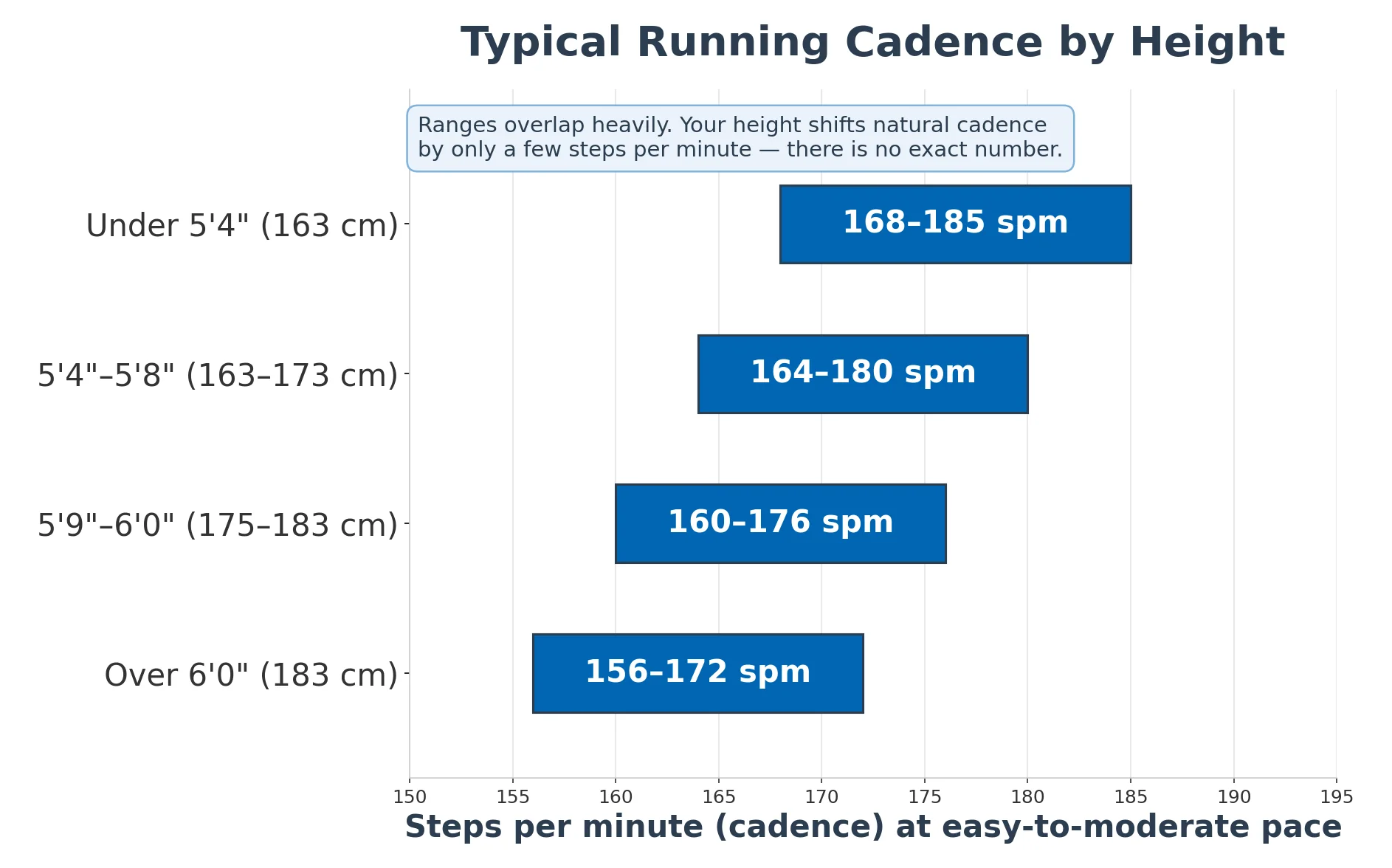
The bands below show where runners of each height usually land at an easy-to-moderate effort, drifting upward as pace quickens.
| Your height | Typical self-selected cadence (easy to moderate pace) | Typical range near race pace |
|---|---|---|
| Under 5 ft 4 in (163 cm) | 168 to 185 spm | 175 to 190 spm |
| 5 ft 4 in to 5 ft 8 in (163 to 173 cm) | 164 to 180 spm | 172 to 188 spm |
| 5 ft 9 in to 6 ft 0 in (175 to 183 cm) | 160 to 176 spm | 168 to 184 spm |
| Over 6 ft 0 in (183 cm) | 156 to 172 spm | 164 to 182 spm |
Read those bands as starting points, because runners of the same height can differ by 15 spm and both run smoothly.
The charts feel scientific because they pin a single number to your height, yet your real cadence depends far more on your speed, your leg length, and your training history.
Your footwear and your fatigue late in a run also nudge your step rate, which is another reason a fixed chart cannot capture your running.
Your height shifts your natural cadence by a handful of steps per minute, not by the 20 to 30 spm that height-based charts often imply.
Where Did the 180 Steps Per Minute Rule Come From?
Jack Daniels, a respected running coach, counted the cadence of elite distance runners at the 1984 Olympics and saw almost all of them running above 180 spm at race pace.
That observation described fast, world-class athletes on race day, so treating 180 spm as a universal target for easy jogging misreads what he measured.
Coaches repeated the 180 figure for decades until it hardened into a rule, even though the original notes described a snapshot of one Olympic final.
Research tracking elite ultramarathoners during a 100 km race recorded an average cadence of 182 spm, with individual runners ranging from 155 to 203 spm.

Even among the best runners in the world, cadence spanned nearly 50 spm, which tells you a single magic number cannot fit every body.
The same study showed that cadence rose mainly with speed, so the 180 figure describes racing legs rather than a jog around your neighborhood.
How Do Speed and Leg Length Change Your Cadence?
Your cadence shifts with your pace, climbing when you speed up and dropping back when you slow down.
When you run faster, you take a blend of longer steps and quicker turnover, so the same runner might jog at 165 spm and race near 180 spm.
Leg length pulls the other way, because a long leg swings more slowly through each stride and lowers your natural step count.
A short leg swings faster than a long one, and that is why height nudges cadence at all.
A 2021 analysis of high school runners reported that leg length ranked among the anthropometric factors tied to a runner’s self-selected step rate.
This is why forcing a tall runner to match a short runner’s cadence often feels unnatural and wasteful.
The ground under you matters too, because a treadmill can read a few spm different from the open road you race on.
Compare your cadence against your own easy and race efforts, rather than against the runner beside you.
Does a Quicker Cadence Reduce Your Injury Risk?
Raising your step rate is one of the simplest ways to cut the impact your joints absorb on every stride.
A University of Wisconsin study found that increasing step rate by 5 to 10 percent reduced the energy absorbed at the knee and hip, easing the load linked to common running injuries.
Those extra steps shorten your stride, so your foot strikes under your hips instead of reaching out ahead and braking hard.
A prospective study of high school runners found that those running at low step rates picked up more shin injuries and anterior knee pain during the season.
Overstriding usually travels with a low cadence, so lifting your step rate brings your foot back under your body where it meets less braking force.
The change is small on paper, yet trimming even 5 percent off an overstride can spare your knees thousands of harder impacts over a training week.
Every stride you overstride sends a sharp braking force up through your shin and knee, and a quicker cadence trims that spike on impact after impact.
RunnersConnect Bonus
Download your FREE Hip Strengthening Exercises Guide.
Download a video version of the 5 most effective hip exercises for runners. You’ll get full descriptions on how to perform and a video to help guide you.
Does Cadence Change Your Race Times?
Cadence and speed rise together, yet forcing your step rate up will not automatically drop your race times.
A study comparing trained and novice runners found that experienced runners naturally settle on a stride frequency close to their most economical rate, while beginners often run below it.
Your self-selected cadence is often near your economical range, which means large forced changes can raise your oxygen cost instead of reducing it.
Your natural cadence is already close to a reasonable range, so aim for a small tune-up rather than a big overhaul.
Pushing to 180 spm at an easy jog can make you bounce more and waste energy on vertical motion.
The biggest gains come from fixing an obvious overstride, not from squeezing extra turnover out of an already smooth stride.
If your times stall, your training load and your race-day pacing will move the needle far more than a metronome ever will.
How Do You Measure and Safely Increase Your Cadence?
You can measure your cadence in under a minute by counting how often one foot touches the ground in 60 seconds, then doubling that count.
Run at your normal easy pace while you count, since cadence at a jog reads lower than your cadence at 10K or marathon effort.
A metronome app or GPS watch makes counting simple, and many watches now show live cadence on every run.
Music with a steady beat near your target works just as well, since your feet will fall into step with the rhythm without much thought.
If your cadence reads low and you keep picking up injuries, a gradual increase can help, using these steps:
- Find your baseline by counting your steps at easy pace on 3 separate runs and averaging them.
- Add 5 percent first by setting a metronome or playlist to 5 percent above your baseline and holding it for short segments.
- Build slowly by keeping the new rhythm for a few weeks before adding another 5 percent, and stop if anything feels forced.
- Cap the change by aiming for a total lift of 5 to 10 percent rather than a jump straight to 180 spm.
A systematic review of stride studies concluded that step rate changes of 5 to 10 percent shift running mechanics meaningfully, while smaller tweaks change little.
If your cadence already falls in a healthy range and you run pain-free, leave it alone and spend your energy on strength and mileage.
Chase a cadence that keeps you healthy and running smoothly, rather than a chart number matched to your height.
| Question | What the evidence says |
|---|---|
| Is there a cadence chart for my height? | No validated chart exists, and height moves your natural step rate by only a few spm. |
| Should everyone hit 180 spm? | No. 180 came from elite racers, who range from 155 to 203 spm themselves. |
| Does cadence affect injuries? | Raising step rate 5 to 10 percent lowers knee and hip loading and links to fewer injuries. |
| Does cadence change my race times? | Not directly. Trained runners already run close to their economical rate, so forcing it up rarely helps. |
| How much should I change it? | Increase gradually by 5 to 10 percent, and only when it helps. |


4 Responses
Just curious about your statement above “For runners who exhibited a high cadence but slow race time, maybe this is evidence that they need to focus more on other aspects of running fitness: strength, posture, mobility, etc.”.
Any chance that this runner (these runners?) were shorter than average? The first thing that occurred to me was the possibility that shorter runners would automatically have a shorter stride and higher cadence.
Hi Cliff.
Yup, as with all things running, there are SO many variables to consider! Height / limb length would definitely be a factor. I’m 6’6″ and know for sure that running at marathon pace with a cadence of ~180spm is pretty unsustainable for me! While I look after a number of athletes 5’1″ – 5″4 who need to run at well above 180spm at their individual marathon paces – there is only so far their stride length can be increased… so instead their bodies choose to manipulate cadence.
Re: the statement Matt makes about running with high cadence yet slow marathon time. Again two many factors to go into without turning this response into an article in it’s own right! But… we’ve all seen the “shuffle runner” with a huge rate of cadence, yet very poor stride length (more a factor of technique this time than height per se). In my experience, these particular guys and girls can benefit greatly from increasing stride length (without over striding).
Hi Cliff, just looking through the archives and noticed I never replied to your comment! Apologies!
James is perfectly right, many other factors to running other than cadence, hence the “shuffle runner” with high cadence but poor stride length. Indeed maybe their high cadence is the product of not having a better alternative to get from A to B, unless of course they are consciously trying to maintain a high spm because of something they have read. Height can indeed be a factor too, although a look at the elites raises some interesting contradictions: Kenya’s Martin Mathathi is 1.67m tall and Sileshi Sihine of Ethiopia is 1.71m tall. And yet, both men have considerably smaller stride lengths than Kenenisa Bekele who is only 1.60m tall. The strategies used by these elites to run the same speed are not dependent on their height. More about that in the article I wrote here: Step Frequency vs. Step Length.
Thanks for the question!
Excellent article because it conveys valuable info and it is explained in terse and clear language. Comments were also helpful. Thanks! I am a triathlete (70-74 age-group) and I am sure that thanks to what you’ve explained in this and other articles, I will substantially improve my cadence which at the moment is rather embarrasingly low: I averaged 143 a couple of weeks ago.
Rafael Furlong (PhD. Litt.) MEXICO.