

You’ve just finished a workout, and your shoulders feel exhausted.
Maybe you ran faster than usual, or you tackled extra miles, and now your arms and shoulders ache the next day.
The first time this happens, it feels strange because you were training your legs, right?
Yet here you are, sore in places you didn’t think about during the run.
Most runners assume this is normal wear and tear, or they worry it means they’re doing something wrong with their form.
The truth is more interesting.
Your arms aren’t sore by accident.
They’re sore because they’re working harder than you realize, and research shows that active arm swing reduces the rotational motion of your torso and saves your body 5-8% of metabolic energy during running.
When your form breaks down under fatigue, they work even harder to keep you balanced and moving forward.
So, in this article you’re going to learn the research-backed practical advice on:
- Why arm swing matters for running efficiency
- How upper body muscles fatigue and become sore
- The timeline for recovery from arm and shoulder soreness
- Specific form changes that reduce arm fatigue
- When soreness is normal and when it signals injury
What Your Arms Actually Do When You Run
Most runners think of arms as passengers during a run.
You move your legs, and your arms tag along.
That’s not how biomechanics works.
Your arms counterbalance the rotational force created by your swinging legs.
When your right leg swings forward, your left arm drives forward to prevent your torso from twisting excessively.
This isn’t optional.
This is how humans are built to run efficiently.
Without active arm swing, your legs create angular momentum that your core muscles must fight against.
Your torso ends up rotating more, your step becomes less stable, and your body has to work harder to move the same distance.
Proper arm swing is a core component of running economy, not a style choice.
Why Arm Muscles Fatigue During Running
Your shoulders and arms are not just passive stabilizers.
They’re working muscles doing a specific job.
The deltoids, trapezius, and rotator cuff muscles all activate to swing your arms and keep your shoulders stable against the rotational forces created by running.
When you run fresh, with good form, these muscles do their job efficiently.
But three things break down this efficiency: training volume spikes, running form breakdown, and the specific demands of sustained arm swing.
Research on shoulder muscle fatigue shows that fatigue changes how your stabilizer muscles respond, often delaying their activation and forcing larger muscles to work harder to compensate.
If you suddenly increase your mileage, your arm muscles haven’t adapted yet to the demands of sustained running.
If your form breaks down in the second half of a long run, your shoulders start hunching upward and your arms swing less efficiently, forcing your trapezius to work much harder just to hold them up.
And if you run with excessive torso rotation from poor running form or upper body tension, your arm swing becomes more exaggerated to compensate, and those muscles fatigue faster.
Arm fatigue during running is often a sign that your form is working harder than it needs to.
How Eccentric Muscle Damage Causes Soreness
Muscle fatigue during a run is one thing.
Soreness the next day is something different.
That soreness comes from muscle damage, specifically from eccentric contractions.
An eccentric contraction is when a muscle lengthens while working against resistance.
Your arm muscles do this constantly during running: they swing your arms while also controlling the movement to keep your shoulders stable.
When you run, especially when you increase speed or volume suddenly, the eccentric load on your upper body increases.
This creates microscopic tears in muscle fibers, damage to the Z-discs inside muscles, and disruption to surrounding connective tissue.
Your body responds with inflammation to repair the damage, and that inflammatory response is what you feel as soreness.
Arm soreness after running is delayed-onset muscle soreness (DOMS), caused by eccentric damage that takes time to produce soreness.
Why Do Your Biceps Get Sore After Running?
Sore biceps confuse runners more than any other spot, because you never lifted anything.
The reason sits in how your elbow holds its shape mile after mile.
You run with your arms bent near 90 degrees, and your biceps hold that angle the entire time.
That steady hold is an isometric contraction, where the muscle stays tense without visibly shortening or lengthening.
Research on the elbow flexors found that sustained isometric contractions produce measurable muscle damage on their own, especially when the muscle is held under tension for long stretches.
An hour of running is thousands of small tension cycles layered on top of that constant hold.
Grip makes it worse.
Many runners clench their fists or curl their hands tight when they push the pace, and clenched hands pull the biceps and forearms into extra tension they do not need.
The fix is to soften everything below the shoulder.
Let your hands stay loose, as if you were carrying a potato chip between two fingers without crushing it.
Let the elbow angle open slightly on downhills and easy stretches instead of locking at a fixed bend.
Most biceps soreness also tracks with fatigue, because your form breaks down as you tire and your arms tense up to hold you together.
Once the soreness has already set in, the same recovery habits that ease soreness after any hard run apply to your arms too.
The Recovery Timeline: When Soreness Peaks and Fades
Understanding when your soreness should peak and fade helps you know whether you’re dealing with normal DOMS or something more serious.
DOMS follows a predictable timeline.
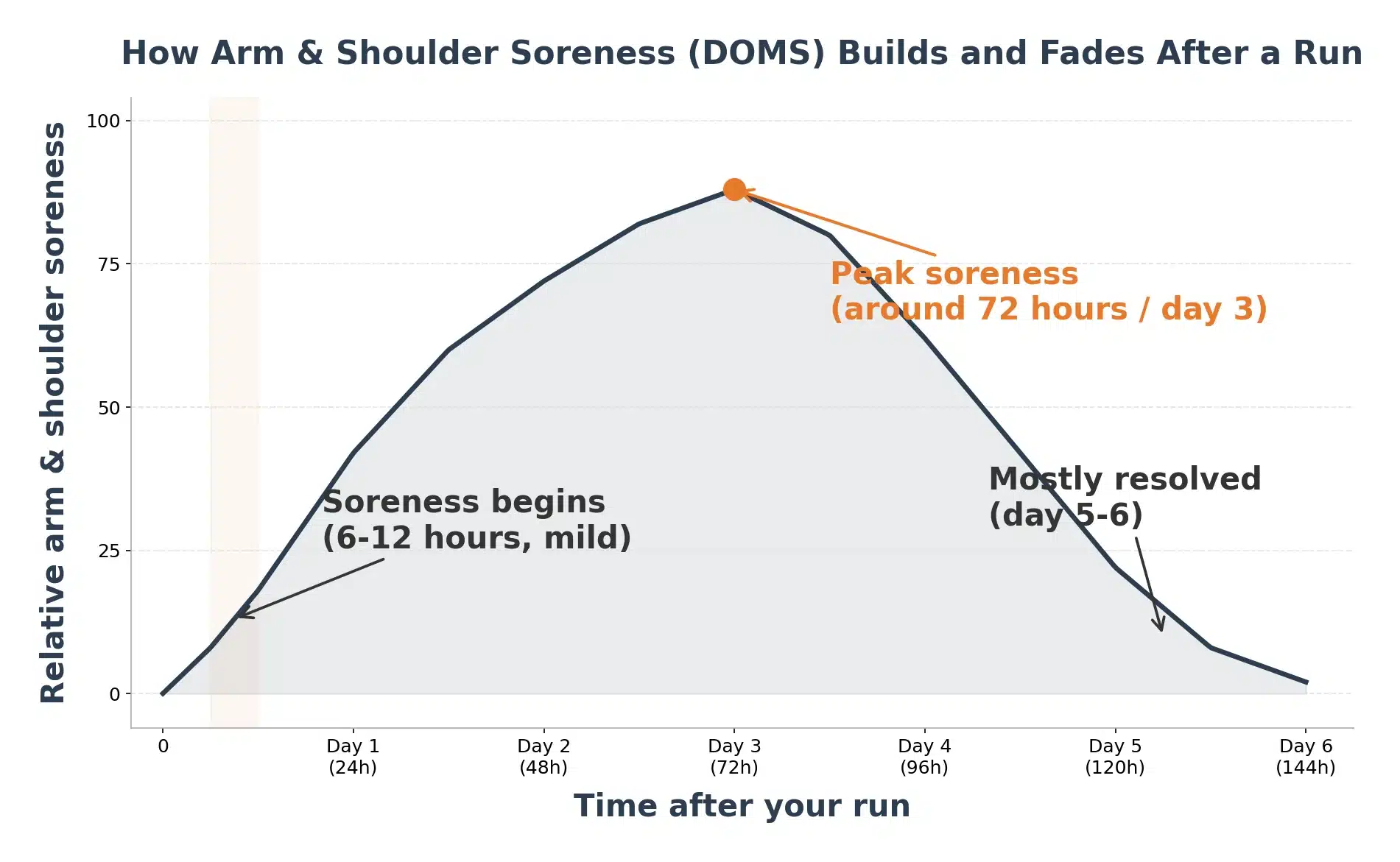
Soreness begins within 6-12 hours after a run, but it’s usually mild at first.
The real soreness appears at the 24-48 hour mark.
This means your arms and shoulders might feel worst on day 3 of soreness, not day 1.
Most runners worry on day 1 because they can barely move, then they panic on day 3 when the pain seems worse, when in fact that’s just the natural progression of inflammation.
By day 5 or 6, the soreness usually resolves.
Light movement, staying hydrated, and getting adequate protein help speed this timeline slightly, but your body heals itself with time.
RunnersConnect Bonus
Download our FREE recovery foods guide, with the top 10 foods for each of the essential recovery vitamins, minerals and macro nutrients. Plus a sample 1-day meal plan!
What You Should Change in Your Running Form
If arm soreness is becoming a recurring issue, the fix is usually in your form, not in your training plan.
Form changes reduce the load on your arm muscles and prevent the fatigue and compensation that lead to soreness in the first place.
Keep your arms at roughly 90 degrees, bent at the elbow, not rigid and swinging stiffly.
Swing your arms forward and backward, not across your body.
Many runners swing their arms across their midline when they fatigue, which increases torso rotation and makes your arms work much harder.
Drive your arm swing from the shoulders, not the elbows.
A common mistake is swinging from the forearm, which reduces efficiency and increases shoulder fatigue.
Avoid hunching your shoulders, especially as you fatigue.
This dramatically increases the load on your trapezius and makes arm soreness much more likely.
Focus on keeping your shoulders relaxed and slightly back, even when you’re tired.
Your arm swing amplitude will naturally increase when you run faster, and that’s correct and expected.
The key is that the motion stays controlled and comes from the shoulder joint, not from upper body tension.
The best way to prevent arm soreness is to run with form that requires the least compensation and the least arm muscle effort.
Arm Soreness Vs. Injury—When to Be Concerned
The soreness you feel 24-48 hours after a hard run is almost certainly normal muscle soreness, not injury.
But muscle soreness and injury pain feel different, and knowing the difference tells you when to rest and when to keep running gently.
Normal muscle soreness is dull, affects multiple spots in the shoulder and arm region, improves slightly with gentle movement, and is symmetric (both sides feel similar).
It’s worst when you move in the direction the muscle was working.
Injury pain is sharp and localized to one specific spot, often worsens with any movement, gets worse over days instead of improving, and may be one-sided.
Injury pain might include swelling that doesn’t go down, or sensations like numbness or tingling.
Normal DOMS improves with light activity like easy running or walking.
Injury pain does not improve with light activity.
If your arm or shoulder soreness doesn’t start improving by day 4, or if it’s accompanied by sharp pain, visible swelling, or any neurological symptoms, see a sports medicine professional.
Most arm soreness after running is normal muscle damage that heals itself, but sharp, localized, or persistent pain needs professional evaluation.
Is Left Arm Pain While Running Ever Serious?
Left arm pain during a run is usually the same muscular soreness you feel on the right side.
Your arms work as a matched pair, so both sides carry a similar load and tend to ache in similar ways.
Muscular soreness is dull, spreads across the arm and shoulder, feels about the same on both sides, and tracks with your arm swing.
A small number of cases are different, and those are the ones worth knowing.
Pain that shows up only on the left side and travels with pressure or tightness in your chest, jaw, or neck can signal your heart, not your muscle.
Warning signs cluster together, so watch for left arm pain paired with shortness of breath out of proportion to your effort, nausea, lightheadedness, or a cold sweat.
These symptoms tend to build with exertion and ease when you stop, which is the opposite of muscle soreness that lingers evenly for days.
Left arm pain with chest pressure, jaw discomfort, shortness of breath, or a cold sweat is a medical emergency, not muscle soreness, so stop and get help.
A separate pattern points to a nerve rather than the heart.
Sharp pain that shoots down one arm along with numbness, tingling, or weakness in the hand suggests an irritated nerve in your neck or shoulder.
That deserves a visit to a sports medicine or medical professional, though it is not the emergency that cardiac symptoms are.
For the everyday runner, dull soreness in both arms after a hard session is normal, and the warning signs above are easy to spot once you know them.