
When you’re sidelined by injury, you face a choice between two non-impact cross-training modalities that both promise to keep you fit until you can run again: aqua jogging and the elliptical.
Both maintain aerobic capacity and allow you to stack high-mileage training volume without the pounding that running demands.
But they’re not equivalent.
One preserves your running-specific muscle activation patterns more faithfully.
One transitions back to running more safely.
One keeps your neuromuscular system primed for a faster return to race fitness.
So, in this article you’re going to learn the research-backed practical advice on choosing between aqua jogging and the elliptical for your cross-training plan.
You’ll learn:
- Which modality maintains cardiovascular fitness more effectively
- Why biomechanical carryover matters for returning to running
- How each modality affects injury recovery timelines
- Practical intensity and heart rate control differences
- Which carries lower injury risk during the recovery phase
- How long you can sustain your aerobic fitness during cross-training
How Do Aqua Jogging and Elliptical Training Maintain Cardiovascular Fitness?
Both modalities sustain aerobic capacity by working your cardiovascular system at intensities comparable to running, despite the absence of impact.
Research has shown that six weeks of deep water running maintains VO2 max, ventilatory threshold, and running economy at levels comparable to land-based run training in trained runners.

The key difference lies in how your body achieves this stimulus.
Aqua jogging uses water resistance to create constant buoyancy-unloading, which reduces joint stress while your muscles work at intensities that push your heart rate into aerobic training zones.
The elliptical operates on mechanical resistance and a fixed bilateral stride pattern, delivering comparable cardiovascular demand but without the rotational and single-leg loading demands of running.
To maintain VO2 max equivalence, you’ll need to work at higher perceived exertion on the elliptical than in the pool: typically 5–10 beats higher in heart rate at the same speed.
Both modalities preserve aerobic fitness at similar rates when matched for intensity, but aqua jogging requires less effort to achieve the same cardiovascular stimulus.
Which Modality Better Preserves Running-Specific Muscle Activation Patterns?
This is where the two diverge significantly.
Running demands single-leg stance, triple extension (ankle, knee, hip), and rapid ground reaction force management.
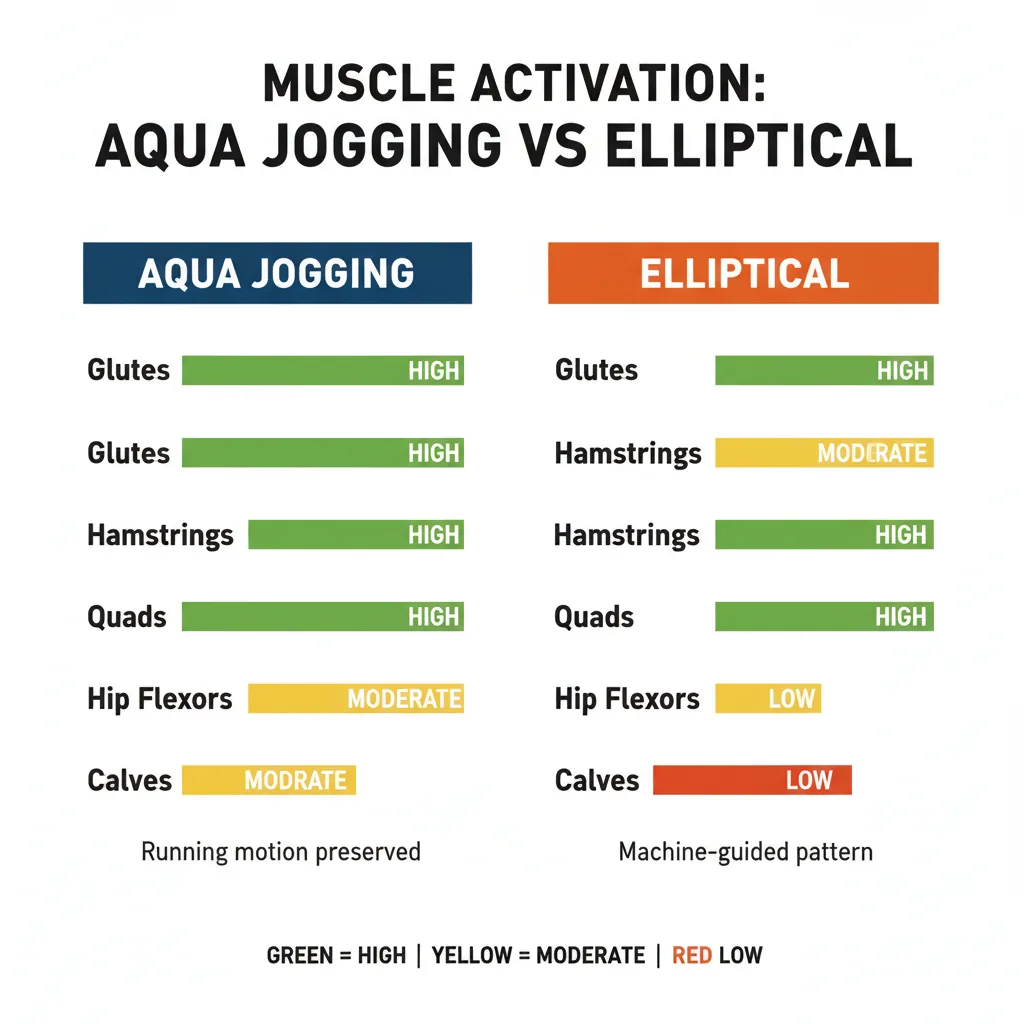
Research on muscle activity during water and land running found no significant differences in EMG activation across all 4 primary running muscle groups — glutes, quadriceps, hamstrings, and calves — between water and land running at matched intensities.
Aqua jogging replicates the running stride by cycling your legs in a running motion against water resistance.
This means your nervous system practices the motor pattern of running even though the mechanical load is different.
The elliptical, by contrast, uses a fixed pedal path and bilateral symmetry that doesn’t require single-leg stability or the explosive triple extension that running demands.
Your glutes and calf muscles work less intensely on the elliptical because the machine guides the pedal through its motion, rather than requiring you to generate and control each step independently.
Aqua jogging preserves your running-specific motor patterns in a way the elliptical cannot replicate.
How Do These Modalities Compare for Return-to-Running After Injury?
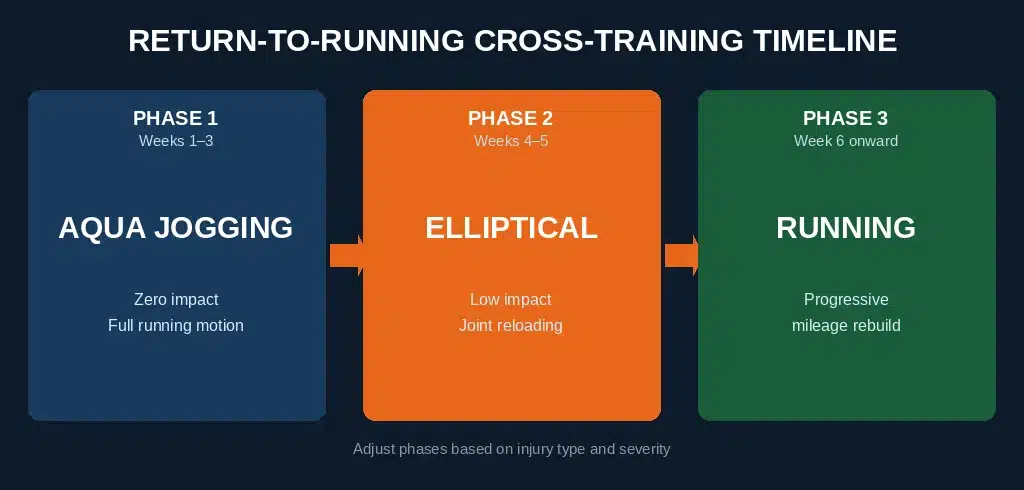
The practical difference in returning to running favors aqua jogging for most injuries, particularly stress fractures, stress reactions, and joint-loading injuries.
Aqua jogging allows you to maintain running form and stride cadence without introducing any ground reaction forces.
This means when you transition back to overground running, your nervous system recognizes the running pattern even though the force environment is new.
Coaches consistently observe that injured runners who use aqua jogging return to training faster than those who cross-trained exclusively on non-running-specific machines, even when total weekly training volume was matched.
The elliptical, while safe for most injuries, doesn’t prepare your joints and tendons for the reintroduction of impact forces.
When you step off the elliptical and back onto the road, your lower legs and joints haven’t been “reminded” of running’s bilateral, asymmetrical load pattern.
You may experience soreness or delayed-onset inflammation during the first 2–3 weeks of return, even if your cardiovascular fitness carried over cleanly.
For injuries where impact reintroduction is critical (shin splints, achilles tendinopathy, metatarsal stress fractures), aqua jogging provides a superior bridge to running because it maintains the biomechanical identity of the sport.
Understanding the full range of cross-training options helps you make the most of your injury timeline.
What Are the Practical Differences in Training Intensity and Heart Rate Control?
Heart rate response differs between the two modalities, which affects how you structure training zones during cross-training phases.
A 2022 systematic review and meta-analysis confirmed that heart rate at equivalent exercise intensities is consistently lower in aquatic environments than on land, due to hydrostatic pressure effects on venous return and cardiac filling.
This means a threshold interval workout on the elliptical will show a higher heart rate than the same workout in the pool, even if both create the same cardiovascular stress.
If you’re using heart rate zones from your running training, subtract 10–15 beats from your target range when moving to the pool.
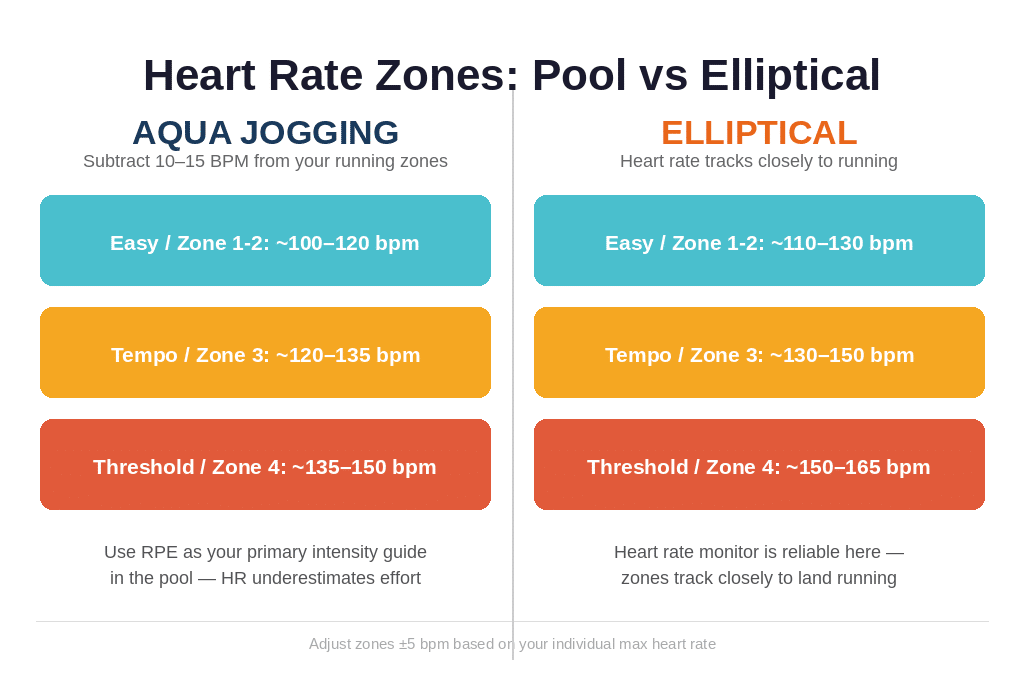
Rate of perceived exertion (RPE) becomes a more reliable tool in water, since your HR reading may underestimate the actual demand.
On the elliptical, your heart rate response is more linear: what you see on the monitor closely matches what your cardiovascular system is experiencing.
This makes zone-based training more straightforward on the machine, though you’ll still need to account for the fact that elliptical work requires slightly higher HR to produce the same VO2 demand as running.
In the pool, RPE is your most reliable intensity guide since heart rate underestimates effort by 10–15 beats.
On the elliptical, heart rate tracks intensity accurately, but subtract 5–10% from your normal running zones to account for the different mechanical demands.
Which Cross-Training Modality Carries Lower Injury Risk During Recovery?
Both are low-impact by design, but they carry different mechanical risks during the recovery phase.
Aqua jogging eliminates joint loading entirely, making it the safer choice for acute injuries (stress fractures, severe tendinopathy, post-surgical phases).
The buoyancy support removes 60–85% of your body weight depending on water depth, which virtually eliminates injury risk from the activity itself.
The elliptical introduces a small amount of impact (roughly 10–20% of running’s ground reaction forces), which can aggravate recent injuries or delay healing in the first 1–2 weeks post-injury.
Biomechanical analysis of elliptical exercise found joint loading forces at the knee and hip reaching roughly 10–20% of running’s ground reaction forces — lower than running, but present at higher resistance settings and longer durations.
However, the elliptical becomes safer than aqua jogging in the later stages of recovery, once the initial inflammation has resolved.
Introducing small amounts of impact force through elliptical training prepares your tendons and joints for the return to running, triggering adaptations that prevent re-injury during the transition.
A practical strategy: use aqua jogging in the first 2–3 weeks post-injury, then transition to the elliptical for 2–3 more weeks before returning to running.
How Long Can You Maintain Your Aerobic Fitness During Cross-Training?
Detraining (the loss of aerobic fitness when you stop training) happens slowly when you’re cross-training consistently, even if the modality isn’t running.
Research on detraining in trained athletes found that aerobic capacity (VO2 max) declines meaningfully within 2–4 weeks when training stops completely, but cross-training at sufficient volume and intensity blunts this loss significantly.
Three cross-training sessions per week at moderate intensity will preserve your aerobic base indefinitely, as long as your injury allows such volume.
Both aqua jogging and the elliptical achieve this maintenance threshold equally well.
The limiting factor is consistency and volume, not the modality choice.
You can return to running without rebuilding your aerobic foundation if you’ve maintained 3–4 sessions per week at threshold effort (roughly 85–92% max heart rate) during your cross-training phase.
For shorter injuries (2–3 weeks), you’ll see minimal fitness loss from either modality as long as you’re training regularly.
For longer injuries (6+ weeks), consistency in either modality matters more than the choice between aqua jogging and elliptical, and both preserve fitness equally if you’re disciplined about frequency and intensity.
| Factor | Aqua Jogging | Elliptical | Best For |
|---|---|---|---|
| Cardiovascular maintenance | Strong : matches land running VO2 max | Strong : comparable at matched intensity | Equal for both |
| Running-specific muscle activation | High : replicates running stride pattern | Lower : fixed bilateral pedal path | Aqua jogging |
| Injury risk during recovery | Minimal : zero ground reaction forces | Low : 10–20% of running’s ground forces | Aqua jogging (acute phase) |
| Heart rate zone accuracy | Lower : subtract 10–15 bpm from land zones | Accurate : tracks running zones closely | Elliptical |
| Return-to-running transition | Smoother : maintains biomechanical patterns | Introduces small impact forces | Aqua jogging (early); elliptical (weeks 4–6) |
| Fitness maintenance timeline | Indefinite with 3+ sessions/week | Indefinite with 3+ sessions/week | Equal for both |