

The last article covered why the weeks between races are the best time of year to get stronger.
This article picks up where that one left off, with what a 6-week strength block between races should look like, week by week.
Most runners who start lifting between races do the same exercises, with the same weight, for the same number of reps, every session.
That routine feels productive, but it stops making you stronger after the first couple of weeks.
So how should a 6-week strength block change from one week to the next, and what do you do with it once race training starts?
To give an evidence-based answer, let’s look at the research-backed practical advice on…
- How much weight to add each week, using the 2 to 10% rule from the American College of Sports Medicine
- Why your strength jumps in the first 2 to 4 weeks without your legs getting any bigger
- How 6 weeks of plyometric jumping exercises made runners 2.7% faster over 3 km
- A week-by-week plan for all 6 weeks, plus how to adjust it for your experience and injury history
Why Does Your Strength Routine Need to Get Harder Every Week?
Your muscles get stronger only when the work you give them is harder than what they are used to.
Once they adapt to a weight, lifting that same weight again keeps the strength you have but stops adding more.
The American College of Sports Medicine (ACSM) guidelines give a simple rule for when to add weight.
When you can lift a weight for 1 to 2 more reps than your target, increase the weight by 2 to 10%.

For example, if your target is 8 squats and you finish 10 with 100 pounds, use 102 to 110 pounds next session.
You don’t need a gym to follow the same rule.
At home, you make an exercise harder by switching to a tougher version of it.
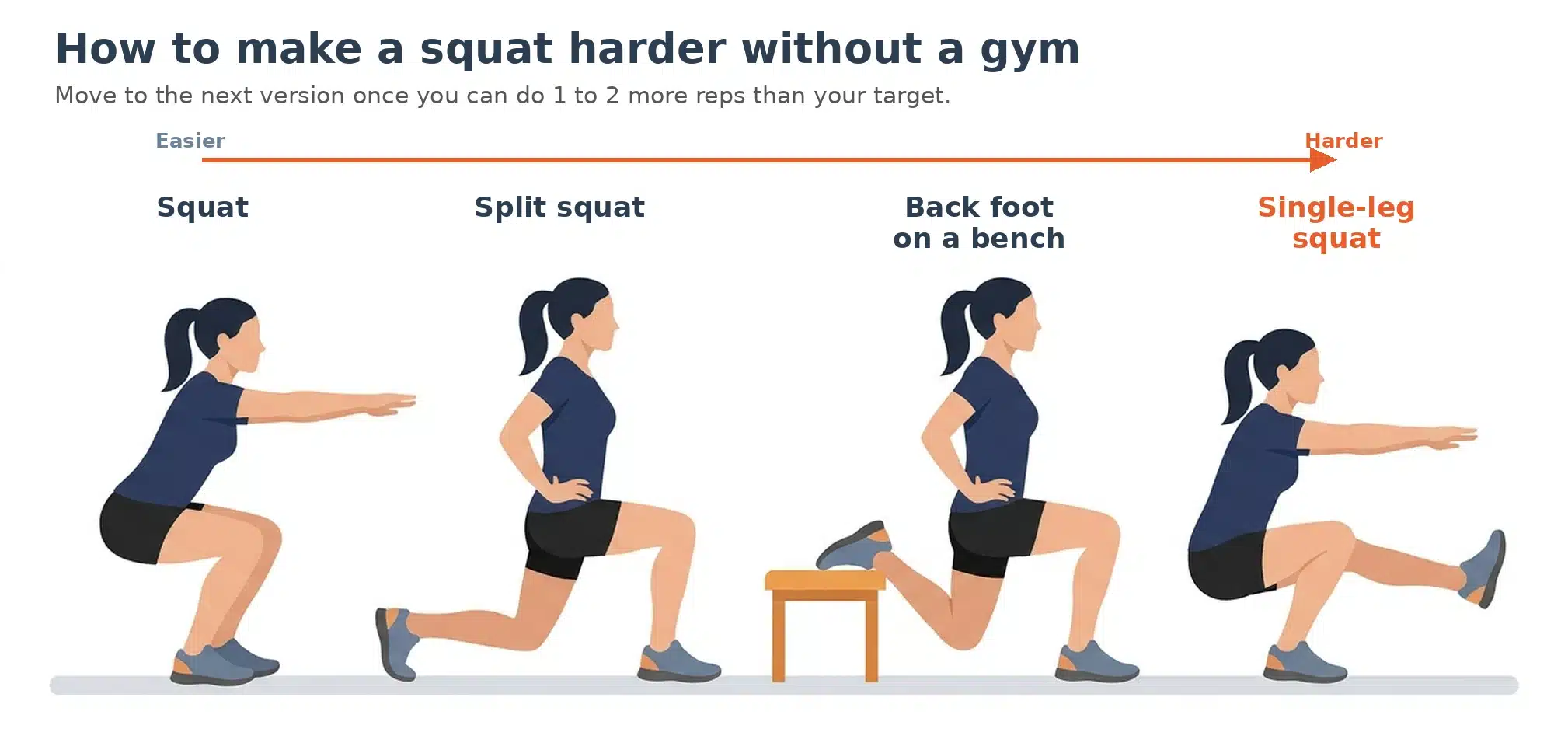
You can also lower each rep over 3 seconds, add a set, or load a backpack with books.
Whichever method you use, change one thing each week so the work is a little harder than the week before.
Here is how that plays out across the 6 weeks.
What Should Weeks 1 and 2 of a Strength Block Look Like?
The first 2 weeks are for learning the exercises with a weight that feels easier than you expect.
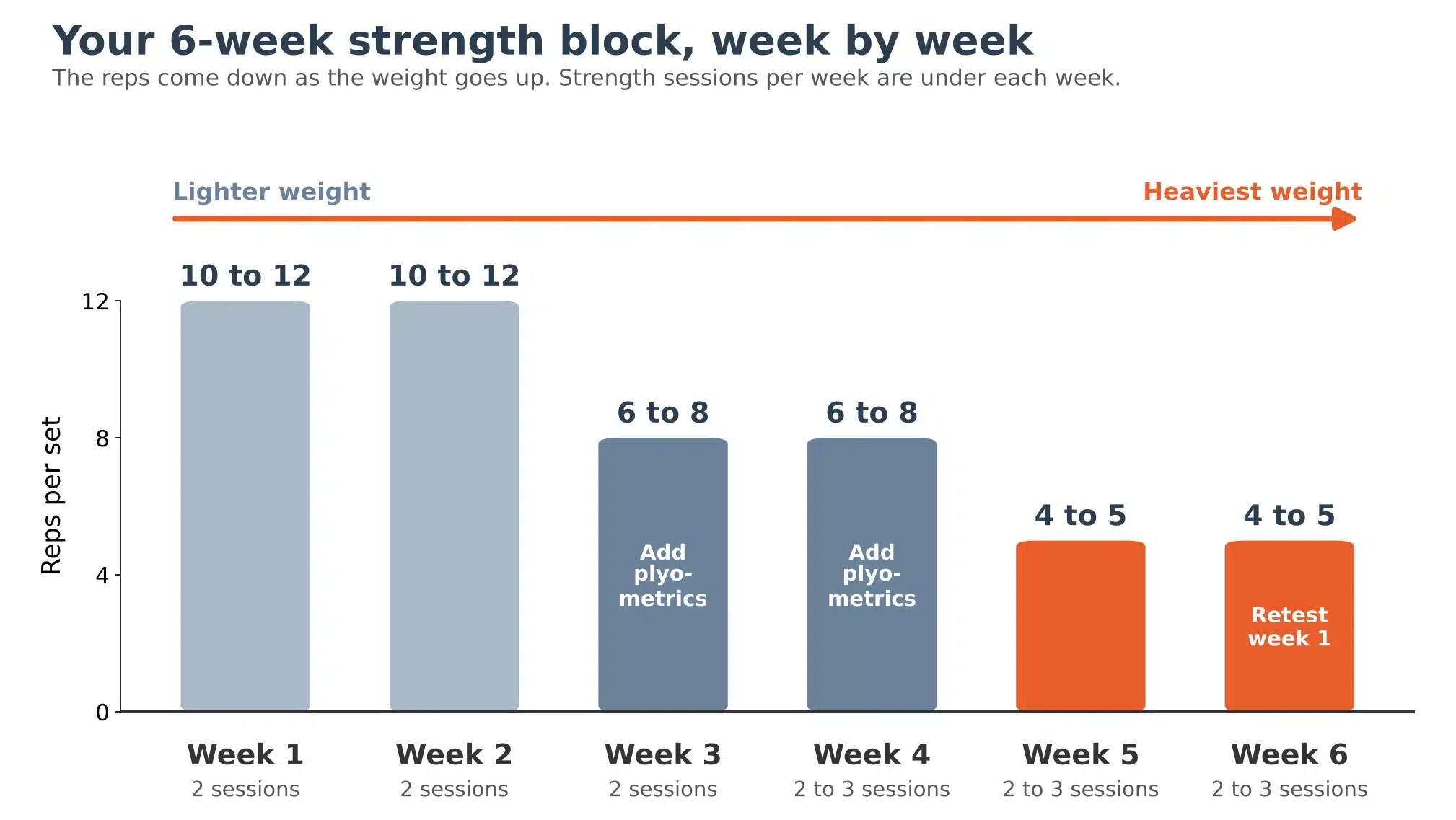
Do 2 sessions a week of 2 to 3 sets of 10 to 12 reps, using a weight you could lift 2 or 3 more times with good form.
That matches the ACSM guidelines for people new to lifting, which recommend 2 to 3 sessions a week with a weight you can lift 8 to 12 times.
Your first few sessions will make your legs sore, and starting light keeps that soreness from ruining your runs for the rest of the week.
A 2021 review of how strength develops found that strength gains in the first 2 to 4 weeks of lifting come mainly from your nervous system, before your muscles grow.
Your nervous system is the network of nerves that tells each muscle when to fire and how hard.
In the first weeks, your brain gets better at firing more of the muscle at once, so you can lift more weight with the same legs.
That means the weights you use can go up every session or two early in the block, without you adding any size.
Lift on the same day as your hard run or at least 48 to 72 hours before your long run, so your legs recover for both.
Easy runs on the days after a strength session are fine.
How Do You Make Weeks 3 and 4 Harder?
In weeks 3 and 4, the weight goes up and the reps come down.
Do 3 to 4 sets of 6 to 8 reps, and add weight using the 2 to 10% rule whenever you hit 1 to 2 reps over your target.
If your legs are recovering well between runs, add a third strength session in week 4.
This is also the point to add plyometrics once or twice a week.
Plyometrics are jumping exercises like ankle hops, skipping and bounding, where your foot spends as little time on the ground as possible.
Keep each set short and rest fully between sets so every jump is fast.
A 2003 study had 17 male runners add 6 weeks of plyometric training to their normal running.
Six weeks of plyometric training on top of normal running made runners 2.7% faster over 3 km.
For a runner who covers 3 km in 15 minutes, 2.7% is about 24 seconds faster.
What Should the Last 2 Weeks of the Block Look Like?
Weeks 5 and 6 are the heaviest weeks of the block.
On your main lift, a squat or deadlift, do 4 sets of 4 to 5 reps with the heaviest weight you can lift with good form.
That is close to the protocol in a 2008 study from the last article.
Runners did 4 sets of 4 heavy half squats, 3 times a week for 8 weeks, and their running economy improved by 5%.
Running economy is how much oxygen you use to run at a given pace.
Your other exercises stay at 3 sets of 6 to 8 reps.
In week 6, keep the week 5 weights and retest what you did in week 1.
Check how much you lift for 5 reps on your main lift and how many single-leg squats you can do on each leg.
Those numbers show you how much stronger you got, and they become the starting point for your next block.
How Should You Change the Plan If You’re New to Lifting?
If you have never lifted weights, stay in the 8 to 12 rep range for all 6 weeks and keep adding weight or moving to harder versions of each exercise.
The ACSM guidelines save heavy sets of 1 to 6 reps for people with more lifting experience.
Your first block builds the base for heavy lifting in your next one.
How Should You Change the Plan If You Keep Getting the Same Injury?
Start your exercise list with the area that keeps getting hurt.
For calf or Achilles problems, that means single-leg calf raises, and for knee or IT band pain, that means hip and glute work like single-leg bridges and side planks.
Can You Follow This Plan Without Building It Yourself?
The 6 Week Strength Bootcamp builds this week-by-week progression for you.
It gives you a daily schedule of strength workouts and runs, customized to your fitness level, age, training history and goals, with no gym needed.
If the workouts feel too easy, the plan speeds up, and if you’re struggling or an injury pops up, it backs off.
If you’re already injured, you also get a day-by-day treatment and rehab plan.
It costs $69, you can start anytime, and you get a full refund if you’re not happy after the first week.
It works best when your next race is at least 10 to 12 weeks away.
If you would rather spend these 6 weeks building volume, the 6 Week Mileage Bootcamp builds your weekly mileage and still includes personalized strength workouts.
What Happens to Your Strength Training Once Race Training Starts?
Your strength training stays a full part of your plan once race training starts.
What changes is the focus, which depends on the race distance you’re training for, your injury history and how long you have been lifting.
Shorter races need power, so strength training for a 5K or 10K keeps the heavy, explosive lifting from the end of your block.
Half marathon training shifts toward muscular endurance, which is how long your muscles can keep working before they tire.
Each half marathon session still starts with one heavy or explosive exercise.
Marathon and ultra training focuses on injury prevention and on helping your legs hold up late in long runs.
The heavy plyometrics come out so you have the energy for your long runs and workouts.
The exercises that protect the area you tend to injure stay in your plan all year.
And if this was your first block, race training is where you keep building the basic strength you started.
The next article in this series covers how to set up your strength training through a full race training block.
Start Week 1 of Your Strength Block Lighter Than You Think
Start the first 2 weeks with a weight you could lift 2 or 3 more times, 2 sessions a week.
Add 2 to 10% whenever you beat your target by 1 to 2 reps, and drop the reps as the weight goes up.
Finish with heavy sets of 4 to 5 in weeks 5 and 6, then retest your week 1 numbers.
When race training starts, keep lifting and shift the focus to your race distance and the injuries you’re most prone to.
Here is the full 6-week block, week by week.
| Week | Sessions per week | Sets and reps | What changes |
|---|---|---|---|
| Week 1 | 2 | 2 to 3 sets of 10 to 12 | Learn each exercise with a weight you could lift 2 or 3 more times. |
| Week 2 | 2 | 3 sets of 10 to 12 | Add weight whenever you beat your target by 1 to 2 reps. |
| Week 3 | 2 | 3 to 4 sets of 6 to 8 | Heavier weight, fewer reps, and plyometrics once or twice a week. |
| Week 4 | 2 to 3 | 3 to 4 sets of 6 to 8 | Add a third session if your runs feel recovered. |
| Week 5 | 2 to 3 | 4 sets of 4 to 5 on your main lift | The heaviest weights of the block. |
| Week 6 | 2 to 3 | 4 sets of 4 to 5 on your main lift | Hold the week 5 weights and retest your week 1 numbers. |