

In January, the new Dietary Guidelines for Americans raised the protein recommendation to 1.2 to 1.6 grams per kilogram of body weight (or 0.55 to 0.73 grams per pound of body weight) per day.
That is up to double the old target of 0.8 grams per kilogram (.36 grams per pound).
For runners, the surprising part is that even the top of the new range is too low based on research in endurance athletes.
Recent research from the University of Toronto found that on training days, endurance runners need closer to 1.8 to 1.9 grams per kilogram (.82 to .86 grams per pound), and women need as much as men.
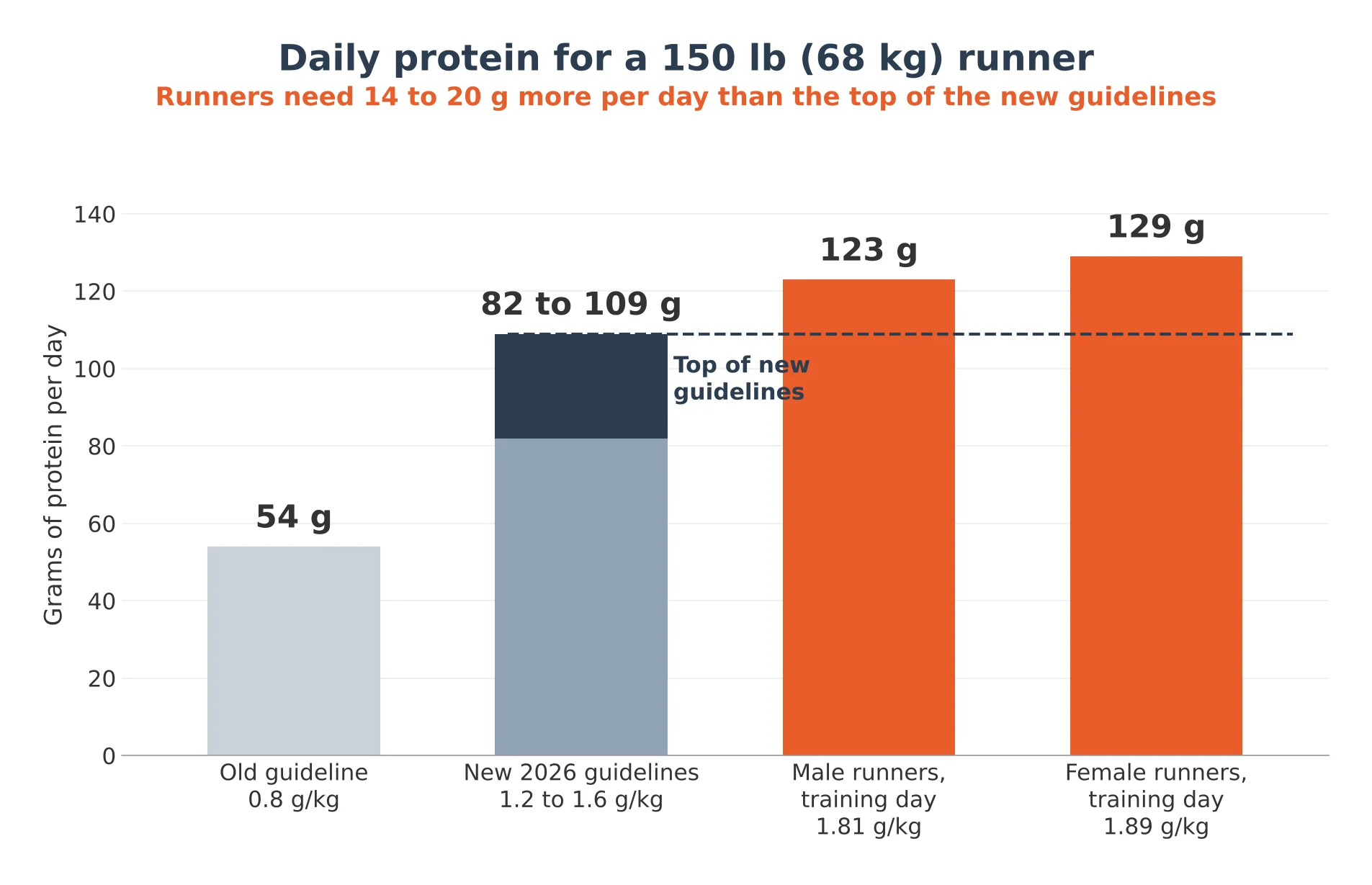
For a 150 lb (68 kg) runner, that works out to about 125 grams of protein a day, roughly 15 to 20 grams more than the new guidelines call for.
So why do runners need more protein than everyone else, and how do you hit that number without living on chicken breasts?
To give an evidence-based answer, let’s look at the research-backed practical advice on…
- How many grams of protein you need on training days for your body weight
- Why a 2025 analysis of 75 trials found protein helps endurance performance, and the reason it works
- Why breakfast is the meal most runners get wrong, and why a big protein dinner isn’t wasted
- The easiest foods and protein powder uses to add 20 to 30 grams a day without changing how you eat
How Much Protein Do Runners Actually Need on Training Days?
On days you run hard or long, your body needs about 1.8 to 1.9 grams of protein per kilogram (.82 to .86 grams per pound) of body weight.
The Toronto researchers measured this directly by having trained runners complete a 20 km (12.4 mile) run, then tracking how much protein their bodies needed to recover.
Research has shown that runners need 1.81 grams of protein per kilogram of body weight for men and 1.89 grams for women on training days, which is above the upper end of current sports nutrition guidelines.
That means a 150 lb (68 kg) runner needs about 125 grams of protein on a training day.
The new dietary guidelines top out at 109 grams for the same runner, and the old 0.8 gram target worked out to just 54 grams.
The researchers expected the women to need less protein, because estrogen helps the body hold on to protein.
The women needed as much as the men, so female runners should use the same target.
To find your number, divide your weight in pounds by 2.2 to get kilograms, then multiply by 1.8.
The studies measured runners on a training day, so on rest days you can drop toward the 1.2 to 1.6 range from the new guidelines.
Why Do Runners Need More Protein Than Everyone Else?
Running raises your protein needs in two ways.
- Your body burns some protein for fuel on long and hard runs. Your muscles break down a small amount of amino acids, the building blocks of protein, and use them for energy. Those amino acids have to be replaced from your diet.
- Your body uses protein to rebuild after every run. Repairing muscle fibers and building new mitochondria, the parts of your muscle cells that produce energy, both use protein from your diet.
The extra protein also directly helps improve endurance performance.
A 2025 analysis of 75 randomized trials in 1,206 athletes found that adding protein to carbohydrate produced a moderate improvement in endurance performance compared to a placebo.
Of the protein types tested, whey was the only one that produced a measurable endurance benefit, although that benefit was small.
But there’s a catch in how this works.
Every benefit the analysis found came from studies where the protein group also ate more total calories than the comparison group.
The researchers concluded that part of the benefit may come from the extra energy rather than the protein itself.
That means protein works best as an addition to your carbohydrate, so a protein shake on top of your normal meals gives you more protein to rebuild and more total fuel to recover.
If you swap your post-run carbs for a protein shake, you give up the extra fuel that likely produced part of the benefit.
How Much Protein Should You Eat at Each Meal?
Your daily total matters most, but how you spread that protein across meals also changes how much muscle you rebuild.
Most people eat a small amount of protein at breakfast, a little more at lunch, and most of it at dinner.
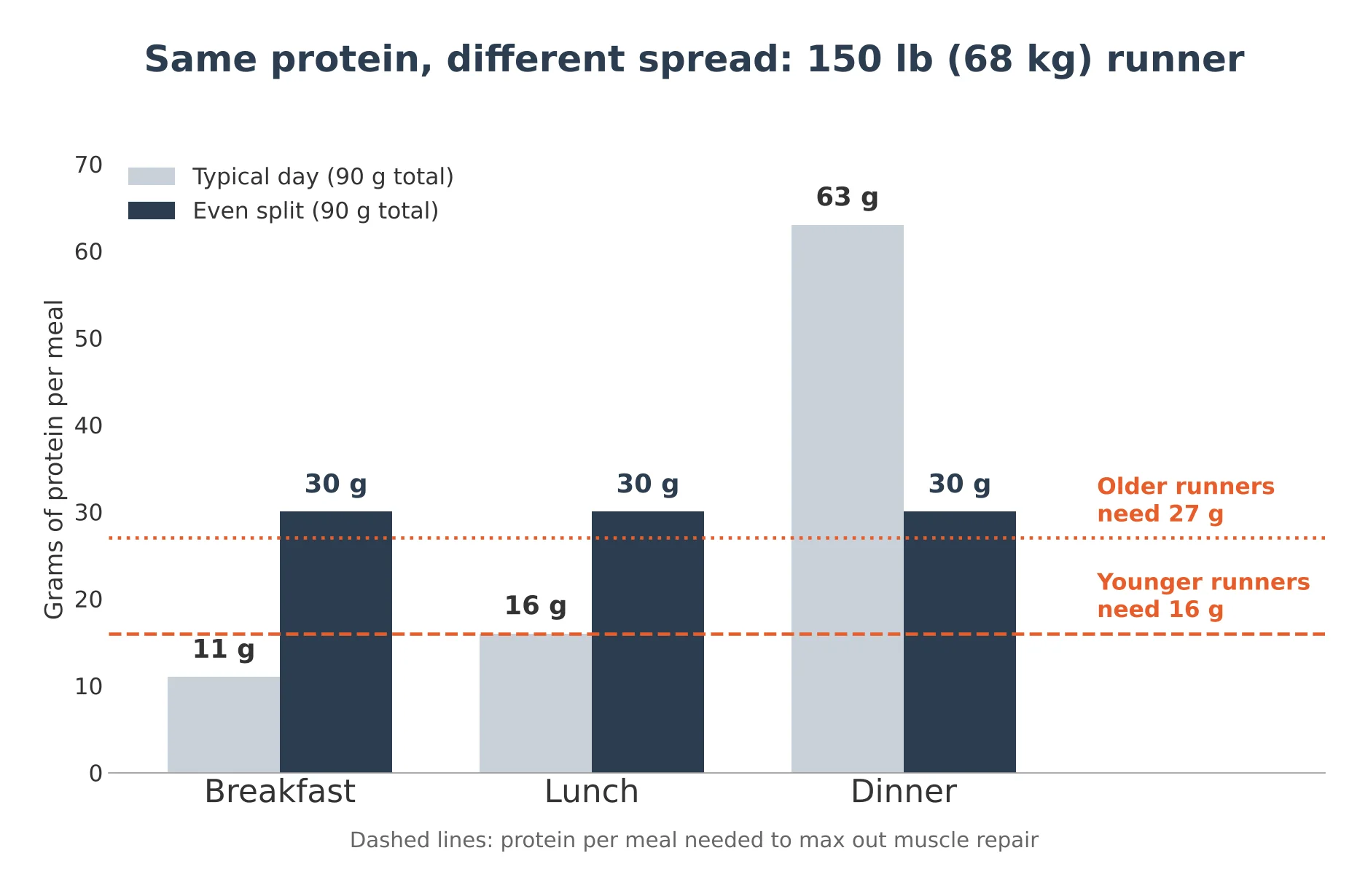
A 2014 study compared that pattern, about 10 grams at breakfast and over 60 grams at dinner, with the same total split evenly at about 30 grams per meal.
After a week, muscle protein synthesis, the process your body uses to rebuild muscle, was 25% higher over 24 hours with the even split.
Now, that doesn’t mean the protein in a big dinner is wasted.
You may have heard that your body can only use 20 to 30 grams of protein at once.
A 2023 study tested that idea by giving men either 25 or 100 grams of protein after a strength workout.
The 100 gram dose built more muscle protein than the 25 gram dose and kept muscle building elevated for more than 12 hours.
That means the weak spots in a typical day are breakfast and lunch, the meals that don’t have enough protein to get rebuilding started.
What is the minimum and maximum per meal?
In research, young men in their early 20s maxed out muscle repair on 0.24 grams of protein per kilogram of body weight in a single meal.
The men around age 70 needed 0.40 grams per kilogram, about two-thirds more, to get the same response.
Most masters runners fall somewhere between those two ages, so if you are over 50, aim toward the higher number.
Here’s how those numbers work out by body weight.
| Body weight | Protein per day on training days | Protein per meal, younger runners | Protein per meal, older runners |
|---|---|---|---|
| 120 lb (54 kg) | About 100 grams | 13 grams | 22 grams |
| 150 lb (68 kg) | About 125 grams | 16 grams | 27 grams |
| 180 lb (82 kg) | About 150 grams | 20 grams | 33 grams |
| 210 lb (95 kg) | About 175 grams | 23 grams | 38 grams |
If tracking every meal is too much, just make sure your breakfast and the meal after your run each hit the per-meal number for your weight.
What Are the Easiest Ways to Sneak More Protein Into Your Diet?
The simplest way to close a 15 to 30 gram gap is to add protein to meals and snacks you already eat.
These foods each add a meaningful amount of protein with almost no prep:
- 2 large eggs: 12 grams, added to toast or a breakfast you already eat
- 6 oz of plain Greek yogurt: 17 grams, in place of a lower-protein afternoon snack
- 1 cup of cottage cheese: 24 grams, with fruit or blended into pancake batter
- 1 cup of milk: 8 grams, used in place of water when you cook oatmeal
- 3 oz of canned tuna: 17 grams, mixed into a lunch salad or wrap
- 1 cup of shelled edamame or cooked lentils: about 18 grams, added to rice bowls, soups and salads
A trick that I’ve seen a lot of the runners I work with have success with when trying to up their protein numbers is using protein powders – but not just as shakes.
You can mix protein into foods you like to eat and it not only can add a ton of flavor, but makes it easy to consume an extra 25g of protein as a meal or as a snack without even realizing it.
For example, you can use a chocolate protein powder mixed into your pancake batter to instantly add chocolate flavor and 25g of protein.
A super easy solution post-long run when your stomach may not want to eat a lot is a post-run smoothie: Blend fruit or peanut butter flavored protein with fruit and milk so you get protein and carbohydrate together.
For those that need breakfast on the go, overnight oats are an amazing choice. Just add a scoop of your favorite protein flavor to dried oats and either water and milk in a mason jar or any cup you can seal. Let them sit overnight and you instantly have a delicious breakfast you can take on the go. You can also get crazy with topics, fruits, etc. and have a truly unique breakfast every morning.
Replace up to about a third of the flour in banana bread, muffins or baked oatmeal with protein powder, and add a splash of extra liquid because whey can dry out baked goods.
Which Protein Powder Do I Recommend for Runners?
The nice thing about protein powders these days is that the options are almost limitless in terms of type and flavor.
One of my favorite brands, and a partner of RunnersConnect, is Naked Nutrition. They have whey, goat, egg, vegan, oat and casein powders so you can match to any dietary restrictions you have.
Moreover, I also like them because they use minimal ingredients and processing. For example, in their whey protein the only ingredient is grass-fed whey protein, from cows raised without the growth hormones rBGH or rBST.
If you don’t have a dietary restriction, whey is the form of protein with the strongest backing in research. So, if you’re not sure where to start, this is your best option.
Start by Adding 25 Grams of Protein to Your Breakfast
On training days, aim for about 1.8 grams of protein per kilogram of body weight, which is more than even the new dietary guidelines recommend.
For most runners, the biggest gap is breakfast, the meal that usually falls short of the per-meal amount needed to start rebuilding muscle.
This week, add about 25 grams of protein to your breakfast, then make sure the meal after your run hits the per-meal number for your weight.
Keep your carbohydrate where it is and add the protein on top.
Your Protein Plan at a Glance
| What to change | Target | Why it matters |
|---|---|---|
| Daily protein on training days | About 1.8 to 1.9 grams per kg of body weight | Runners measured after a 20 km run needed more than the new 1.6 gram guideline. |
| Protein at each meal | 0.24 grams per kg for younger runners, 0.40 grams per kg for older runners | Meals below this amount don’t get muscle rebuilding fully started. |
| Breakfast | Add about 25 grams | An even split across meals produced 25% more muscle protein synthesis than a dinner-heavy day. |
| Post-run nutrition | Protein added on top of carbohydrate | Protein’s endurance benefit appeared in trials where athletes also got extra calories. |