

Your alarm goes off at 5:30 for a Sunday long run, and you haven’t eaten since dinner at 7 the night before.
Before you head out the door, work out how many carbs your body burned while you slept and whether you need to replace them.
The answer comes down to 2 numbers: how many calories you burn, and what share of those calories comes from carbohydrate at each effort level.
Here’s what you’ll learn about carb burning:
- Your body burns close to the carbohydrate you eat, about 245 grams on a 1,950-calorie rest day for a 150-pound man.
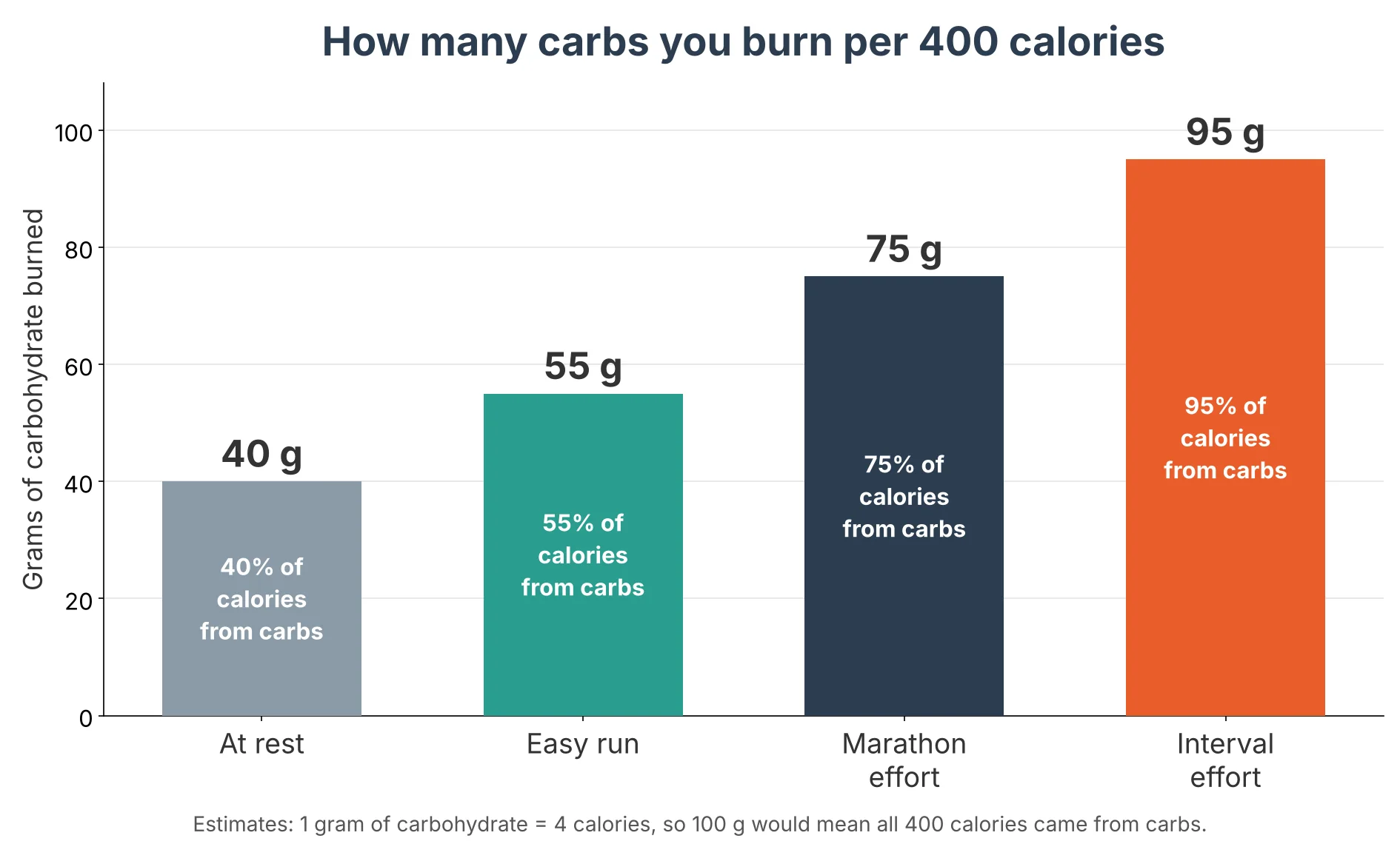
- Every 400 calories you burn uses between 40 and 95 grams of carbs, depending on how hard you’re working.
- Overnight, your liver drains glycogen while the glycogen in your leg muscles barely changes.
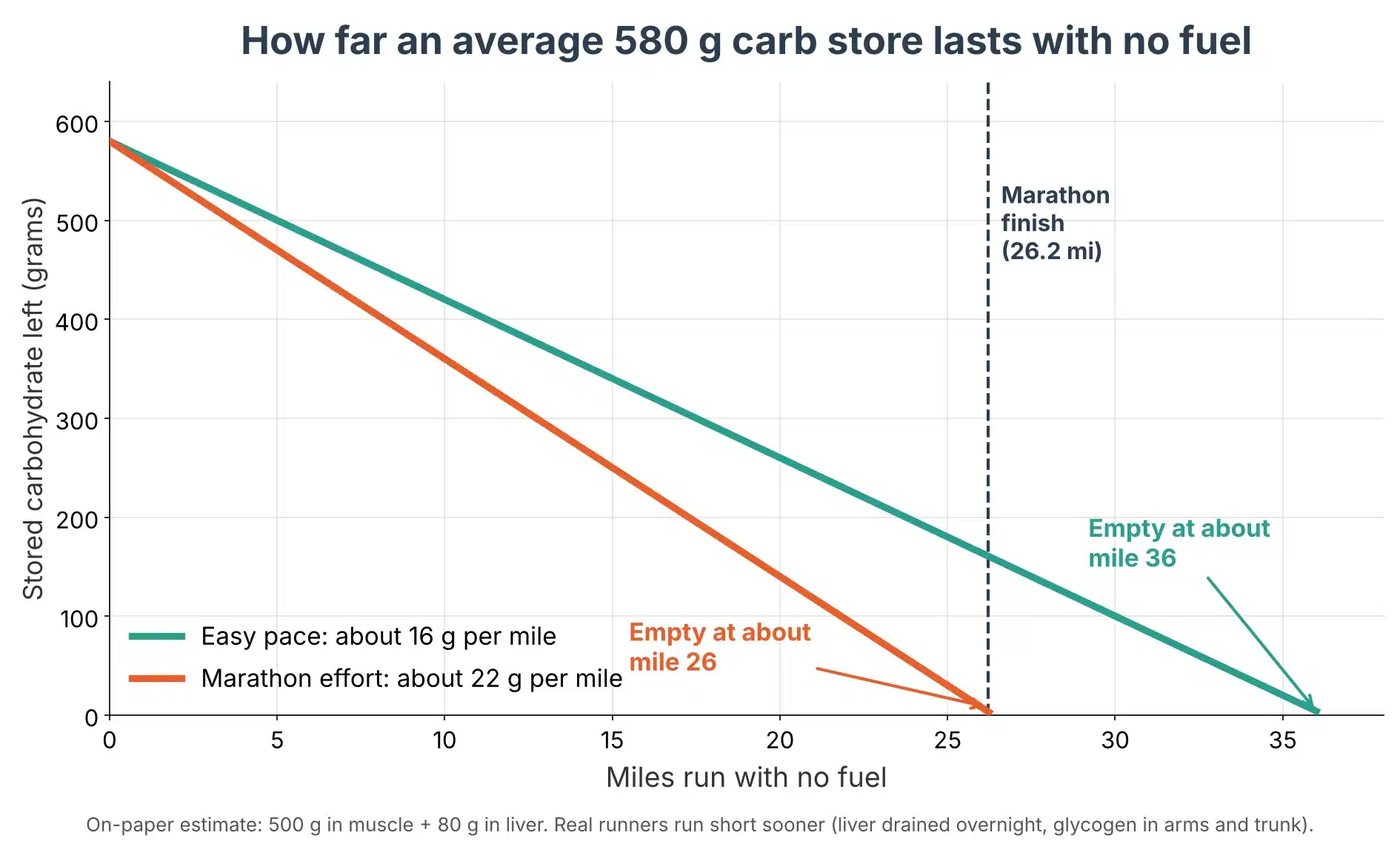
- A mile at easy pace uses about 16 grams of carbs, and a mile at marathon effort uses about 22 grams.
- About 50 grams of carbohydrate in the morning keeps your liver glycogen from falling further after an overnight fast.
How Many Carbs Do You Burn a Day?
Your body burns roughly the same amount of carbohydrate you eat each day, because it raises or lowers carb burning to match what you take in.
Research has shown that when 54 adults spent 24 hours in a metabolic chamber, their bodies matched carbohydrate burning to carbohydrate intake, while body fat absorbed almost all of the day-to-day surplus or shortfall in calories.

That means the quickest way to estimate your daily carb burn is to look at how many carbs you eat.
As an example, a 150-pound man who is 5’10” and 35 years old burns about 1,620 calories a day at complete rest, based on a widely used resting metabolism equation.
Normal daily movement adds about 20% on a day without a workout, which brings him to roughly 1,950 calories burned.
If half of the calories he eats come from carbohydrate, his body burns about 245 grams of carbs on that rest day, or 980 calories’ worth.
Eat fewer carbs and your body burns fewer carbs. Adults with obesity who cut their carbohydrate intake for 6 days in a 2015 inpatient diet trial burned more fat, and their fat burning stayed higher for all 6 days.
A run adds to the daily total. Treadmill testing in 2004 measured about 115 calories burned per mile at 9:31/mi (5:55/km), so a 6-mile easy run burns close to 690 calories.
If about 55% of those 690 calories come from carbohydrate, the run burns roughly 95 grams of carbs.
Eat enough carbohydrate to replace it and your intake and carb burn both rise to about 340 grams for the day.
Skip the extra carbs and those 95 grams stay missing from your glycogen stores.
If You Burn 400 Calories, How Many Carbs Did You Burn?
Every gram of carbohydrate you burn releases about 4 calories, so 400 calories that came entirely from carbs would equal 100 grams.
Your body burns a mix of carbohydrate and fat, and the carbohydrate part of that mix grows as your pace picks up from easy to interval effort.
To measure that mix, exercise scientists use the respiratory exchange ratio, which compares the carbon dioxide you breathe out to the oxygen you take in.
An updated conversion table shows that a ratio of 0.85 means about 50% of your calories come from carbohydrate, while a ratio of 0.95 means about 84%.
Lab testing in trained cyclists found fat burning peaked at about 64% of VO2max and supplied almost none of the energy above about 89% of VO2max.
The carb shares in this article use typical exchange ratios for each effort, converted with that table.
That puts carbohydrate at about 40% of your energy at rest, about 55% at an easy pace, about 75% at marathon effort and about 95% at interval effort.
Your fitness and your last meal change these shares, so use them as a starting point.
At rest, 400 calories uses about 40 grams of carbs, but at interval effort the same 400 calories uses close to 95 grams.
Use the chart below to turn 400 calories into grams of carbohydrate at each effort, and use the calculator after it to estimate how many calories you burn each day.
RunnersConnect Bonus
Download your Calorie Calculator for Runners. This calculator will tell you the exact amount of calories you burn each day so you can better target your nutrition needs.
Do You Burn Carbs While You Sleep?
You burn carbohydrate all night, mostly as blood glucose that your liver releases to keep your brain and other organs supplied.
The same 150-pound runner burns about 68 calories an hour at rest, or roughly 540 calories across 8 hours of sleep.
If 33% to 50% of those calories come from carbohydrate, he burns about 45 to 70 grams of carbs overnight.
That fits a cross-check from a 1996 liver study, which measured the liver’s fasting glucose output at 1.9 milligrams per kilogram of body weight per minute.
For a 150-pound runner, that rate works out to about 62 grams of glucose over 8 hours.
MRI scans of 10 men showed that liver glycogen fell about 26 times more during an overnight fast than calf muscle glycogen changed across the entire day.
That means you wake up with a partly drained liver and leg muscles that still hold most of the glycogen you stored the day before.
As a run goes on, your muscles take more of their fuel from your blood, and your liver is the organ that keeps blood glucose supplied.
Tracer measurements in 5 trained athletes found that during 2 hours at 65% of VO2max, the fuel taken from the blood rose steadily while muscle glycogen use fell.
How Many Carbs Do You Burn Running a Mile?
Running burns about 115 calories per mile for the runners in that 2004 treadmill testing, and the faster you run, the more of those calories come from carbs.
Here’s roughly how many grams of carbs a mile uses at 3 effort levels:
- Easy pace gets about 55% of its energy from carbs, which is 63 calories, or about 16 grams per mile.
- At marathon effort, carbs supply about 75% of the energy, so each mile uses 86 calories of carbohydrate, about 22 grams.
- Interval effort runs close to 95% carbohydrate, which comes to 109 calories, or about 27 grams per mile.
At marathon effort you burn about 22 grams of carbs per mile, close to the carbohydrate in one energy gel.
The calories you burn running scale with body weight, so a 180-pound runner burns about 20% more carbs per mile than a 150-pound runner.
How Long Does It Take to Burn Off Carbs?
After a meal, your liver keeps storing carbohydrate for about 5 hours before it starts drawing that store down.
In the same 1996 liver study, liver glycogen rose after a mixed meal, peaked at about 5 hours and then fell quickly.
Muscle holds most of your stored carbohydrate. A 2018 review of glycogen metabolism puts the average at about 500 grams in muscle and about 80 grams in the liver.
Muscle glycogen barely changes unless you exercise, which is why it moved so little overnight in that same MRI study.
At marathon effort, 580 grams divided by 22 grams per mile covers about 26 miles.
Part of your muscle glycogen sits in your arms and trunk, and your liver starts a morning run partly drained.
Your average store of about 580 grams of carbs covers only about 26 miles at marathon effort on paper, so runners who take no fuel run short in the final miles.
Taking in carbohydrate during a run keeps your liver from running out of glycogen. A 2016 review found that eating more than 1.5 grams of carbohydrate per minute can prevent liver glycogen depletion during moderate-intensity exercise.
That works out to more than 90 grams of carbohydrate an hour, or about 4 energy gels.
Does Running Before Breakfast Make You Burn More Fat?
Exercising before breakfast raises the amount of fat you burn over the full day.
The researchers who measured it think the carbohydrate your body used up overnight is part of the reason.
A metabolic chamber study found that 60 minutes of easy cycling before breakfast raised fat burning to 717 calories over 24 hours, compared with 456 calories on a day with no exercise.
The same 60 minutes done after lunch produced 446 calories of fat burning, and after dinner 432 calories, so only the before-breakfast session changed the daily total.
That means a fasted morning run is a reasonable choice for an easy, conversational-pace day when burning more fat is your goal.
It’s a poor choice before a long run or a hard workout, because those sessions run mostly on carbohydrate and you’d be starting them with a partly drained liver.
Should You Eat Before a Morning Run After an Overnight Fast?
For runs longer than about an hour, eat something with carbohydrate before you head out the door.
A review of 46 studies found that eating before exercise improved time-trial and time-to-exhaustion scores in tests lasting longer than 60 minutes, but made no clear difference in shorter tests.
That means an easy run under 60 minutes on an empty stomach is fine, while a long run or a workout goes better with some carbohydrate first.
You don’t need a big breakfast to cover what you burned overnight, because your leg muscles still hold most of their glycogen when you wake up.
In a small 2014 imaging trial, a 50-gram glucose drink after an overnight fast kept liver glycogen from falling for 4 hours.
A zero-calorie drink let it keep dropping.
Fifty grams of carbs is about 200 calories, roughly what you get from a banana and a slice of toast with jam.
Eat it 30 to 60 minutes before you start, and use this guide on what to eat before a run to pick foods your stomach handles well.
RunnersConnect Bonus
Download your FREE Guide where we share the Best Foods to Eat Before Running.
How Much Carbohydrate Do Sleep, Rest Days and Runs Use?
Here’s a chart of how many carbs a 150-pound runner burns in common situations.
| Situation | Calories burned | Share from carbs | Carbs burned |
|---|---|---|---|
| 8 hours of sleep | About 540 | 33% to 50% | 45 to 70 grams |
| Rest day with no workout | About 1,950 | About 50% | About 245 grams |
| 1 mile at easy pace | About 115 | About 55% | About 16 grams |
| 1 mile at marathon effort | About 115 | About 75% | About 22 grams |
| 400 calories at interval effort | 400 | About 95% | About 95 grams |