
2 groups of runners came into a lab with near-identical fitness: one group averaged 39:10 for 10K and the other averaged 39:00.
Both groups then ran for 90 minutes at their lactate threshold while researchers measured how much oxygen it took them to hold that pace.
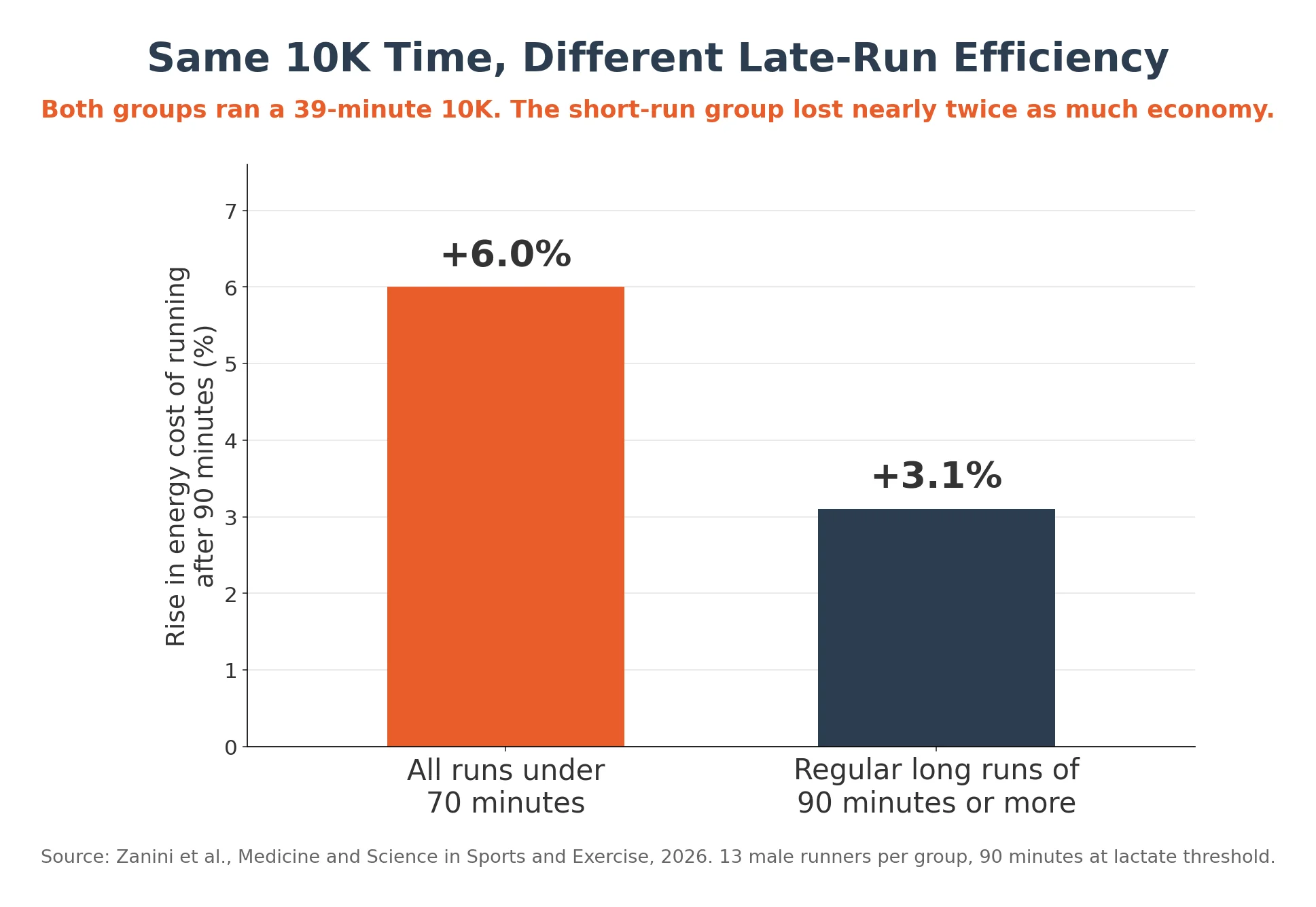
By the 90-minute mark, the runners who never ran longer than 70 minutes in training had lost 6.0% of their running economy.
The runners who did regular long runs of 90 minutes or more lost only 3.1%, so the short-run group lost almost twice as much efficiency from the same starting fitness.
A 10K race, a VO2 max test and a race-time calculator all measure you fresh.
Your half marathon and marathon are decided after you’ve been running for well over an hour.
For a runner aiming for a 2-hour half marathon, the 90-minute mark arrives with about 5 km (3 miles) still to go.
A 4-hour marathoner has covered less than 40% of the race by then.
How well you hold your efficiency late in a run is what researchers now call durability.
Durability shapes your finish time on top of the fitness you bring to the start line.
So, in this article you’re going to learn the research-backed practical advice on running economy durability:
- Why 2 runners with the same 10K time lost different amounts of efficiency after 90 minutes
- How a 6% loss in running economy can cost a 9:00/mi (5:35/km) runner roughly 30 seconds per mile
- Why the length of the longest weekly run showed a stronger link to late-run efficiency than total training volume
- How much threshold pace a group of 3:17 marathoners lost after a 90-minute run
- How twice-weekly strength training helped runners last 35% longer at a hard pace after 90 minutes of running
What Is Running Economy Durability?
Durability describes how much of your running efficiency you keep as a long run or race goes on.
Running economy is the amount of oxygen your body uses to hold a given pace, so a more economical runner spends less energy at the same speed.
Lab tests measure your economy when you’re fresh, yet in most studies the oxygen you need to hold the same pace rises as a long run goes on.
According to a 2024 review in The Journal of Physiology, resistance to that decline should count as a fourth pillar of endurance performance.
The other 3 pillars are VO2 max, running economy and lactate threshold.
Critical power is the highest power an athlete can sustain for a long effort.
The review describes cycling data where critical power can fall by an average of 10% after 2 hours of hard riding.
That drop ranged from under 1% to about 32% between athletes, so one athlete can lose almost nothing over a long effort while another loses nearly a third.
Marathon runners show a similar decline in the lab.
A 2025 study of marathoners found that after 2 hours of running, their running economy was 5.8% worse and their lactate threshold pace had slowed from 6:54/mi (4:17/km) to 7:26/mi (4:37/km).

The 14 runners in that study averaged 2:47 for the marathon.
Their threshold pace after 2 hours was about 30 seconds per mile (20 seconds per km) slower than their fresh lab test showed.
The losses also grew with time, since their VO2 max had dropped 3.1% after 90 minutes and 7.1% after 120 minutes.
That matters most for marathoners, who run well past the 2-hour mark.
Do Long Runs Make You More Efficient Late in a Race?
In the one study that compared them directly, runners who regularly ran 90 minutes or longer lost about half as much running economy late in a run as runners who kept every run short.
A 2026 study found that after 90 minutes of running, running economy worsened 6.0% in runners who never ran over 70 minutes and 3.1% in runners who did regular long runs.
The researchers recruited 2 groups of 13 male runners and paired each runner with a partner of the same 10K ability, so the groups averaged 39:10 and 39:00.
Their VO2 max values were also close, at 56.6 and 58.9 ml/kg/min, which means the gap between the groups opened up during the 90-minute run itself.
The short-run group’s running economy also started to slip earlier in the run than the long-run group’s did.
Which Matters More for Durability, Your Long Run or Your Training Volume?
Across the runners in the study, the length of each runner’s longest weekly run accounted for about 45% of the difference in economy loss from one runner to the next.
Weekly training volume was linked to durability as well, but more weakly, accounting for about 23% of that difference.
Did Tired Legs Explain the Difference?
The short-run group lost more leg strength during the 90 minutes, with maximal squat force dropping 19.4% compared with 12.2% in the long-run group.
Jump power fell 6.6% in the short-run group, while the long-run group’s jump power rose 2.2%.
Those strength losses weren’t related to how much running economy each runner lost, so the extra drop in leg strength can’t account for why the short-run group became less efficient.
What Are the Limits of This Study?
Keep 3 limits in mind before you apply these results to your own training.
- Only men were tested: a 2026 comparison of performance-matched runners found women’s time-trial speed dropped 1% after 3 hours of running, compared with 10% for men. Running economy worsened similarly in both sexes, although the women covered less distance.
- The study compared 2 groups at a single point in time. Nobody was assigned to start doing long runs, so the results show an association, and the authors say training studies are needed to confirm it.
- The runners were quick. A 39-minute 10K is faster than most everyday runners race, and the research on runners with slower race times is mixed.
RunnersConnect Bonus
Download your FREE Long Run and Aerobic Pacing Calculator now.
Need help converting your race times to your optimal easy and long run pace? Download our FREE calculator and we’ll do the math for you.
How Much Does Losing Running Economy Slow You Down?
At a typical everyday training pace, losing 6% of your running economy slows you by roughly 6% if you keep your effort the same.
Modeling research on running speed shows that at paces slower than about 9:00/mi (5:35/km), a change in running economy produces a slightly larger percentage change in the speed you can hold.
As an example, a runner holding 9:00/mi (5:35/km) who loses 6% of their running economy would need to slow to roughly 9:32/mi (5:56/km) to keep the effort the same.
With a 3.1% loss, that same runner would slow to roughly 9:17/mi (5:46/km).
For a 9:00/mi runner, that means the difference between the 2 groups’ losses works out to about 16 seconds per mile (10 seconds per km) by the 90-minute mark.
These are estimates built from the economy numbers, since the study measured oxygen use and never timed a race.
Does Durability Affect Your Marathon Time?
Durability has also been linked to real marathon results in a group of 3:17 marathoners.
A study of London Marathon runners found their lactate threshold pace slowed from 7:33/mi (4:41/km) to 7:59/mi (4:58/km) after a 90-minute run, and smaller slowdowns went with faster marathons.
The 18 runners in that study averaged 41 years old and finished the 2024 London Marathon in an average of 3:17.
Their running economy held steady over the 90 minutes, and their slower threshold pace went along with a drop in VO2 max.
That works out to a threshold pace about 26 seconds per mile (16 seconds per km) slower after 90 minutes.
Do Runners With Slower 10K Times Lose More Running Economy?
The evidence on this question is mixed, and it depends on which part of durability you measure.
A 2024 study of 44 male runners compared a faster group averaging 31:20 for 10K with a group averaging 41:50.
After 90 minutes of running, the faster runners’ economy had worsened by 2.4%, and the 42-minute 10K runners’ economy had worsened by 4.5%.
The London marathoners kept their running economy over 90 minutes, yet their threshold pace still slowed.
That means running economy is only one of the ways fatigue slows you down late in a race.
Runners further back in the field also stay on the course longer, so a 4:30 marathoner runs for 3 hours past the 90-minute mark.
The 2:47 marathoners in the 2025 study had about 1 hour 17 minutes left to run after the same point.
The longer your race takes, the more of it you run past the 90-minute mark, where studies have measured a slower threshold pace.
An analysis of more than 4 million marathon results found that 28% of men and 17% of women hit the wall, slowing sharply for a sustained stretch late in the race.
Hitting the wall usually happens when your stored carbohydrate runs low, and any rise in the energy cost of each mile uses up that store faster at the same pace.
How Do You Train Running Economy Durability?
The research points to 5 training habits that help you hold your efficiency late in a run, and the weekly long run comes first.
How Long Should Your Long Run Be to Build Durability?
Build your long run to at least 90 minutes and keep it there on a regular basis.
The long-run group in the 2026 study ran 90 minutes or more, while the short-run group never went past 70 minutes.
Coaches consistently see most of a long run’s training benefit come between 90 minutes and 2 hours 30 minutes.
Those same coaches see runs longer than 3 hours add fatigue and injury risk without adding much fitness.
If your longest run is currently under 90 minutes, use this progression:
- Start from your longest run of the past 6 weeks. That run is your baseline.
- Add 10 minutes each week at an easy, conversational pace, and walk the hills if you need to.
- Every 4th week, cut the long run back below your baseline so your legs can recover before the next step up.
- Once you reach 90 minutes, run at least that long most weeks of a half marathon or marathon build. Marathoners can extend toward 2 hours to 2 hours 30 minutes.
If you only change one thing, get your weekly long run to 90 minutes before you add more total mileage.
Does Weekly Mileage Matter as Much as the Long Run?
Weekly mileage still counts, since higher training volume was linked to better durability in the 2026 study, just more weakly than the long run.
Years of consistent, high-volume training might promote fatigue resistance, according to a 2025 review on physiological resilience, although the authors describe the data as scant.
Research pooling 85 marathon studies has linked higher weekly distance, more runs of 20 miles (32 km) or longer and a longer longest run to faster marathon times.
That means you protect the long run first, then add easy mileage around it a little at a time.
Should You Add Race Pace to the End of Your Long Runs?
Running at race pace over the final miles of a long run makes you hold pace on tired legs, the same situation you face late in a half marathon or marathon.
The same 2025 review names long sessions with race-pace running as a possible way to train resilience.
Long sessions that pick up the pace as fatigue builds made the list too, although the evidence for both is still limited.
A fast finish long run is the simplest version.
Run most of the distance easy, then run 3 to 4 miles (5 to 6.5 km) at goal marathon pace or up to 15 seconds per mile (9 seconds per km) faster.
Finish with an easy mile or two (1.5 to 3 km), and schedule a fast finish every second or third long run with easy long runs in between.
Does Strength Training Help You Hold Running Economy Late in a Run?
Heavy strength training combined with jumping drills helped runners hold their running economy late in a 90-minute run.
A 2025 randomized trial found that twice-weekly heavy strength training and jumping drills improved running economy at the 90-minute mark by 2.1% in 10 weeks, while a running-only group got 0.6% worse.
The trial split 28 male runners, matched for performance, into those 2 groups, and the strength group did heavy lifting plus plyometric jumps on top of their usual running.
Right after the 90-minute run, both groups ran at a hard pace until they couldn’t continue.
The strength group lasted 35% longer than they had before the training block, and the running-only group lasted 8% less.
That means the benefit showed up most clearly at the end of a long effort, when the runners had to push hard on legs that had already run for 90 minutes.
If you want a structured plan instead of piecing together routines yourself, our Strength Training for Runners program includes 24 routines built for runners, with prescriptions by race distance.
Does Fueling During Long Runs Help Durability?
Taking in carbohydrate during long sessions helped athletes hold their threshold later into the effort.
A study published in the European Journal of Applied Physiology found that after 150 minutes of riding, power at the first threshold dropped 6% without carbohydrate and 3% with it.
The athletes were trained cyclists and triathletes, so the result still needs testing in runners.
The result is one more reason to take in carbohydrate on your long runs the same way you plan to on race day.
What If You Don’t Have Time for a 90-Minute Run?
If 90 minutes doesn’t fit your week, build toward it in 10-minute steps on the day you have the most time, which is usually the weekend.
The research hasn’t tested whether 2 runs of 45 minutes give the same benefit as 1 run of 90 minutes, so the single 90-minute run is the safer choice.
Strength training is a time-efficient option too, since 2 sessions a week improved late-run economy in the 2025 trial without any extra running.
RunnersConnect Bonus
Download your FREE Long Run and Aerobic Pacing Calculator now.
Need help converting your race times to your optimal easy and long run pace? Download our FREE calculator and we’ll do the math for you.
This table lists each training habit, what the research found and how to put it into your week.
| Training habit | What the research found | What to do |
|---|---|---|
| Weekly long run | Runners doing regular 90-minute long runs lost 3.1% of their running economy after 90 minutes, compared with 6.0% for runners who kept every run under 70 minutes. | Build your long run to at least 90 minutes and run that long most weeks. |
| Weekly mileage | Higher training volume was linked to better durability, but less strongly than the long run. | Add easy mileage around the long run a little at a time. |
| Race pace late in long runs | A 2025 review names it as a possible way to build resilience, with limited direct evidence so far. | Run a fast finish every second or third long run. |
| Strength training | Twice-weekly heavy lifting and jumps improved running economy at 90 minutes by 2.1% in 10 weeks. | Lift heavy and add jumps twice a week. |
| Carbohydrate on long runs | Cyclists lost 3% of their threshold power with carbohydrate after 150 minutes, compared with 6% without it. | Fuel your long runs the way you plan to fuel on race day. |