
Lactate carries a worse reputation than any other molecule in running.
You have probably been told it is a waste product, that it pools in your legs, and that the burn at the end of a hard interval is lactic acid sloshing around your muscles.
That description came out of exercise physiology in the 1970s, and research laboratories moved past it decades ago.
Lactate is a fuel, and your muscles, heart and brain burn it while you run.
How much of it you can burn, and how quickly, turns out to be one of the largest measurable differences between a trained runner and an untrained one.
So, in this article you’re going to learn the research-backed practical advice on how your body uses lactate as fuel.
- Why your fast-twitch fibers hand lactate to your slow-twitch fibers, and what that handoff does for your race pace
- The number that shows how much faster a trained runner disposes of lactate than an untrained one at the same effort
- What your lactate threshold is actually measuring, and why elite runners do not hit it at a higher percentage of their ceiling than you do
- Five workouts that develop your ability to burn lactate, including a scaled version of the double session Renato Canova built for his marathon medallists
- The pacing mistake that turns a lactate clearance session into an ordinary hard run
Is Lactate a Waste Product or a Fuel Source?
Your body produces lactate constantly, at rest and at every running pace, and it burns nearly all of it.
Research has shown that during exercise your body disposes of 70 to 75% of its lactate by burning it for energy.
The old story held that lactate appears when your muscles run short of oxygen.
A 2018 review in the European Journal of Applied Physiology put the correction plainly: lactate production does rise when tissue is genuinely starved of oxygen, and that situation is the exception rather than the rule.
Your muscles make lactate under fully aerobic conditions, on your easy runs, at your desk, and while you sleep.
Your heart makes the strongest case for lactate as a fuel.
A study using carbon-labeled tracers measured what the human heart did with the lactate and glucose it pulled from the blood during moderate cycling.
The heart burned essentially every lactate molecule it took up, compared with 53% of the glucose it took in over the same period.
Cardiac lactate uptake more than tripled within five minutes of starting exercise, at an intensity of only 40% of maximum oxygen uptake.
Your brain does something similar once blood lactate rises.
Danish researchers found that blood lactate supplied 27% of the brain’s total energy use during cycling at 75% of maximum oxygen uptake, once arterial lactate had been raised to around 7 mmol per liter.
The burning sensation you feel late in a hard interval tracks hydrogen ions, which are produced alongside lactate and make the muscle more acidic.
Lactate and hydrogen ions leave the muscle together, and only the lactate comes back to you as fuel.
What Is the Lactate Shuttle and How Does It Work in Your Muscles?
Lactate does not stay where it was made, and the traffic between muscle fibers is the part most runners have never had explained.
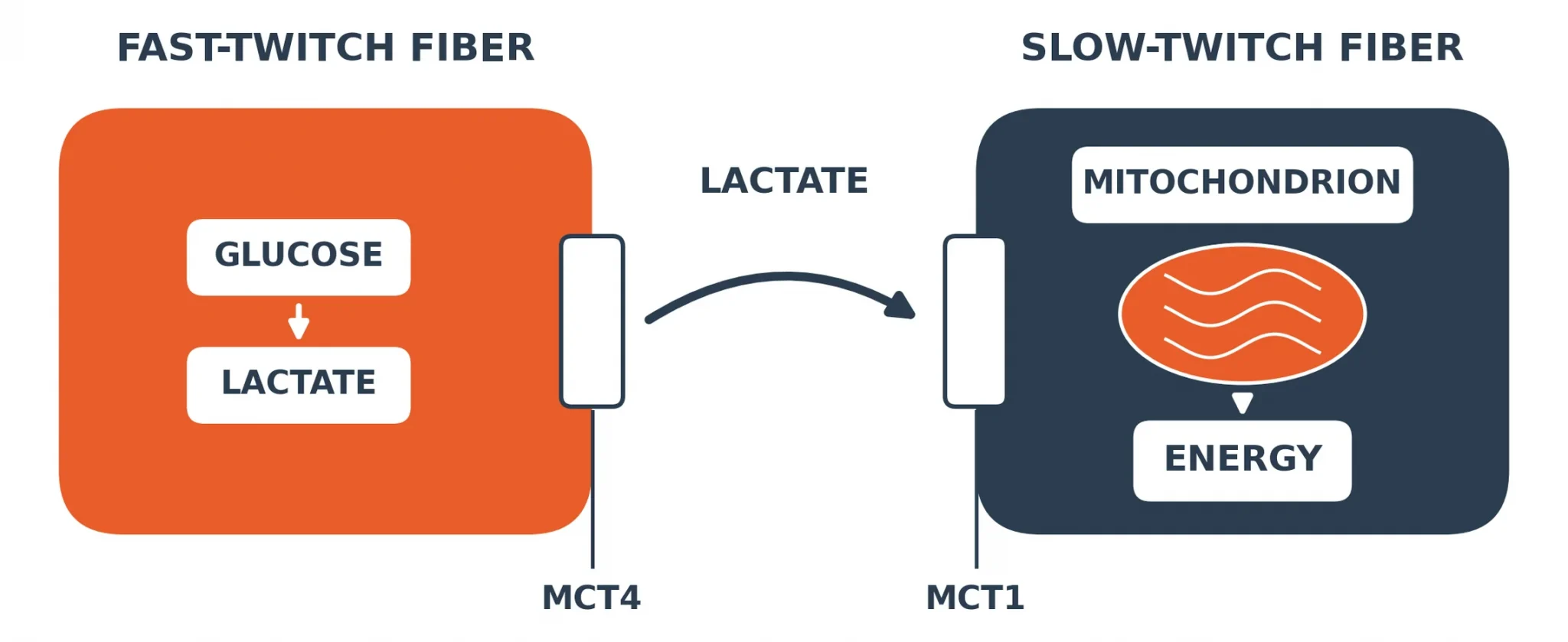
When you pick up the pace, your body recruits fast-twitch fibers, which break down glucose quickly and produce lactate faster than they can burn it.
Those fibers push the surplus out through MCT4, a monocarboxylate transporter, which is a protein that carries lactate across a cell membrane.
Slow-twitch fibers sitting alongside them pull that lactate in through a different transporter called MCT1, then feed it into their mitochondria and burn it for energy.
George Brooks named this traffic the lactate shuttle, and the exchange between glycolytic and oxidative fibers inside a single working muscle bed is the version that matters most while you run.
According to a 2024 review, 75 to 80% of the lactate your muscles produce is used up inside the working muscle itself.

Most of the lactate you produce during a workout never reaches your liver.
Your calves and quads are handing lactate to the fiber next door rather than shipping it out to be reprocessed elsewhere.
The transporters also explain why the burn and the fuel travel together.
Research on human muscle samples has shown that these transporters move lactate and hydrogen ions across the membrane in a strict one-to-one pairing, which makes them part of how your muscle manages its own acidity.
One honest caveat belongs here.
The tidy picture of MCT4 living in fast-twitch fibers comes mostly from animal muscle, and the same human research found MCT4 density in human muscle to be independent of fiber type, while MCT1 tracked the proportion of slow-twitch fibers closely.
Does Endurance Training Lower Lactate or Just Clear It Faster?
Training changes the disposal side of the equation far more than it changes the production side.
That distinction reverses how most runners think about threshold work.
A 1983 study in trained and untrained animals found lactate clearance 37% greater during easy exercise and 107% greater during hard exercise after training, with no change at all in the rate lactate was produced.
The human numbers point the same direction.
A 2013 study in the Journal of Applied Physiology found that trained men removed lactate from the blood 97% faster than untrained men working at the same relative effort.
Your lactate threshold is the fastest pace at which lactate production and lactate disposal still balance, which for most runners falls somewhere between 15k and half marathon race pace.
At their own lactate threshold, the trained group still cleared lactate 34% faster.
The trained group also produced more lactate at threshold than the untrained group did, because they were holding a much faster pace to get there.
Training raised the ceiling on both sides of the exchange, and it raised the disposal side further.
A nine-week training study pinned down what that improvement looks like at a matched blood lactate concentration.
At an identical blood lactate of 6 mmol per liter, the rate at which subjects burned lactate roughly doubled after nine weeks of training.
That same study found that more than 80% of lactate was being burned in the final stages of hard exercise, supplying around 45% of all the carbohydrate energy used.
Conversion of lactate back into glucose actually fell after training in those subjects.
The recycling that matters for your running happens inside the muscle rather than on a round trip through the liver.
A separate 2013 tracer study found that blood lactate supplied about one third of the carbohydrate energy subjects used during an hour of steady exercise.
In that study, 90% of the lactate the trained men burned was oxidized directly, compared with 75% in the untrained men.
Training does lower the lactate reading you would see at any given absolute pace.
A 1999 study of nine men recorded arterial lactate 41% lower at the same workload after nine weeks of cycling.
Both things happen at once as you get fitter.
The same 7:30 per mile (4:40 per kilometer) that once left you gasping becomes a pace your oxidative fibers can keep fueling.
What Changes Inside Your Muscles When Lactate Clearance Improves?
Three physical changes account for most of that improvement, and they respond to different kinds of running.
How Much Do Lactate Transporters Increase With Training?
The transporters that move lactate in and out of muscle fibers multiply in response to training.
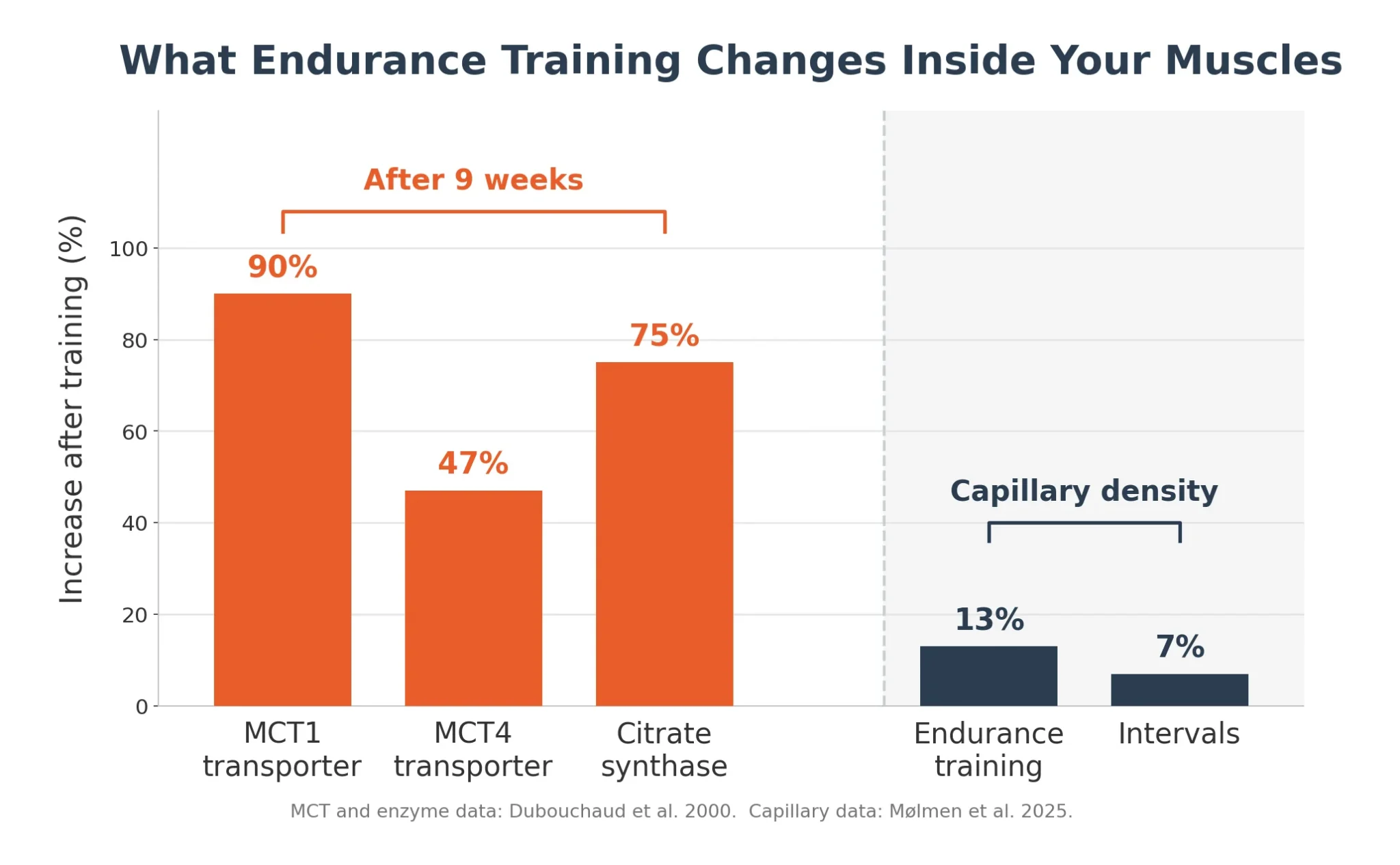
Researchers at Berkeley found that nine weeks of endurance training increased MCT1, the transporter that carries lactate into oxidative muscle fibers, by 90%.
MCT4, the transporter that moves lactate out of glycolytic fibers, rose 47% at the muscle surface in the same study.
Citrate synthase, a standard marker of how much aerobic machinery a muscle contains, climbed 75%.
A study of 15 men across different training backgrounds found that muscle MCT1 content tracked how quickly each man actually removed lactate from his blood after all-out exercise.
Why Do Your Mitochondria Set the Ceiling on Lactate Use?
Mitochondria are the structures inside your muscle cells where fuel is combined with oxygen to make energy, and they are where lactate finally gets burned.
The Berkeley team found MCT1 in the mitochondrial membranes themselves, which points to lactate being taken directly into the mitochondria rather than converted elsewhere first.
That specific finding remains contested among researchers, and several laboratories have failed to reproduce it.
The larger point holds regardless of how that argument resolves.
Your capacity to burn lactate is limited by how much mitochondrial machinery your working muscles contain.
What Do Easy Miles Add That Hard Sessions Do Not?
Lactate has to physically reach an oxidative fiber before it can be burned, and that depends on your capillary bed.
A 2025 meta-analysis covering nearly 6,000 participants found that steady endurance training raised capillary density by 13%, while high-intensity interval training raised it by 7%.
Mitochondrial content responded similarly to both approaches, rising 23% with endurance training and 27% with intervals.
Your easy volume builds the delivery network, and your harder sessions build the machinery at the destination.
One result cuts against all of the above.
A three-week training study in 18 cyclists improved all-out power by about 7% with no measurable change in either transporter.
Transporter counts are one input into performance among several.
What Actually Sets Your Lactate Threshold?
The pace you call threshold marks the point where your disposal system runs out of headroom.
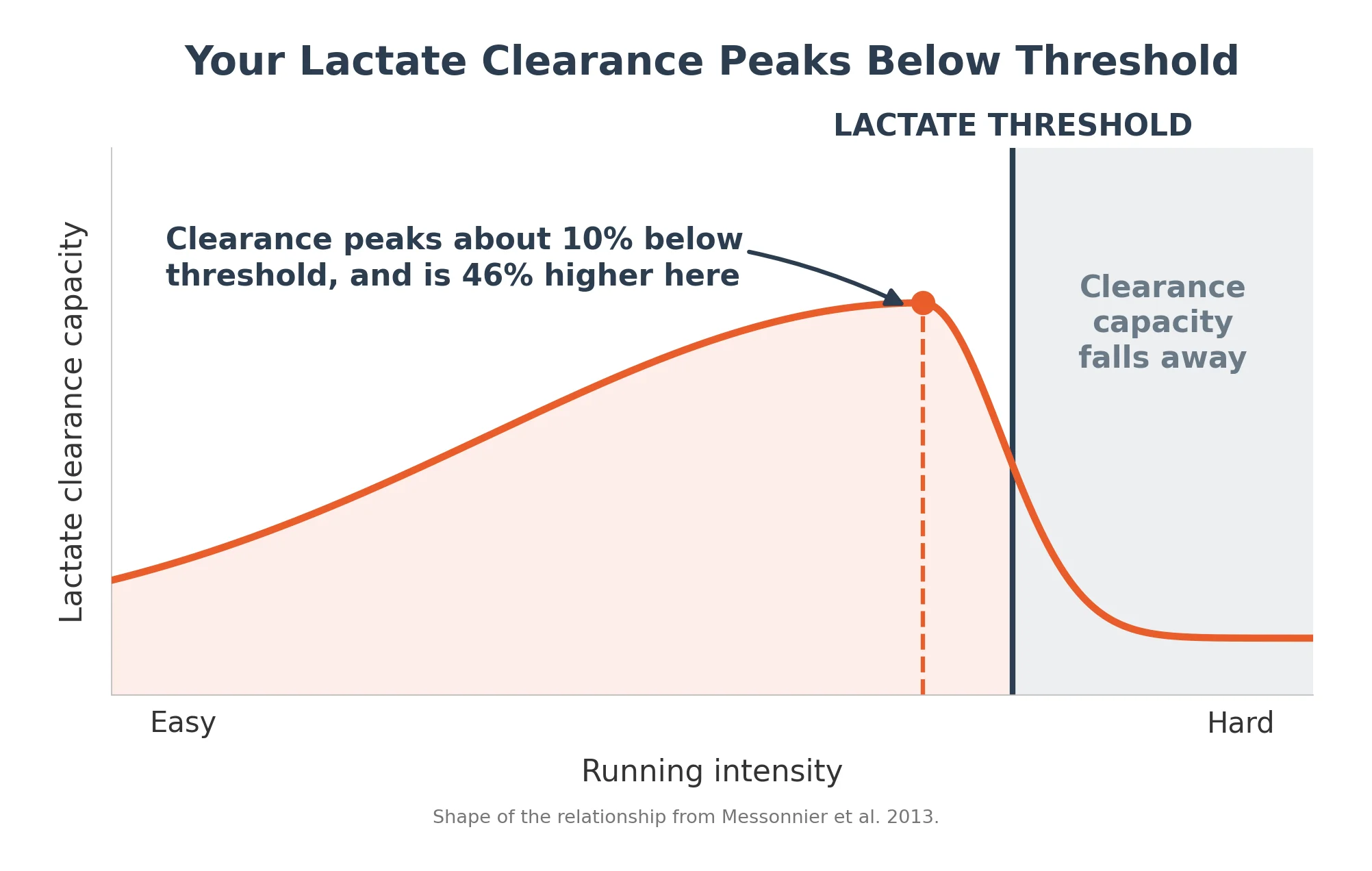
The 2013 lactate threshold study found that lactate clearance capacity reaches its peak at an intensity below the lactate threshold, and that the threshold itself corresponds to a limitation in clearance.
Your threshold is a measurement of the shuttle running at full capacity.
Elite distance runners give the clearest illustration of what a large shuttle capacity buys you.
Testing on ten top-level Kenyan marathon runners found they reached lactate threshold at roughly 90% of their maximal aerobic speed and raced the marathon at around 82% of it.
Maximal aerobic speed is the slowest running speed at which you reach your maximum oxygen uptake.
Their average maximum oxygen uptake was 64.9 ml per kilogram per minute, a figure plenty of well-trained club runners also record.
Testing on 53 high-level Ethiopian runners at altitude produced a similar picture from the other direction.
The Ethiopian men were still sitting at 2.5 mmol per liter of blood lactate while running 6:02 per mile (3:45 per kilometer), and doing it at altitude.
The elite advantage gets misreported at exactly this point.
A study of 75 competitive runners found that elite, national and everyday runners all hit lactate threshold at a similar percentage of their maximum oxygen uptake.
What separated the groups was the speed they could hold when they got there.
A 2026 analysis of 888 runners and cyclists reached the same conclusion from a much larger sample, finding that maximum oxygen uptake and running economy together accounted for around 95% of the differences in threshold speed.
The fraction of capacity a runner sustains contributed very little across that mixed group.
The number worth chasing is the speed you can hold at threshold rather than the percentage of your ceiling where threshold sits.
Which Workouts Train Your Body to Burn Lactate as Fuel?
Five sessions develop the machinery described above, and they work on different parts of it.
In one of the classic training studies, eight well-trained runners added a single 20-minute run per week at their 4 mmol lactate pace and raised their threshold speed over 14 weeks with no change in maximum oxygen uptake.
- The lactate clearance tempo. Run the first portion of a tempo at roughly 10k pace, then hold the remainder at marathon pace without stopping. For a 3:30 marathoner that looks like two sets of 3 miles, with the first 2 miles at 7:20 per mile (4:33 per kilometer) and the last mile at 8:00 per mile (4:58 per kilometer), with 3 minutes easy between sets. The fast portion floods the system with lactate and the moderate portion forces your oxidative fibers to burn it while you are still running.
- The alternating tempo. Alternate a kilometer slightly faster than threshold with a kilometer slightly slower, continuously, for 20 to 24 minutes of total work. The faster kilometers do the producing and the slower kilometers do the burning, and you never stop long enough for blood lactate to fall away.
- Straight threshold volume. Twenty to forty minutes at your threshold pace, or the same total broken into 8 to 12 minute repetitions with 60 to 90 seconds of easy jogging. Time spent at that intensity is the input that raised threshold speed in the study above, and one session per week is enough to move it.
- Easy aerobic volume. The capillary and mitochondrial work in the previous section comes disproportionately from steady, comfortable running. Runners who cut easy mileage to add another hard session usually shrink the delivery network their hard sessions depend on.
- Short, fast repetitions on top of your endurance work. A study of seven endurance-trained runners found that 18 sessions of near-maximal 5 to 15 second sprints over six weeks increased MCT1 protein without any change in MCT4. Six to eight 15-second hill sprints after an easy run twice a week is enough.
One detail applies across all five sessions.
A study of 17 well-trained men compared active and passive recovery between hard intervals and found blood lactate lower and blood pH higher after active recovery, with peak power in a following all-out effort about 7% higher.
Jog your recoveries, and keep running through the moderate portions of a clearance session.
Should You Try Canova’s Special Block?
The most demanding lactate session in distance running belongs to Italian coach Renato Canova, who set it out with Enrico Arcelli in the IAAF text Marathon Training: A Scientific Approach.
Canova called it a special block, and the structure is two hard sessions in the same day.
Canova writes these paces as a percentage of marathon race speed, so 90% of marathon pace is slower than marathon pace and 106% is faster.
Each session opens with 10 to 15 kilometers at 85 to 90% of marathon pace, and then adds a second fast component of similar length.
Three variants appear in his work, each built for a different athlete.
- The intensive variant. Maria Curatolo ran 10 kilometers at 90% of marathon pace followed by 10 kilometers at 106% of marathon pace in the morning. In the afternoon she ran 10 kilometers at 87% of marathon pace followed by 10 x 1000m at 111% of marathon pace, in the build-up to her European Championship silver.
- The extensive-intensive variant. Davide Milesi ran 10 kilometers at 89% of marathon pace followed by 15 kilometers at marathon pace, then repeated the same session in the afternoon.
- The extensive variant. Ornella Ferrara ran 24 kilometers at 99% of marathon pace in the morning and 24 kilometers at marathon pace in the afternoon before her 1995 World Championship bronze.
The second session is the point of the whole exercise, because it lands on legs already loaded by the morning.
Two things need saying plainly before you write one into your own plan.
- Canova never called this a lactate workout. He described the special block as a way to develop specific marathon quality. The physiological reading offered here is this article’s interpretation of what the session does.
- No controlled study has tested it. The special block, the double threshold day and every hard-then-moderate session belong to coaching practice rather than to trial evidence. The mechanisms underneath them are well evidenced, and the sessions built on top of those mechanisms are inference.
A scaled block that a 3:30 marathoner can absorb runs to about 14 miles across the two sessions.
- Morning: 3 miles at 8:55 per mile (5:32 per kilometer), then 5 x 1 kilometer at 7:35 per mile pace (4:43 per kilometer) with 2 minutes jogging between.
- Evening: 3 miles at 8:55 per mile (5:32 per kilometer), then 5 miles at 8:00 per mile (4:58 per kilometer).
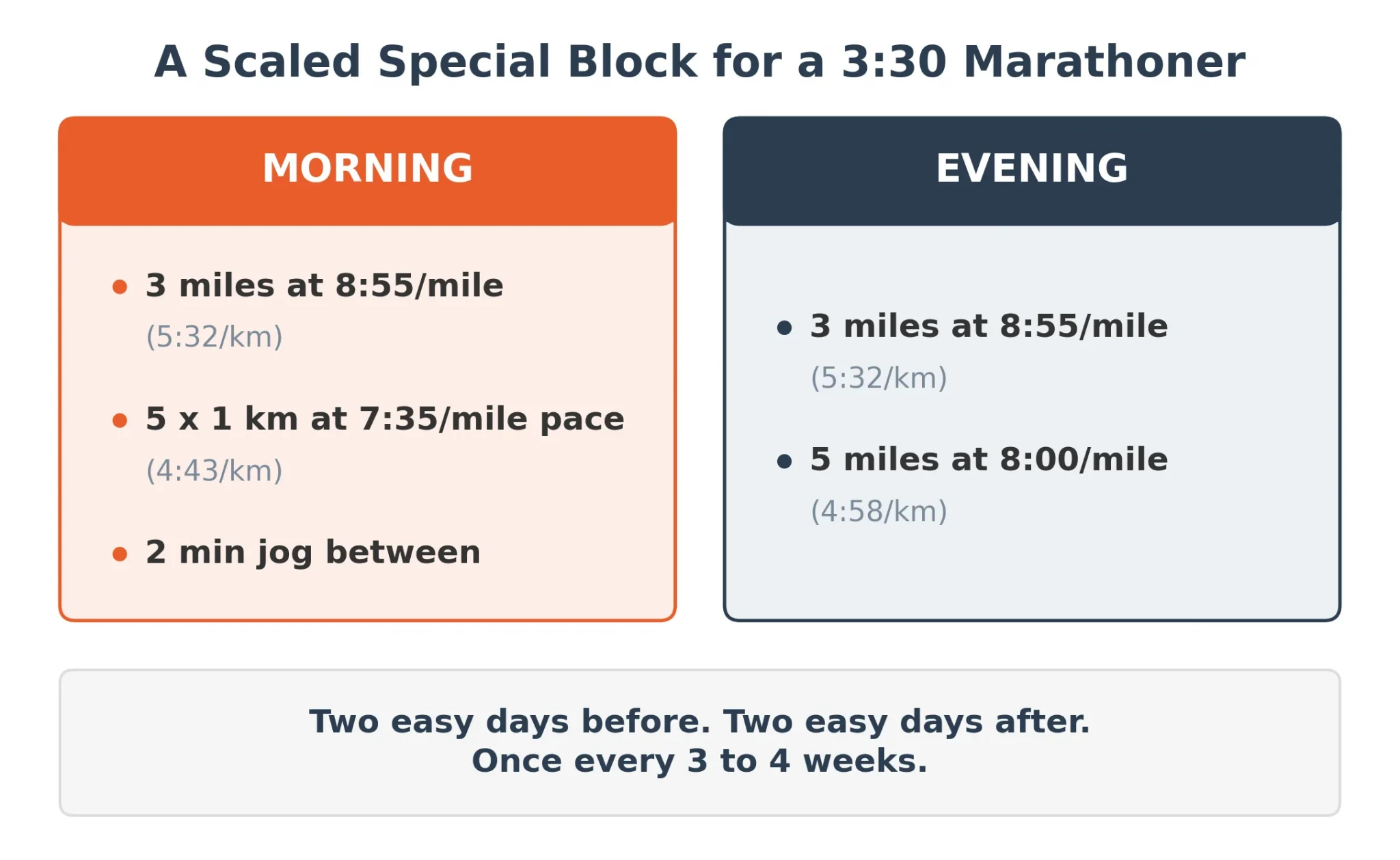
Take two genuinely easy days before it and two after, which is the recovery pattern Canova insisted on around his own blocks.
One block every three to four weeks during a marathon-specific phase is the realistic ceiling for a runner on 50 to 60 miles per week.
The more accessible relative of the special block is double threshold training, where both sessions sit at or just under threshold rather than above it.
A 2023 review of that model describes world-class runners holding blood lactate between 2 and 4.5 mmol per liter during those sessions and measuring it every one to three repetitions, and its authors state directly that no controlled study has tested the model’s effectiveness.
Why Do Lactate Workouts Backfire When You Run Them Too Hard?
The most common way to ruin one of these sessions is to run the moderate portion at the pace of the fast portion.
The 2013 lactate threshold study measured what happens on either side of threshold, and the result is the strongest argument for restraint in the whole literature.
Dropping the workload just 10% below lactate threshold raised the rate at which trained men cleared lactate by 46%.
Clearance capacity peaks below your threshold and falls away above it.
Running the recovery portion at threshold pace stops your muscles from doing the one thing the session was designed to train.
The operating rule RC gives every athlete applies directly here.
You can underrun a threshold workout and still collect most of the benefit, and running it too fast forfeits the benefit entirely.
Finish a clearance session feeling that one more repetition would have been possible.
Use a five-beat heart rate range around your threshold rather than a single number, because heat, sleep and caffeine move heart rate enough to turn a threshold session into an interval session on the wrong day.
Add One Lactate Clearance Tempo to Your Next Training Block
Your ability to burn lactate is trainable, and it responds to running that alternates between producing lactate quickly and burning it while you keep moving.
Start with the lactate clearance tempo once a week for four weeks, running the fast portion at 10k effort and the moderate portion at marathon effort.
Protect the easy running around it, because the capillary network built on those miles is what carries lactate to the fibers that burn it.
Keep the moderate portions honestly moderate, at marathon effort or a touch easier.
| Workout Type | Purpose | When To Use | Example |
|---|---|---|---|
| Threshold volume | Raises the speed you hold at lactate threshold, with one added 20-minute session per week enough to move it in 14 weeks | Every week, year round | 20 to 40 minutes at threshold, or 8 to 12 minute repetitions with 60 to 90 seconds jogging |
| Lactate clearance tempo | Trains you to burn lactate while still running hard, and clearance capacity rises 46% just below threshold | Once a week in a build phase | 2 x 3 miles, first 2 miles at 10k pace and the last at marathon pace, 3 minutes easy between |
| Easy aerobic running | Builds the capillary delivery network, which grows 13% with steady training against 7% with intervals | Most days of every week | The large majority of weekly mileage, run comfortably |
| Short hill sprints | Increases MCT1 transporter content, the protein that carries lactate into oxidative fibers | Twice a week after an easy run | Six to eight 15-second hill sprints with full recovery |
| Special block or double threshold day | Develops marathon-specific quality on fatigued legs, with no controlled trial behind either format | Marathon-specific phase only | Two sessions in one day, two easy days either side |