
A new pair of super shoes costs $250 to $280, and the foam that makes them fast lost most of the benefits by 280 miles (450 km).
If you’re like most runners I coach, you save them for race day and do your tempo runs, intervals and long runs in regular trainers.
But, what if there were a way to get some of the benefits from super shoes (the carbon plate) without the price tag?
That’s the advantage carbon fiber insoles promise. But is it supported in the research?
That’s what we’re going to dig into today, so you can learn…
- If a carbon plate insole has any performance benefit (and if so what and how much)
- Why an insole won’t give you the full 4% a super shoe does on race day
- Who insoles will work for and who they won’t
- How to break insoles in without overloading your calves and Achilles
What Part of a Super Shoe Can a Carbon Insole Copy?
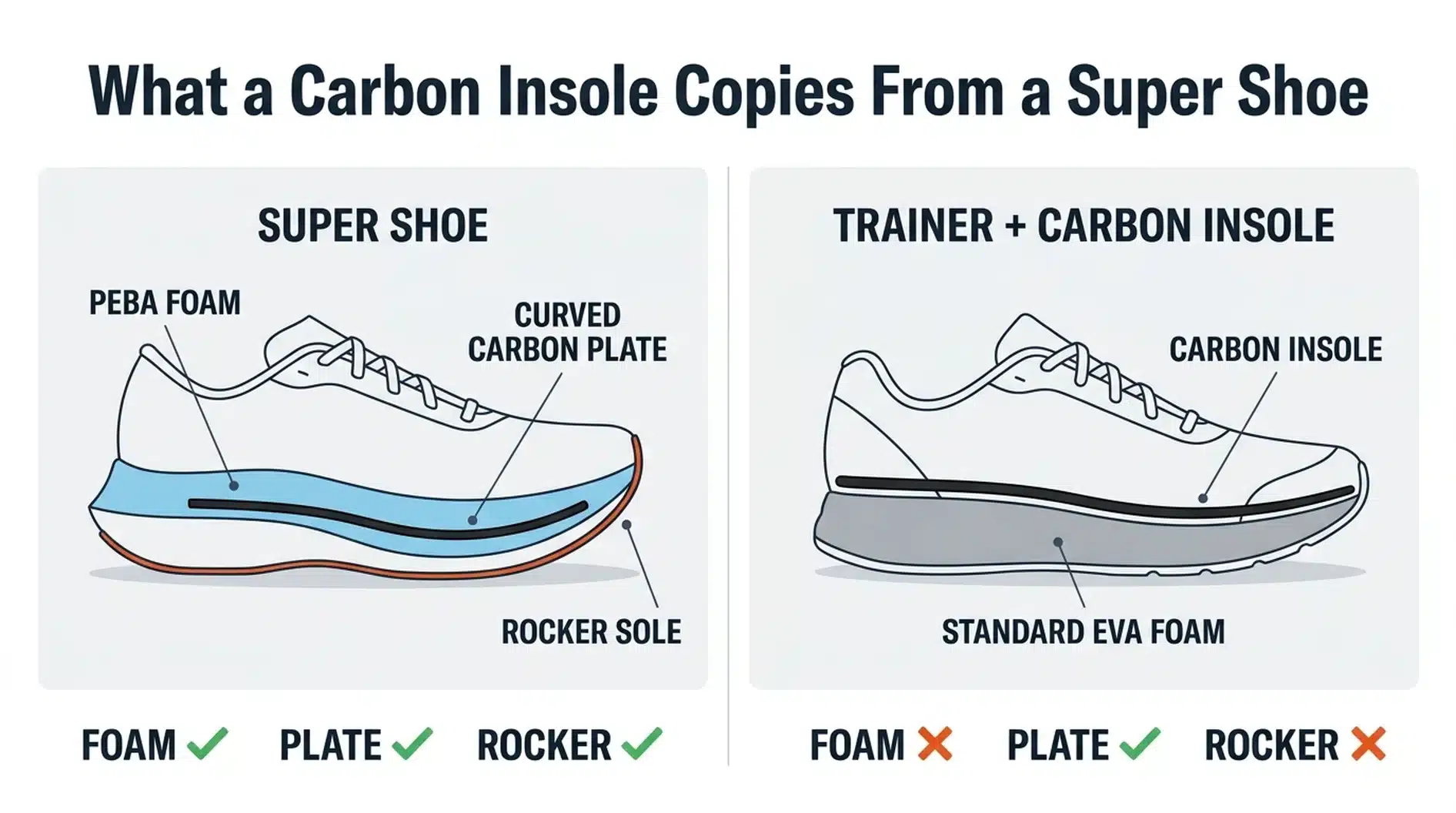
Super shoes help you race faster due to 3 design features working together.
- PEBA foam: a lighter, bouncier midsole foam that gives back more of the energy you put into it than the standard EVA foam in most trainers.
- A stiff carbon plate: a thin, rigid layer that stops your toes from bending as far when you push off.
- Rocker geometry: a tall sole that curves up at the front so your foot rolls forward through toe-off.
What Does a Carbon Plate Do?
When you push off, the joints at the base of your toes bend and absorb energy that your body isn’t able to use.
Carbon plates stiffen this area during your stride, so less of that energy is lost.
This was confirmed in a 2000 study that showed shoes with carbon plates reduced energy loss at those toe joints, and vertical jump height rose by 1.7 cm.
The plates in that study didn’t store and return extra energy, which points to less energy lost at the toe joints as the source of the benefit.
That means a carbon plate works mainly by limiting how far your toes bend, even though insole marketing often describes it as a spring.
Researchers measure this saving as running economy, which is how much energy you use to hold a given pace.
The shape of the plate matters as much as how stiff it is.
A 2022 analysis of 12 studies found that shoes with a curved carbon plate improved running economy by 3.45% compared with no plate, while flat plates produced no improvement.
How Much Does a Carbon Plate Help on Its Own?
Adding a carbon plate to a regular running shoe lowered the energy cost of running by a few percent in trained runners, at easy and fast paces alike.
A study published in Medicine and Science in Sports and Exercise found that adding a carbon plate cut the energy cost of running by up to 3.8% and made a 3000 m time trial about 5 seconds faster.

Those trained runners ran 10 km in 38 to 45 minutes, and the plate helped them at both 10:44/mi (6:40/km) and 7:26/mi (4:37/km).
The national-level runners in the same study, all under 34 minutes for 10 km, gained only at their fastest test pace of 5:41/mi (3:32/km).
Spread across a full 10K at the same rate, 5 seconds per 3000 m would come to roughly 17 seconds, although nobody has tested the plate over that distance.
Weight eats into that gain, because the same 2022 analysis found the benefit shrank to a small one when the stiff shoe weighed about 35 grams more than the flexible one.
That means you should pull out your shoe’s stock liner and put the carbon insole in its place, so the plate replaces weight instead of adding to it.
Stiffer insoles stop helping past a certain point.
A 2024 study of 2 experimental super shoes that differed in plate stiffness found the moderately stiff version cut energy cost by 1.98% compared with the stiffest version.
The stiffest version saved no more energy than a traditional running shoe without a plate.
Some insole brands sell several stiffness levels, and VKTRY assigns its Gold insole’s stiffness by body weight and sport, although no study has tested that sizing method.
When a brand offers several stiffness levels, pick a moderate one over the stiffest.
Why Won’t a Carbon Insole Match a Super Shoe on Race Day?
Most of the energy expenditure you save in a super shoe comes from its foam and sole shape, and a carbon insole can’t add either one to your regular trainer.
The original Nike-funded test of the Vaporfly prototype found it lowered the energy cost of running by about 4% in 18 high-level runners.
Researchers then tested how much of that 4% belonged to the plate alone.
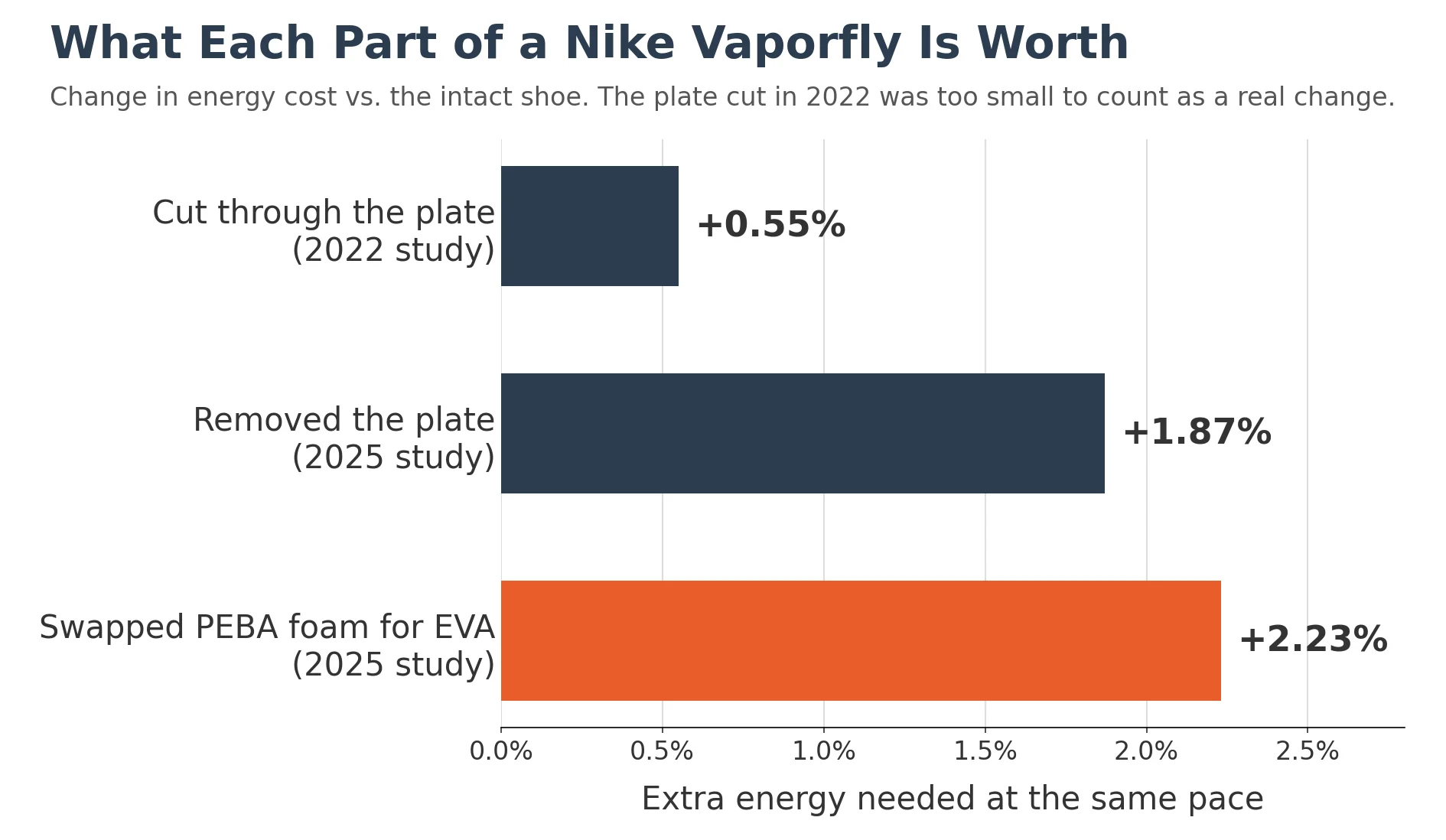
Researchers at the University of Massachusetts cut through the carbon plate of a Nike Vaporfly and found running economy got only 0.55% worse, a change too small to count as a real difference.
That means the plate’s stiffness explained only a small part of the Vaporfly’s advantage, and the researchers credited the foam and sole shape working with the plate for most of the saving.
A 2025 study that removed the Vaporfly plate entirely put the plate’s share higher, with energy cost rising 1.87% without it.
Swapping the PEBA foam for standard EVA foam in that study raised energy cost by 2.23%, so the foam still accounted for the bigger loss.
A meta-analysis in the Journal of Sport and Health Science pooled 48 studies and found that neither stiffness nor bouncy foam lowered oxygen use on its own, and only shoes that combined the two did.
That means a carbon insole in a standard trainer gives you the stiffness without the foam that the plate normally works with.
Trials that put carbon insoles in regular shoes and measured oxygen use have found no benefit so far.
A 2024 trial of 10 runners with an average 5K time of 18:37 compared a curved carbon insole with a rubber insole in the same lightweight racing shoe.
Oxygen use, blood lactate and 3 km time trial results were the same in both insoles.
The runners also rated the carbon insole less comfortable.
A 2023 trial in 15 moderately active men found no change in jump height, sprint distance or oxygen use with carbon insoles.
The same men reported feeling more propulsion and less fatigue in the carbon insoles, which shows how easily a stiff insole can feel faster than it measures.
Both trials were small, with 10 and 15 participants, so they can’t rule out a benefit for the runners who respond to stiffness.
Keep your super shoes for your goal race, because the foam carries most of their benefit and no insole can add it to your trainers.
Where Do Carbon Insoles Beat Super Shoes?
A carbon insole has 3 practical advantages over a super shoe, and all of them show up in training.
You Can Use One Pair of Carbon Insoles in Every Shoe
You can move the same insoles between your tempo shoe and your long-run trainer, as long as both shoes are the same size and have a removable liner.
That puts extra stiffness under your foot in the workouts where you do most of your training, instead of only on your 2 or 3 race days a year.
How Much Do Carbon Insoles Cost Compared With Super Shoes?
A full-length carbon insole costs $95 to $149, compared with $250 to $280 for the current super shoes from the major brands.
| Product | Type | Price |
|---|---|---|
| Nike Alphafly 4 | Super shoe | $280 |
| Nike Vaporfly 4 | Super shoe | $260 |
| Adidas Adios Pro 4 | Super shoe | $250 |
| VKTRY Gold | Full-length carbon insole, stiffness assigned by body weight | $149 |
Check that the plate runs under your toes before you choose an insole. A heel-and-arch cap won’t stiffen your forefoot the way the plates in these studies did.
Do Carbon Insoles Wear Out Like Super Shoe Foam?
Carbon fiber doesn’t compress the way midsole foam does.
That matters because the foam in a super shoe loses some of its benefit with mileage.
A 2024 study that tested super shoes new and after 450 km (280 miles) found the worn PEBA shoe cost runners about 2% more energy than the new one.
That 2% was enough to erase the worn shoe’s advantage over a plated racer made with standard EVA foam.
The evidence on foam wear is mixed, though.
A separate 2024 study found no link between mileage and running economy in runners’ own super shoes with up to 522 km (324 miles) on them.
The foam top layer of a carbon insole still wears.
No published study has measured how long the plate keeps its stiffness, so the durability advantage is a reasonable expectation that hasn’t been tested.
Which Runners Benefit Most From Carbon Insoles?
Your response to a stiffer forefoot is individual, and the group averages in most studies combine runners who use less energy with runners who use more.
Research on 96 runners found that about 30% used 2.7% less energy in a stiffer shoe, about 27% used 2.7% more, and the rest saw no change.
The runners who improved were the fitter runners in that group, with a higher top aerobic speed than the runners who used more energy.
That means fitter runners are the most likely to respond, and the research points to 2 groups who gain and 2 who don’t.
Do Carbon Insoles Help on Tempo Runs and Intervals?
The 2022 analysis of 12 studies found stiffness improved running economy more at higher speeds, which matches how super shoe benefits shrink at slower paces.
Speed alone doesn’t guarantee a response.
The runners in the 2024 insole trial averaged 18:37 for 5K and still saw no benefit from the carbon insole.
Use your insoles for tempo runs, intervals and race-pace work first, since those are the paces where stiffness has the best chance to help.
Should Older Runners Who Land on Their Heels Use Carbon Insoles?
A 2023 study of 9 runners over 60 who land heel first found flat carbon inserts didn’t change running economy at any of 3 stiffness levels.
Stiffer inserts in that study also raised the peak force your foot puts through the ground with each step, so a carbon insole is a poor match if you’re over 60 and land heel first.
Should You Use Carbon Insoles on Trail Climbs?
A 2025 study of 10 amateur trail runners found that a carbon plate raised energy cost by 2% on uphill running, so leave the insoles out of your trail shoes.
Do Carbon Insoles Put More Strain on Your Calves and Achilles?
A stiffer forefoot moves the point you push off from further toward your toes, which gives your ankle a longer lever to work against than a flexible shoe does.
A 2014 study that fitted runners with carbon insoles 1.9 mm and 3.2 mm thick found both insoles shifted that lever forward, with the biggest shifts at the foot and ankle.
The runners in that study split into 2 groups, with some producing more force at the ankle and others spending longer on push-off to handle the longer lever.
Higher force at the ankle means more work for the calf and Achilles, the muscle and tendon that power push-off.
The 2023 study of 30 young men measured less than 1% more calf and shin muscle activity in the carbon insoles, and the men rated them less comfortable than the standard insole.
Nobody has tested whether carbon insoles prevent running injuries.
Brands market carbon insoles for problems like plantar fasciitis and shin splints, and the one randomized trial in plantar fasciitis gives that claim only partial support.
A 2024 trial funded by VKTRY found carbon insoles reduced plantar fasciitis pain by week 6.
A basic polyethylene insole in the same trial reduced pain by week 2, so the carbon insole showed no advantage over a basic one.
Treat a carbon insole as a new training load for your calves and Achilles, and build into it over 3 to 4 weeks.
How Should You Start Using Carbon Insoles and Test Whether They Work?
Ease into carbon insoles over 3 to 4 weeks, then run a simple heart rate test to see whether your stride responds to the extra stiffness.
Sports medicine doctors who reported 5 bone stress injuries in the foot among runners wearing carbon-plated shoes recommend a gradual transition into stiff footwear.
Build in over the first month in 4 steps:
- Replace the stock liner: Take out your shoe’s original liner, put the carbon insole in its place, and check for heel slip and toe room on a short easy run.
- Weeks 1 and 2: Wear the insoles for 1 or 2 faster workouts a week, and keep your easy runs in your usual setup.
- Weeks 3 and 4: Add them to one long run a week if your calves and Achilles feel normal the morning after your workouts.
- Back off: Return to your stock liner for a few runs if calf or Achilles soreness lasts longer than 48 hours.
Once the insoles feel normal, compare your heart rate at a fixed pace with and without them:
- Run the same flat loop or treadmill setting at your marathon pace for 10 to 15 minutes.
- Alternate days with and without the insoles until you have 3 runs in each.
- Compare your average heart rate over the final 5 minutes of each run.
A heart rate that’s 3 or more beats per minute lower with the insoles on every comparison suggests your stride responds to the stiffness.
Feeling faster can still help you push through a hard workout, although the 2023 trial in moderately active men showed that feeling and measured energy use can disagree.
RunnersConnect Bonus
Struggling with Achilles Tendonitis or Retrocalcaneal bursitis? Download our Achilles Injury Prevention Routine.
It’s a PDF with images and descriptions of the 10 most effective prevention and rehab exercises for runners with Achilles issues.
So Should You Use Carbon Insoles or Super Shoes?
A carbon insole gives you the stiff plate of a super shoe in any trainer you own, at about half the price of a new pair of racers.
Stiffness alone saved energy for about 30% of runners in the largest study, and fitter runners were the most likely to respond, but the foam in a super shoe carries most of its race-day advantage.
Here’s a chart on when to use each one:
| Situation | Best choice | Why |
|---|---|---|
| Goal race on the road | Super shoe | Foam and plate together save the most energy |
| Tempo runs and intervals in trainers | Carbon insole | Stiffness helps most at faster paces |
| Field or court sports | Carbon insole | Small gain in jumping power |
| Easy runs in your first 2 weeks | Your usual liner | Gives your calves time to adapt to the stiffness |
| Trail climbs | Your usual liner | A plate raised uphill energy cost by 2% |
| Over 60 and landing heel first | Your usual liner | No economy gain and higher peak ground force |