

You’ve probably noticed it at your local running store: that wall of colorful shoes with promises of better performance, injury prevention, and revolutionary technology.
But here’s what the sales associate probably didn’t tell you: the biggest breakthrough in running shoe research has nothing to do with the latest foam compound or carbon plate design.
Instead, researchers studying 264 recreational runners for 22 weeks discovered something that could cut your injury risk nearly in half and extend your shoe life by up to 60%.
The secret is buying multiple shoes and rotating them strategically.
In this article I’ll show you exactly how to put this research-backed strategy to work in your own training.
You’ll see why your shoes need recovery time just like your muscles do, how different shoe characteristics create beneficial training adaptations, and the specific rotation protocols that lower your injury risk while improving performance.
Here’s what we’ll cover:
- The research showing how shoe rotation affects your biomechanics and why variety builds strength.
- The science of foam recovery and why your shoes are still “tired” 24 hours after your last run.
- How to build your own rotation, matching specific shoe types to different training purposes.
- A practical 30-day plan that takes you from single-shoe runner to strategic rotator.
By the end, you’ll know which shoes to buy, when to wear them, and how to track their performance, so your shoe closet works as a training tool instead of an expensive collection.
Why Your Feet (and Your Training) Need Variety
The biomechanical rationale goes deeper than shoe longevity.
Different shoes create subtle variations in ground contact patterns, proprioceptive feedback, muscle activation sequences, and joint loading.
A landmark study published in the Scandinavian Journal of Medicine & Science in Sports [1] tracked 264 recreational runners for 22 weeks.
The research revealed that multiple-shoe users averaged 3.6 different pairs during the study period, while single-shoe runners did 91% of their mileage in the same pair.
The Adaptation Principle Applied to Footwear
Your body adapts to repetitive stress patterns.
When you run thousands of steps in identical shoes, you’re creating the same biomechanical demands over and over.
Multiple studies [2] demonstrate that different heel-to-toe drops, midsole densities, and outsole patterns alter joint angles and muscle recruitment patterns.
This variation challenges your neuromuscular system in ways that can strengthen stabilizing muscles and improve movement efficiency.
Why Your Shoes Need Rest Days Too
Think of your running shoes like a sponge.
Every time your foot hits the ground, the foam in your shoe gets squished down just like squeezing a sponge.
Research on EVA foam performance [3] shows that this “sponge” doesn’t bounce back to its original shape right away.
Your Shoes Are Still Tired the Next Morning
That foam needs about 24 hours to fully “unsquish” itself.
During your run, thousands of foot strikes compress those tiny air bubbles inside the foam, and they need time to refill and expand back to their original size.
A study examining what happens to shoes over time found that after 300 miles of running, the pressure on your foot doubled [4].
That’s like running on a shoe that’s only half as cushioned as when you bought it.
When your foam stays compressed, two things happen that hurt your running.
First, you lose that bouncy feeling that helps propel you forward, and research shows [5] that fresh foam gives you more energy return with each step.
Second, your legs have to work harder because they’re not getting the cushioning and support they expect.
RunnersConnect Bonus
Download your FREE Injury Assessment and Prediction Video now.
A good injury prevention program starts with assessing where you’re weak and where you might be tight or inhibited. In the video I’ll demonstrate the six mobility tests you need to perform to assess what you need to begin working on.
Building Your Shoe Rotation System
The gains from rotation come from pairing shoes with different drops, stack heights, and midsole densities, so each run loads your legs a little differently.
Effective rotation comes down to pairing complementary shoe types, not just owning several pairs.
The Foundation Shoe Categories
Daily Trainers: These workhorses should handle 60-80% of your weekly mileage.
Look for shoes with 8-12mm heel-to-toe drop and moderate cushioning (typically 25-35mm stack height).
Tempo/Workout Shoes: Designed for speed work and threshold runs.
These typically feature firmer midsoles and lower profiles (20-30mm stack) for better ground feel and responsiveness.
Long Run Shoes: Maximum cushioning platforms for your weekly long efforts.
Higher stack heights (35-45mm) provide enhanced impact protection during extended mileage.
Race Day Shoes: Performance-optimized designs often incorporating carbon plates or advanced foam compounds.
Reserve these for races and key workouts to preserve their performance characteristics.
Stack Height and Drop Variation Strategy
Research indicates that varying heel-to-toe drop affects Achilles tendon loading and calf muscle engagement [6].
A systematic review found that different drops create measurable changes in ankle joint mechanics and posterior chain muscle activation.
Start with shoes within a 4mm range of your preferred drop, then gradually introduce more variation as your body adapts.
How Many Shoes Do You Actually Need?
Budget-conscious runners can get rotation benefits with just 2 pairs.
Pair a cushioned daily trainer with a firmer tempo shoe.
Alternate between them every other day, allowing each shoe 48 hours of recovery time.
This simple rotation provides biomechanical variation while giving the foam enough time to recover.
The Optimal System: 3-4 Shoe Rotation
Serious recreational runners benefit from a 3 to 4 shoe system.
Runners using 3-4 different models experience the greatest injury reduction benefits [7].
The added variety gives you more loading options without overwhelming your body’s adaptation demands.
When More Becomes Counterproductive
Beyond 4 pairs, diminishing returns set in for most recreational runners.
Too much rotation can prevent proper adaptation to any single shoe’s characteristics.
Focus on quality over quantity, and choose shoes that serve distinct training purposes rather than collecting marginally different options.
Data-Driven Shoe Management
Smart rotation is also about knowing when to use which shoe and when to replace them.
Reading Your Shoes Like a Book
Your shoes tell the story of how you run, and learning to “read” them can prevent injuries and save money.
Flip your shoes over and look at the bottom.
Normal wear pattern: The wear should be fairly even across the heel and forefoot, with maybe slightly more wear on the outer edge of the heel where you first land.
Red flag patterns: If you see heavy wear on just the inside edge of your heel, or if the outside edge of your forefoot is getting chewed up much faster than the rest of the shoe, your running form might be putting extra stress on certain parts of your body.
When to worry: If your shoes show extreme wear patterns after just 100-150 miles, or if one shoe wears completely differently than the other, consider getting your running form analyzed by a specialty running store or physical therapist.
Mileage Tracking Strategies
Digital platforms like Strava, Garmin Connect, or dedicated apps can track shoe mileage automatically.
For analog tracking, keep a simple log noting distance and shoe model for each run.
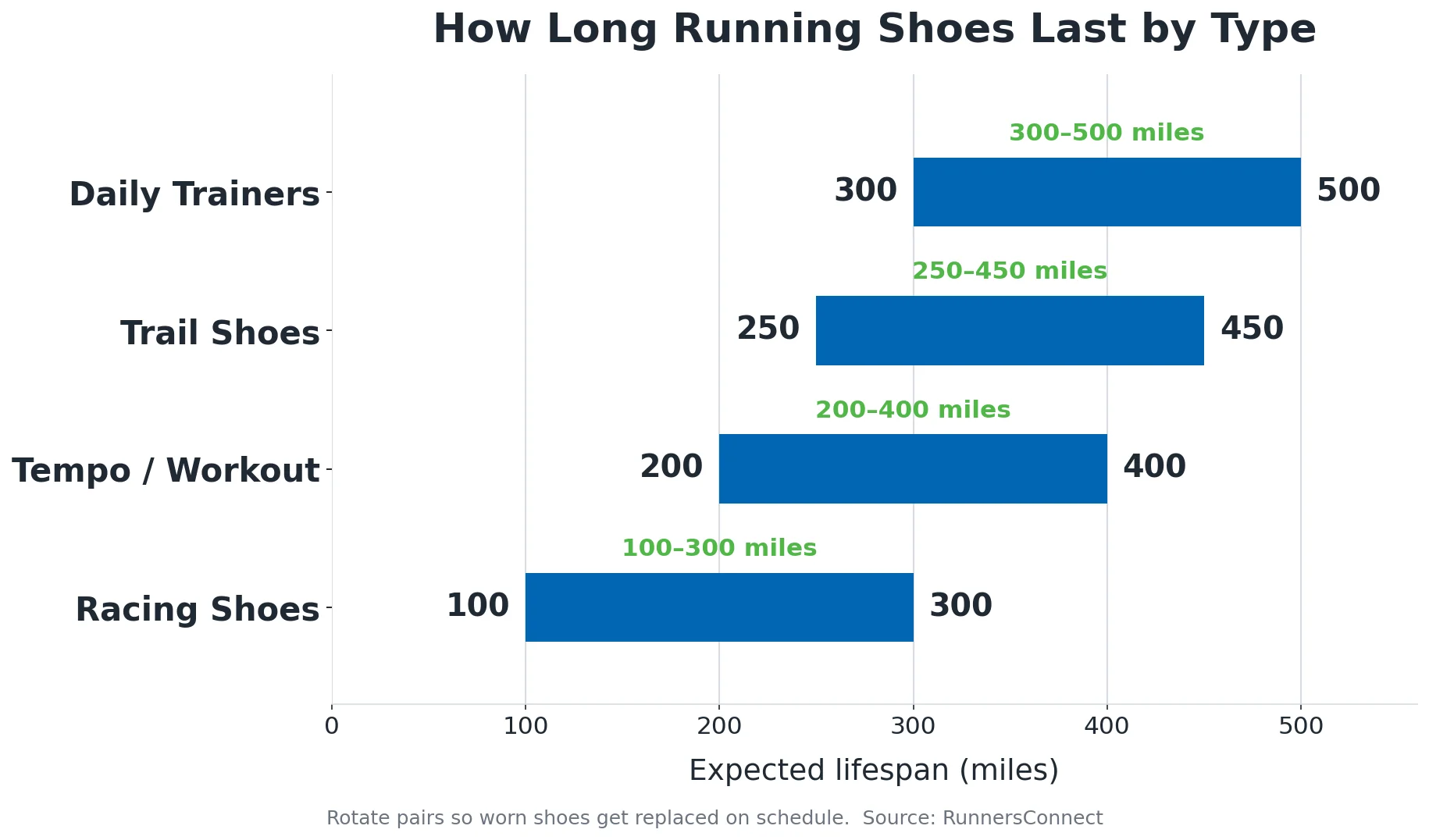
Expected lifespan varies by category:
- Daily trainers: 300-500 miles
- Tempo shoes: 200-400 miles
- Racing flats: 100-300 miles
- Trail shoes: 250-450 miles (depending on terrain)
Performance Drop-Off Indicators
Subjective markers include increased post-run soreness, decreased comfort during runs, or visible midsole compression.
Objective measures involve monitoring your perceived exertion at standard paces.
If effort increases at familiar speeds, consider shoe condition as a contributing factor.
Common Rotation Mistakes to Avoid
Most runners approach shoe rotation in ways that limit the benefits.
The “Same Brand, Same Model” Trap
Buying multiple pairs of identical shoes provides no biomechanical variation.
Even different colorways of the same model offer negligible rotation benefits.
Choose shoes with different characteristics, varying drops, stack heights, or midsole compositions.
The Minimalist Shoe Integration Error
Adding low-drop or minimalist shoes requires gradual integration.
Start with 10-15% of weekly mileage in minimalist options, increasing by 5% weekly.
Sudden integration often leads to Achilles tendon irritation or calf strain.
Racing Shoe Overuse
Carbon-plated racing shoes aren’t designed for daily training.
Their aggressive geometries and firm ride can increase injury risk during easy runs.
Reserve performance shoes for races and specific workouts, typically 5-10% of total mileage.
Your 30-Day Shoe Rotation Implementation Plan
Transform your approach systematically rather than making drastic changes.
Week 1-2: Assessment and Baseline
Document your current shoe inventory, noting mileage and condition.
Photograph wear patterns on existing shoes.
Track subjective comfort ratings and any recurring aches or pains.
Week 3-4: Strategic Additions
Based on your assessment, identify rotation gaps.
If you only own neutral trainers, consider adding a lightweight tempo option.
Introduce new shoes gradually, starting with one run per week in each new pair.
Monitor your body’s response to different shoe characteristics.
The Bottom Line on Shoe Rotation
The research supports shoe rotation as an injury prevention strategy.
The 39% injury reduction found in multiple studies represents significant protection for recreational runners.
Combined with the practical benefits of extended shoe life and improved training variety, rotation gives you clear advantages.
Minimum viable strategy: Alternate between two complementary pairs, allowing 24-48 hours between uses of the same shoe.
Optimal approach: Develop a 3 to 4 shoe rotation matching specific training purposes, from daily trainers and tempo shoes to long run and race day options.
Implementation timeline: Introduce changes gradually over 4-6 weeks, monitoring your body’s adaptation to new biomechanical patterns.
Start with your current favorite shoe as the foundation, then add complementary options that serve distinct training purposes.
Your feet, your training, and your wallet will thank you for this evidence-based approach to shoe management.