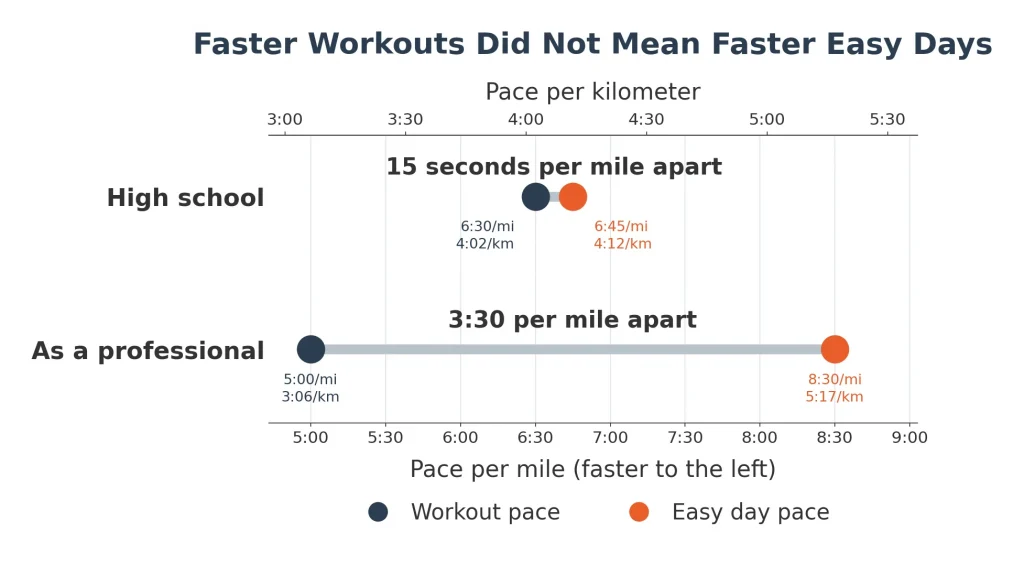
Two runners can share the same VO2 max and the same lactate threshold, then finish minutes apart over a half marathon.
The gap between them is usually running economy.
Running economy is how much energy you burn to hold a given pace, and it separates runners who look identical on a lab test but race very differently.
Your VO2 max sets your ceiling. Your running economy decides how much of that ceiling you actually spend to run 8:00/mi (4:58/km).
The good news is that economy is one of the most trainable parts of your fitness. Before you can improve it, you need to know what actually determines it.
Here’s what you’ll learn:
- What running economy is and how labs measure it
- The physiological, biomechanical, and body-composition factors that determine it
- How much your body weight really affects the energy cost of running
- Which changes deliver the biggest economy gains for everyday runners
What is running economy, and how is it measured?
Running economy is the amount of oxygen you consume to run at a steady, submaximal pace.
Two runners at the same speed can have very different oxygen demands. The one who uses less oxygen for that pace is the more economical runner.
A 2015 review of running economy reports that a distance runner has to improve running economy by roughly 2.2 to 2.6% before a coach can be confident the change is real.

Labs measure economy by having you run at a fixed submaximal speed while a mask collects your expired air.
The result is usually expressed as oxygen cost, or converted to an energy cost of about 1 kcal per kilogram of body weight per kilometer.
A more economical runner spends less energy to hold race pace, which leaves more for the finish.
What determines your running economy?
Running economy is the sum of several systems working together.
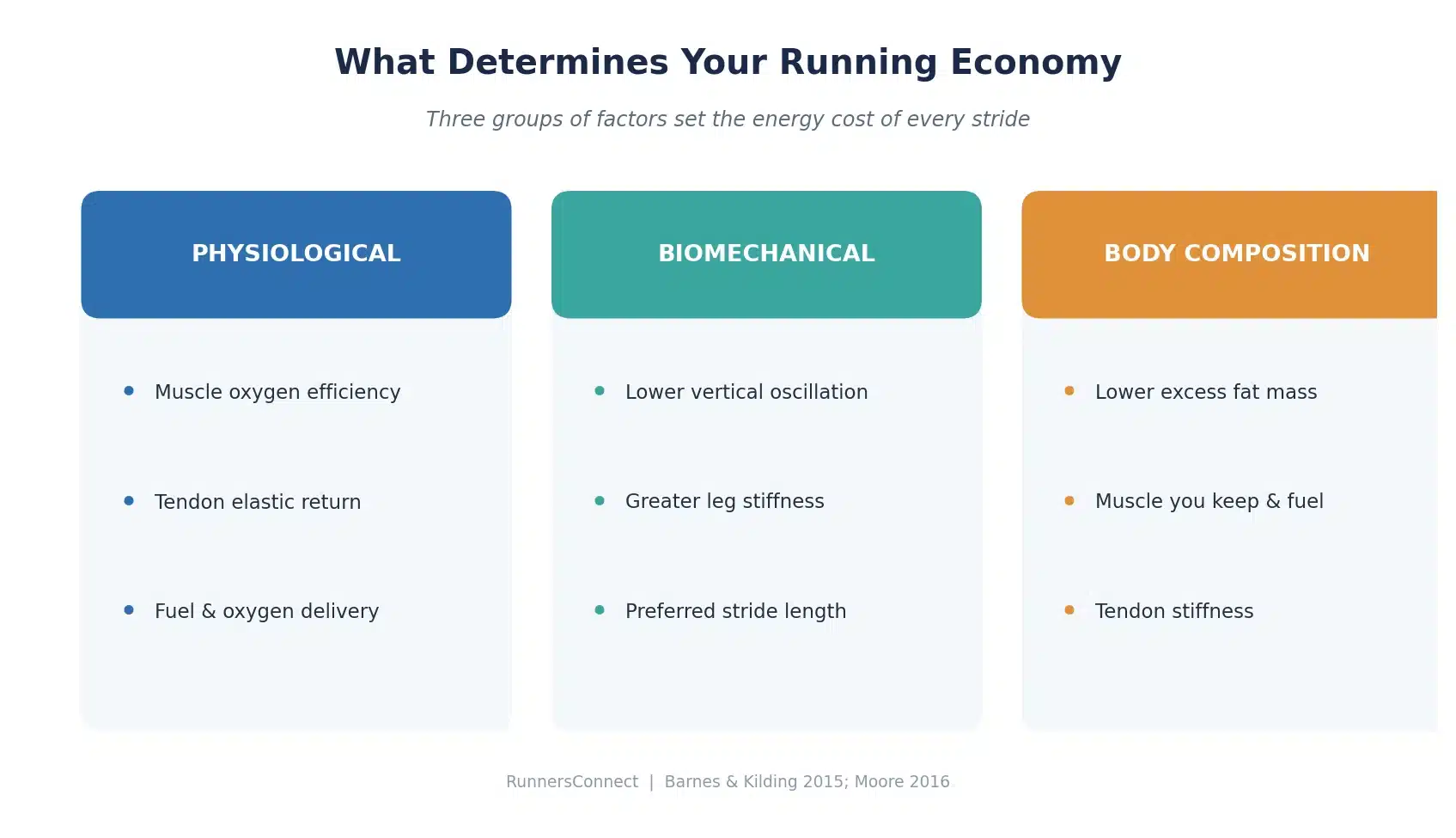
The same 2015 review groups the determining factors into physiological, biomechanical, and structural categories, and no single one explains economy on its own.
Physiological factors. How efficiently your muscles use oxygen, how much elastic energy your tendons return, and how well your cardiovascular system delivers fuel all shape the cost of each stride.
Biomechanical factors. Stride length, vertical bounce, ground contact time, and how your leg absorbs and returns force change how much energy leaks with every step.
Structural and body-composition factors. Your body mass, the distribution of that mass, and tendon stiffness set the mechanical demand your muscles have to meet.
Because economy has several inputs, improving it comes from small gains across many of them rather than any single change.
How much does body weight affect running economy?
Body weight changes the absolute energy you burn, but the picture is more nuanced than heavier equals less economical.
Energy cost is usually scaled to body mass, expressed per kilogram. On that mass-specific basis, heavier runners are not automatically less economical than lighter ones.
What matters more for most runners is body composition, especially the ratio of fat mass to the muscle doing the work.
Researchers tracking amateur athletes for 12 months found that reducing fat mass through targeted diet and training lowered the energy cost of running.
Fat mass is weight your muscles have to move without contributing any force to move it.
Shedding excess fat while keeping muscle lowers the load per stride, which is why economy tends to improve per kilogram of fat lost.
The trap is chasing weight so aggressively that you lose muscle or under-fuel your training.
An under-fueled runner runs worse, recovers slower, and gets injured more often, which erases any economy gain from a lower number on the scale.
Get Your Ideal Weight Calculator
Based on your height, gender and body fat, researchers have developed a formula to determine what your “ideal running weight is“.
So, with just a few simple inputs, this calculator helps determine your ideal weight and how much over or under this ideal you are.
Which biomechanical factors improve running economy?
Your stride mechanics decide how much energy escapes as wasted motion instead of forward propulsion.
A 2016 review of running technique links better economy to a preferred stride length, lower vertical oscillation, greater leg stiffness, and lightweight footwear.
Vertical oscillation is how much you bounce up and down with each stride.
Every inch you travel upward is energy spent lifting your body instead of moving it toward the finish line, so reducing excess bounce improves economy. You can train this directly by working on your vertical oscillation.
Leg stiffness sounds like a flaw, but a stiffer, springier leg stores and returns more elastic energy at ground contact.
That elastic return is free propulsion your muscles do not have to generate, which lowers the oxygen cost of the stride.
Trying to force a stride length or foot strike that isn’t yours tends to hurt economy. Your self-selected stride is usually close to optimal.
Does strength training improve running economy?
Adding heavy and explosive strength work is one of the most reliable ways to improve running economy.
A 2018 systematic review found that strength training improved running economy by 2 to 8%.
Strength training makes your muscles and tendons better at producing and returning force.
A leg that can generate the same push with less effort spends less oxygen at your usual pace, which is exactly what better economy means.
The economy benefit comes from heavy lifting and explosive plyometrics done for low reps.
Two to three short sessions a week of heavy compound lifts and jumping drills is enough to shift economy over a training block.
How do you actually improve your running economy?
The biggest economy gains come from stacking several small improvements rather than hunting for one breakthrough.
Consistent mileage teaches your muscles to use oxygen more efficiently, and it is the base every other gain sits on.
Heavy strength training and plyometrics build the force and elastic return that lower the cost of each stride.
Reducing excess fat mass while fueling your training lowers the load you carry without sacrificing the muscle that moves you.
Running drills and strides sharpen the mechanics that reduce wasted vertical motion.
For the full session-by-session breakdown of these methods, see our guide to improving your running economy.
Stack consistent mileage, heavy strength work, plyometrics, and smart body composition, and economy improves as a byproduct.
Conclusion
Running economy is what lets one runner outrace another with identical lab numbers.
It is determined by how efficiently your muscles use oxygen, how your stride mechanics move you forward, and how much dead weight you carry.
None of those factors is fixed. Mileage, strength work, plyometrics, and body composition all move the needle.
Improve a handful of them at once, and you will run the same pace at a lower cost, then hold it longer when the race gets hard.