

A survey of 1,145 UK park runners found that 570 of them were dealing with some type of injury during the run itself.
From minor tweaks to gait-altering injuries, more than half the runners were making one of the major mistakes physical therapists see most injured runners do.
Most of the other major mistakes sound sensible: rest the injury completely, stretch before you run, roll out the calf that keeps going tight.
But, these are largely based on myths and running-specific physical therapists wish runners would stop doing them.
So, in this article we’re going to…
- Detail the 9 mistakes physical therapists see runners make the most
- What the research says about each
- And how to change your approach and what to do differently
1. Running Until the Pain Changes Your Stride
Running through pain that alters your stride is the fastest way to turn one injury into two.
When you limp to compensate for an existing injury, you shift impact, loading, and force to another area of the body that isn’t designed to handle that extra work.
The moment your stride changes to protect something, the run is over and you walk home.
Most runners keep going because they cannot tell soreness from damage.
Delayed onset muscle soreness is dull, spreads across a whole muscle group, shows up on both legs, and eases as you warm up.
Injury pain is sharp, sits in a spot you can cover with one fingertip, usually shows up on one side only, and gets worse the longer you run.
How to Decide Whether to Start Today’s Run
Run three checks before you head out the door.
- Press the sore area with one finger. A single point that makes you flinch, especially over bone, means skip the run and book an appointment.
- Hop 10 times on the sore leg. Pain on landing that you do not feel on the other leg points to bone or joint involvement.
- Run the first 10 minutes at conversational effort. Pain that fades as you warm up is usually safe to continue, and pain that climbs means you stop.
The stride rule overrides all three checks: if your gait changes at any point, the run ends there.
2. Calling Total Rest a Rehab Plan
Taking two full weeks off and expecting the tissue to be stronger when you come back is the most common rehab mistake in running.
Tendon, muscle, and bone build capacity in response to load.
Remove the load entirely and you limit the body’s ability to adapt and when you return to running your muscles, tendons and bones are less capable of handling your old mileage.
This has been tested directly in runners.
Researchers randomized 38 people with Achilles tendinopathy into two groups.
One group kept running and jumping throughout, held to a pain rule, and the other stopped all tendon-loading activity for the first six weeks.
Both groups tracked Achilles pain, stiffness, and how much running the tendon tolerates and given a score from 0 to 100. Both groups started at a score of 57.
Twelve months later the runners who never stopped scored 85 and the rest group scored 91, with no difference between them in how quickly they recovered.
Six weeks of no running cost those patients six weeks of training and bought them no faster recovery.
How to Keep Loading an Injured Tendon Without Making It Worse
That trial used a pain-monitoring rule you can apply to most soft-tissue injuries.
- Pain during the activity can reach 5 out of 10. Below that line, keep going. Above it, cut the session short.
- Pain must settle by the next morning. Soreness still elevated 24 hours later means the load was too high.
- Pain must not climb week to week. A stable or falling weekly pain score means the progression is working.
Confirmed bone stress injuries are the exception, and they need protected weight bearing under a doctor’s supervision before any loading progression starts.
3. Treating Only the Spot That Hurts
When your calf hurts, massaging your calf feels like the obvious move.
But the area where you feel the pain isn’t often where the injury originated. The weak link causing the injury is often higher up, at your hip or your trunk.
As an example, weakness in the gluteus medius, the muscle on the outside of your hip that keeps your pelvis level, lets your pelvis drop a little with every stride.
That drop tilts your knee inward and drives extra load down into your shin, your arch, and the outside of your knee.
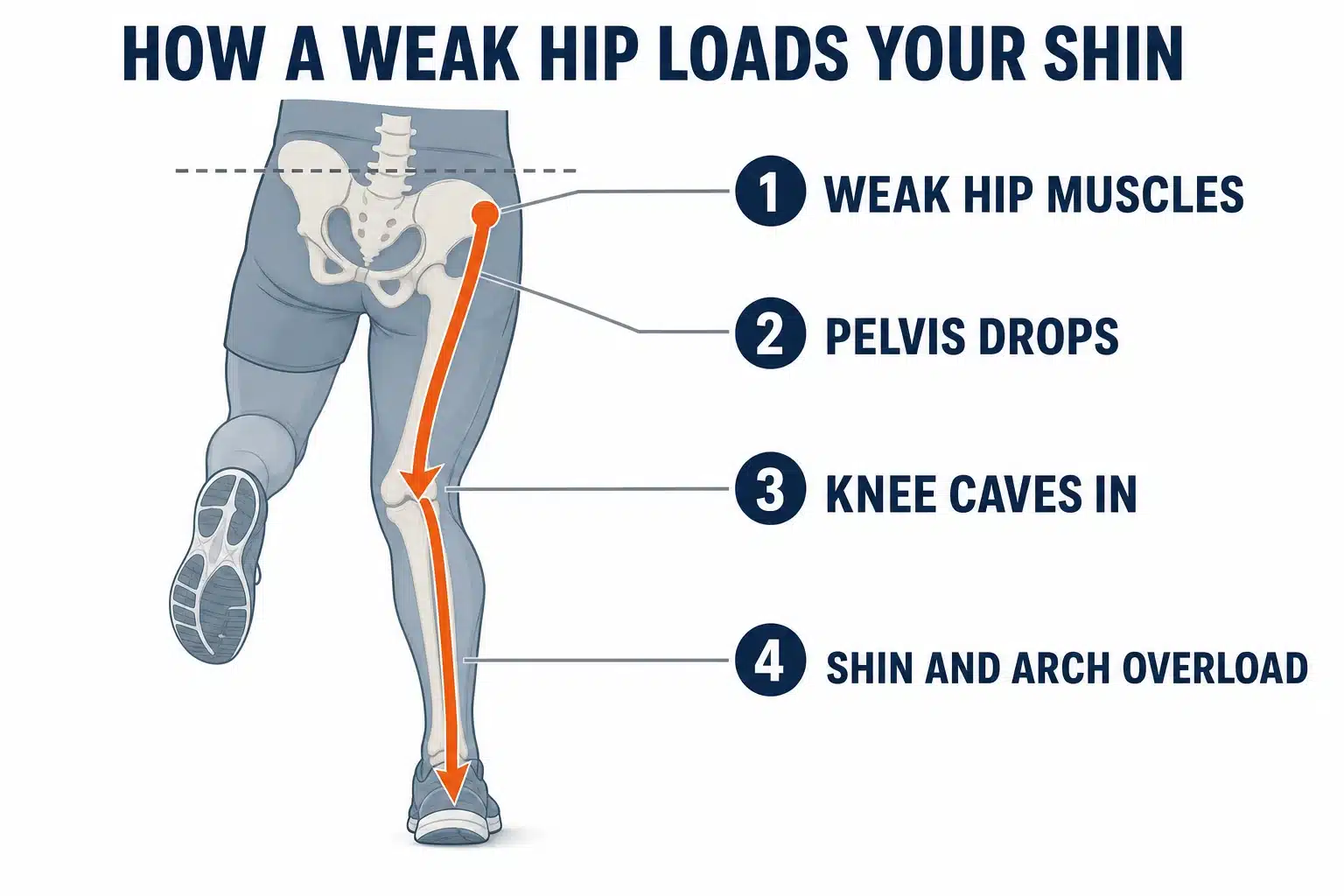
That’s why you need to treat the source of the injury, not just where it hurts.
Researchers have even tested this theory.
A 24-week trial split 325 runners suffering from lower leg injuries into two rehab groups: one that performed a hip and core strength training program and a another just a foot and ankle program.
The hip and core program cut the weekly rate of overuse injuries by 39%. The foot and ankle program produced no reduction at all.

The hip and core group also had 52% fewer of the serious injuries that stop you training altogether.
That means roughly 4 out of 10 of the niggles that would normally interrupt your training week never happen when the strength work goes to the hips and trunk.
How to Find the Link That Is Actually Failing
Three tests will show you where the control is missing, and you only need a mirror.
- Single-leg squat, facing a mirror. Watch whether the knee drifts inward or the opposite hip drops. Compare left to right.
- Single-leg calf raises to failure. A difference of more than three or four reps between legs is a target worth working on.
- Side plank hold, both sides. A gap of more than 15 seconds points to trunk control that stops holding your pelvis level under fatigue.
Load the weaker side twice a week with single-leg deadlifts, step-downs, split squats, and loaded side-lying hip abduction.
If you only run one of these tests, make it the single-leg squat, because the hip drop it exposes is behind most of the trouble on this list.
4. Doing the Same Three Rehab Exercises at the Same Weight for Months
Clamshells with a red band, glute bridges, and a 30-second calf stretch feel like rehab, and for the first week or two they are.
After that, they stop doing anything, because running already gives your legs thousands of light contractions every session.
More light work adds almost nothing your running is not already providing.
What running never provides is heavy loading, and heavy loading is where you actually make positive gains in strengthening an area.
A meta-analysis of six trials covering 7,738 athletes found that strength training cut injury risk by roughly a third.
That means for every three injuries among the athletes who skipped the weights, the athletes who lifted had one.
Every 10% you add to your strength training volume cuts your injury risk by another 4 percentage points, and the researchers never found a ceiling.
How to Progress a Rehab Exercise Every Single Week
Move each exercise up one rung whenever you can finish all your sets with two reps left in the tank.
- Rung 1: both legs, bodyweight, controlled tempo
- Rung 2: both legs, bodyweight, three-second lowering phase
- Rung 3: single leg, bodyweight
- Rung 4: single leg with dumbbells or a loaded backpack
- Rung 5: single leg, heavy, 4 to 6 reps where the last rep is genuinely hard
Two sessions a week is the minimum that produced results in the research.
Put those sessions on your hard running days so your easy days stay easy.
5. Using Stretching as Your Injury Prevention Plan
Most runners were taught that tight muscles cause injuries and that stretching prevents them.
Researchers have now tested that claim across tens of thousands of athletes, and it does not hold up.
A meta-analysis of 25 trials covering 26,610 participants and 3,464 injuries found that stretching programs produced no measurable reduction in injury rates.
The same analysis found strength training cut injuries to less than a third, and balance work roughly cut them in half.
That means the ten minutes you spend holding stretches before a run go to the one intervention on the list with no measurable payoff.
Stretching still has a place.
It improves range of motion, it feels good on a stiff hip, and no evidence suggests it causes harm.
It just should not be the thing standing between you and your next injury.
How to Spend Your Ten Minutes Before a Run
Replace the static holds with a warm-up that raises tissue temperature and rehearses the movement you are about to do.
- Walk or jog easy for 3 to 4 minutes. Raising muscle temperature is the part of a warm-up that actually does the work.
- Do 5 to 6 minutes of dynamic work. Leg swings front to back and side to side, walking lunges, A-skips, and high knees.
- Finish with 4 strides of 20 seconds. Build to roughly 5k effort and float back down.
Save the long static holds for after the run or for a separate mobility session on an easy day.
If the full routine is too much before an easy run, keep the 3 to 4 minutes of easy jogging and drop the rest.
6. Taking Ibuprofen Before a Run or a Race
Enough runners take a pre-race ibuprofen that researchers were able to study it in the middle of an actual ultramarathon.
Running already pulls blood flow away from your kidneys, and dehydration pulls it down further.
Ibuprofen blocks prostaglandins, the compounds that keep the blood vessels feeding your kidneys open under exactly that kind of stress.
In a placebo-controlled trial of 89 ultramarathon runners, 52% of those taking ibuprofen developed acute kidney injury during a 50-mile (80 km) race, compared with 34% on placebo.
That works out to one extra case of kidney injury for roughly every 5 runners who took the pill.
The second problem is the one physical therapists care about more.
Pain is the warning system that tells you your stride is about to change.
Take that warning away on race morning and you have turned off the only alarm you have between mile 6 and mile 20.
How to Handle Race-Day Aches Without Reaching for NSAIDs
Fix the input in the weeks before the race, then manage the morning with things that do not touch your kidneys.
- Extend the warm-up. Give a cranky Achilles or a sore hip a full 15 minutes and two extra strides.
- Use caffeine. It lowers perceived effort and has a strong performance record with no effect on your kidneys.
- Talk to your doctor about non-NSAID options if you genuinely need pain relief on race day.
Hold off on anti-inflammatories for the first 48 hours after the race as well, because that window is when tendon and bone remodeling signals are strongest.
7. Underfueling Through a Training Block
Runners with textbook mechanics get stress fractures, and runners with sloppy mechanics often never do.
The difference researchers keep finding is whether the runner ate enough to cover their training.
When you underfuel for weeks at a time, your body cuts back the hormones that build bone: estrogen, testosterone, IGF-1, and thyroid hormone.
The IOC calls this Relative Energy Deficiency in Sport, and identifies that hormonal suppression as a primary driver of bone loss in endurance athletes.
Your bones stop laying down new tissue, and no calcium supplement changes that.
Across 156 male distance runners followed for up to seven years, 27% sustained a bone stress injury, and each one-point rise in a risk score built mainly on energy availability predicted a 37% higher injury rate.
The same pattern shows up in women, where a five-year study of female runners found more than four times the rate of bone stress injuries in the highest-risk group.
That means if your weight is drifting down in the middle of a build, your injury risk is climbing while it happens.
How to Tell Whether You Are Fueling the Training You Are Doing
These signs show up weeks before a bone gives out.
- Body weight drifting down during a build when you were not trying to lose weight
- Appetite that disappears after hard sessions and returns as intense hunger at night
- Cold hands and feet and difficulty staying warm on easy runs
- Broken sleep and a resting heart rate that will not settle
- Missed or irregular periods, which is a symptom and a driver at the same time
Eat carbohydrate before every run over 60 minutes, refuel within an hour of finishing, and add a real snack on any day over 8 miles (13 km).
A training build is the wrong time to be in a calorie deficit.
8. Running Every Mile in Your Race Shoes
Carbon-plated race shoes earn their place on race day.
The trouble starts when they become the only shoes you run in.
The plate stiffens the forefoot and shifts work away from your foot and ankle, which changes where load lands on every stride.
Your bones need time to adapt to that new loading, and sports medicine researchers have documented five navicular bone stress injuries in competitive runners using carbon plate shoes.
The navicular is a small bone in the middle of your foot, and it is one of the slowest bones to heal.
Rotating your shoes has real data behind it too.
Researchers tracked 264 runners over 22 weeks and found about 39% lower injury risk in the runners who rotated between multiple pairs.
Keep the plated shoes for races and one key session a week, and rotate two other pairs with different stack heights and drops through your easy mileage.
9. Running Easy Days at Moderate Effort
Most runners hold their easy days somewhere between genuinely easy and comfortably hard, because that pace feels productive and the watch number looks respectable.
That middle zone is too hard to recover from and too easy to make you fitter.
You show up to your hard sessions already tired, so you cannot hit the paces that actually drive fitness.
And your tissue never gets the genuinely low-load day it needs to repair.
The load that breaks a tendon is rarely the load from one session.
A review of 36 studies covering 23,047 runners found that no single training number consistently predicted injury on its own, including weekly mileage, frequency, and intensity.
What matters is the total stress you pile up across the week, and easy days that are not easy add stress on the days that were supposed to remove it.
How to Make Your Easy Days Actually Easy
Use effort, not pace, and be willing to be slower than you expect.
- Hold a full conversation in complete sentences. If you are speaking in short bursts, you are running too hard.
- Add 60 to 90 seconds per mile (about 40 to 55 seconds per km) to your marathon pace. That range is where most everyday runners’ easy pace actually sits.
- Cap easy days by time, not distance. Fatigue changes your mechanics late in a run, and a time cap stops you chasing a round number on tired legs.
Give this four weeks before you judge it, because the first two weeks feel like you are wasting your training.
Start With the Two Habits That Cost You the Most
Nine habits is more than anyone can change at once, so start with two.
Add two strength sessions a week built around single-leg work for your hips and trunk, and make the load heavier every week you can finish your sets with two reps to spare.
Then slow your easy days down until you can talk in full sentences the whole way.
If you are hurt right now, apply the stride rule from habit one on your next run before you change anything else.