

The day before a race, resting completely feels like the safe choice because you want fresh legs on the start line.
But a short, easy run the day before a race usually leaves your legs feeling looser on race morning than a full rest day does, and it won’t take anything away from your fitness.
The research on tapering backs this up, because runners race best when they cut how far they run in race week while still running on most days.
In this article, you’ll learn the research-backed answer to:
- Why a short run the day before a race won’t leave you tired
- How far to run the day before a 5K, 10K, half marathon or marathon
- When to skip the run and what to do instead
Should You Run the Day Before a Race?
Unless you’re injured or sick, a 10 to 30 minute easy run is a better choice than a full rest day before a race.
No study has randomly assigned runners to run or rest on the day before a race, so the best evidence comes from research on how to taper.
A 2023 review of endurance athletes found that time-trial results improved when athletes cut their training volume by 41 to 60% before a race while keeping the same number of training days.

That means the run you do the day before a race is part of a good taper, because skipping it cuts how often you run in the week that matters most.
Runners have tested a big cut in mileage directly.
In a 1990 study, well-trained runners cut their weekly mileage by 70% for 3 weeks and ran 5 days a week instead of 6, and their 5K race times didn’t change.
That means you can run far less in the days before a race without losing fitness, as long as you keep running on most days.
Will Running the Day Before a Race Make You Tired?
A short shakeout run is too small a training load to leave you tired on race day.
During your training block, your legs recovered from 40 to 60 minute easy runs between workouts, so they’ll recover from 20 easy minutes well before the next morning.
The fuel you use is small as well.
For a 150 lb (68 kg) runner, 20 easy minutes burns about 200 calories, and roughly half of that comes from carbohydrate.
A 20 minute shakeout uses about 25 grams of carbohydrate, which a cup and a half of cooked pasta at dinner replaces.
The most common complaint coaches hear after a full rest day before a race is legs that feel flat and heavy in the first mile.
A short run keeps the routine your body is used to, and you get to check that your legs, shoes and stomach all feel normal before the gun goes off.
RunnersConnect Bonus
Download your FREE Race Day Checklist now.
Make sure that you don’t forget a single detail on race day!
How Far Should You Run the Day Before a 5K or 10K?
For a 5K or 10K, run 15 to 30 minutes at an easy, conversational pace, then add 4 to 6 strides.
Strides are 15 to 20 second pickups to about your 5K race pace, with a full walking or jogging recovery between each one.
As an example, a runner who races 5K in 25:00 averages 8:03 per mile (5:00 per km).
Their shakeout should be around 10:00 per mile (6:13 per km), and their strides should feel close to 8:00 per mile (4:58 per km).
The strides matter most before short races, because a 5K starts fast and a few short efforts at race pace make that pace feel familiar after a week of easy running.
If you’re racing your first 5K, keep the run to 15 to 20 minutes and skip the strides.
Before a 10K, the same plan works, with your strides at 10K pace rather than 5K pace.
Finish the run feeling like you could keep going for another 20 minutes, because the goal is to loosen up, and the fitness is already built.
How Far Should You Run the Day Before a Half Marathon or Marathon?
Before a half marathon or marathon, keep the run to 10 to 20 minutes of easy jogging with 3 or 4 relaxed strides.
The run is shorter than before a 5K or 10K because the day before a long race is also your biggest day of eating, and you want that carbohydrate stored in your muscles for the race.
Sports nutrition guidelines recommend eating 10 to 12 grams of carbohydrate per kilogram of body weight (4.5 to 5.5 g per lb) each day for the 36 to 48 hours before a race lasting longer than 90 minutes.
For a 150 lb (68 kg) runner, that works out to about 680 to 820 grams of carbohydrate a day.
That means a long run the day before a half marathon or marathon would burn through carbohydrate you’re working hard to store, so keep it short.
If you want the full day-by-day plan, this guide to carb loading for runners walks through how much to eat and when.
The same logic applies to how hard you run.
Keep the whole run at a pace where you could hold a conversation, and stop the strides well short of a sprint so your legs don’t carry any soreness into the race.
Before a marathon, you can skip the strides and jog 10 to 15 minutes, which is enough to loosen up after travel and a day on your feet at the expo.
Should You Run 2 Days Before a Race?
If you want a full rest day in race week, take it 2 days before the race and keep a short run on the day before.
A rest day 2 days out gives your legs an extra day of recovery, and the shakeout the next day means you don’t start the race after 48 hours with no running at all.
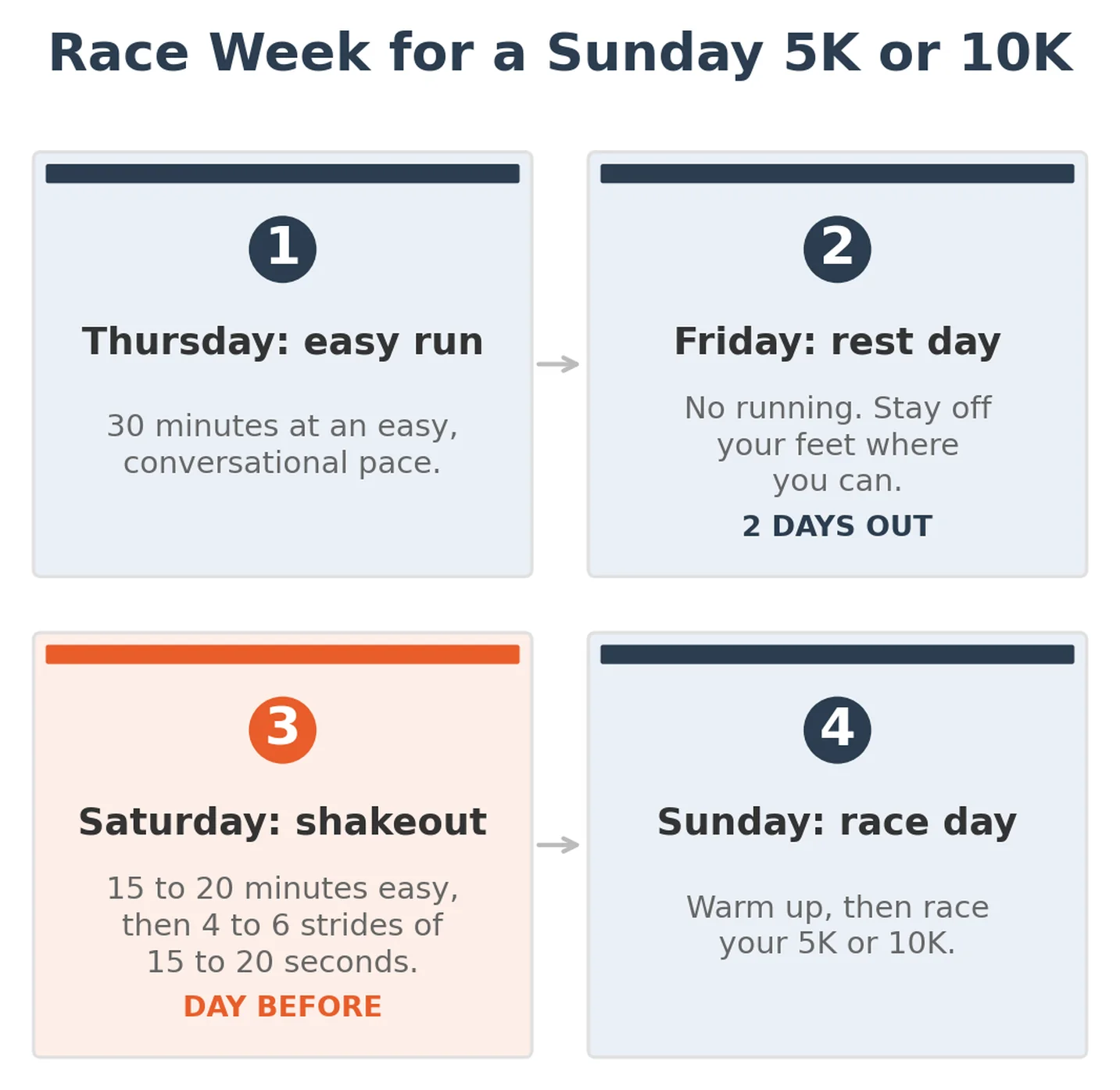
A common race week for a Sunday 5K or 10K is an easy 30 minutes on Thursday, rest on Friday, and a 15 to 20 minute shakeout with strides on Saturday.
Take your rest day 2 days before the race and keep a short, easy run on the day before.
The same idea applies if your half marathon is on Sunday and you love your Saturday parkrun.
Jog it at your easy pace with a few strides at the end, and save the racing for Sunday.
Does a Shakeout Run Help With Pre-Race Nerves?
A short run the day before a race also takes some of the edge off pre-race nerves, and those nerves affect how well you sleep the night before.
Research has shown that 64% of athletes slept worse before an important competition, and most of them blamed thoughts about the race.
Exercise helps, although the effect is modest.
A 2015 review of randomized trials found that a single bout of exercise lowered anxiety compared with control conditions, but the drop was small.
That means a shakeout run will take some of the edge off your nerves without making them go away.
Run in the morning, and use the time to walk through your race plan, from your pace for the first mile to where you’ll take water.
If you’re travelling with friends or a club, run together, because the conversation keeps your mind off the race for 20 minutes.
When Should You Skip the Run the Day Before a Race?
There are a few situations where a different plan works better than a shakeout run.
- You’re managing a minor injury. Swap the run for 15 to 20 minutes of easy cycling or elliptical, which gets your legs moving without the impact.
- You have a fever or feel sick below the neck. Rest, and use the day to decide whether you should start the race at all.
- You’ve spent hours on a plane or in a car. Jog 10 minutes or walk 20 minutes to loosen stiff legs, and skip anything longer.
- Fitting the run in would mean rushing. An early flight or a packed travel day is a good reason to rest instead.
Missing the run won’t hurt your fitness.
In a 1992 study of trained distance runners, 14 days of no running lowered VO2max by only about 4%, so a single day off won’t change your fitness.
What Should You Do the Day Before a Race?
Here’s a quick guide to the day before your race, by distance.
| Race | Run the day before | Strides | Eating focus |
|---|---|---|---|
| 5K | 15 to 30 minutes easy | 4 to 6 x 15 to 20 seconds | Normal meals |
| 10K | 15 to 30 minutes easy | 4 to 6 x 15 to 20 seconds | Normal meals with a carbohydrate-heavy dinner |
| Half marathon | 10 to 20 minutes easy | 3 or 4 relaxed | 10 to 12 g/kg (4.5 to 5.5 g/lb) carbohydrate |
| Marathon | 10 to 15 minutes easy | Optional | 10 to 12 g/kg (4.5 to 5.5 g/lb) carbohydrate for 36 to 48 hours |
| Injured or sick | 15 to 20 minutes cycling, or rest | None | Normal meals |
Spend the rest of the day off your feet as much as you can, lay out your race kit the night before, and settle on your pacing plan.
Ready For More?
Get Our FREE Race Day Strategy Calculator!
You’ll learn how to calculate your exact splits for the marathon in both KM and miles.




One Response
Good post and advice. Here’s my philosophy the week before an event: http://skorarunning.com/blog/never-taper-again
As said in the link, the week and day before an event should be hard running, but in short spurts. This should not leave a runner fatigued. As you bring up in your article, keeping the neuromuscular system ready to go is very important. Spending two weeks doing nothing but LSD and reduced volume is not ideal before an event!