

Overtraining is the first explanation most runners reach for when training stops working, and the advice that follows is almost always to cut mileage and rest.
Research on athletes with confirmed overtraining syndrome found something that breaks that logic.
Their training loads matched the training loads of healthy athletes who were thriving on the same volume.
What separated the two groups was how much they ate, how well they slept, and how much stress they carried outside of running.
So, in this article you’re going to learn the research-backed practical advice on…
- Why cutting your weekly mileage is usually the wrong first response to feeling flat
- The three eating patterns that independently triggered overtraining syndrome in a landmark study
- Which recovery metrics actually catch overreaching early, and which ones your watch oversells
- How long real recovery takes, and the two-week test that tells you what you’re dealing with
What Is Overtraining Syndrome, and How Is It Different From Normal Training Fatigue?
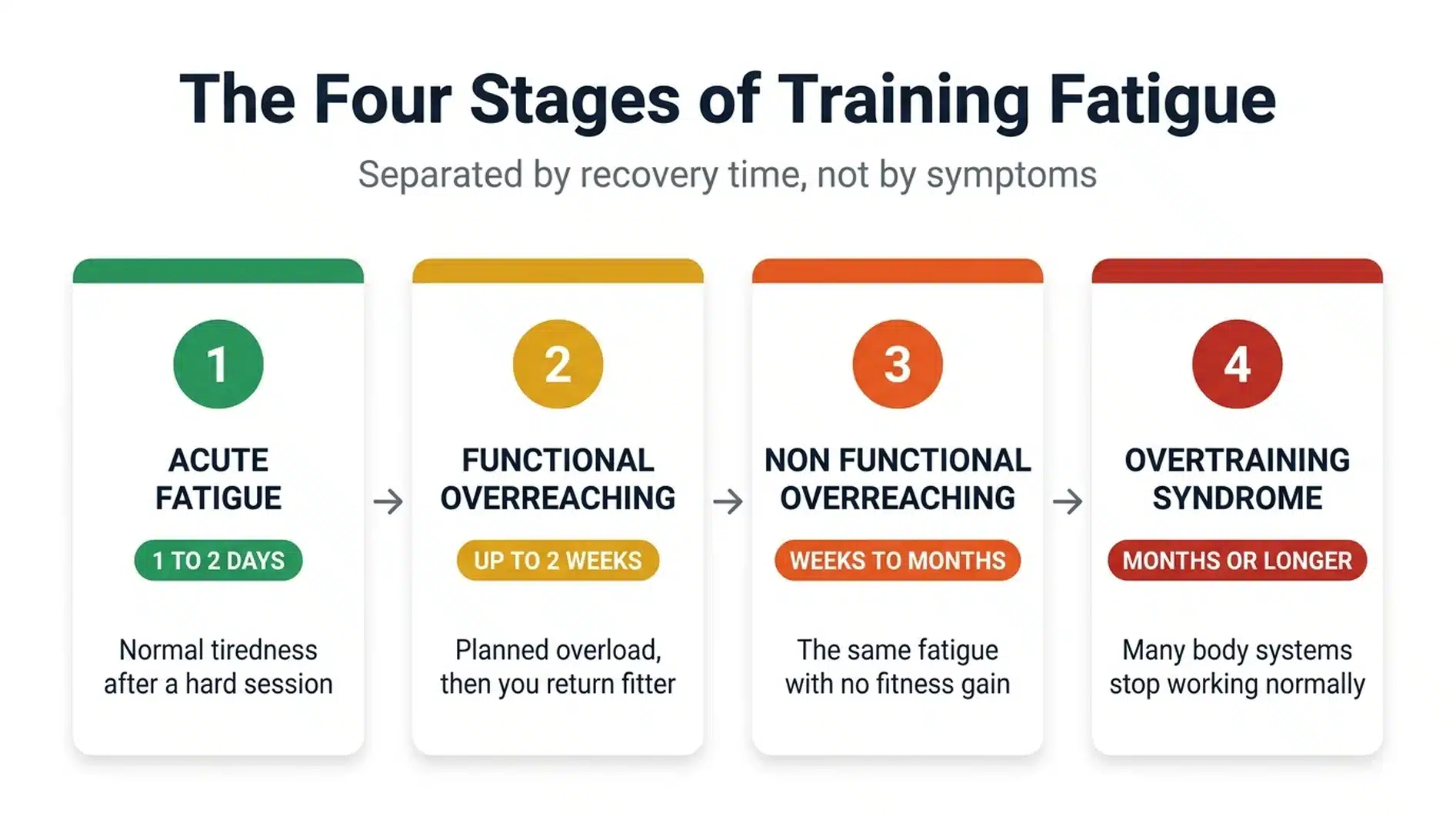
Training fatigue sits on a four-stage continuum, and the stage you’re on is defined by how long it takes you to bounce back.
A review of more than 5,500 studies found no single blood test, heart rate reading, or wearable metric that can diagnose overtraining syndrome on its own.
Acute fatigue is the tiredness you feel the day after a hard session, and it clears in a day or two.
Functional overreaching is a deliberate short-term overload that drops your performance for days to about two weeks, after which you come back fitter than before.
Non-functional overreaching is the same fatigue without the payoff, and the flat patch stretches into weeks.
Overtraining syndrome sits at the far end, where performance stays suppressed for months and multiple body systems stop working normally.
The joint consensus statement from the European College of Sport Science and the American College of Sports Medicine describes the key marker of the syndrome as prolonged maladaptation, meaning the problem has spread past your legs into hormonal and neurological regulation.
The symptoms across these stages look almost identical, which is why runners self-diagnose so badly.
Two weeks of genuine rest is the dividing line, so recovering inside that window means you were overreached, and staying flat beyond it means something else is driving the fatigue.
Why Do Overtrained Runners Train No More Than Healthy Runners?
Weekly running volume turns out to be the weakest predictor of who develops the syndrome.
The Endocrine and Metabolic Responses on Overtraining Syndrome study, known as EROS, measured 117 markers across 14 affected athletes, 25 healthy athletes, and 12 non-athletes.
Research comparing overtrained athletes to healthy athletes found their training patterns were similar, so excessive training was not a risk factor for the syndrome.

Since both groups trained the same way, the variables that differed between them are the ones carrying the causal weight.
A joint analysis of all four arms of the EROS study found that 44 of 67 measured parameters differed significantly between groups.
Of those 44 markers, 32 showed a loss of the conditioning effects that exercise normally produces.
Those athletes had drifted back toward the physiology of untrained people, which is why the researchers proposed renaming the condition paradoxical deconditioning syndrome.
Cutting mileage as your first move treats the one variable that was never different between the runners who broke down and the runners who did not.
Is Under-Fueling the Real Cause of Overtraining in Runners?
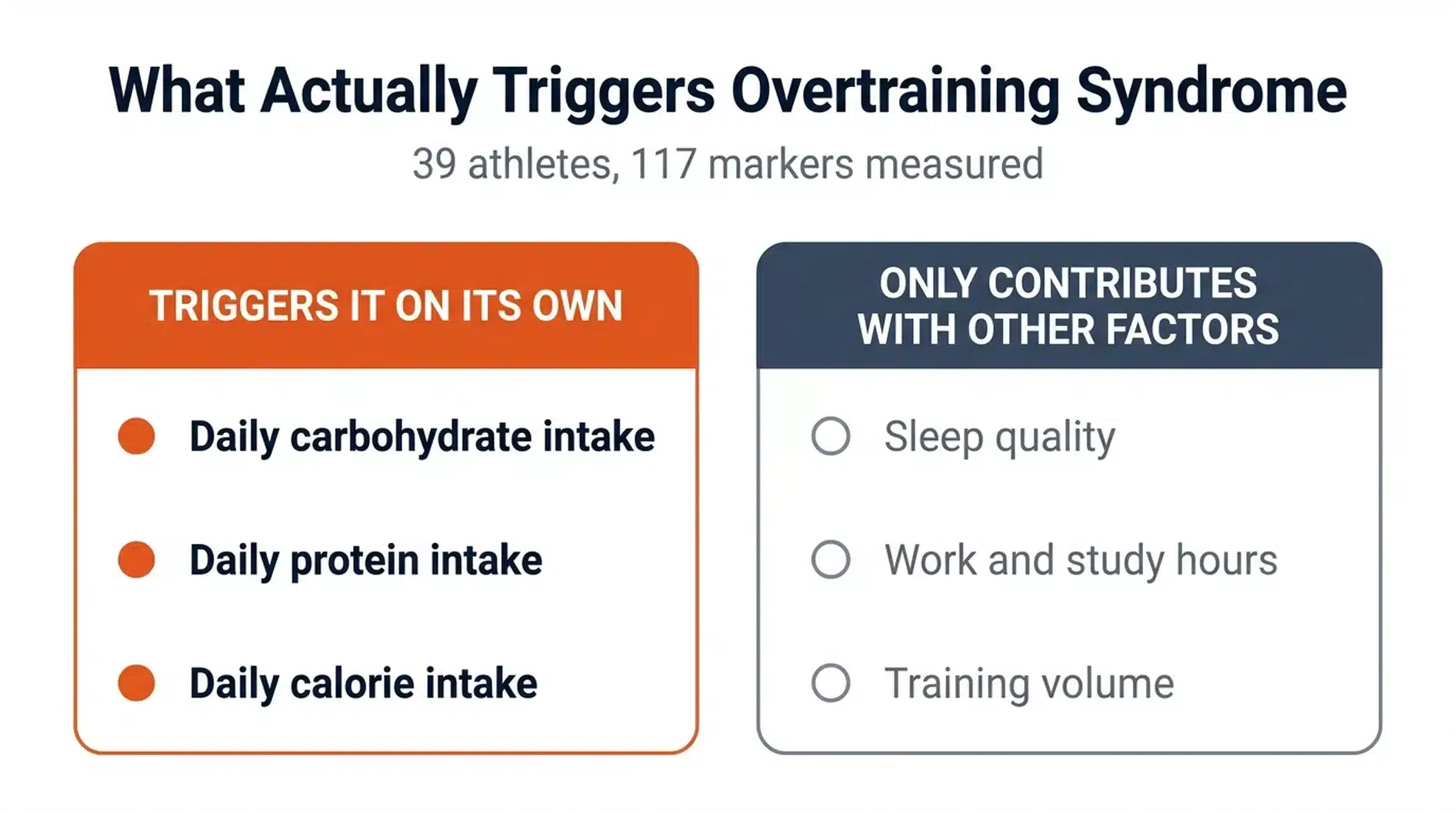
Three eating variables came out as independent triggers of the syndrome once the EROS researchers controlled for everything else.
- Daily carbohydrate intake. Carbohydrate availability predicted how quickly the affected athletes’ hormones responded to stress and how well they produced explosive efforts during exercise.
- Daily protein intake. Protein intake predicted body composition and metabolic rate, both of which were measurably worse in the overtrained group.
- Daily total calorie intake. Overall energy intake predicted muscle recovery and morning alertness, independent of how the calories were split across macronutrients.
Sleep quality, social demands, and training characteristics all needed help from other factors to push an athlete over the edge.
The eating patterns did it on their own.
The profile study within EROS found that affected athletes had lower basal metabolic rates, burned less fat, carried more body fat, and had less muscle mass than the healthy athletes training alongside them.
This is what chronic under-fueling looks like once it has been running for months.
A 2025 meta-analysis of 46 studies found that 44.7% of athletes were eating too little to support both their training and their basic bodily functions.
Carbohydrate deserves separate attention because it does damage that a calorie count alone will not reveal.
A controlled trial in elite race walkers put athletes on six days of either low carbohydrate, low overall energy, or a normal diet, then measured their response to a 25km effort.
Only the low-carbohydrate group showed worsened inflammatory, iron, and cortisol responses to exercise.
The low-energy group looked no different from the controls over that timeframe.
Fixing carbohydrate intake around your hard sessions changes your hormonal and immune response to training faster than any adjustment to weekly mileage will.
How Do Sleep Debt and Work Stress Push Runners Toward Overtraining?
Poor sleep and heavy cognitive demands separated the overtrained athletes from the healthy ones almost as clearly as their eating did.
The EROS profile data showed the affected athletes reported worse sleep quality and spent more hours per day working or studying.
Neither group was training more than the other.
A follow-up analysis found that sleep quality predicted mood state, and that excessive concurrent cognitive effort in athletes under intense training predicted impaired metabolism.
Your body processes a demanding work project and a demanding tempo run through overlapping stress pathways.
When both are running at once, the recovery budget gets spent twice.
A study of 536 athletes found that low sleep duration in the previous 48 hours was associated with a measurable increase in injury risk.
That same study found very poor sleep quality raised illness risk more sharply than short sleep duration alone.
The quality of your sleep carries more weight for recovery than the number of hours you log in bed.
Most runners have this backwards, protecting the training block while letting sleep and food absorb whatever is left over.
How Do You Catch Overreaching Before It Becomes Overtraining Syndrome?
The markers that flag excessive fatigue early are simpler and cheaper than the ones most running watches promote.
A 2024 study followed 24 everyday runners through a three-week baseline, a two-week overload block, and a one-week recovery week, testing 3000m performance at every stage.
Research on everyday runners found that on an identical two-week overload block, one group improved their 3000m time by 2.5% while the other group got slower.
The researchers classified 12 of the runners as responders and 8 as overreached, all following the same program.
The runners who overreached saw their nighttime heart rate climb 3.2%, while the runners who adapted saw theirs fall 2.8%.
Three markers reached 85% or better accuracy at separating the two groups.
- Nocturnal heart rate. Your average heart rate while asleep moves in opposite directions for runners who adapt and runners who overreach. It is also measured while you are perfectly still, which strips out the caffeine, stress, and timing noise that makes morning readings inconsistent.
- Self-rated readiness to train. The overreaching group reported a sharper drop in how ready they felt and a sharper rise in leg soreness before their race times confirmed anything.
- Heart rate at a fixed running effort. A lower heart rate at a pace that normally sits higher, paired with the session feeling harder, is a consistent signature of accumulated fatigue.
Heart rate variability performs worse than its marketing suggests.
A systematic review of 12 studies on endurance athletes found that changes in power output, heart rate, perceived exertion, and daily stress questionnaires all reflected functional overreaching, while heart rate variability and VO2max did not.
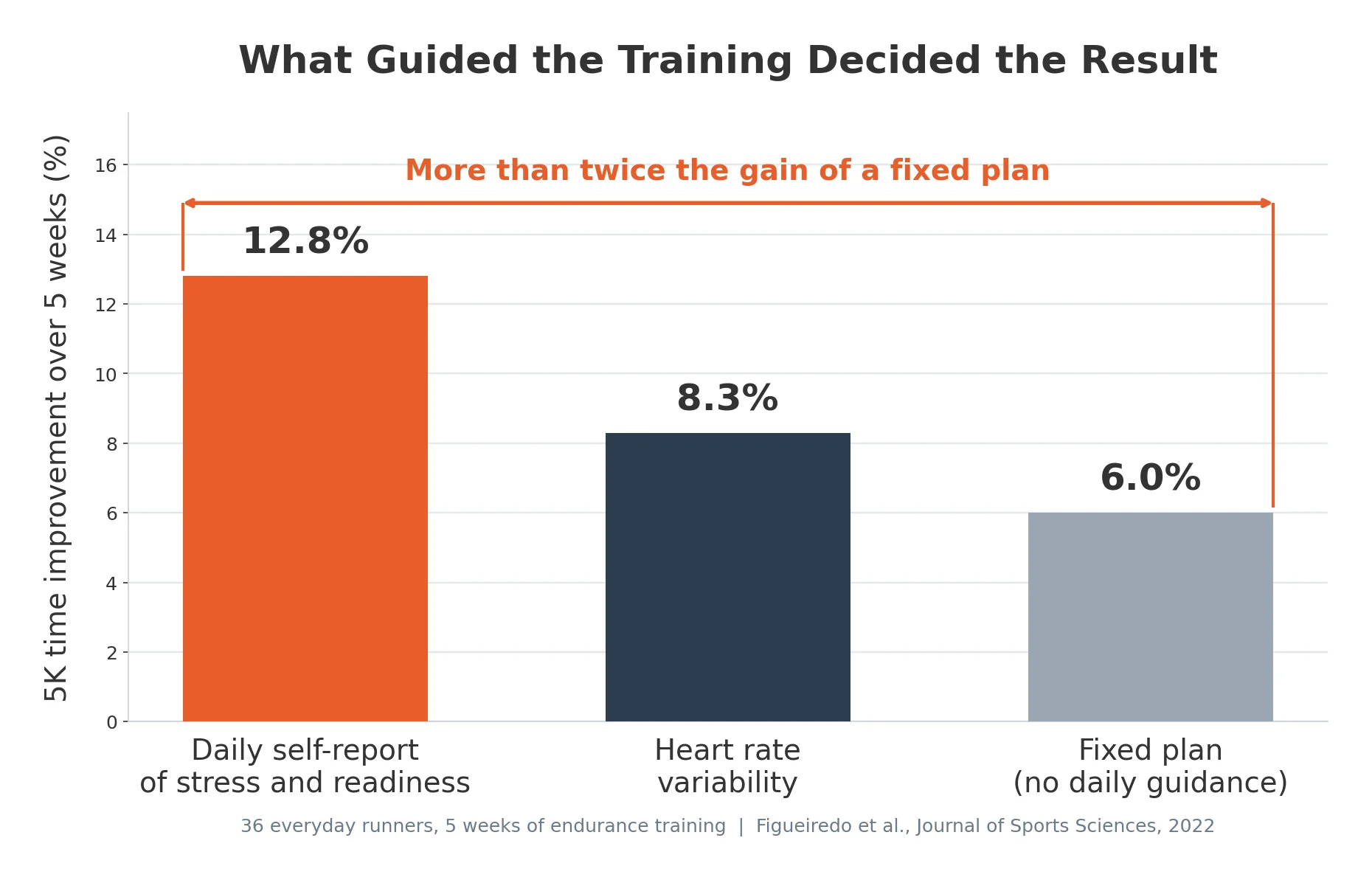
A separate trial handed 36 everyday runners one of three approaches to prescribing five weeks of training.
The group whose daily training was guided by a self-reported stress questionnaire improved their 5km time by 12.8%.
The heart rate variability group improved by 8.3%, and the group following a fixed plan improved by 6.0%.
A daily rating of how ready you feel to train tracked overreaching more reliably than heart rate variability in both of these studies.
How Long Does It Take to Recover From Overtraining?
Recovery time is the variable that defines the diagnosis, which makes it the one number worth knowing.
Two weeks of relative rest is the reference threshold used across the research literature, and coming back inside that window puts you in a normal and often useful training state.
Research on recovery from overtraining syndrome found that a 12-week program of increased calories, paused training, better sleep, and stress management produced only partial recovery across most markers.
That trial ran 12 affected athletes through the full protocol and measured 50 separate parameters afterward.
Hormonal markers moved in the right direction, including cortisol response, growth hormone response, and testosterone.
Body composition and metabolic rate barely shifted at all.
Three months of doing everything correctly was not enough to fully undo it.
Most runners resist this because they fear losing fitness during the layoff.
A 2024 review of detraining in endurance athletes found that the early drop in VO2max after stopping training comes largely from reductions in blood and plasma volume rather than from lost aerobic machinery.
Dropping to easy running preserves substantially more fitness than stopping altogether, which makes a reduced two-week block the cheapest way to find out what you are dealing with.
How Do You Prevent Overtraining Without Cutting Your Mileage?
Prevention works on the inputs that actually separated the affected athletes from the healthy ones, and weekly volume was not among them.
- Fuel the session, not the daily average. Carbohydrate availability around hard efforts drove the hormonal and immune differences in the research, so the timing of your carbohydrate intake matters as much as the weekly total.
- Treat sleep quality as a training variable. Sleep quality predicted mood and recovery status more reliably than time in bed, which makes consistency, room temperature, and a fixed wake time worth more attention than an extra 30 minutes of broken sleep.
- Count non-training stress as training load. Weeks with heavy work demands should carry lighter training, because the research shows cognitive load and physical load draw from the same recovery budget.
- Schedule down weeks before you need them. Planned recovery phases are what convert an overload block into supercompensation instead of into a flat patch that stretches for months.
- Run the two-week test at the first sign of flatness. Two easy weeks costs you almost nothing in fitness and tells you immediately whether you’re dealing with overreaching or something that needs medical attention.
Deep sleep is the stage where the majority of physical adaptation to training actually occurs, which makes sleep quality the point where a hard training block either pays off or does not.
A systematic review and meta-analysis of 60 studies covering 6,894 people concluded that valerian root is a safe and effective option for promoting sleep.
That’s why we partnered with MAS Sleep, which is built around a valerian-based blend called Valerest.
It’s an all-natural formulation designed to work alongside good sleep habits rather than in place of them.
What Should You Take Away From the Research on Overtraining?
| Trigger | What the research found | What to change first |
|---|---|---|
| Low carbohydrate and calorie intake | Independent trigger of overtraining syndrome. 44.7% of athletes across 46 studies show low energy availability. | Fuel hard sessions with carbohydrate before adjusting weekly volume. |
| Poor sleep quality | Separated affected athletes from healthy ones. Short sleep in the prior 48 hours raised injury risk. | Target consistency and sleep quality rather than total hours in bed. |
| High work and cognitive load | Predicted impaired metabolism in athletes under intense training. | Reduce training load during weeks with heavy work demands. |
| Weekly training volume | Training patterns were similar between overtrained and healthy athletes. | Cut mileage only after fueling, sleep, and life stress are addressed. |