

You’re standing in corral D with thirty minutes until the gun and the temperature stuck in the low 40s.
The runner next to you is cranking out walking lunges like it’s an interval workout.
You’re not sure whether to mirror them, jog in place, or just stand still and save your legs.
Warming up for a marathon is one of the trickiest balancing acts in racing.
A proper warm-up raises your muscle temperature, activates the nervous system, and speeds oxygen delivery to your legs.
The problem is that those benefits cost energy.
In a race where glycogen depletion is a real concern, every extra minute of warm-up is a minute burning fuel you’ll want at mile 22.
The goal is to prime your body just enough without dipping into the glycogen you need for the final 10K.
Here’s what you’ll learn about warming up for a marathon without wasting energy:
- Why a marathon warm-up is different from warming up for shorter races
- When to wake up on race morning and what to do first
- How long a pre-marathon shakeout run should be
- What to do in the starting corral that primes your legs without wasting glycogen
- How to use the first miles of the race as the final piece of your warm-up
Why is a marathon warm-up different from a 5K warm-up?
The same warm-up that primes you for a 5K can leave you short on glycogen by the halfway mark of a marathon.
Research shows that every 1°C rise in muscle temperature lifts short-duration performance by 2 to 5%.

That temperature boost comes from three linked mechanisms.
A review of warm-up physiology points to faster nerve conduction, lower muscle stiffness, and quicker oxygen delivery as the primary drivers of the performance benefit.
Warmer muscles also produce force more efficiently at any given contraction velocity, which means your early miles feel easier at the same pace.
A meta-analysis of 32 warm-up studies found that properly done warm-ups improved performance in 79% of tested outcomes.
The catch for a marathon is that glycogen is finite and the race is long.
A 5K runner can spend 20 minutes jogging, drilling, and doing strides because the race is over before any fuel limitation bites.
A marathoner doing that same routine burns through a measurable chunk of the glycogen they will need at mile 20.
The rest of this article is the protocol that gives you the warm-up benefits without the fuel tax.
When should you wake up before a marathon?
Set your alarm for at least 2.5 to 3 hours before the gun.
Plan to be fully awake at least 2.5 hours before the gun so your body temperature, gut, and nervous system all have time to come online.
Core body temperature rises gradually after waking.
That is why your legs on the drive to the start are less coordinated than they will be once you are up, moving, and warm.
That early wake-up also buys time for everything else on race morning.
You need to eat breakfast, use the bathroom, travel to the start, check your bag, and find your corral without feeling rushed.
Losing an hour or two of sleep the night before a marathon will not meaningfully hurt your performance if you have banked solid sleep in the week leading up.
The sleep that matters most is the night before the night before.
RunnersConnect Bonus
Download our Active Stretching Maintenance Routine
It’s a PDF and video with images and descriptions of the most effective active stretches for runners.
What should your morning-of shakeout run look like?
Run 10 minutes of easy jogging as soon as you have changed into your race gear.
A study of priming exercise found that moderate-intensity activity before a race improved subsequent severe-intensity performance by roughly 2 to 3%.
The priming effect has two pieces that matter on race day.
Your oxygen uptake machinery responds faster in the opening miles, so you spend less time digging into anaerobic reserves while your aerobic system catches up.
Blood flow to the working muscles is already elevated, which primes the delivery of oxygen and glucose from the first step of the race.
The shakeout does not need to be longer than 10 minutes.
Going further or faster starts costing more glycogen than the priming effect is worth, which defeats the entire point of keeping the warm-up short.
Finish the shakeout, shower if you have time, eat your pre-race meal, and relax until it is time to leave for the start.
How do you warm up in the starting corral without wasting glycogen?
Spend 3 to 5 minutes on a dynamic stretching routine and wear throwaway clothes to keep your body heat from escaping while you wait.
A systematic review of stretching research found that dynamic stretching produces a small performance gain, while holding a static stretch for 60 seconds or longer reduces strength by roughly 4.6%.
Static stretching damps down muscle activation, which is the opposite of what you want heading into the gun.
Dynamic stretching moves the joint through its range while the muscle contracts, which wakes up the nervous system and primes force production.
A good pre-marathon dynamic stretching routine can fit in a corral footprint and takes less than five minutes.
Leg swings (forward and side to side): ten each leg, each direction, to open the hips and activate the glutes.
Walking lunges: five to eight per leg to extend the hip flexors and fire the posterior chain.
High knees and butt kicks: 20 total, alternating, to raise heart rate and reinforce the running cadence pattern.
Ankle rolls and skips: 20 seconds of each to wake up the small stabilizers that take the first impact of every footstrike.
That is the entire routine.
Doing more is where the glycogen cost creeps in.
Research on cyclists has shown that a shorter and lower-intensity warm-up produces better subsequent performance than a traditional 50-minute protocol.
For the rest of the wait, keep an old sweatshirt, hat, and gloves on, and shed them only when the announcer signals a few minutes to start.
Most large marathons pick up discarded clothing at the start and donate it to charity, so there is no guilt in ditching a cheap hoodie at mile zero.
Should the first two miles of the marathon be your warm-up?
Yes, and running them slightly slower than goal marathon pace is one of the highest-leverage choices you can make on race day.
An analysis of 91,929 marathon performances found that men slowed by 15.6% in the second half on average, while women slowed by 11.7%.
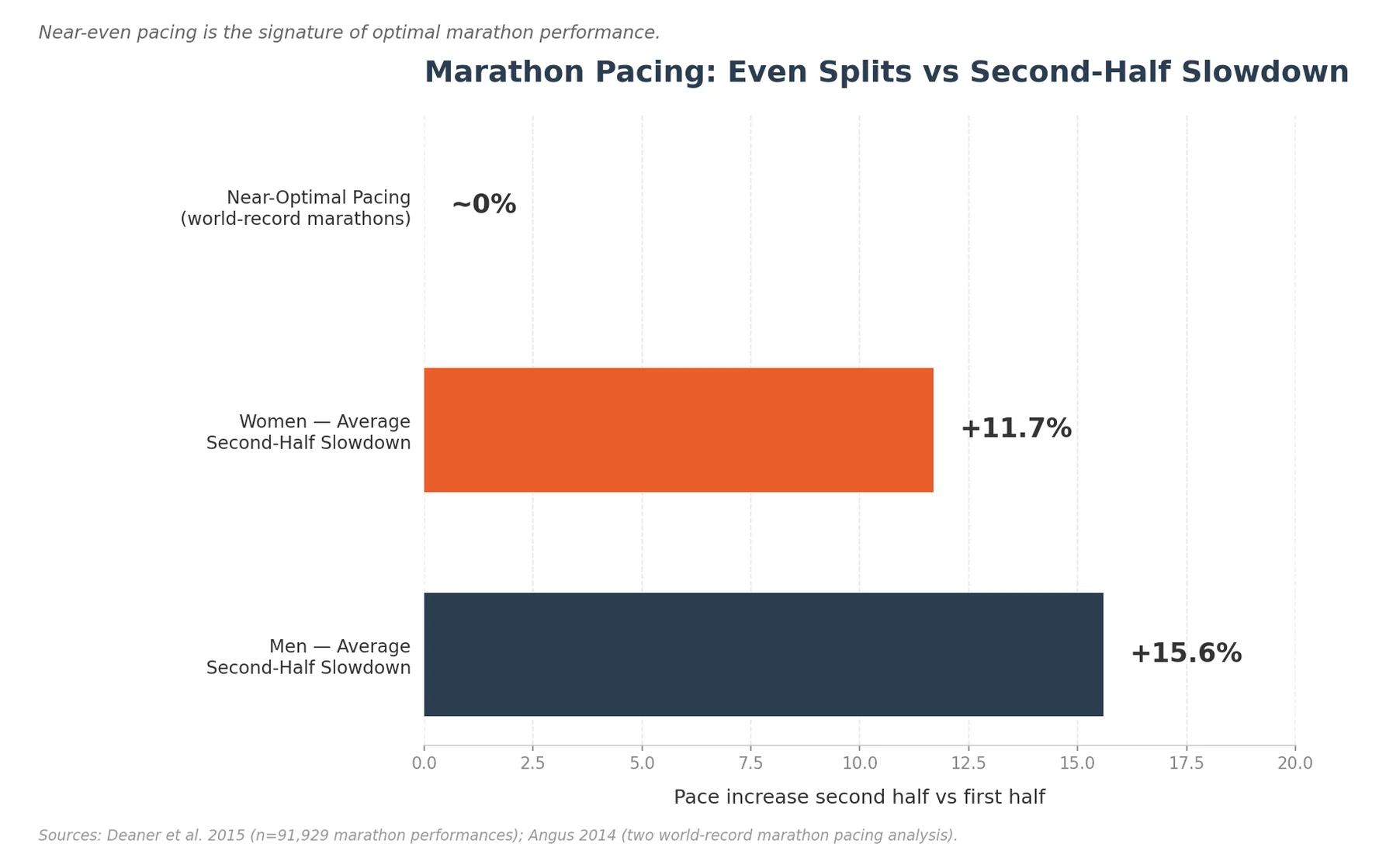
Those are not small gaps between first and second half splits.
They are the signature of runners who started too fast and blew up in the back end of the race.
Treating the first two miles as a final warm-up is the cleanest way to protect yourself from that same blowup.
An analysis of two world-record marathons found that the closest-to-optimal pacing came from runners who held near-even efforts across the full 42 kilometers.
Hold the first two miles 10 to 20 seconds per mile (roughly 6 to 12 seconds per kilometer) slower than your goal marathon pace.
By mile three your legs, breathing, and nervous system are fully online, and you can slide into goal pace feeling smooth instead of strained.
Every second you bank early in a marathon is paid back in the final 10K.
A good marathon pacing strategy treats the first two miles as the final component of your warm-up.
RunnersConnect Bonus
Download our Active Stretching Maintenance Routine
It’s a PDF and video with images and descriptions of the most effective active stretches for runners.
All five steps stacked together give you the warm-up benefits without the fuel debt.