
You’re ten weeks into marathon training, your right knee is starting to bark, and your coach says to keep your heart rate up without pounding the pavement.
Or maybe you’re healthy but your schedule only allows four running days, and you want to fill the gaps without trashing your legs before the long run.
Either way, you’re staring at the bike in your garage wondering if it actually counts.
It does. Use it correctly, though, and it becomes one of the most effective tools in your training plan.
So, in this article you’re going to learn the research-backed practical advice on incorporating cycling into marathon training.
- Why cycling builds real aerobic fitness that transfers directly to your running
- What intensity to use on the bike to get a training effect without burning out
- How to translate cycling time into a meaningful training load
- When cycling belongs in your training week and when it does not
- What cycling genuinely cannot replace, so you protect your running-specific fitness
Why Does Cycling Work as Cross-Training for Runners?
Cycling works because the cardiovascular system does not care which muscles are powering it.
When you ride at a moderate-to-hard effort, your heart rate rises, your stroke volume increases, and your body demands more oxygen delivery.
That is the same stimulus your heart and lungs respond to whether you’re running a tempo or grinding up a hill on the bike.
Research has shown that runners who replaced half their sessions with cycling for 5 weeks improved their VO2max and their 5,000m times just as much as runners who only ran.

The underlying biology explains why.
Mitochondria are the organelles that produce aerobic energy in your muscle cells. They multiply in response to sustained cardiovascular stress.
Your body builds more of them regardless of whether the stress comes from running or cycling.
Your heart gets stronger, your lungs become more efficient at extracting oxygen, and your blood volume expands.
All of that translates directly to your marathon fitness.
Cycling adds one more advantage: it removes the pounding.
Running generates ground reaction forces of roughly 2 to 3 times your body weight with every footfall.
Cycling generates almost none.
That means you can accumulate aerobic training time without the cumulative tissue stress that leads to shin splints, stress fractures, and overuse injuries.
Cycling trains the same cardiovascular system that powers your marathon. It does so without the impact forces that make running the most injury-prone endurance sport.
Does Cycling Actually Improve Your Marathon Fitness?
Cycling builds measurable aerobic fitness that shows up in running performance. The caveat: you need enough of it at the right intensity.
The carryover is real, and it’s partial. Testing triathletes, runners and cyclists on both a treadmill and a bike produced higher VO2max values on the treadmill for every group, with the gap averaging 10.5 percent for the runners and 2.8 percent for the cyclists.
The more you ride, the more of that aerobic ceiling shows up on the bike, and the ceiling you raise there is a real one you’ll reach in your running.
What the research also makes clear is that maintaining fitness is easier than building it.
If you replace running miles with cycling during a down week or an injury block, you retain most of your aerobic capacity for significantly longer than if you stopped exercising entirely.
You can also race well off cross-training.
That is not just anecdotal runner wisdom.
It has a real physiological basis.
The practical implication: adding cycling to a healthy training block builds aerobic volume without adding running injury risk.
Adding it during an injury block preserves the fitness you spent months building.
Both uses are legitimate and backed by research.
What Intensity Should You Use When Cycling for Marathon Training?
Intensity is where most runners get cycling wrong, and it costs them the training benefit they’re after.
The two most common mistakes are going too easy or going too hard.
Too easy means treating every bike ride as an active rest day.
Too hard means turning a recovery ride into another taxing session that leaves your legs flat for the next day’s run.
Research tracking 384 training sessions in well-trained endurance athletes found 75 percent were done at low intensity, 8 percent at moderate intensity, and 17 percent hard. That distribution applies directly to cycling cross-training for runners.
Here is how to match cycling intensity to your training goal:
- Recovery rides (easy effort): These belong on the day after a hard run. Keep your perceived effort at a 4 to 5 out of 10. You should be able to hold a full conversation. Duration: 30 to 45 minutes. The goal is blood flow to sore muscles, not a cardiovascular training stimulus.
- Aerobic base rides (moderate effort): These substitute for easy running days or add volume to a lighter running week. Perceived effort: 5 to 6 out of 10. You can speak in sentences but not comfortably chatter. Duration: 45 to 90 minutes. This is where most of your cycling time should live.
- Threshold rides (hard effort): Use sparingly, once per week at most, and only when you have easy running days surrounding it. Perceived effort: 7 to 8 out of 10. These are your cycling equivalent of a tempo run and deliver a genuine aerobic stimulus comparable to running at lactate threshold.
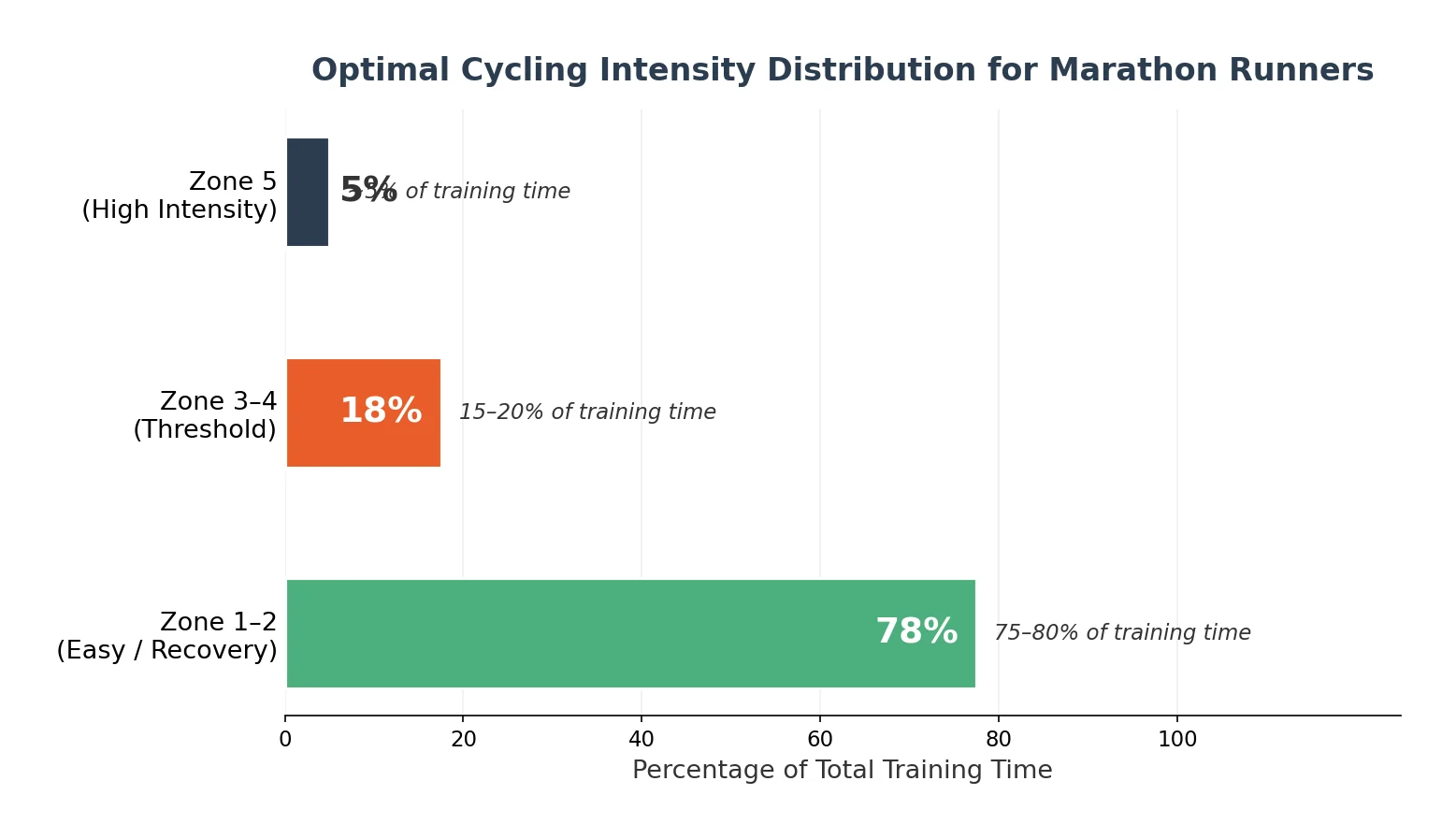
Commit to either real recovery effort or a real training stimulus. The fuzzy moderate-hard middle is where runners waste the most cycling time.
RunnersConnect Bonus
Download our Heart Rate Calculator to find out what your individual heart rate zones are.
How Much Cycling Equals How Much Running?
There is no perfect conversion, but there are useful rules of thumb grounded in the difference in mechanical efficiency between the two sports.
Running burns more calories and generates more cardiovascular stress per minute than cycling at a comparable perceived effort.
That is partly because running requires your body to support its full weight with every stride, while cycling offloads most of that to the saddle and pedals.
| Goal | Running Time/Distance | Cycling Equivalent |
|---|---|---|
| Replace a 30-minute easy run | 30 min / ~4 mi (6.4 km) | 45–60 minutes easy |
| Replace a 60-minute aerobic run | 60 min / ~7–8 mi (11–13 km) | 90 minutes moderate |
| Replace a 30-minute tempo run | 30 min at threshold pace | 40 minutes at hard effort |
| Active recovery after long run | Not running | 30–45 minutes very easy |
A widely used practical guideline is a 1.5-to-1 ratio for easy cycling versus easy running by time.
That means one hour of easy running equates to roughly 90 minutes of easy cycling for a similar aerobic training load.
At higher intensities, the ratio narrows. A hard 40-minute cycling interval session generates a training stimulus closer to a 30-minute tempo run.
Use these as planning anchors, not precise scientific conversions.
Your body’s response to any workout is ultimately individual, and heart rate is the most honest real-time guide to whether you are actually getting the load you want. Time or miles alone does not tell you that.
How Many Miles on a Bike Equal a Marathon?
Roughly 75 to 90 miles (120 to 145 km) of steady cycling produces the aerobic work of running a 26.2-mile (42.2 km) marathon.
A bike carries your body weight for you and moves you faster at the same effort, so each cycling mile costs far less energy than a running mile.
How much of your energy becomes forward motion on a bike is close to fixed. Researchers who tested 69 riders spanning recreational cyclists to world-class professionals measured gross efficiency between 18 and 19 percent in every group, with no advantage for the elites.
Your conversion rate on the bike stays roughly the same as your fitness improves, so these distance ranges hold up whether you’ve been riding for a month or a decade.
The 1.5-to-1 time ratio covered above turns into a distance ratio once you account for speed.
At an equivalent easy effort you cover about twice the ground per minute on a bike, and 1.5 times the duration at double the speed works out to roughly 3 times the distance.
Here’s how that converts for the races most runners train for:
- Marathon, 26.2 mi (42.2 km): 75 to 90 miles (120 to 145 km) of steady riding.
- Half marathon, 13.1 mi (21.1 km): 38 to 45 miles (60 to 72 km).
- 10K, 6.2 mi (10 km): 18 to 21 miles (29 to 34 km).
Riding 26.2 miles (42.2 km) is a separate question, and a much smaller one.
Most riders cover that distance in 90 minutes to 2 hours at a moderate effort, which sits closer to a long easy run than to a marathon.
Terrain and wind move these numbers more than anything else. Hills and headwind push you toward the low end of each range, while flat roads, a tailwind, or riding in a group push you toward the high end.
Time and heart rate training zones stay more reliable than distance for judging what a ride actually cost you.
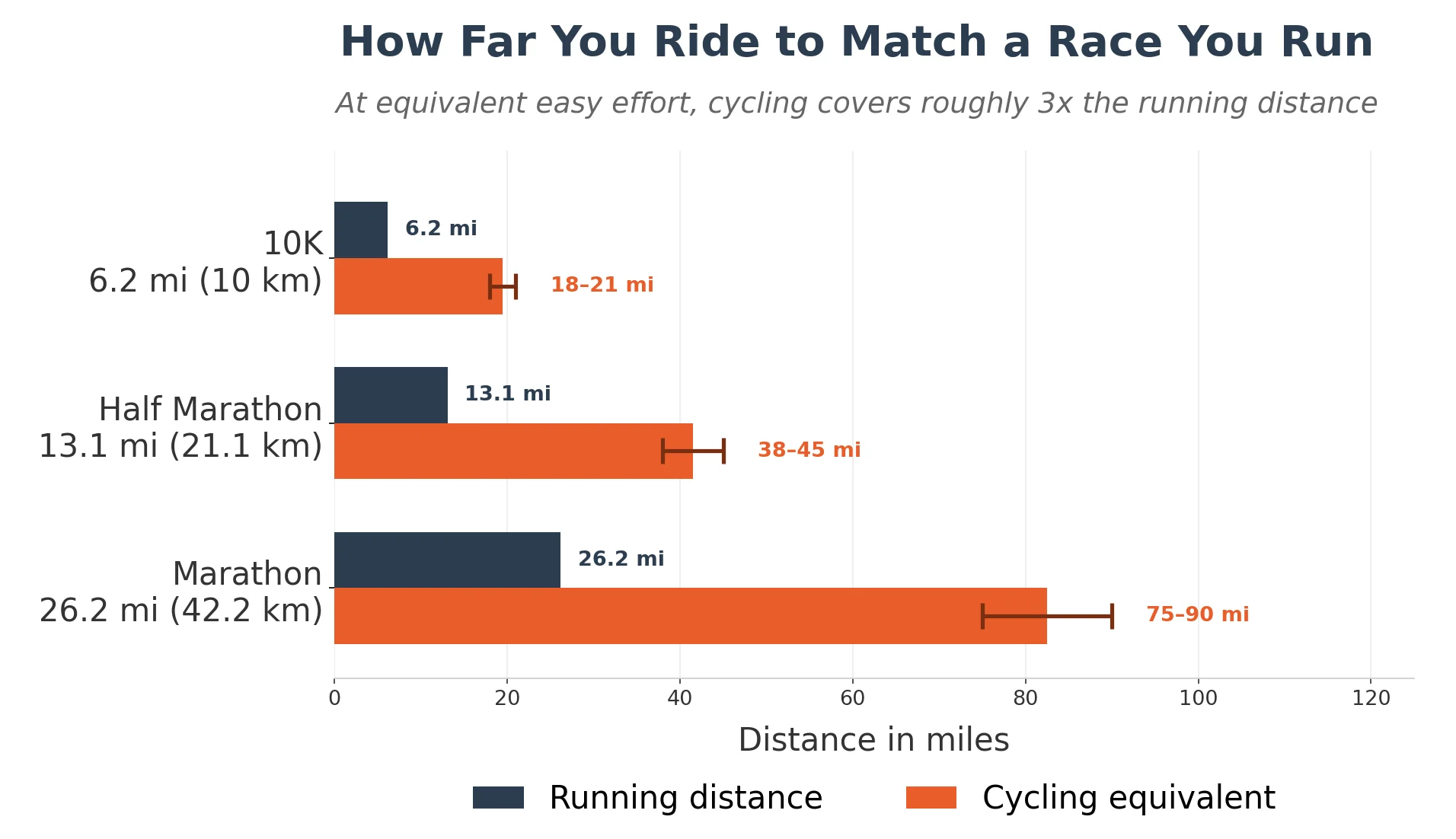
Plan your rides by distance and verify them by heart rate, because 40 miles into a headwind and 40 miles in a group are not the same workout.
When Should You Use Cycling During Marathon Training?
Cycling earns its place in marathon training in three specific situations, and knowing which situation you’re in changes how you use it.
Situation 1: Injury prevention and volume management.
If you’re logging 50 miles (80 km) or more per week, every additional mile adds cumulative impact stress.
Cycling lets you add aerobic volume without adding more footfalls. The cardiovascular adaptations come with it.
A systematic review of running injury research found strong evidence that a high weekly training distance raises injury risk in male runners, which makes non-impact cross-training a logical tool for managing total training stress.
A practical rule: if adding another run would push your weekly mileage up by more than 10 percent, add a cycling session instead.
You get the aerobic work without violating the mileage progression guideline that keeps most runners healthy.
Situation 2: Recovery after long runs and hard sessions.
The day after your long run is the most common place to add cycling.
A 30-to-45-minute easy spin promotes blood flow to fatigued muscles, speeds nutrient delivery, and keeps your aerobic system ticking without adding mechanical load.
This is active recovery at its best, and it is one area where the cross-training options available to runners genuinely beat sitting on the couch.
Situation 3: Maintaining fitness during injury or forced rest.
If a running injury takes you off the road, cycling is your primary tool for preserving the aerobic base you’ve spent months building.
Get on the bike within 48 hours of dropping running if at all possible.
Match the time and intensity of your missed sessions as closely as your injury allows.
Classic detraining research tracked trained athletes after they stopped exercising and recorded a 7 percent drop in VO2max within the first 3 weeks. Cycling delays and substantially reduces that loss.
The best time to start using cycling in your training is before you need it. Starting only after injury forces the issue means you are always playing catch-up.
What Can’t Cycling Replace in Marathon Training?
Cycling builds your aerobic engine, but it cannot fully replicate the specific physical demands that running places on your body.
Understanding this limit protects you from a critical mistake: thinking you can ride your way through marathon training and show up on race day fully prepared.
White and colleagues had competitive distance runners replace half their weekly running volume with cycling for 5 weeks, and their VO2max held steady while their 3,000m times slipped 3.4 percent, against 1.4 percent for the runners who kept running.
Here is what cycling does not train:
- Running-specific neuromuscular patterns. Every time your foot contacts the ground, your nervous system fires a precise sequence of muscle contractions. Cycling uses a rotary pedaling motion that trains a completely different recruitment pattern. You cannot bike your way to a better foot strike.
- Tendon and connective tissue adaptation. Your Achilles tendon, plantar fascia, and the connective tissue throughout your lower legs adapt to running stress only through running. Cycling provides no eccentric loading of these structures. Runners who return from a long cycling block often report that their tendons and feet feel unprepared even when their cardiovascular fitness is strong.
- Running economy at marathon pace. Running economy, meaning how efficiently your body uses oxygen at a given speed, is highly specific to running. Cycling can raise your VO2 max ceiling, but your body’s ability to run efficiently at 8:00 per mile (4:58/km) or 9:00 per mile (5:35/km) comes only from running at those paces regularly.
- Late-race durability. The ability to hold form and pace in miles 20 through 26 of a marathon is built largely through long runs and goal-pace work. No amount of cycling replicates what happens to your legs at mile 22.
The practical conclusion: cycling supplements running, it does not substitute for it.
Aim to preserve a minimum of three to four running days per week during any period when you’re leaning heavily on cycling, and never drop your long run unless a specific injury requires it.
What Are the Best Cycling Workouts for Runners?
Three cycling workout types cover nearly every training need a marathon runner has on the bike.
1. The Recovery Spin
Duration: 30 to 45 minutes. Effort: very easy, perceived exertion 4 to 5 out of 10.
Cadence: 80 to 95 revolutions per minute.
Use this the day after a long run or hard workout.
Keep resistance low enough that your legs feel like they’re barely working.
This session is about flushing, not fitness.
2. The Aerobic Builder
Duration: 60 to 90 minutes. Effort: steady, perceived exertion 5 to 6 out of 10.
Cadence: 85 to 100 revolutions per minute.
This is your primary volume-building ride, the one that accumulates real aerobic training time.
Use it on days when running is off the schedule or when you’re substituting cycling for a second easy run of the week.
If you have a heart rate monitor, target 65 to 75 percent of your maximum heart rate for the bulk of this session.
3. The Threshold Ride
Structure: 10-minute warm-up, then 2 to 3 blocks of 10 to 15 minutes at a hard sustained effort (perceived exertion 7 to 8 out of 10) with 5-minute easy pedaling recovery between blocks, followed by a 10-minute cooldown.
Total duration: 50 to 70 minutes.
Use this once per week at most, on a day followed by an easy running day or a rest day.
This is your cycling equivalent of a tempo run, and it delivers a genuine lactate threshold training stimulus that carries over to your running.
If you only have time for one type of cycling session, make it the aerobic builder. Volume at moderate intensity is where the marathon-specific aerobic adaptations accumulate.
What Does a Marathon Training Week With Cycling Look Like?
Where you place the bike sessions matters as much as which sessions you pick.
One rule governs every placement decision: cycling never compromises your long run or the week’s quality running session.
That rules out a threshold ride the day before a long run, and it rules out stacking a hard bike session onto a day that already holds a quality run.
| Day | Healthy runner adding aerobic volume | Runner managing an injury |
|---|---|---|
| Monday | Rest or 30 min recovery spin | 45 min aerobic ride |
| Tuesday | Quality run (intervals or tempo) | Threshold ride, 2 x 15 min hard |
| Wednesday | Easy run | 30 min recovery spin |
| Thursday | Easy run plus 45 min aerobic ride | 90 min aerobic ride |
| Friday | Rest | Rest |
| Saturday | Long run | Longest tolerable run, or 2 hr ride |
| Sunday | 30 to 45 min recovery spin | 45 min recovery spin |
The left column adds around 75 minutes of aerobic work across the week without a single extra footfall.
Thursday doubles up the easy run and the ride on purpose, which keeps Friday genuinely empty and leaves Saturday’s long run on fresh legs.
Swapping a large share of your running for cycling carries a measurable cost. That same 5-week substitution study found runners who replaced half their weekly running with cycling held their aerobic capacity steady but ran 3,000m 3.4 percent slower, against 1.4 percent slower for the group that kept running.
That trade is worth making when an injury forces it and worth avoiding while your legs are healthy.
Keep cycling under about a third of your weekly aerobic time when you’re running normally, and let it climb past half only when a running injury limits how much you can safely run.