

The first time you step onto a running track, the markings look like a puzzle nobody handed you the key to.
Staggered lines, numbered lanes, chalked hash marks that seem to serve no purpose.
Most runners never get a proper introduction to the track.
They guess at the distances, run every workout in lane 4 because the inside lanes feel too exposed, and wonder why their times never match the plan.
This guide answers the questions runners search for most: how far one lap is, how many laps make a mile, what the markings mean, and how to run your first workout without feeling out of place.
You’ll Learn:
- How far one lap around a standard track really is, and how a mile compares
- Why four laps in lane 1 is not quite a mile, and what to do about it
- How much extra distance each outside lane adds to every lap
- What the staggered starts, relay zones, and hash marks actually mean
- A beginner-friendly workout structure that builds speed without breaking you
How Far Is One Lap Around a Standard Running Track?
One lap of a standard outdoor running track measures 400 meters in lane 1, measured from the inside curb out.
Every modern outdoor track built to competition specifications uses this 400-meter loop.
The straights are each 84.39 meters long and the two semicircular turns cover the remaining 231.22 meters, giving you that round 400-meter figure exactly once per lap.
One lap in lane 1 is 400 meters, which equals 0.249 miles, or roughly a quarter mile.
Indoor tracks are usually shorter than outdoor ones.
Most collegiate indoor facilities use a 200-meter loop with banked turns, and some smaller training facilities run 160 or 180 meters per lap.
If you are training on an indoor track, ask the facility for the lap length before you plan your workout.
A high school or recreation track built before the mid-1970s may still be measured in yards, with a 440-yard lap instead of 400 meters.
440 yards is 402.34 meters, so four laps of an old imperial track sits very close to a true mile without any adjustment.
How Many Laps Is a Mile, a 1600, and a Metric Mile?
Four laps of a 400-meter track equal 1,600 meters, which is 9 meters short of a true mile.
A true mile is 1,609.344 meters. Four laps only covers 1,600 meters.
The difference is small on paper but it matters when you run a timed mile, because those 9 meters take most runners about 2 to 3 seconds to cover at workout pace.
A metric mile is a different distance entirely.
In competitive track, the metric mile is 1,500 meters, which works out to 3 laps and 300 meters.
The 1,600 meter race that most American high schools run is sometimes called a metric mile in casual conversation, but the true metric mile on the international competitive calendar is the 1,500.
| Laps (Lane 1) | Meters | Miles | Common Name |
|---|---|---|---|
| 1/2 lap | 200m | 0.125 mi | Stride or speed drill distance |
| 1 lap | 400m | 0.249 mi | Quarter mile |
| 2 laps | 800m | 0.497 mi | Half mile |
| 3 laps + 300m | 1,500m | 0.932 mi | Metric mile (international racing) |
| 4 laps | 1,600m | 0.994 mi | American high school mile |
| 4 laps + 9m | 1,609m | 1.000 mi | True mile |
| 5 laps | 2,000m | 1.243 mi | Steeplechase distance |
| 8 laps | 3,200m | 1.988 mi | Two-mile race |
| 12.5 laps | 5,000m | 3.107 mi | 5K race distance |
| 25 laps | 10,000m | 6.214 mi | 10K race distance |
Every distance above applies to lane 1 only. The moment you step into an outside lane, the math changes.
Why Running in an Outside Lane Adds Distance to Every Lap
Each lane outward adds roughly 7 to 8 meters per lap because the turns get wider as you move away from the inside curb.
Lane widths on a competition track are 1.22 meters.
The straight sections stay the same length regardless of lane, but the curved sections get longer with each lane because you are running a wider arc.
By the time you reach lane 8, a single lap measures about 453 meters, which is 53 meters further than the same lap in lane 1.
| Lane | Meters per lap | 4 laps total | Extra vs. lane 1 |
|---|---|---|---|
| Lane 1 | 400.0m | 1,600m | 0m |
| Lane 2 | 407.7m | 1,631m | +31m |
| Lane 3 | 415.3m | 1,661m | +61m |
| Lane 4 | 423.0m | 1,692m | +92m |
| Lane 5 | 430.7m | 1,723m | +123m |
| Lane 6 | 438.3m | 1,753m | +153m |
| Lane 7 | 446.0m | 1,784m | +184m |
| Lane 8 | 453.7m | 1,815m | +215m |
Every lap you run in lane 4 is about 23 meters longer than the same lap in lane 1.
This is why you see every serious racer fighting for a spot in lane 1 during a longer track race.
Over a 5,000-meter event, a runner stuck in lane 4 for the entire race covers about 285 extra meters, which works out to roughly 60 to 70 seconds of wasted time for a mid-pack runner.
Training-wise, the practical takeaway is simple.
Run your intervals in lanes 1 or 2 when the track is quiet, and move to lanes 3 or 4 when faster runners are using the inside.
Your GPS watch will never show you those extra meters because track loops defeat the satellite smoothing most watches rely on.
What Do the Track Markings Mean?
The markings on a track encode every common race start, relay zone, and lane break in a single visual system, but most of them only matter if you are racing.
The main finish line is the thick white line crossing all lanes at one end of the home straight.
Every race on the track finishes here, and counting backward from the finish line gives you the start position for any distance.
Start lines are painted in colors that correspond to different race distances.
The 800-meter start uses a green line near the top of the home straight.
The 1,500-meter start is a staggered white line partway around the back turn, and the 400-meter start uses individual lane hash marks.
The 200-meter start sits halfway down the back straight.
Staggered starts exist to equalize the race distance for runners in outer lanes.
For a 400-meter race, each lane starts progressively further around the turn so every runner covers exactly 400 meters from their own start line to the shared finish line.
Relay zones appear as 20-meter segments marked with triangles on both sides of the straight.
In a 4×100 relay, the outgoing runner can receive the baton anywhere inside that 20-meter exchange zone, and the team is disqualified if the handoff happens outside the zone.
The break line at the top of the back straight marks where runners in an 800-meter race can leave their starting lane and cut into lane 1.
Races below 800 meters stay in lanes the entire way around.
Hurdle placements appear as small hash marks on the surface of lanes during the summer track season.
The 10 hurdle positions for a 400-meter hurdles race are spaced every 35 meters after a 45-meter approach from the start.
What Does a Beginner Track Workout Look Like?
A beginner track workout uses a three-part structure: easy warm-up, a short main set of faster efforts with rest between each, then an easy cool-down.
Research has shown that runners who complete 2 to 3 high-intensity sessions per week improve both aerobic capacity and running performance significantly within 6 weeks.

The warm-up matters more before a track session than before an easy run because hard efforts stress your tendons and your nervous system at speeds they rarely see in normal training.
Run 10 to 15 minutes at an easy conversational pace before your first hard effort.
Add 4 to 6 strides of 20 seconds each at a fast but relaxed speed to prime your legs for the intervals.
For the main set, a clean starting point is to run 200 meters at roughly 85 to 90 percent of your maximum effort.
Walk the next 200 meters back to your starting point as your recovery, then repeat.
Four to six rounds is enough for a first workout.
Start with 4 to 6 repeats of 200 meters fast, 200 meters walking. Build from there.
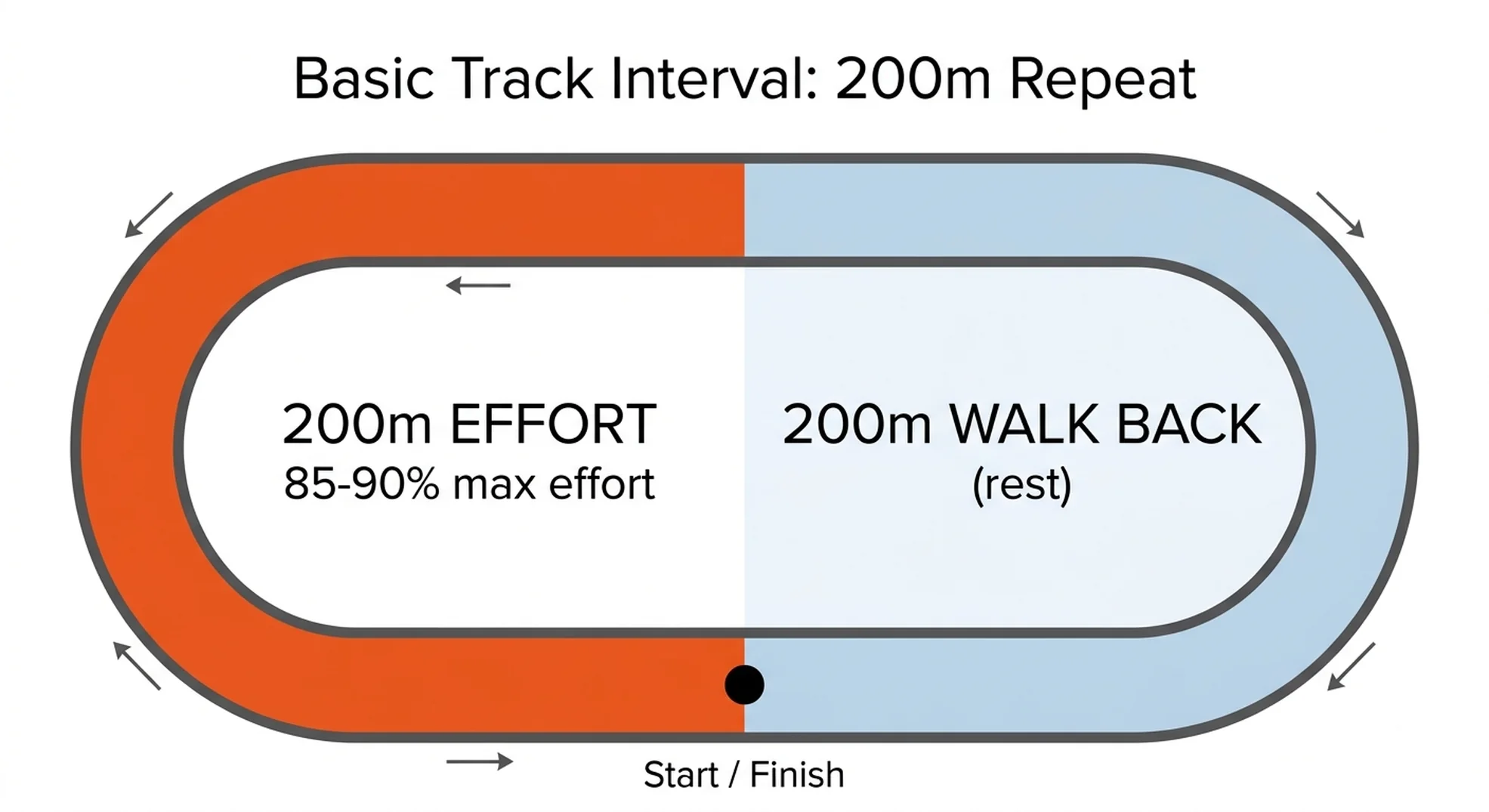
As that becomes manageable over several weeks, extend the repeat distance to 400 meters and switch to a 90-second standing rest between efforts instead of the walk-back.
Your rest interval length determines which energy system you are training, so pick the format that matches your goal.
Skipping the cool-down leaves your legs stiff the next day and adds recovery time between sessions.
Run 5 to 10 minutes of easy jogging after your last effort, followed by a few minutes of walking.
Once basic repeats feel controlled, threshold intervals are the logical next step.
Longer efforts at a harder sustainable pace produce significant aerobic gains once the base speed work is in place.
RunnersConnect Bonus
Download your FREE Improvement Performance Calculator now.
This handy pace calculator helps you to determine what pace you should be running at in training and at each racing distance based on a recent race result.
How Do You Time a Mile on the Track?
To run an exact mile on the track, start 9 meters behind the standard finish line so your four laps cover the full 1,609 meters.
Most tracks have a mile start line painted just behind the common finish line for this reason.
Look on the inside of lane 1 for a white line labeled “1 mile” about 9 meters before the finish.
If your track is not marked for the mile, line yourself up about 9 yards behind the finish line.
That is close enough for a training time trial, and the error is smaller than a typical stride length.
Start 9 meters behind the finish line, run four laps, stop at the finish. That is a true mile.
For pacing, plan your target time in 400-meter splits.
A runner aiming for a 7:00 mile needs to hit roughly 1:45 per 400-meter lap, with the last lap slightly faster if there is anything left in the tank.
A 10:00 mile pace is 2:30 per lap, and a 6:00 pace is 1:30 per lap.
Run each lap on the inside of lane 1 where possible.
Moving outside the line even by a foot stretches the distance and throws off your split targets for the rest of the workout.
What Are the Rules of Track Etiquette?
Track etiquette exists to protect faster runners from collisions and to keep the workout productive for everyone sharing the surface.
Lane 1 is reserved for the fastest runner on the track at any given moment.
If you are doing an easy recovery run or walking, stay in lanes 3, 4, or higher.
Lane 1 is for interval repeats and race-pace efforts only.
If you are the fastest runner and someone is blocking your lane, call out “track” or “on your left” as you approach.
The slower runner should step up one lane to give you a clear path.
You pass on the outside, not the inside.
Faster runners take lane 1. Slower runners and walkers stay in lanes 3 and up.
Standard running direction is counterclockwise.
Most public tracks ask runners to reverse direction on certain days to balance the wear on the surface, so check the sign posted at the gate.
Keep your bag, bottle, and phone off the track surface.
Set them in the infield or against the fence, because anything left on the track becomes a tripping hazard for runners focused on their splits.
Dogs and strollers belong on a bike path or sidewalk, not on a track.
Most facilities prohibit both for safety reasons, and the rule is usually posted at the entrance.
What Should You Wear on the Track?
Road shoes are fine for every beginner track workout.
Flats and spikes are specialty tools that most runners do not need until they are racing on the track regularly.
Flats are lightweight road shoes with less cushioning and a snugger fit.
Wear them for the main set of your workout if you want, but switch back to your regular trainers for the warm-up and cool-down.
Running 10 miles per week in flats is a fast way to end up with a calf strain or Achilles tendon flare-up.
Spikes are stripped-down racing shoes with metal or ceramic spikes screwed into the forefoot.
They grip the rubber surface and shave seconds off every lap, but they are only worth the risk for races or final tune-up workouts.
Use the shortest spike length your track allows. Most outdoor facilities cap spike length at 1/4 inch or shorter.
The posted spike rule at each track matters for the surface itself.
Longer spikes shred the rubber and shorten the lifespan of a track that took 100,000 dollars to install.
Look for the sign at the gate or on the coach’s office door before you screw anything into your shoes.
For clothes, wear what you would wear for any hard run.
Shorts and a technical shirt work in most weather.
A pair of gloves and a light long-sleeve layer are worth carrying for the warm-up in cold conditions, because your body cools rapidly between reps.



3 Responses
So who passed the test above?
What lead me to this page was a search for a picture of the old “lane use” sign that Bowerman put up at Hayward Field in the 1970’s. Didn’t find it, but this page is a great resource to share with others. All the info in one place! The old sign said “lanes 1-2 for running”, and I believe “lanes 3-6 for sprints, 5-6 when using hurdles, 7-8 for jogging and walking”.
Heading to my local track now. Thanks for the info!