You finish a brutal long run or a race, feel wrecked for days, and someone tells you to load up on vitamin C.
The advice sounds reasonable, since vitamin C is an antioxidant and hard running floods your body with the oxidative stress antioxidants are built to neutralize.
The research tells a more useful story, and part of it may surprise you.
Vitamin C can cut your odds of catching a cold after a long race roughly in half, yet taking too much of it during training can slow the fitness you are trying to build.
Here’s what you’ll learn:
- Whether vitamin C protects runners from post-race colds
- What it does for muscle soreness and recovery
- Why high-dose vitamin C can blunt your training adaptations
- How much vitamin C runners need, and where to get it
- When a supplement makes sense and when food is enough
Does vitamin C help runners?
Vitamin C helps runners in one clear way, does little in another, and can backfire in a third, so the dose and timing matter more than the pill itself.
Your body cannot make vitamin C, so you need to eat it every day, and it does real work building the collagen in your tendons, ligaments, and blood vessels.
Hard running also raises oxidative stress, the wave of reactive molecules that comes with burning large amounts of oxygen, and vitamin C is one of the antioxidants that mops them up.
That antioxidant role is why the supplement gets recommended for recovery.
The catch is that some of that oxidative stress is the signal your body uses to get fitter, so clearing all of it slows the adaptations you are training for.
That single fact is why the same nutrient can protect your immune system and hold back your training, depending on how much you take and when.
Can vitamin C stop you getting sick after a marathon?
Protection against post-race colds is the one benefit where vitamin C earns its place for runners.
Heavy training and racing suppress your immune system for hours to days after you finish, which is why a sore throat is common in the days after a marathon.
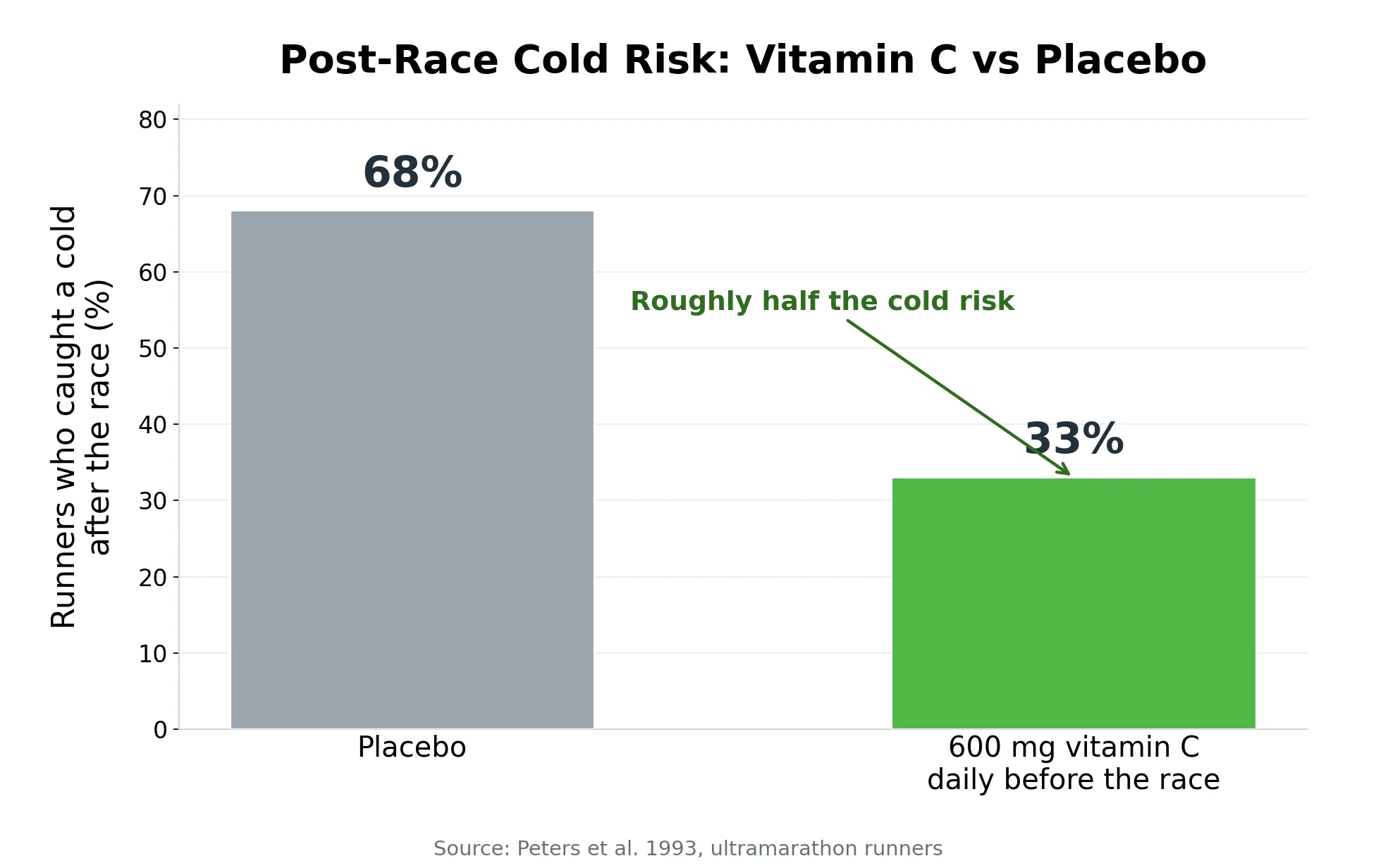
Research on ultramarathon runners found that 68% of those taking a placebo caught an upper respiratory infection after the race, compared with 33% of those who took 600 mg of vitamin C daily beforehand.

That is roughly half the cold risk, and later reviews found the same protection holds for runners under heavy physical stress.
A review of 5 trials in marathon runners, skiers, and soldiers found that regular vitamin C cut the risk of catching a cold roughly in half.
That same review found no drop in cold risk for the general population, so vitamin C’s cold protection belongs to people putting their bodies under real physical stress, which describes most runners in a hard build.
If you get sick after big races, our guide to post-race sickness covers the rest of the immune picture.
Does vitamin C speed up recovery and reduce soreness?
Vitamin C calms some of what happens inside your muscles after a hard run, but it does not make your legs feel better or recover faster.
A meta-analysis of 18 trials found that vitamin C lowered markers of oxidative stress and the inflammatory signal interleukin-6 after a hard bout of exercise.
Those are the lab numbers, and they look promising on paper.
The same analysis found no effect on muscle soreness, muscle damage, or how quickly strength returned.
So vitamin C changes what a blood test sees without changing what you feel the next morning.
Sleep, real meals, easy days, and patience do far more for recovery than any antioxidant pill, and you can sidestep the common traps in our guide to recovery mistakes.
RunnersConnect Bonus
Download our FREE recovery foods guide, with the top 10 foods for each of the essential recovery vitamins, minerals and macro nutrients. Plus a sample 1-day meal plan!
Can too much vitamin C hurt your training?
High doses of vitamin C can blunt the exact adaptations your training is meant to produce.
The oxidative stress from a hard run is not only damage, it is also the signal that tells your muscles to build more mitochondria, the tiny engines that power endurance.
Research on training adaptations found that 1,000 mg of vitamin C a day reduced the number of new mitochondria the muscles built and cancelled the endurance gains seen in the unsupplemented group.
A human trial found the same pattern.
A controlled trial in 54 men and women found that 1,000 mg of vitamin C plus vitamin E each day blunted the training-driven rise in mitochondrial proteins over 11 weeks of endurance work.
When you swallow a large antioxidant dose every day, you soften the same stress your body reads as a reason to get fitter.
Across a full training block, that trade can quietly flatten the endurance gains you spent months of hard running to earn.
How much vitamin C do runners need, and where should you get it?
Most runners need only a modest amount of vitamin C, and food covers it without the risks that come with mega-doses.
A review of vitamin C and performance concluded that about 200 mg a day, the amount in 5 or more servings of fruit and vegetables, is enough to handle exercise oxidative stress without hurting your training.
That same review found daily doses above 1,000 mg impaired performance in every study that tested them.
Reaching 200 mg from food is easy across a normal day.
- Citrus and kiwi: one orange or two kiwi covers most of a day’s target on its own.
- Peppers: a single red bell pepper carries more vitamin C than an orange.
- Berries and broccoli: a bowl of strawberries or a serving of broccoli each add another large share.
Aim for vitamin C from food rather than a daily high-dose pill, so you get the immune benefit without blunting your fitness.
Should you take a vitamin C supplement or get it from food?
Food should be your default, with a short high-dose course saved only for the days around a hard race or ultra.
During normal training, keep vitamin C coming from meals so your body can turn the oxidative stress from each run into fitness.
In the 1 to 2 weeks before a marathon or ultra, a daily 600 to 1,000 mg dose is a reasonable way to lower your post-race cold risk, since you have finished building fitness for that block.
Stop the high dose once the race is behind you and go back to getting vitamin C from food.
Use high-dose vitamin C only as a short pre-race tool, then return to food once the race is done.
| Goal | What vitamin C does | What to do |
|---|---|---|
| Avoid post-race colds | Cuts cold risk about in half after hard or long races | 600 to 1,000 mg daily for 1 to 2 weeks around the race |
| Ease soreness | Lowers lab markers but not real soreness or damage | Lean on sleep, meals, easy days, and patience instead |
| Build endurance | High daily doses reduce the new mitochondria you build | Skip daily mega-doses during hard training |
| Daily needs | About 200 mg covers exercise oxidative stress | Eat 5 or more servings of fruit and vegetables |