

Shin splints are one of the most common overuse injuries in runners.
In a 2018 study of first-year physical education students, 1 in 4 developed shin splints within a single 10-month school year.
Most advice for fixing them focuses on the lower leg: new shoes, calf stretches and icing the sore spot.
But research has found that people with weaker hips are more likely to develop shin pain in the first place.
So, can weak hips cause shin splints, and will strengthening them help?
To give an evidence-based answer, let’s look at the research on:
- How weak hips change the way your lower leg handles each stride
- Whether hip strength training lowers your risk of overuse injuries
- The hip exercises that work your glutes hardest, and when to fit them into your week
Can Weak Hips Cause Shin Splints?
People whose hip muscles test weaker are more likely to develop shin splints over the following months.
A 2014 study of 95 female physical education students found that the 21 who went on to develop shin splints had weaker hip abductors, the muscles on the outside of your hip, when they were tested at the start of the school year.

Testing everyone before they got hurt matters, because it shows the hip weakness came first and wasn’t caused by the shin pain.
Strength in the hip external rotators, the muscles that turn your leg outward, made no difference to who got hurt.
The same link shows up in runners.
A 2018 study that followed 24 college cross-country runners for 2 years found that the runners who developed shin splints had started with weaker hip abductors than the runners who stayed healthy.
That means weak hip abductors are a warning sign you can check and work on before your shins start to hurt.
How Do Weak Hips Put More Stress on Your Shins?
Your gluteus medius, the main hip abductor, keeps your pelvis level each time one foot hits the ground.
When it’s weak, the opposite side of your pelvis drops a little with every stride, and your knee drifts inward.
The runners who developed shin splints in the 2018 cross-country study showed both of those patterns.
They had more pelvic drop while running, and their feet rolled inward further and for longer on each step.
In that study, every extra 1% of ground contact time your foot spent rolling inward raised the odds of developing shin splints by 38%.
The muscles that control that inward roll attach along the inner edge of your shin bone, which is where shin splints hurt.
How well your hips hold steady when you land also matters.
A second 2014 study of 86 of the same students had them hop down from a step on one leg and jump straight back up.
The students who later developed shin splints twisted more through their hips and upper body as they landed and pushed off.
That means your hip muscles need to hold your pelvis steady at the moment your foot lands, not just test strong on a machine.
RunnersConnect Insider Bonus
Download our Shin Splint Prevention Guide inside your Insider Members area.
It’s a PDF with the four best exercises to help you prevent shin splints.
Does Hip Strength Training Help Prevent Shin Splints?
The best evidence comes from a trial that compared hip training with lower leg training in new runners.
A 2024 trial of 325 novice runners found that the runners who did a hip and core exercise program before their runs had 39% fewer overuse injuries in an average week than runners who only stretched, across 24 weeks of training.
A third group did a foot and ankle program instead, and they had no fewer overuse injuries than the runners who stretched.
They also had a higher rate of sudden injuries than the stretching group.
That lines up with why resistance band exercises for your shins won’t help you avoid shin splints.
The trial counted all overuse injuries in the legs, so it doesn’t prove that hip training prevents shin splints on their own.
But for runners starting a new running program, the hips were the better place to spend strength training time.
If you already have shin splints, hip training can also change how you run.
A 2024 trial of 40 recreational runners with shin splints found that adding 8 weeks of hip abductor training to standard physical therapy reduced pelvic drop and inward knee movement more than physical therapy alone.
That means hip work improves the stride pattern linked to shin splints, although the trial didn’t measure whether pain cleared up faster.
Are Weak Hips the Only Cause of Shin Splints?
Hip weakness is one risk factor among several, and the research on it is mixed.
A 2017 review found that 3 of the 4 studies that tested hip muscles before anyone got hurt found no link to injuries of the lower leg, ankle and foot.
The same review suggested that some of the hip weakness seen in injured people may be a result of the injury rather than its cause.
A 2017 analysis that pooled 22 studies of shin splint risk factors found 5 that held up across studies:
- Being female, which more than doubled the odds
- Higher body weight
- An arch that drops further when you stand on it
- A previous running injury
- More range of motion when rotating the hip outward
Hip strength wasn’t one of them.
In the 2018 student study, a history of shin splints raised the odds of getting them again 5-fold.
That means hip training is one part of preventing shin splints, alongside building your mileage gradually, and it’s worth starting early if you’ve had shin splints before.
Can Shin Splints Cause Hip Pain?
Shin splints cause pain along the inner edge of your shin bone rather than in your hip.
If your shins and hips hurt at the same time, the pelvic drop linked to shin splints is one likely reason, because it puts extra strain on the muscles on the outside of your hip as well.
Changing your stride to protect a sore shin can also shift extra force onto your hips, which aren’t used to handling that extra work.
That’s why you need to treat your hips along with your shins, not just the spot that hurts.
If the pain is sharp, gets worse with every run, or sits in one small spot on your shin bone, see a doctor or physical therapist to rule out a stress fracture.
Which Hip Exercises Best Protect Your Shins?
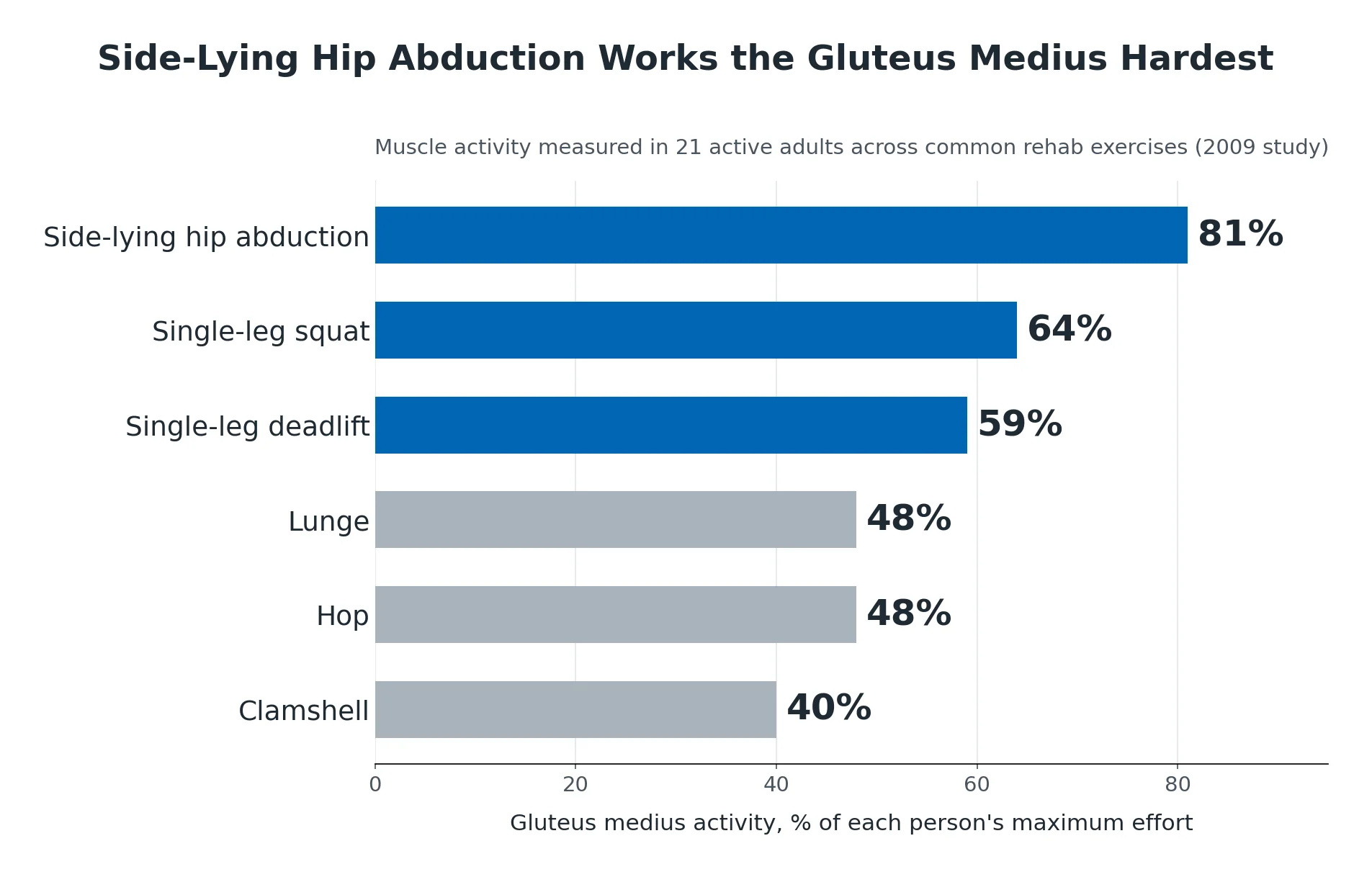
The best hip exercises for shin splints are the ones that work your gluteus medius hardest.
A 2009 study measured how hard the glute muscles worked during 12 common rehab exercises, as a percentage of each person’s maximum effort.
Side-lying hip abduction worked the gluteus medius at 81% of maximum effort, about twice as hard as clamshells at 40%.
Start with these 4 exercises.
Side-Lying Hip Abduction
Lie on your side with your bottom knee bent, then lift your top leg up and slightly behind you with your toes pointing forward.
Single-Leg Squat
Stand on one leg and lower yourself slowly, keeping your knee in line with your second toe and your pelvis level.
This worked the gluteus medius at 64% of maximum effort, and it trains your hip to stay steady while your leg bends under load, the way it does when you land.
Single-Leg Deadlift
Balance on one leg and hinge forward at the hip, reaching toward the floor while your free leg extends behind you.
It worked both the gluteus medius and the gluteus maximus at 59% of maximum effort.
Side Plank
Hold your body in a straight line on one forearm, with your hips lifted off the floor.
It trains your hip abductors and trunk together, which targets the twisting through the hips and upper body seen in the students who developed shin splints.
Do your hip exercises right before your runs, the way the new runners in the 2024 trial did, so they become part of your routine instead of an extra session.
For a progression once these get easy, work through these hip drop exercises for runners.
RunnersConnect Bonus
Download your FREE Hip Strengthening Exercises Guide.
Download a video version of the 5 most effective hip exercises for runners. You’ll get full descriptions on how to perform and a video to help guide you.
What Does the Research Say About Hips and Shin Splints?
Here’s a summary of the studies covered in this article.
| Study | Who was studied | What it found |
|---|---|---|
| 2014 hip strength study | 95 female physical education students | Weaker hip abductors predicted shin splints, and external rotator strength did not |
| 2014 hop test study | 86 of the same students | More twisting through the hips and upper body when landing predicted shin splints |
| 2018 cross-country study | 24 college runners over 2 years | Runners who got shin splints had weaker hip abductors, more pelvic drop and longer inward foot roll |
| 2024 novice runner trial | 325 new runners over 24 weeks | Hip and core exercises cut overuse injuries by 39% compared with stretching, and foot and ankle exercises did not |
| 2024 shin splints trial | 40 runners with shin splints | 8 weeks of hip abductor training reduced pelvic drop and inward knee movement |
| 2009 exercise study | 21 active adults | Side-lying hip abduction worked the gluteus medius hardest, at 81% of maximum effort |



2 Responses
Great article – but I wonder if the they were testing the wrong thing – testing abductor and external rotation strength instead of testing eccentric control of adduction and internal rotation? Thats what the glutes do when we run so makes sense to test for eccentric strength not concentric strength – I would think that there were be a higher correlation between eccentric strength and injury than concentric strength
Excellent article. I wrote a similar article on causes if medial tibial stress syndrome. While shin splits are highly correlated to glute medius weakness (eccentrically, concentrically, and through all planes of motion). Let’s not forget the importance of distalovent dysfunction. Inhibition and weakness of the anterior and posterior tibialis, flexor digitorums, and the medial gastrocnemius coupled with the hypertonicity of the peroneals and lateral gatrocniemus. Together this distal lower extremity dysfunction decreases ability to dissipate ground reaction forces. Subsequently, the forces are transferred to the medial tibial periosteum and eventually shin splints. Correctin both proximal and distal dysfunctional movement patterns will significantly reduce a runners risk of shin splits.