
Sarah had been running pain-free for three months when she decided she was ready to return to her normal training routine.
Two weeks later, she was back on the couch with the same IT band pain that had sidelined her initially.
Sound familiar?
If you’ve ever rushed back from injury only to find yourself hurt again, you’re not alone.
Research consistently shows [1] that 20 to 70% of runners who return from injury will re-injure themselves, often within the first few months of their comeback.
But here’s what’s truly frustrating: most of these re-injuries are completely preventable.
The problem isn’t that injured runners are unlucky or fragile.
The problem is that most runners, and unfortunately, many healthcare providers, don’t understand the fundamental difference between tissue healing and tissue readiness for running.
Just because something doesn’t hurt doesn’t mean it’s ready for 1,500 foot strikes per mile.
If you’re currently sidelined with an injury, have experienced the frustrating cycle of injury-comeback-reinjury, or want to ensure your next comeback is your last, this article will transform how you approach return to running.
More importantly, you’ll understand exactly why following arbitrary timelines (“6 weeks for a stress fracture”) or pain-based decisions (“it doesn’t hurt, so I must be ready”) sets you up for failure.
So in this article, we’re going to dig deep into…
- The tissue healing science that determines when your body is actually ready to handle running loads again
- A systematic 4-phase return protocol that progresses based on functional markers, not calendar dates
- Injury-specific modifications for the most common running injuries: stress fractures, plantar fasciitis, and IT band syndrome
- The psychological factors that can sabotage even the most perfectly planned physical comeback
- Red flag symptoms that should immediately pause your return, and why ignoring them costs you months of additional recovery time
The Hidden Truth About Running Injury Recovery
Why Most Comeback Attempts Fail
The statistics on running injuries paint a sobering picture.
Recent research shows [2] that runners face a 45.9% annual injury rate, with those who have a previous injury being twice as likely to sustain a new running-related injury.
But here’s what’s truly alarming: Studies consistently show [3] that recurrence of running injuries occurs in 20 to 70% of cases.
Most failed comebacks stem from three fundamental misconceptions:
The “Pain-Free Equals Ready” Myth: Simply because you can walk without pain doesn’t mean your tissues are ready for the repetitive loading demands of running.
The “Time-Based Recovery” Fallacy: Following arbitrary timelines rather than tissue-specific healing phases and functional benchmarks.
The “Jump Back In” Approach: Attempting to resume previous training loads without systematic tissue preparation.
The Cost of Getting It Wrong
The economic impact alone should give every runner pause.
Research indicates [5] that 84.4% of recreational runners have an injury history, with 44.6% experiencing an injury within the past year.
Each improper comeback attempt extends recovery time by an average of 3-6 months while increasing re-injury risk exponentially.
More concerning is the psychological toll, many runners develop kinesiophobia (fear of movement) after multiple failed comeback attempts, leading to permanent reduction in activity levels.
Understanding Tissue Healing: The Science Behind Recovery Timelines
The Three Universal Phases of Tissue Repair
Every injured tissue in your body progresses through three distinct but overlapping phases, regardless of whether it’s bone, muscle, or tendon.
Inflammatory Phase (0-7 days): This initial response involves increased blood flow, swelling, and the recruitment of immune cells to clear damaged tissue.
Research demonstrates [6] that the inflammatory stage lasts approximately 48 hours and consists of erythrocyte, leukocyte, and platelet infiltration.
Proliferative Phase (3-21 days): Your body begins rebuilding damaged tissue by laying down new collagen fibers in a somewhat disorganized pattern.
During this phase, fibroblasts produce type III collagen, a less durable but faster-forming protein that serves as scaffolding for stronger tissue.
Remodeling Phase (21 days-2+ years): The longest and most crucial phase where disorganized tissue becomes stronger and more functional.
A study on tendon healing shows [7] that this third stage begins months after initial injury, can last longer than 12 months, and involves collagen I synthesis replacing the weaker collagen III.
Injury-Specific Healing Timelines
Understanding that different tissues heal at dramatically different rates is crucial for setting realistic expectations.
Stress Fractures: Bone healing requires 6-16 weeks based on location and severity, with high-risk sites like the femoral neck requiring longer periods.
Data from systematic reviews [8] shows that tibial bone stress injuries have high recurrence rates when return-to-running protocols aren’t properly followed.
Plantar Fasciitis: One of the most persistent running injuries, with resolution typically taking 6-18 months when managed conservatively.
Research on plantar fasciitis treatment [9] demonstrates that 10% of people (50% of runners) experience Achilles tendinopathy by age 45.
IT Band Syndrome: Usually resolves in 4-12 weeks when underlying biomechanical factors are addressed.
A landmark study [10] found hip strengthening protocols reduce IT band syndrome recurrence by 67%.
Factors That Accelerate or Delay Healing
Age significantly impacts recovery, with research showing that tissue healing slows progressively after age 30 due to decreased metabolic activity and reduced growth factor production.
Nutrition plays a critical role, adequate protein intake (1.2-1.6g/kg body weight) is essential for collagen synthesis, while vitamin C, D, and zinc deficiencies can extend healing times by months.
Sleep quality affects recovery through growth hormone release, with studies showing that less than 7 hours of sleep can increase injury risk by 70%.
RunnersConnect Bonus
Download your FREE Hip Strengthening Exercises Guide.
Download a video version of the 5 most effective hip exercises for runners. You’ll get full descriptions on how to perform and a video to help guide you.
How Do You Know You’re Ready to Run Again?
You earn your first run back by passing a short set of physical checks.
What your legs can do under load tells you when you are ready.
Research on injured athletes found that loading a healing tissue is safe when pain during the session stays at or below 5 on a 10-point scale and settles back to normal by the next morning.

That next-morning response is the most useful readiness test you have.
If a walk, a set of calf raises, or a short jog leaves you sore the following day, the tissue could not handle that load yet.
4 checks tell you whether your body has the capacity to start running again.
Pain-free walking: You can walk 30 minutes at a brisk pace with no pain during or after.
Strength symmetry: Your injured leg produces close to 90% of the strength of your healthy leg on single-leg tests like calf raises and single-leg squats.
Two simple hip strength and stability tests give you a way to check that side-to-side gap at home.
Full range of motion: The injured joint or muscle moves through its normal range without pain or stiffness.
The 24-hour rule: Any soreness from yesterday’s loading is gone by the next morning.
| Readiness check | Pass standard before your first run |
|---|---|
| Pain-free walking | 30 minutes at a brisk pace, no pain during or after |
| Strength symmetry | Injured side within about 90% of the healthy side on single-leg tests |
| Range of motion | Full, pain-free movement at the injured site |
| 24-hour response | Loading soreness settles by the next morning |
Clear all 4 and your tissue has the capacity to begin the return protocol below.
Miss one and you stay in preparation until it passes, because starting early is what turns a single injury into a recurring one.
The Evidence-Based Return-to-Running Protocol
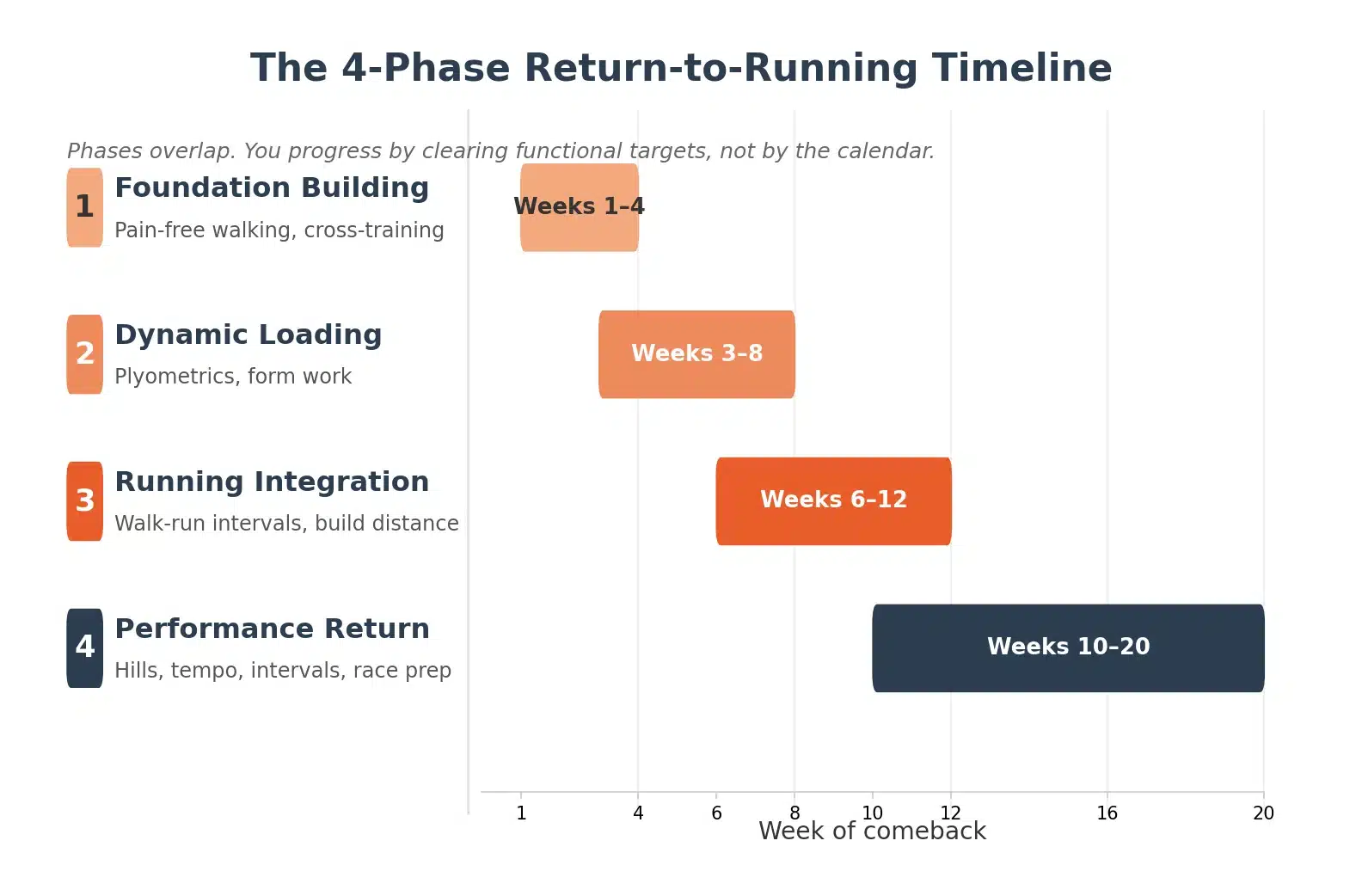
Phase 1: Foundation Building (Weeks 1-4)
The first phase focuses on establishing pain-free movement patterns and basic load tolerance.
Load Tolerance Testing: Begin with 30 minutes of pain-free walking at a brisk pace before considering any running activities.
This benchmark, used in clinical protocols [11], ensures your tissues can handle sustained loading without inflammatory response.
Movement Quality Restoration: Address any compensatory movement patterns that developed during your injury period.
Research shows [12] that injured runners often demonstrate altered kinematics, including changes in knee valgus and thorax movement patterns.
Cardiovascular Maintenance: Maintain fitness through cross-training that doesn’t stress the injured tissue.
Pool running, cycling, and elliptical training can maintain cardiovascular fitness while allowing tissue healing to progress.
Phase 2: Dynamic Loading Introduction (Weeks 3-8)
The second phase introduces controlled impact loading through specific exercises and movement patterns.
Progressive Impact Loading: Start with low-level plyometrics – single-leg hops, double-leg bounds, and lateral movements.
Clinical research suggests [13] that 500-600 foot contacts between one and two legs represents adequate preparation for running activities.
Tissue-Specific Protocols: Bone stress injuries require different loading progressions than soft tissue injuries.
For stress fractures, gradual weight-bearing progression is essential, while soft tissue injuries benefit from progressive tensile loading.
Biomechanical Assessment: This is when movement pattern correction becomes critical.
Studies show [14] that runners who land more softly have significantly lower injury rates than those with high vertical loading rates.
Phase 3: Running Integration (Weeks 6-12)
The third phase systematically reintroduces running through structured walk-run intervals.
The Walk-Run Protocol: Start with alternating intervals rather than continuous running.
A proven progression begins with 0.1 mile walk/0.1 mile jog repeated 10 times, gradually increasing the jogging portions while decreasing walking intervals.
Surface and Speed Progression: Begin on predictable surfaces like treadmills or tracks before progressing to varied terrain.
Research on ground reaction forces shows [15] that surface changes significantly alter loading patterns on recovering tissues.
Volume vs. Intensity Prioritization: Always progress distance before speed during this phase.
Clinical evidence supports [16] building weekly mileage by 10-30% increments rather than focusing on pace improvements.
Phase 4: Performance Return (Weeks 10-20)
The final phase prepares you for return to previous training intensities and race preparation.
Sport-Specific Loading: Gradually reintroduce training elements like hill running, tempo efforts, and interval work.
Return-to-Competition Guidelines: Objective markers include completing 75-80% of pre-injury weekly mileage without symptoms for 2-3 consecutive weeks.
Evidence-based protocols [17] suggest this benchmark indicates readiness for normal training progression.
What Do the Clinical Return-to-Running Programs Recommend?
The return-to-running programs used in sports medicine clinics share a single rule.
You advance to the next stage by hitting a physical target that shows the tissue is ready.
Every program starts from the same base of 30 minutes of pain-free walking before any jogging.
From there, they use a graded walk-run structure, alternating jogging and walking and raising the jogging share as your symptoms stay quiet.
The run-walk method is the tool most of these programs are built on, and it lets you add running load in small, controlled doses.
A 2024 survey of physiotherapists found that clinicians now base return decisions on objective strength and movement tests rather than time since the injury.
Workload research found that injury risk climbs sharply when a week’s training load jumps more than 50% above what the body has been handling.
That means a safe return builds running volume in small weekly steps, even once you feel good.
Choose a criteria-based walk-run program and advance only once you clear each benchmark.
Injury-Specific Comeback Protocols
Stress Fracture Return Protocol
Stress fractures require the most conservative approach due to catastrophic failure risk if healing is incomplete.
High-Risk vs. Low-Risk Sites: Femoral neck, anterior tibial shaft, and navicular fractures require longer healing periods than posterior tibial or metatarsal fractures.
A systematic review [18] identified five critical components before resuming running: resolution of bony tenderness, pain-free walking, radiological healing evidence (for high-risk fractures), adequate strength testing, and identification of contributing factors.
Bone Loading Progression: Start with partial weight-bearing activities and progress based on pain response rather than arbitrary timelines.
Pool running allows cardiovascular maintenance while minimizing bone stress during critical healing phases.
Nutrition Optimization: Ensure adequate calcium (1200-1500mg daily), vitamin D (800-1000 IU), and protein intake throughout recovery.
Plantar Fasciitis Comeback Strategy
Plantar fasciitis requires addressing both tissue healing and underlying biomechanical factors.
Morning Pain Assessment: Use first-step morning pain as a healing indicator – complete resolution should occur before progressing to running phases.
Progressive Loading Protocol: Begin with pain-free walking tolerance, then advance through calf raises, single-leg heel raises, and finally dynamic loading activities.
Research demonstrates [19] that high-load strength training significantly improves outcomes compared to traditional stretching approaches.
Footwear Considerations: Studies show mixed results for orthotic interventions, but proper footwear selection based on individual foot mechanics remains important.
IT Band Syndrome Recovery Framework
IT band syndrome recovery focuses heavily on addressing hip weakness and training modifications.
Hip Strengthening Protocol: Target hip abductor weakness, which research shows [20] is present in most runners with IT band syndrome.
Specific exercises include clamshells, side-lying hip abduction, and single-leg glute bridges performed 3-4 times per week.
Running Gait Modifications: Increase step rate by 5-10% and focus on landing with the foot closer to your center of mass.
Training Error Correction: Address the “too much, too soon” progression that typically precipitates IT band syndrome through structured mileage increases.
The Psychology of Injury Comeback: Overcoming Fear and Building Confidence
Understanding Kinesiophobia in Runners
Fear of re-injury affects movement patterns at a subconscious level, often persisting long after tissues have healed.
Research shows [21] that up to 19% of athletes do not return to sport due to fear of re-injury, even after successful physical rehabilitation.
This psychological barrier can create altered movement patterns that actually increase injury risk, creating a self-fulfilling prophecy.
Building Physical Confidence Through Objective Markers
Functional Movement Screens: Use standardized assessments like single-leg squats, hop tests, and movement quality screens to build confidence through measurable progress.
Performance Benchmarks: Establish specific strength and movement thresholds before advancing between phases.
For example, being able to perform 25 single-calf raises or hop 90% of the distance compared to your uninjured leg provides objective confidence markers.
Progressive Exposure Therapy: Systematically expose yourself to challenging movements in controlled environments before attempting them during running.
Mental Strategies for Long-Term Success
Expectation Management: Understand that some discomfort during return phases is normal, but sharp or worsening pain requires immediate attention.
Process Focus vs. Outcome Focus: Research on adherence shows [22] that focusing on daily process goals leads to better long-term outcomes than outcome-based goals.
Building Resilience: Develop coping strategies for minor setbacks, as small flare-ups during comeback are common and don’t necessarily indicate failure.
Red Flags: When to Pause Your Comeback
Physical Warning Signs
Pain Pattern Recognition: Sharp, shooting, or progressively worsening pain requires immediate cessation of activities.
Inflammatory pain typically presents as constant, throbbing discomfort that worsens with activity, while mechanical pain is often intermittent and related to specific movements.
Load Response Indicators: Monitor symptoms for 24-48 hours after each training session.
If pain increases significantly or persists beyond this timeframe, your tissues aren’t ready for the current loading level.
Compensatory Movement Patterns: Be alert for limping, favoring one side, or altered running mechanics that indicate incomplete healing or inadequate strength.
Performance Markers That Indicate Problems
Decreased Running Economy: Noticeable increases in perceived effort at previously comfortable paces often indicate incomplete recovery.
Asymmetry Patterns: Significant differences in strength, range of motion, or movement quality between injured and uninjured sides suggest continued healing needs.
Abnormal Training Response: Unusual fatigue, poor sleep quality, or extended recovery times between sessions may indicate excessive loading.
Building Your Injury-Resistant Future
The 80/20 Prevention Protocol
Load Management: The most important factor in injury prevention involves managing the balance between training stress and recovery capacity.
Research consistently shows [23] that sudden increases in training load, rather than total volume, correlate with injury risk.
Strength Training Integration: Two sessions per week focusing on running-specific movements can reduce injury risk by up to 50%.
Key exercises include single-leg deadlifts, lateral lunges, and posterior chain strengthening that address common running injury patterns.
Recovery Optimization: Prioritize sleep quality (7-9 hours nightly), stress management, and nutritional adequacy as foundational injury prevention strategies.
Long-Term Monitoring Strategies
Early Warning Systems: Track subjective markers like sleep quality, energy levels, and muscle soreness alongside objective measures like resting heart rate variability.
Periodic Assessment: Schedule quarterly movement screens and strength assessments to identify developing problems before they become injuries.
Training Modification Triggers: Develop specific criteria for reducing training loads, such as three consecutive days of elevated soreness or significant sleep disruption.
Your Comeback Action Plan
Week-by-Week Implementation Guide
Weeks 1-4 Assessment: Can you walk 30 minutes pain-free at 3.5+ mph? Can you perform 25 single-calf raises? Do you have full range of motion in the previously injured area?
Weeks 5-8 Progression: Successfully complete 500+ foot contacts through plyometric exercises? Demonstrate symmetrical movement patterns in functional screens? Maintain pain levels below 3/10 during and after activities?
Weeks 9-12 Integration: Complete walk-run intervals without symptom flare-ups? Demonstrate normal running mechanics on treadmill analysis? Achieve 50-75% of pre-injury weekly mileage?
Weeks 13-20 Performance: Sustain 75-80% of previous training volume for 2-3 consecutive weeks? Successfully complete sport-specific training elements like hill runs or tempo efforts? Pass return-to-competition functional testing?
Building Your Support Team
When to Involve Professionals: Seek guidance from sports medicine physicians for diagnosis and clearance, physical therapists for movement assessment and exercise prescription, and running coaches for training progression advice.
Communication Strategies: Maintain detailed training logs including pain levels, sleep quality, and subjective energy levels to provide objective data to healthcare providers.
Self-Advocacy: Ask specific questions about tissue healing status, functional benchmarks for progression, and red flags that should pause your comeback.
Remember that successful return to running after injury requires patience, systematic progression, and attention to both physical and psychological factors.
The evidence is clear: runners who follow structured, criteria-based return protocols have significantly lower re-injury rates and better long-term outcomes than those who rely on time-based guidelines alone.
Your running future depends not on how quickly you return, but on how systematically you rebuild your foundation for long-term success.