

That sharp, stabbing pain in your side during a run feels like someone is driving a knife into your ribs.
It only happens on one side, makes it hard to breathe, and suddenly running feels impossible.
The good news: side stitches are extremely common and manageable once you understand what’s happening and how to fix it.
About 70% of runners experience a side stitch at some point, which means you’re not alone and there’s plenty of solid research on preventing them.
So, in this article you’re going to learn the research-backed practical advice on:
- What side stitches actually are and why you feel them below your ribs
- Three competing theories on the cause, and what science says about each
- Which foods and drinks you should avoid before running
- Who’s most at risk and why fitness level matters
- How to stop a stitch mid-run when one strikes
- Long-term prevention strategies with proven effectiveness
What Is a Side Stitch?
A side stitch is a sharp, stabbing, or cramping pain that appears just below your ribs, almost always on one side of your body.
Medical researchers call it exercise-related transient abdominal pain (ETAP). The word “transient” means it goes away quickly once you stop running or slow down.
The pain can range from a mild ache to an intense stab that makes you want to stop moving completely.
Sometimes the pain extends to the tip of your shoulder on the same side, a detail that turns out to be important for understanding what causes stitches.
Side stitches typically vanish within minutes of reducing your pace or stopping activity entirely.
Though they’re painful in the moment, they’re not dangerous.
Side stitches don’t indicate an injury or underlying condition.
Newer runners and younger athletes experience stitches more often, but even experienced marathoners can get them, especially if they’re racing hard or have eaten close to run time.
Are Side Stitches Dangerous?
A side stitch feels alarming, but exercise-related transient abdominal pain carries no physical danger and leaves no lasting harm.
Decades of research across running, swimming, and horseback riding have consistently found that ETAP resolves quickly after activity stops and causes no injury, organ damage, or long-term consequences.
The word “transient” in the medical name captures the defining feature: this is temporary pain tied directly to exercise intensity.
Knowing when pain is definitely a stitch, and when it might be something else, matters for your decision-making mid-run.
A stitch behaves in a specific, predictable way: it arrives during exercise, usually within the first 15 to 20 minutes of running hard, and it eases when you slow down or stop.
Side stitches feel very different from muscle cramps, which involve an involuntary, sustained contraction in a specific muscle belly rather than a sharp stabbing pain just below your rib cage.
Two patterns should prompt medical attention even when pain first appears during a run.
The first: abdominal pain that does not improve within 20 to 30 minutes of stopping activity.
The second: pain that arrives alongside fever, vomiting, or nausea during or after exercise.
Pain that does not resolve within 30 minutes of stopping activity warrants a doctor’s evaluation.
What Causes Side Stitches When Running?
The exact cause of side stitches remains a scientific puzzle. Three main theories dominate the research, and each one is supported by actual evidence.
Understanding these competing ideas helps explain why different prevention strategies work for different runners.
Theory 1: Low Blood Flow to the Diaphragm (Largely Disproven)
For decades, the prevailing explanation was that blood flow drops to your diaphragm during hard running, starving the muscle of oxygen and causing pain.
The logic made sense: when you run hard, your leg muscles demand blood, and the stomach demands blood if you’ve eaten recently, so the diaphragm might be left short.
But evidence has largely dismantled this theory.
In 2006, researchers at Avondale College in Australia tested 28 athletes with a history of side stitches, measuring their breathing and lung function before and after a treadmill run.
Fourteen athletes developed a stitch during the test, and fourteen did not.
When the researchers compared the two groups, they found only a minor decrease in exhalation power in the stitch group but no meaningful difference in inhalation strength.
If blood flow were the culprit, inhalation strength (controlled by the diaphragm) would show obvious weakness during stitch episodes.
That didn’t happen, so ischemia theory fell out of favor.
Additional evidence against this theory: horse riders experience stitches in up to 62% of rides, yet horseback riding demands almost no heavy breathing. Blood flow shouldn’t be an issue.
Theory 2: Organs Pulling on Ligaments and Irritating the Abdominal Lining (Most Supported)
The most widely supported explanation involves the mechanical stress of impact.
Your stomach, liver, and other abdominal organs are anchored to your diaphragm and abdominal wall by connective tissues called visceral ligaments.
Every time your foot strikes the ground while running, your organs bounce downward. The ligaments holding them in place stretch under that weight.
When the strain reaches a tipping point, those stretched ligaments irritate the parietal peritoneum, a sensitive membrane that lines the inside of your abdomen.
That irritation is the pain you feel.
Research has shown that high-sugar fluids increase stitch severity significantly compared to water or sports drinks during exercise.
This theory elegantly explains several confusing aspects of side stitches.
If your stomach is fuller or heavier because you ate a large meal or drank concentrated juice, there’s more weight pulling on those ligaments, making a stitch more likely.
Sugary drinks stay in your stomach longer because they absorb more slowly than water or isotonic sports drinks, meaning the mechanical stress lasts longer.
This also explains why some sports trigger stitches far more than others. Running and horseback riding involve vertical jolting that yanks organs downward, while swimming involves rotational twisting that stresses the ligaments differently.
Cycling, by contrast, keeps organs relatively stable, which is why cyclists rarely report stitches.
This finding strongly supports the visceral ligament theory over the other two competing explanations.
Theory 3: Irritation of the Upper Spine Nerves (Emerging Evidence)
A third explanation focuses on the thoracic spine, the section of your backbone in the upper back.
In a 2004 clinical report, researchers Morton and Aune found that in 47% of athletes with a history of side stitches, they could reproduce the exact stitch pain by applying manual pressure to specific vertebrae (T8-T12) in the upper back.
This suggests that dysfunction in the thoracic spine, or how the spine moves during running, contributes to ETAP.
The nerve connections support this theory: the phrenic nerve (which controls the diaphragm) and the nerve branch that reaches to your shoulder tip both originate from the same area of the spine.
That’s why some stitches extend pain to your shoulder. It’s referred pain along the same nerve pathway.
Posture matters here too: research has linked kyphosis (excessive forward curvature of the upper back) to an increased risk of stitches, likely because the rounded posture increases stress on the thoracic vertebrae during the vertical impact of running.
However, this theory doesn’t fully explain the strong connection to food and fluid intake, which is more easily explained by the visceral ligament theory.
Does What You Eat and Drink Before Running Cause Side Stitches?
Yes. The research is clear that timing and content of pre-run meals and fluids significantly affect your risk.
A landmark 2004 study had 40 athletes with a history of side stitches consume different fluids before treadmill running: water, sports drinks, fruit juice, or nothing at all.
Fruit juice, with its high concentration of sugar, triggered severe stitches in far more cases than the other options.
Sports drinks (moderate sugar) performed better than juice but worse than plain water.
The mechanism: high-sugar fluids are hypertonic, meaning they pull water into the stomach for dilution rather than absorbing quickly into the bloodstream.
The result is a stomach that stays full and heavy for longer, prolonging the mechanical stress on those visceral ligaments.
Avoid concentrated sugary drinks like fruit juice for 60-90 minutes before running.
Large meals have the same effect whether they’re high-sugar or not. A full stomach weighs more and pulls harder on the ligaments as you run.
Most runners find that waiting 2-3 hours after a substantial meal before running reduces stitch risk dramatically.
If you’re running very early in the morning and need fuel, stick to something small and easily digestible: a banana, a handful of nuts, or a small piece of toast.
Test your pre-run nutrition during training runs, never during a race or important workout.
RunnersConnect Bonus
Still struggling with side stitches? Download our side stitch prevention guide.
It’s the 3 most critical stretching and strengthening exercises you can perform to prevent and treat side stitches.
Who Gets Side Stitches Most Often?
Side stitches are not distributed equally across all runners.
Certain factors predict who’s more vulnerable. The good news is that most of them are changeable.
Age and experience level. Younger, less experienced runners report stitches more frequently than older, well-trained athletes.
Consistent training appears to have a protective effect.
The more you run, the less likely you are to develop stitches, even in the early season.
This suggests that adaptation and conditioning matter, not just age.
Posture and spinal alignment. Runners with excessive upper back curvature (kyphosis) experience stitches more often, likely because the rounded posture increases stress on thoracic vertebrae during running impact.
If you have chronic stitches, check your running posture for excessive forward hunching.
Core strength. A 2014 study of 50 runners found that athletes with stronger abdominal muscles, specifically a larger resting transversus abdominis, reported significantly less pain from ETAP.
Weak core muscles can’t stabilize your torso effectively during running, which increases stress on the diaphragm and overlying ligaments.
Breathing patterns. Shallow breathing or breath-holding during running restricts your diaphragm and can trigger spasm or pain.
Deep, rhythmic breathing (belly breathing) allows the diaphragm to move fully and reduces strain.
Could That Side Pain Be Your Appendix?
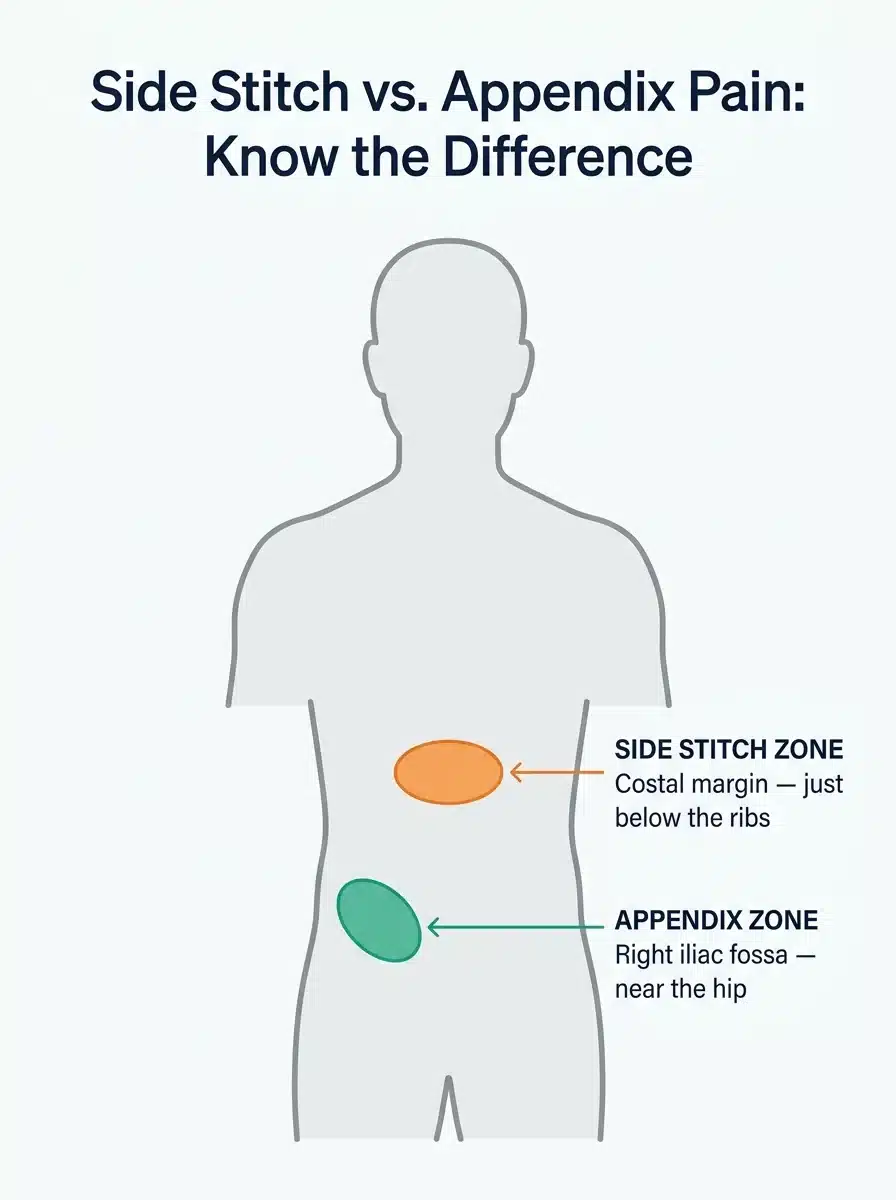
The appendix sits in the lower right abdomen, roughly 3 to 5 inches below the belly button, in the region doctors call the right iliac fossa.
Side stitches occur at the costal margin, the curved edge where your lower rib cage meets your abdomen, well above where the appendix sits.
That anatomical gap makes location your first differentiating factor.
Pain at or just below your ribs fits the ETAP pattern.
Pain lower down, closer to your hip or right groin, deserves more careful attention before you attribute it to a stitch.
Three clinical features separate appendicitis from a side stitch.
Resolution with rest.
A side stitch eases within 2 to 5 minutes of slowing down or stopping.
Appendicitis pain does not improve with rest. It intensifies gradually over hours regardless of activity level.
Accompanying symptoms.
ETAP produces no systemic symptoms beyond the localized pain.
Appendicitis almost always includes at least one of: nausea, vomiting, fever above 99°F, or complete loss of appetite.
Character of the pain.
A stitch produces a sharp, stabbing sensation that peaks and then subsides with reduced effort.
Appendicitis produces a constant, progressively worsening ache that does not fluctuate with your pace.
Right-sided abdominal pain that does not resolve after 30 minutes of rest, or that comes with fever or vomiting, requires immediate medical evaluation.
How Do You Get Rid of a Side Stitch Mid-Run?
If a stitch catches you during a run, several techniques provide fast relief. Prevention is always preferable to treating a stitch once it starts.
Slow your pace and focus on deep breathing. Reduce to an easy jog or walk and shift to slow, deep belly breathing through pursed lips.
This fully engages your diaphragm and reduces the cramping sensation.
Many runners report relief within 30-60 seconds of breathing this way.
Bend forward while tightening your core. Stop or slow dramatically, then bend at the waist while pulling your abdominal muscles in tight.
This changes the position of your organs and reduces tension on the stretched ligaments.
Relief often comes within 60-90 seconds.
Adjust your running form. Shorten your stride, reduce the impact force, or shift your weight forward slightly to reduce vertical bouncing.
Even a small reduction in impact can diminish stitch intensity.
Apply external pressure or wear compression. Some runners find that a snug belt or compression around the waist provides temporary mechanical support and eases discomfort.
Most stitches resolve within 5 minutes if you slow down and apply one of these techniques.
How Long Does a Side Stitch Last? What to Do If Yours Won’t Go Away
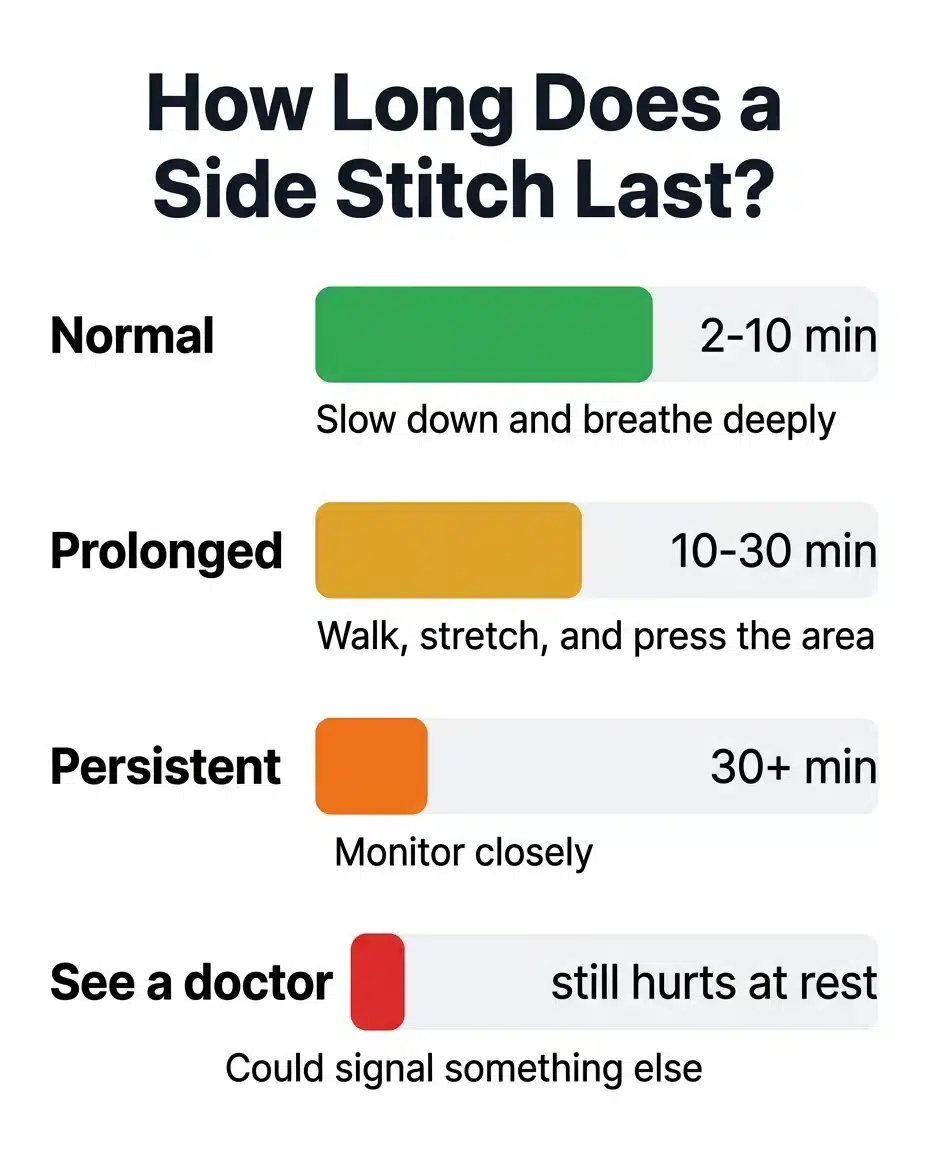
Most side stitches resolve within 2 to 5 minutes of slowing to an easy jog or walk and focusing on deep, controlled breathing.
The “transient” label in exercise-related transient abdominal pain reflects exactly this: the pain is short-lived once you remove the mechanical trigger.
Research reviewing ETAP across multiple sports found that the condition is directly tied to exercise intensity, with pain reliably subsiding once effort decreases.

A stitch that lingers for more than 10 minutes after stopping completely is uncommon and suggests something beyond a routine episode.
When runners describe a “constant side stitch” or pain that seems to last for days, three patterns explain most cases.
An unresolved recurring trigger.
Eating too close to a run, consuming high-sugar fluids before heading out, or training above your current conditioning level can reliably reproduce a stitch on nearly every run.
The pain feels constant because the same trigger repeats each run.
Thoracic spine involvement.
When vertebrae T8 through T12 are restricted or irritated, referred pain along that nerve pathway can feel persistent rather than episodic.
Runners with chronic forward posture or upper back tightness are most susceptible to this pattern.
A condition requiring evaluation.
Abdominal pain that genuinely does not resolve with rest, or that recurs in the same specific location regardless of nutrition or breathing changes, warrants a medical review to rule out causes unrelated to exercise.
If your side stitches recur on most runs and haven’t improved after 4 weeks of addressing nutrition timing, breathing mechanics, and core strength, a sports physiotherapist can assess whether thoracic spine dysfunction is driving the pattern.
How Do You Prevent Side Stitches From Coming Back?
Long-term prevention is far more effective than chasing relief during runs.
The strategy has three parts: manage pre-run nutrition, improve breathing and form, and build strength.
Part 1: Pre-Run Nutrition and Hydration
Timing and food choice matter equally.
Avoid solid meals 2-3 hours before running. This gives your digestive system enough time to move food from your stomach into your small intestine, so there’s less weight pulling on ligaments during your run.
For fluids, avoid anything high in sugar 60-90 minutes before running. Skip fruit juice, soda, and heavily sweetened sports drinks.
Water or a low-sugar electrolyte drink is your safest bet for pre-run hydration.
If you run in the early morning and need fuel, eat something small and easily digestible 30-45 minutes before heading out. Consider a banana, a piece of toast with a thin spread of nut butter, or a small handful of almonds.
These options provide energy without sitting heavy in your stomach.
Critical rule: Always test new fueling strategies during easy training runs, not before a race or hard workout.
Your gut’s tolerance changes with pace, intensity, stress level, and individual factors that only your experience will reveal.
Part 2: Breathing and Running Form
How you breathe directly affects diaphragm stress.
Shallow, chest breathing leaves your diaphragm cramped and vulnerable.
Instead, practice belly breathing: allow your abdomen to expand when you inhale, drawing air deep into your lungs.
Start this practice during easy runs when you’re relaxed, not during hard efforts when you’re already stressed.
Once belly breathing feels natural, maintain it during all your runs, especially during speed work.
This single change eliminates stitches for many runners.
Your running posture also matters. Aim for an upright torso with your shoulders back, not hunched forward.
Forward slouching compresses your abdomen and restricts diaphragm movement, increasing stitch risk.
A brief 5-10 minute warm-up at an easy pace before any hard effort also reduces stitch frequency, likely by giving your digestive system and respiratory system time to settle into a pattern.
Part 3: Core and Spine Strength
Strengthening your core, especially the transverse abdominis (your deepest abdominal muscle), provides the most durable long-term protection against ETAP.
Research shows that runners with stronger trunk muscles and larger resting transversus abdominis experience significantly less ETAP pain.
You don’t need elaborate routines. Ten to 15 minutes of core work, 3 days a week, creates measurable strength gains in 4-6 weeks.
Focus on planks (front and side), dead bugs, bird dogs, and carries (farmer’s carry, suitcase carry).
These exercises build stability without requiring equipment.
If you have chronic stitches or suspect thoracic spine involvement, also include spinal mobility work. Thoracic rotations and gentle extensions help restore movement in the upper back and reduce nerve irritation.
Hip and back strength matter too. Running demands stability from your core, back extensors, and hip muscles as you move through each stride.
When these muscles are weak, compensation patterns emerge, and your diaphragm bears extra load.
A physical therapist can assess whether thoracic spine dysfunction or posture issues are contributing to your stitches and design a targeted program.
If you experience chronic stitches despite trying these strategies, have a physical therapist evaluate your posture and spine mobility.
Kyphosis or disc issues may require hands-on treatment that goes beyond self-directed core work.



8 Responses
Just an FYI – shoulder tip pain can also occur with diaphragmatic irritation. As you correctly pointed out, the diaphragm and shoulder have a nerve supply from the same spinal root. Consequently they have a similar location in the brain’s sensory cortex (put simply, the map of a Sensation’s nerve to where it is on the body). This proximity can be a source of error, so diaphragm sensation can be mapped to the shoulder. This occurs in many conditions affecting the liver and gallbladder as well.
Hi CP, thanks for reaching out and sharing. That is interesting to know, and something that definitely contributes to the article, thank you for adding it to the discussion!
With my own experience of suffering from chronic stitches, I never thought a respiratory problem was necessarily a cause, but just that because of where the pain is, you wind up controlling your breathing patterns and the deepness of your breaths in order to keep yourself from more pain. I also have Crohn’s disease – when I suffer from a flare up, I generally feel/experience it on my right side, right around my appendix, occasionally a bit closer to my abdomen. Just like with my runners stitch, I have to control my breathing during a flare up, too, even though it isn’t a respiratory issue – but a digestive issue. Controlling my breathing helps alleviate the pressure in the area, so sometimes I feel like I am barely breathing at all, or forcing a shortness of breath, just to feel more comfortable, and I’ve realized that it is the same thing I do with a stitch. So perhaps other runners who feel this pain in their sides do the same thing, but perhaps some are unaware that they are doing it because it just becomes a subconscious effort.
Hi Devlin, thanks for sharing your experience. Controlling breathing has a big impact, and it is good that you have realized what works for you, other runners may find comfort in your findings. Thanks for sharing! Can we help with anything for your running?
Great article! Very well written and informative. I got here by googling this question, and really impressed by your thorough and cogent review of the literature on side pain during running. Thanks for writing this.
Thanks Lisa, glad you found it helpful. Is there anything else we can help you with?
I took a long break after a couple of marathons, now I’ve started running again and recently, every time I train I experience severe side stitches. I run empty stomach and just sip some water now and then while I run and no sugary or fruit drinks before or even during the runs. I tried changing my breathing pattern but in vain. I’ll try stretching my abdominal muscles and deep breathing next time i run. I wonder if I ever get back to my earlier best performances! Thanks for this article.
Hello,
I would first like to congratulate you on a fantastic article.I have suffered with side stitches my whole life with no cure other than stopping once I get one with controlling my breathing and stretching. The side stitch can be accompanied with shoulder pain also. I have a diagnosed hole in my diaphragm and also ulcerative colitis. I believe that there is a definitely a link with these problems and the stitches that occur due to similarities with the article and other members comments. The major issue with the diaphragm hole is it makes me more prone the acid in my stomach so if I run on an empty stomach it will give me acidic discomfort in my stomach and if I eat food it is said that i will increase my risk of stitches. This leave me in a tricky situation. Maybe if more members that have similar issues can express if they get chronic side stitches alongside having these issues. If anyone also has any advice on relief or prevention it would also be a great help.
Thank,
Jack