

Most runners who develop IT band syndrome, patellofemoral pain, or chronic hip tightness share one underlying problem: their pelvis drops several degrees too far on every single stride.
That movement is called hip drop, and the fix is more straightforward than most injury guides suggest.
In this article, you’ll learn:
- Why hip drop happens and what it does to your running mechanics
- Which muscles are responsible and why they weaken in runners
- The 5 exercises, ranked by research effectiveness, that directly fix the problem
What Is Hip Drop and Why Does It Affect Your Running?
Hip drop, also called pelvic drop or Trendelenburg gait, happens when the pelvis on your non-weight-bearing side falls more than 5 degrees during the stance phase of running.
The muscle that prevents this is the gluteus medius, a smaller glute that runs along the outer side of your pelvis.
When it’s weak, the pelvis can’t stay level as you shift your weight from foot to foot.
That drop sets off a mechanical chain reaction.
Your knee tracks inward, your IT band absorbs extra lateral stress, and your center of gravity bounces higher on each stride, which burns more energy for the same pace.
A hip drop of just a few degrees, the kind most runners never notice, is enough to shift load onto structures that weren’t designed to carry it.
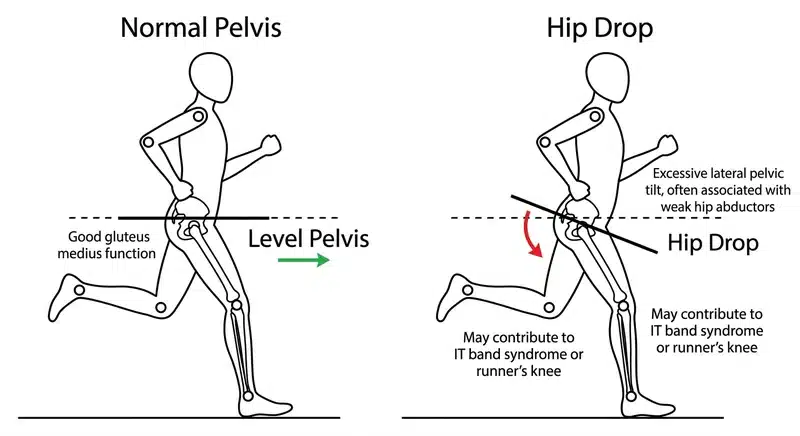
Research published in Clinical Journal of Sport Medicine found that runners with IT band syndrome had measurably weaker hip abductor muscles on their injured side, and 22 out of 24 were completely pain-free after a six-week gluteus medius strengthening program.

The same pattern shows up with patellofemoral pain, shin splints, and hip flexor problems.
Hip drop is not just an injury risk. It’s a running efficiency problem that costs you speed and increases fatigue even when nothing hurts.
Why Weak Hip Abductors Are Usually the Cause
The gluteus medius is the primary hip abductor, responsible for moving the leg away from the body’s midline and, more importantly, controlling the sideways tilt of the pelvis during single-leg stance.
Every running stride puts you on one leg for a fraction of a second.
During that brief moment, the gluteus medius on your stance-side leg fires to keep the opposite hip from dropping.
For most runners, this muscle never gets trained directly.
The bigger glute muscles handle propulsion, so the gluteus medius gets by with minimal recruitment, until the mileage climbs, fatigue sets in, or the stride length extends during a race.
That’s when hip drop becomes visible and the injuries that follow it start.
An electromyographic analysis in the International Journal of Sports Physical Therapy measured gluteus medius activation across 12 common exercises and found that pelvic drops, side-lying hip abduction, and single-leg squats produced the highest muscle activation relative to maximum effort.
This research is the basis for the exercise rankings below.
Not all hip exercises activate the gluteus medius equally, and doing the right ones in the right order makes the difference between a frustrating plateau and actual progress.
A deeper look at how hip drop shows up during running explains what those mechanics actually look like at race pace.
5 Hip Drop Exercises Ranked by Research Effectiveness
These exercises are ordered by their gluteus medius activation percentage from the EMG studies: the higher the activation, the more directly the exercise targets the muscle responsible for hip drop.
Start with exercises 1 and 2 if hip drop is severe or you’re recovering from injury.
Progress through the full list once you can complete exercises 1 and 2 with clean form and no compensations.
1. Hip Drops (Pelvic Drops)
Stand with one foot on a step and let the opposite hip drop downward, then drive it back up using the hip abductor on your standing leg.
This exercise directly mimics the motion your gluteus medius controls during running, making it the most specific drill in this list.
Keep your standing knee straight throughout. Any bend in the supporting knee means the glute med is compensating instead of driving the movement.
Sets: 3 sets of 15–20 reps per leg
Tempo: 2 seconds down, pause at the bottom, 2 seconds up
Progression: Once 20 reps feel controlled, add a resistance band above the knee
2. Side-Lying Hip Abduction
Lie on your side with your hips stacked, body in a straight line, and lift the top leg to about 30 degrees while keeping the foot level with or slightly below the heel.
It looks simple, and it is, which is exactly why it works.
This exercise isolates the gluteus medius without asking your body to stabilize anything else, which makes it the best starting point when the muscle is genuinely weak or inhibited.
Sets: 3 sets of 15–25 reps per side
Tempo: 1 second up, 2-second hold at top, 3 seconds down
Progression: Add a resistance band above the ankles once 25 reps feel easy
3. Single-Leg Squat
The single-leg squat scores the highest gluteus medius activation of any exercise in the research, but it requires enough balance and hip control to do correctly.
To maximize glute med recruitment, initiate the movement by shifting your hips backward and downward, not by pushing the knee forward.
Place a chair behind you at a height that catches you if you lose balance.
As your hip control improves, lower the chair height until you can reach parallel without support.
Sets: 3 sets of 10–15 reps per leg
Tempo: 3 seconds down, 1 second up
Progression: Start with a higher chair, progress to a lower surface, then no support
4. Single-Leg Deadlift
Hinge forward from the hip while balancing on one leg, reaching both hands toward the floor while keeping your back flat and your standing knee as straight as possible.
The non-weight-bearing leg lifts behind you as a counterbalance.
This exercise strengthens the gluteus medius and the posterior chain simultaneously, which makes it particularly valuable for runners who also have hamstring or hip flexor imbalances.
Sets: 3 sets of 10–15 reps per leg
Tempo: 3 seconds down, 1 second up
Progression: Add a light dumbbell or kettlebell in the opposite hand once 15 reps feel controlled
5. Clamshell
Lie on your side with hips flexed to about 30 degrees, knees bent, and heels stacked.
Open your top knee while keeping your heels together and your pelvis completely still.
The clamshell scores lower on the EMG rankings than the exercises above, but it’s easier to execute correctly, making it the best starting point for runners who struggle to feel the gluteus medius fire in the other exercises.
If you place your hand on the outer hip while doing it, you should feel the muscle contracting just below the hip crest.
Sets: 3 sets of 15–25 reps per side
Tempo: 1 second up, 2-second hold, 3 seconds down
Progression: Loop a resistance band just above the knees once 25 reps feel easy
RunnersConnect Bonus
Download your FREE Hip Strengthening Exercises Guide.
Download a video version of the 5 most effective hip exercises for runners. You’ll get full descriptions on how to perform and a video to help guide you.
How Often Should You Do These Exercises?
Two to three sessions per week is the research-supported frequency for gluteus medius strengthening.
If you’re currently dealing with IT band syndrome, patellofemoral pain, or an active hip injury, start with exercises 1 and 2 every other day and build from there.
If you’re injury-free and strengthening as prevention, 2 sessions per week fits into most training plans without adding meaningful fatigue.
Do these exercises after a run or as a standalone session, never before a key workout when fresh muscle recruitment matters for form.
The full 5-exercise routine takes 20–25 minutes when you include warm-up and the prescribed rest periods.
You don’t need to do all five in every session: exercises 1, 2, and 3 cover the highest-activation range and are enough for a focused 15-minute session.
| Exercise | Glute Med Activation | Difficulty | Best For |
|---|---|---|---|
| Hip Drops | High | Beginner–Intermediate | Running-specific rehab |
| Side-Lying Hip Abduction | High | Beginner | Isolation, early rehab |
| Single-Leg Squat | Highest | Intermediate–Advanced | Strength + balance |
| Single-Leg Deadlift | High | Intermediate | Full posterior chain |
| Clamshell | Moderate | Beginner | Muscle activation, awareness |
How Long Does It Take to Fix Hip Drop?
In Fredericson’s study on IT band syndrome, runners completed a six-week hip abductor strengthening program and 22 of 24 returned to pain-free running.
Six weeks is a reasonable minimum for structural strength gains.
Most runners notice improved hip stability during runs within 3–4 weeks, and reduced injury symptoms (if present) within 6–8 weeks of consistent training.
The key word is consistent: three sessions per week without skipping is more effective than four sessions in week one and none in weeks three through five.
Progress is not always linear: expect the first two weeks to feel uncomfortable as the gluteus medius adapts, then a noticeable shift in how stable your hips feel on longer runs.
A study in the Journal of Orthopaedic and Sports Physical Therapy confirmed that the side-lying hip abduction and pelvic drop exercises produce high gluteal muscle activation levels comparable to more complex functional movements, supporting their use as a foundational strengthening protocol.
If you’re also dealing with an active injury, pair this program with whatever your physio or sports medicine doctor has prescribed. These exercises complement rather than replace clinical rehab.



42 Responses
Great article, very helpful!
Hip strengthening is definitely an area I need to work on.
Time to start doing those exercises…
Hey Chris! Glad you enjoyed it. Thanks for sharing. Always great to hear comments, good or bad!
Thank you for facts as well as exercises. I’m working on my hip strength and the article is a good motivator to keep it up.
Hey Nick. Glad you have found it useful. Thanks for your comment!
How often do you recommend doing these exercises? I’ve been trying to do them everyday – is that too often? Thanks.
Hi Janet. Good question! Tricky to answer!
The frequency, intensity and duration of any exercise will depend on your level of fitness, your individual needs & goals. For any exercise that is new to the body, whatever the level of fitness, it is always wise to introduce yourself carefully and give your body time to let you know how it feels about what you have subjected it to!
In the early days, much of the effort will be concentrating on technique. I find it useful to look at it as follows (although it is a simplification): You are targeting a muscle/muscle group that your body has not used optimally for who knows how long, and your body has found an alternative way of producing the movement using alternative muscles that are now more than ready to step in and get the job done! Unless you watch yourself carefully or have someone watch you, your body will naturally use the alternative methods it is had grown accustomed to using (commonly referred to as “cheating” or “compensating”) until through repeated use the weaker muscles/muscle groups present themselves as a viable alternative.
How long it takes to be able to perform the exercises with good form will depend on the individual. Some people need to do a little everyday, some people every other day. Once you are performing them well and able to concentrate on gradually increasing number of repetitions, advice on how often you perform them will vary from trainer to trainer and will depend a lot on your lifestyle and time available. Ultimately, I am a believer of ensuring your hard training days are hard, and your easy days easy. This helps promote recovery and reduce risk of over-training. With that in mind, I often recommend doing conditioning the same day as your more intensive run, leaving the easy day for relaxing, recovering and listening to your body. But it will depend on the individual!
Hope that helps Janet!
Aloha Matt,
I’ve been running ultras up to 50mi for the past 2 years and I’m having a recurring in jury show up again pes aserine area/ any suggestions on strengthening this area?? I took some time off like a month or so/ I’m able to run again but downhills seam to aggravitite some. I have a 100mi this Sept with 22k of E.G and E.L.
Mahalos for your time
Kade
Great advice. Working in strength training is always a challenge when you’re doing high miles, but so, so important. If you only had 15 minutes a day, what would you recommend?
Hi I have weak right hip, I do single leg deadlift standing on my right and I am about to fall over but if I do it on my left everything is fine!
I also have right hip sometimes popping back in forth on the right hip, is that a sign of a weak hip?
I’m 22 and basketball player, and I PLAY a lot. I recently had some knee pain on my right side as well, could this help?
Hey Skip. Thanks for the question. With regards to your “popping”, can’t diagnose without proper assessment but if it’s accompanied by pain I’m always a fan of getting these things checked out. Given the relatively less stability you experience when standing on right leg does sound like you would benefit from some strengthening exercises. Knee pain is often related to what’s going on in the hip, so could be connected.
Like I say, best to get it checked but in the meantime think about performing hip exercises that involve you moving the hip in ways you do not normally move it (as long as there is no pain). You can download a free Runners Connect hip routine here: https://runnersconnect.net/hip-strengthening-for-runners/
A few weeks of new, run specific strength & mobility training can often make many niggles disappear. Frequently works better than attempting to target a specific muscle. Variety of motion provides the lotion!
Let us know how you get on!
Great article! Do you think this weakness is why one of my feet splay out when I my leg up?
Whenever I see photos or videos of me running, my right foot is always splaying out 🙁
This is very likely. It could also be a glute issue, but closely related.
I develop Piriformis syndrome when I am at the end of training for a long race (for me currently half marathons but I am looking to do a full next year). It is always on the same side (right) and really impedes my pace and frankly my love of being on the road. I work at a desk during the day which means pretty regular pain (isolated and not radiating) when this is acting up. I feel a difference in my gait from left to right which to me means I may have some weakness on the right side that is contributing to my issue. I am very fit and attend boot camp several times a week along with regular running. I am going to try the above exercises. Do you have anything else you would recommend I try?
Thanks for posting the article. I feel like I am finally getting to root of the problem and can hopefully do something to alleviate and get back on the road.
Hi,
Just wanted to say thanks for this post.
I developed some severe knee (and then as a result, hip pain) from long-distance cycling. Had this pain for over a year and couldn’t manage to sort it out. Even resorted to an MRI scan (which didn’t reveal anything interesting).
Following these exercises every other day for 6 weeks has pretty much cleared the pain up entirely (in combination with some hip stretches).
FWIW I could barely even stand on my left leg initially. Now I can do 15 single leg deadlifts with relative ease.
Cheers,
Dan
Hey Dan, really good to hear this helped clear up your knee and hip pain. Doing one’s “homework” is such a crucial part in recovery so it’s great to hear your consistency over 6 weeks paid off. Thanks for sharing!
Thank you so much for this, I have been searching for hours and hours after being diagnosed (via MRI) with Gluteus Medius Tendonitis. Its been 3 months of pain, nothing was helping, tired of spending $ on PT, I am going at this alone with all these exercises! Thanks again <3 this !
I had to hip fracture in January 2013 due to a car accident and went through hip pinning surgery. We are at a year later now. I had to stop PT in May 2013 because insurance wasn’t going to cover more sessions and I was heading back to work. I am 28 year old female. I don’t think I am back at where I need to be, strenght wise. Still have a slight limp. I should have continued PT at home, regret not keeping up with it! I will now be consistent with it! Will these exercises help a year post surgery?
I have been doing hip strengthening regularly while I have been recovering from a metatarsal stress fracture (left foot). Prior to the injury, I had noticed for quite some time it seemed my right knee would bend more than the left during running. I have read through this post several times, and am saw that that greater knee bend is often caused by weak glute medius. Would that indicate the weakness is on my left side (less knee bend), or the right side (greater knee bend)?
Thank you for a very thorough and insightful article. I appreciate your use of references and research to back up your statements. For the single leg squat, can you tell me of any comparison to chair pose from yoga? Is it comparable, or rather, just as good, better or worse?
I have IT band syndrome in my left and it’s really flaring today. I also has SI joint dysfunction, but I find the more I exercise, the better I feel. But it’s too painful right now to get into my T25 exercises or the elliptical.
Thanks.
Hey Michelle,
Many thanks for your feedback! As far as I can see, there are many variations of the single leg chair pose just as there are of a single leg squat, and so there should be! Variety is great, it’s exactly what the body and brain needs. That said, different versions will suit different people with different objectives. With runners, I commonly see over dependence on the anterior muscles of the legs (quads) rather than the posterior (glutes and hamstrings) so I tend to have them do single leg squats / chair pose with the knee behind the toes and weight off the toes. What the non weight bearing leg does will also depend on the needs of the runner. Externally rotating it and tucking it into the weight bearing leg may be a common yoga pose but will my runner benefit from that external rotation? With regards to your ITB Syndrome, I would need to assess you first but I may well have you back off the single leg squats as they could possibly add to the issue. My recommendation would be to see a therapist who specializes in running injuries to assess your ITB issue. Exercise choice can play an important part in rehabilitation and recovery. The fast nature of T25 / Insanity style workouts may need modifying for a short time. Keep in touch!
The problem with a lot of these exercises is that a lot of them are difficult to perform at the beginning and it’s hard to progress them. The lying down exercises are ok in the beginning of rehab but will not restore full functionality. The single leg squat is good but it tires your quads and hamstrings so quickly.
The best exercise i have found is the standing single leg row.
You tie an elastic band onto a door handle, stand half a metre away from the door, balance on one leg and pull the band towards your waist whilst remaining balanced.
You will notice that on your stronger leg you will be able to stand further away from the door and maintain balance. The goal is to gradually increase the weak glute’s strength so that you can move further and further back until it matches the strength of the stronger glute.
I hope this exercise helps, it is one that is easy to progress.
Hi Matt,
Great article!
I’m currently about six weeks into rehabbing a PFPS injury that came on during a marathon training in April. I’m just about ready to start running again (I think) and am wondering if you have any exercises to add to this routine.
Weighted single leg raises have also been a part of my routine but am still avoiding the deep squatting exercises as to not aggravate the knee. Also, would you recommend doing these strength exercises before or after running?
Thanks for any insight…
Bill
Hey Bill, many thanks for your comments – great to hear you are on your way to returning to running!
As far as more exercises for the glute med, there are plenty more than I shared here dependent on what stage you are at.
One important angle to look at is that in running the glute med works on the weight bearing leg, i.e stops the opposite hip from falling too much. In order to recreate this it is useful to include exercises that work the glute med in this way. A favourite of mine is standing say on your left leg with your right leg raised to hip height, (knee bent to 90°) and your bent right leg pushed into a wall or mirror. This position forces your legt glute med to hold the right pelvis up. To make it harder, hold a weight (e.g. a med ball) out infront of you and rotate your upper body over the stabilising left leg. A few of these and you should really feel your left glute med start working! If you can perform over 20 with good form, consider increasing the weight.
For more exercises, consider our Runners Connect Strength Training Package. Many clear & safely progressed exercises there!
Thanks again for your comment! Let us know how your return to running goes. Here’s a link for the Strength Package: https://runnersconnect.net/strength-training-for-runners/
I’m a 51 year old male, good health, active. I have had 3 total hips on my right hip. The first 25 years ago because of the pain. I had child hood legg-calve-perthes (osteochondrosis) causing me pain later in my adult life. The next was 4 years ago and then one 11 months after that to correct a miss aligned cup installation. Not one Dr. has ever explained to me about my limp, Trendelenburg gait. I have in the last couple weeks been reading everyting I can find about it. 2 weeks ago I had a PRP (platelet rich plasma) Intra-articular Injection on my knee of the good leg. I believe my limp is causing my knee problems. And just maybe if I can correct my limp by doing your exercises I bet my knee will also be able to heal. I will start today with them and keep you informed. Your article has been the most informative to me I have seen yet. Thank you
Any suggestion for spinal stenosis. I love to run but the pain is so bad in my left thigh. I’ve started biking and that’s helped but I want to hit the road again.
Does this exercise allow to a hip replacement patient? Thanks
how many days should i do this a week?
Hi Nick, you will find the best results occur if you do them at least 3 times per week, no more than 5 though! Hope this helps!
excellent article! I’ve started with most of these a year and a half ago and am ready to progress to some more challenges, so I am using a functional trainer with an ankle cuff and kicking out to the side with the moving leg positioned behind the stationary leg to pinpoint the medius better. I was wondering if there might be any advantage to doing these side kicks with the moving leg out in front of the stationary leg instead ? would that concentrate more on the Minimus? would that be a more “balanced” way of training the abductors?
Hello, I am sorry but I am not qualified to answer that question for you. You can reach out to Matt Phillips through his twitter @sportinjurymatt if you would like to ask him. Glad you enjoyed the article 🙂
Hey Matt, I have had trouble with my knees and lower back for a year now. When I squat and deadlift, my lower back rounds and my butt tucks under. This is 100% not a technique issue. A personal trainer and saw me in the gym and he said my hip hinge was brilliant, but that when I get past a certain point everything crumbled, back rounds and backside tucks under. I have been told this could be tight hip flexors, coupled with inactive glutes and weak hamstrings. I cannot confirm this for certain but I am performing exercises to combat this problem. What are your thoughts?
Hi Mike! Thanks for the question. It’s obviously tricky to answer without seeing you in person but what I will say is due to anatomical variance, people should not all expect to be able to squat to the same depth. The shape of the femur head and hip socket have a significant determining factor in how much hip flexion you can get. After that point, the only way to get any lower is a backward rotation of the pelvis and the resulting roundening of the back you are referring to. I don’t know if this is what is happening in your case but worth checking.
Limited ankle dorsiflexion is another factor you may want to check out. Does it make any difference if your heels are raised, e.g. up on a weight plate?
You mention tight hip flexors as a possible issue but in my experience lack of flexibility there is not always the issue. Not that much is really needed during a squat.
If as you have said your technique is good and you have developed the coordination required to do deep squats, I’d check out the two points I have suggested.
Hope this helps and thanks again for a great question!
Matt.
Where should I feel the hip drop? I feel it in the hip on my support leg. Is that right?
It would be difficult to feel it yourself, as you will be so used to it, but others can watch you run and look for it, however, if you do feel it, that means it must be pretty prominent. Yes, it would likely be in your support leg. Hopefully the exercises in this post will help you learn how to strengthen it. You may also enjoy this podcast we did, which talked a lot about running gait https://runnersconnect.net/running-interviews/matt-phillips-gait-analysis/
I wasn’t clear. I meant the exercise called the hip drop, not the drop of the hip when I run. Which muscles should feel the exercise? The ones in my planted, stationary leg?
Hi Gale! Yes, correct. You should feel the gluteus medius of the planted leg contracting (shortening) when you raise the opposite side hip and working eccentrically (lengthening under tension) as you slowly lower that side. Placing your hand over the hip & buttock of the planted leg can help you feel this happening.
I hope that helps and thanks for leaving the comment!
I am hoping that these exercises work for me! I broke my hip in a bad car accident three years ago, and I am tired of using my “unbalanced” hips as an excuse to not run. I broke my hip in four places on my left side, including my sacrum. I did not place any weight on that side for only two months, and it through everything off. I will definitely be trying these suggestions to strengthen my hips, especially on my left side!
Hi Anna, thanks for reaching out. Sorry to hear about your accident. We hope you find this helpful, and there is a very good chance you are going to feel much better after they have time to be effective. Best of luck, let us know if we can help with anything else as you recover.
Hi Anna,
Thanks very much for sharing. I am inspired by the determination I hear in your voice and hope the exercises help your return to running! Bear in mind that you may also need to address your running form as well, as you may well have developed compensatory ways of moving since your accident. A full body gait analysis would be useful to identify any drills you may need to get those hips working well again once you have strengthened them! Thanks again for sharing and let us know how you get on!
203009 8192I conceive this internet web site has got some really superb information for everybody : D. 423289
Matt
Thank you for this article it is just what I need!
I have literally spent the last 16 years trying to work out what the pain in my right glutes and hip area is all about.
Interestingly I have noticed that it is usually runners websites seem to make most sense for me.
Thinking about it at school and in the army in the 80s and 90s I was primarily A cross country runner. I Richard my ACL left side in 1990 and had it reconstructed in 92. 16 years ago I started to get discomfort in my glutes on the right side. Massage and stretching and hot water bottles help, but the problem always comes back especially in the early hours of the morning and prevent me from getting proper sleep.
A Specialist physiotherapist has recently suggested that I probably have a chronic piraformis problem. I think it is only part of the problem however as stretching muscles such as TFL, psoas,hamstrings and IT band really do seem to help.
Anyway to come to the point, I came cross your article searching for hip abductor and adductor exercises. Just ran through the routine once in my lounge and really seemed to exercise just the right muscles and stretch the right muscles too.
Many many thanks and any advice from you would be very gratefully accepted thank you!
Andrew Lewis, Andover, Hampshire.
Sorry, typo, Richard should have been ruptured.