You’ve spent months building strength in the gym.
Your squats are solid, your deadlifts are strong, and race day is now a few weeks away.
The question hits every marathon runner at some point in taper: when exactly do you shut the gym down?
Most runners stop strength training four to eight weeks before the marathon, assuming earlier means safer.
Research on detraining and neuromuscular recovery tells a different story.
Stopping that early costs you weeks of training time without improving your race readiness.
In this article, you’ll learn the research-backed timeline for when to stop strength training before a marathon:
- How long your strength gains actually last when you pull back from the gym
- When to cut heavy lifting versus when to keep light maintenance work going
- What the pre-marathon strength timeline looks like week by week
- How the timing shifts for a half marathon
Why Most Runners Stop Strength Training Too Early Before a Marathon
The instinct to quit the gym early runs deep.
Most runners cut strength training four to six weeks before their marathon, reasoning that fresh legs on race day matter more than one more week of squats.
That reasoning overshoots the actual recovery window by several weeks.
Heavy lifting causes delayed onset muscle soreness that peaks 24 to 72 hours after a tough session.
During marathon taper, when your legs should feel responsive and light, that residual soreness feels dangerous.
Add the psychological weight of heavy legs during taper, and the urge to quit strength work early becomes hard to resist.
Cutting strength training to protect your race readiness is a different decision from cutting it because your gains will disappear.
Your muscle adaptations: the strength, power, and work capacity built over months: are highly resistant to short-term loss.
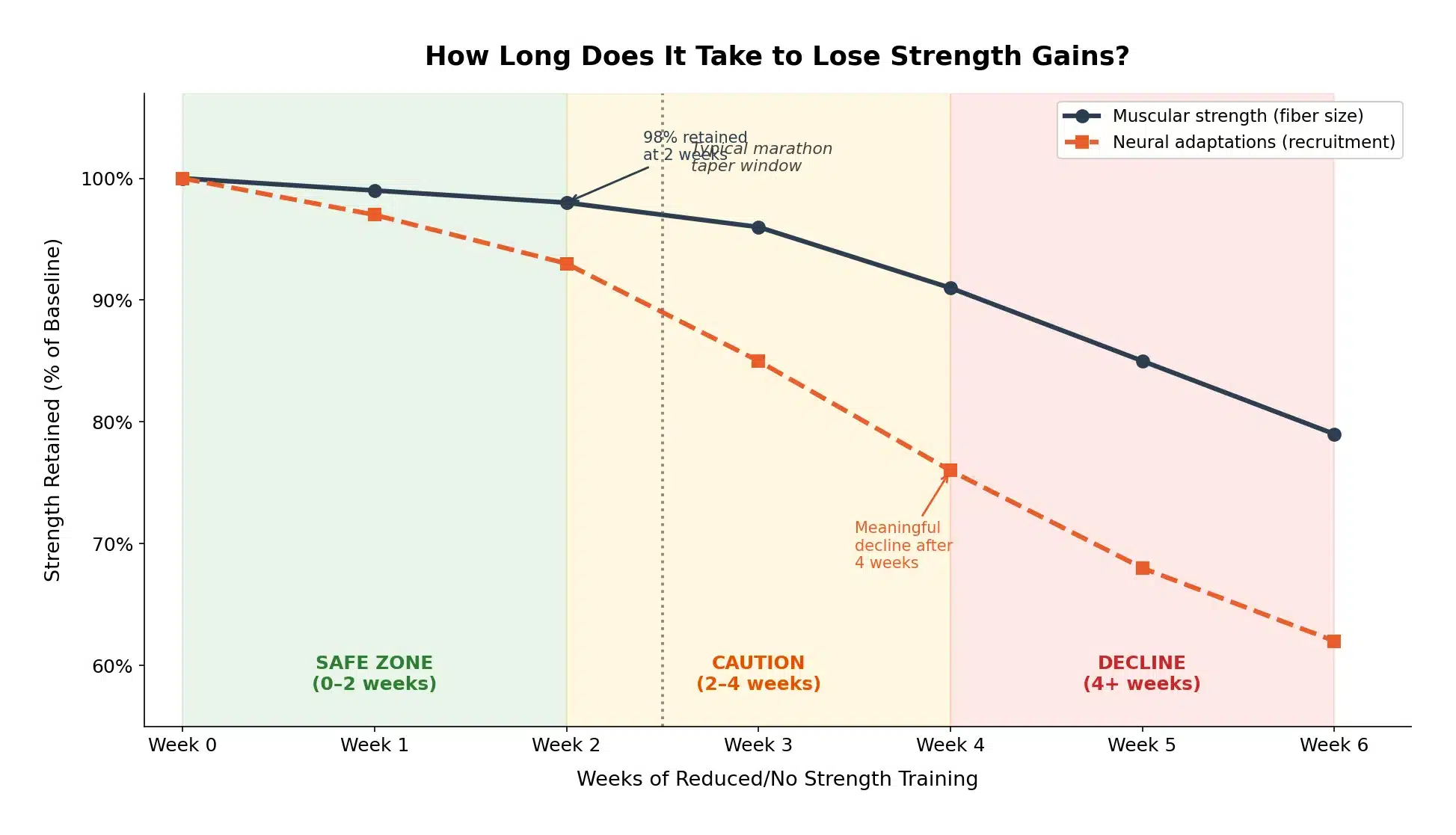
Research has shown that strength performance is readily maintained for up to 4 weeks of inactivity in trained athletes, with meaningful declines only appearing after extended periods of complete rest from resistance training.

A two- to three-week taper is well within the safety window for strength retention.
The real question shifts from “Will I lose my gains?” to “When should I reduce intensity so my nervous system is fully recovered for race day?”
Stopping strength training six or more weeks before your marathon costs you weeks of fitness without improving your taper readiness.
How Long Does It Take to Lose Strength Gains?
Your strength is more durable than it feels during a heavy taper week.
Muscle fiber recruitment patterns, contractility, and power output don’t disappear in two to three weeks of reduced training.
Muscle strength relies on two major adaptations: neural and muscular.
Neural adaptations involve your nervous system’s ability to recruit muscle fibers efficiently.
Muscular adaptations involve the size and contractility of the fibers themselves.
Neural adaptations develop relatively quickly and can fade within a couple of weeks of complete inactivity.
Muscular adaptations take months to build and take weeks to meaningfully decline.
During a standard three-week marathon taper, your nervous system may feel slightly less sharp, but your muscle fiber quality and size remain largely intact.
Strength loss research consistently shows minimal measurable decline in the first two to three weeks of reduced volume, with significant loss only appearing after four or more weeks of complete cessation.
For marathon runners whose typical taper spans two to three weeks, that threshold stays well outside the danger zone.
Three weeks of reduced training is too short to produce meaningful strength loss in a conditioned runner.
If you want to understand how long your running-specific strength gains last when you take a break, this research breakdown covers the full detraining timeline in detail.
Get Your Strength Plan PDF & Video
Get a sample weekly plan so you can tailor your strength workouts to your race distance.
This PDF will give you a weekly calendar you can follow based on your race distance plus video links to specific strength routines you can try.
GET MY GUIDE
When Should You Stop Heavy Strength Training Before a Marathon?
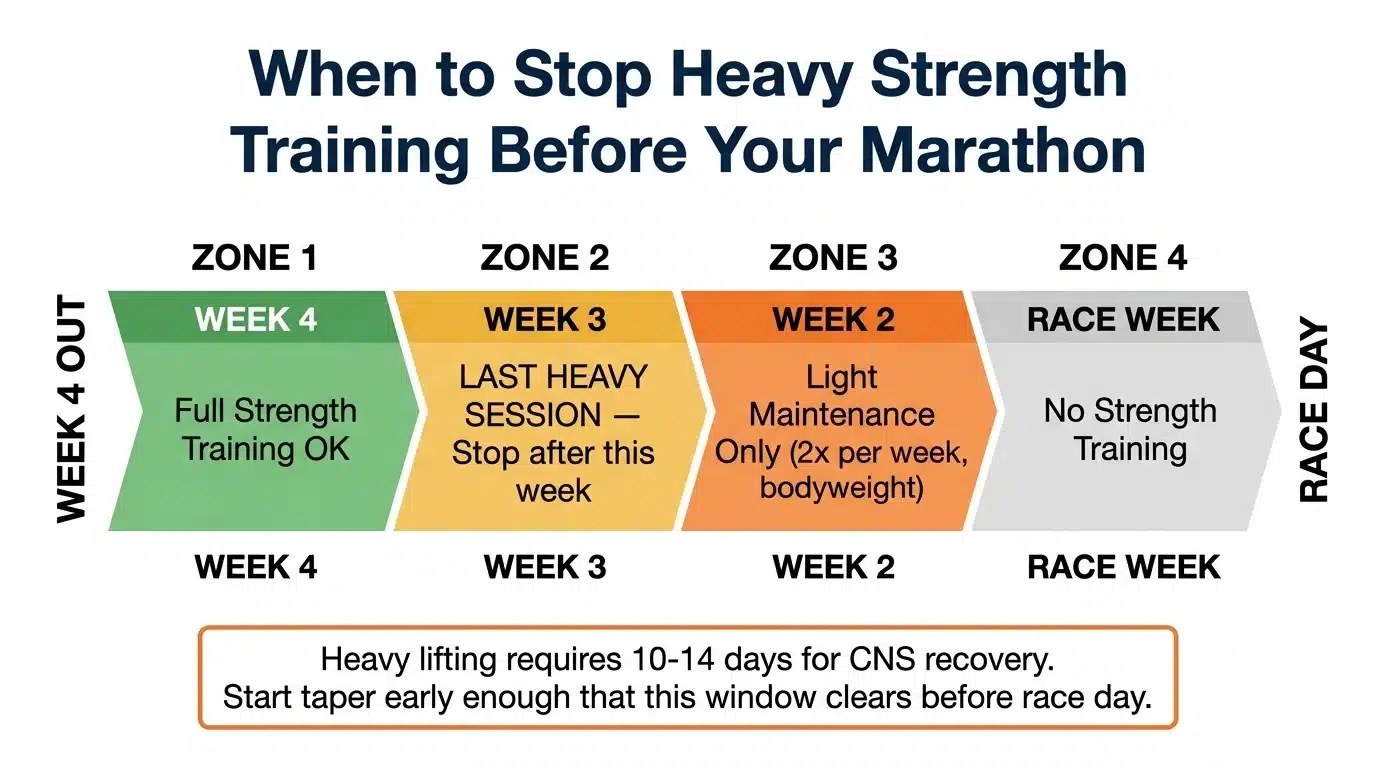
Heavy strength training should stop two to three weeks before marathon day.
This timing aligns with when your running taper begins.
Heavy lifting creates central nervous system fatigue that extends beyond the typical 24 to 48 hour recovery window.
Your central nervous system coordinates the muscle contractions your marathon pace relies on.
When you stress it hard in the gym, it requires 10 to 14 days to fully recover from that loading stimulus.
During marathon taper, when your running volume drops to 40 to 50% of peak training, heavy gym stress competes directly with your race preparation.
Your recovery resources are finite, and taper should direct them toward running performance.
Research on concurrent strength and endurance training in marathon runners found that neuromuscular fatigue from resistance training persists across multiple days and directly affects running performance outcomes.
In practical terms, “heavy” means max-effort compound lifts: squats, deadlifts, heavy carries, and high-speed plyometrics.
Any session that leaves you sore or fatigued well into the next day is too intense for the taper period.
Your last heavy strength session belongs in week four of your marathon countdown, when running volume is starting to drop but hasn’t entered the formal taper window.
After that, pivot to maintenance work.
Stop heavy strength training 2 to 3 weeks before your marathon and shift to light maintenance work.
What Strength Training Can You Do During the Final Two Weeks?
Light strength maintenance during the final two weeks is safe and beneficial.
It preserves neuromuscular coordination, reduces injury risk on race day, and can lower cramping.
The prescription is two sessions per week, 20 to 30 minutes each, using bodyweight or light load at 30 to 40% of your one-rep max.
Focus on movement quality and stability rather than intensity or load.
This is a maintenance phase that keeps your nervous system primed without creating fatigue.
Good exercise choices include single-leg squats, planks, side planks, rotational core work, light carries, and bodyweight air squats.
These movements reinforce the patterns you’ve drilled all season without the neuromuscular cost of heavy loading.
Timing within the week matters slightly.
One maintenance session in week three out, when taper begins, is ideal.
In the week before race day, complete one very light session or skip entirely, depending on how your legs feel.
Five to seven days before race day, a brief 10-minute activation session can help your legs feel sharp race morning.
Light maintenance works because it preserves the recruitment patterns your running economy depends on.
Your muscles and nerves retain motor patterns even with two weeks of reduced training stimulus.
Light work refreshes that signal without triggering fatigue or soreness.
Two light sessions per week during taper, 20 to 30 minutes each at bodyweight intensity, protects your race without interfering with taper recovery.
Does the Timeline Change for a Half Marathon?
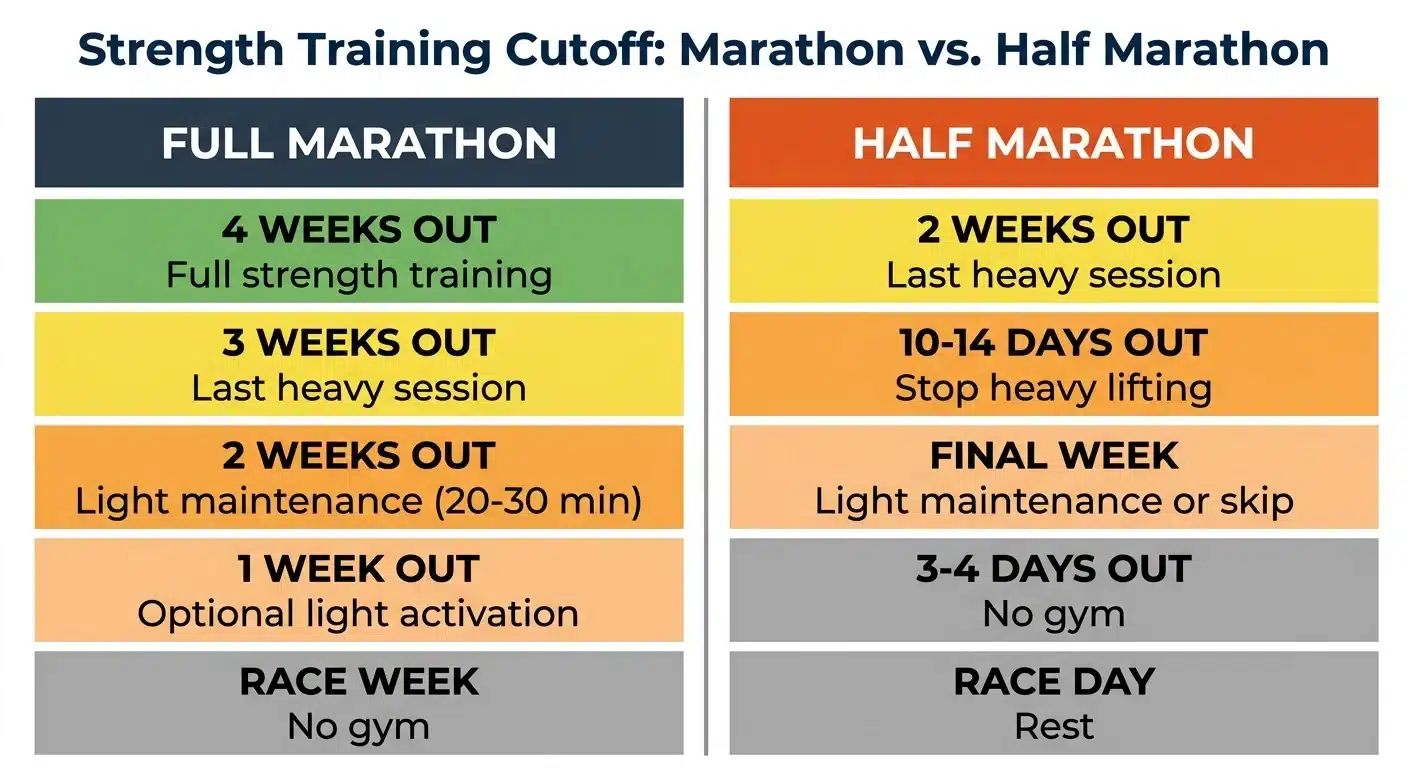
Half marathon taper is shorter, typically one to two weeks compared to two to three weeks for a full marathon, and strength timing compresses accordingly.
For a half marathon, stop heavy strength training 10 to 14 days before race day.
Light maintenance work can continue into the second week of taper if volume stays minimal: one light session under 20 minutes.
Half marathon efforts demand higher running intensity than full marathon pace.
Your recovery window is tighter, so every day of nervous system recovery carries more weight.
Runners who have handled heavy training well throughout the season can continue light strength work until three to four days before a half marathon.
Listen to your legs.
Skip the session entirely if they feel flat or fatigued.
For a half marathon, stop heavy strength training 10 to 14 days before race day.
Your Pre-Marathon Strength Timeline: Week by Week
Here is how to structure your strength training in the final month before your marathon.
| Week Out | Strength Focus | Examples | Notes |
|---|---|---|---|
| Week 4 | Full strength training | Squats, deadlifts, carries, plyometrics | Normal training volume; running not yet tapered |
| Week 3 | Last heavy session early in week | Heavy compound lifts, max-effort | Final intense gym session; running taper begins |
| Week 2 | Light maintenance only | Bodyweight, 30 to 40% load, 20 to 30 min | 2x weekly; no soreness; focus on movement quality |
| Week 1 | Optional light session | Stability work, planks, single-leg exercises | Early in week or skip; 10 to 15 minutes max |
| Race week | Complete rest from strength training | Activation only if needed | No gym work; running legs only |
A few principles guide the whole approach.
- Stop heavy work early enough that CNS fatigue fully clears before race day
- Keep light maintenance work going to preserve neuromuscular coordination
- Stay consistent in the final weeks to avoid race-day surprises from sudden schedule changes
- Listen to your legs: if they feel flat or heavy after a light session, skip the next one entirely
Follow this timeline and you preserve the strength foundation you’ve built all season while fully committing to the aerobic and recovery demands of marathon taper.
For more on structuring your taper week by week, this guide covers the full marathon taper protocol with percentage breakdowns for each week.