
Most runners assume that adding a second run each day is only for elite athletes training for major marathons or Olympic trials.
Running doubles, two runs on the same day, can fit into the training life of any committed distance runner once the timing is right.
Deciding when to add them matters more than the idea itself.
Your body has a specific readiness threshold for doubles, and crossing it too early creates injury risk without the aerobic benefit you’re chasing.
So, in this article you’re going to learn the research-backed practical advice on:
- What running doubles means and whether running twice a day is safe for you
- The aerobic fitness level you need before adding a second run each day
- How training frequency triggers cellular adaptation in your muscles
- The exact recovery window your body needs between sessions
- The weekly structure that makes doubles sustainable without overtraining
What Does It Mean to Run Doubles, and Is It OK to Run Twice a Day?
Running doubles means splitting your daily mileage into two separate runs instead of one, usually an easy run in the morning and a second run later in the day.
Runners also call these two-a-days or double runs, and the two sessions together add up to the volume you might otherwise cover in a single run.
Running twice a day is safe for most trained runners once a consistent aerobic base is in place.
It becomes risky when you add the second run before your body has adapted to the training you already do.
A runner holding steady easy mileage for several months can usually absorb a second daily run without raising injury risk.
Someone still working toward 4 consistent running days a week cannot, because the extra frequency arrives before the aerobic adaptations that make doubles worthwhile.
The benefit of doubles comes from added training frequency at low intensity, so keep both of your daily sessions genuinely easy.
How Does Running Doubles Actually Improve Your Aerobic Fitness?
Doubles work because training frequency sends more adaptation signals to your body than a single long run.
Research has shown that twice-a-day training improves mitochondrial efficiency and reduces perceived exertion during steady-state running compared to once-daily training.
Your muscles contain mitochondria, the cellular powerhouses that generate energy from oxygen.
When you run, your body breaks down muscle tissue and burns through glycogen stores.
The rebuild happens between runs, not during them.
Each time you run, you trigger a signal that tells your body to build more mitochondria, increase aerobic enzyme activity like citrate synthase, and develop more capillaries to deliver oxygen to working muscle.
More frequent training signals mean more opportunities for adaptation at the cellular level.
A runner training 5–6 days per week develops more aerobic enzyme activity than a runner covering the same total mileage in 3 longer sessions, because the adaptation stimulus arrives more often.
Doubles compress this frequency benefit into fewer calendar days.
Instead of spreading the same volume across a full week, you’re hitting your aerobic system twice in 24 hours, which sends two separate adaptation signals before full recovery.
Are You Aerobically Ready for Doubles?
Readiness is not about total weekly mileage alone.
A runner might log 40 miles per week and still lack the physiological capacity to benefit from doubles.
A runner at 25 miles per week with strong aerobic development can sometimes start doubles safely.
The question is whether your aerobic system can sustain easy effort without fatigue breaking down your running form.
The research marker is perceived exertion during easy running sessions.
If you feel tired or struggle to hold a conversational pace during a 40-minute easy run, your aerobic base is not ready for the frequency stimulus of doubles.
Your heart rate should also drop quickly after finishing a run, falling by 12–20 beats per minute within 60 seconds of stopping.
If recovery is sluggish, your aerobic system is still adapting to the training load you already handle.
Another readiness marker is whether you can run for 30–40 minutes at a truly easy pace without checking your watch or feeling like you’re racing the clock.
This reflects genuine aerobic development, not just time spent on your feet.
Add doubles before this aerobic foundation exists and you raise injury risk without triggering the adaptive benefit doubles are designed to create.
What’s the Ideal Recovery Window Between Your Two Runs?
Time between runs determines whether your second session benefits from recovery or compounds fatigue.
Your muscles store glucose as glycogen, and running depletes it.
A moderate-effort run lasting 60 minutes burns 100–120 grams of glycogen.
If your second run starts before glycogen has been restored, you’re running on an empty tank, which blunts the aerobic adaptation signal your body would normally receive.
Too short a window, under 5 hours, means your second session depletes what little glycogen is left and leaves you in a deeper deficit overnight.
That deficit raises cortisol and slows recovery, the opposite of what doubles are supposed to achieve.
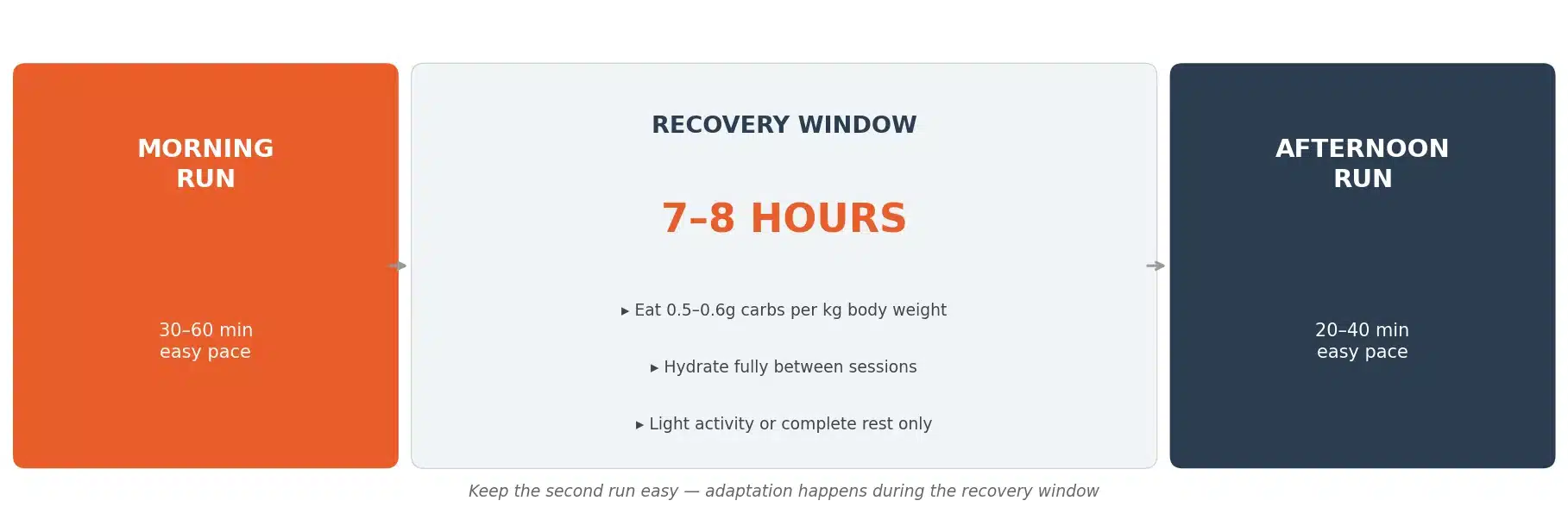
A 7–8 hour window is optimal.
This lets glycogen resynthesis progress well into its insulin-dependent phase, so your second run happens with meaningfully restored fuel and your body finishes the day with less total glycogen depletion.
A practical schedule is a morning run at 6:00 a.m. and a second run at 2:00–3:00 p.m.
This gives the first run 8–9 hours of recovery before your second effort begins.
What Should You Eat Between Your Two Runs?
What you consume between runs directly determines whether the recovery window actually works.
For a 150-pound runner, this works out to roughly 35–40 grams of carbs every 30 minutes, or 70–80 grams per hour.
The timing window matters as much as the amount.
Carbs eaten within 30 minutes of finishing your first run trigger immediate insulin release, which accelerates glycogen rebuilding while your muscles are most receptive.
A practical post-run meal is 40–60 grams of carbs (rice, pasta, toast, fruit) plus 10–20 grams of protein (yogurt, eggs, chicken) within 30 minutes of finishing.
Then, 2–3 hours before your second run, eat a balanced meal with 60–100 grams of carbs to top off glycogen stores without triggering digestive discomfort during the run.
Hydration and sodium are equally important.
Sweat contains sodium, and replacing it helps your body retain fluid between runs.
Adding 300–500 milligrams of sodium to your between-run meal restores hydration faster than plain water alone.
Skipping nutrition between runs is the most common reason doubles fail, because the second session becomes a glycogen-depleted slog instead of a productive aerobic stimulus.
RunnersConnect Bonus
Doubles only work when you refuel between runs, and the fastest way to restore glycogen is knowing exactly which foods rebuild it.
Our free Recovery Foods Guide lists the top 10 foods for every recovery nutrient your body needs, plus a sample recovery meal plan you can lean on between your two sessions.
How Much Total Weekly Mileage Is Safe With Doubles?
Adding doubles means adding volume, and total training load matters more than the fact that it’s split across two sessions.
This threshold matters more when you’re doubling because it’s easy to hide volume creep.
Two 5-mile runs feel manageable, yet 10 miles of total volume in a day compounds quickly across the week.
If your longest run is 10 miles, no single session should exceed 1 mile more than the week before, since that small cap prevents the physiological shock that triggers injury.
The injury risk window is sharpest in the first 21 days after a volume increase, particularly increases of 20–60%.
This is why doubling your number of running days without shortening individual runs is dangerous.
Your weekly mileage might stay the same, but the frequency shock alone can trigger injury.
Overtraining is the other risk when weekly totals climb unchecked, because high-volume training without strategic recovery is the main driver of it.
This doesn’t mean doubles cause overtraining.
It means that when you add doubles, weekly totals should drop relative to your highest-mileage weeks rather than stay flat or increase.
What’s the Ideal Structure for Your Running Week With Doubles?
Doubles fit into a weekly structure, and they don’t replace thinking about the week as a whole.
Most runners shouldn’t run doubles every day.
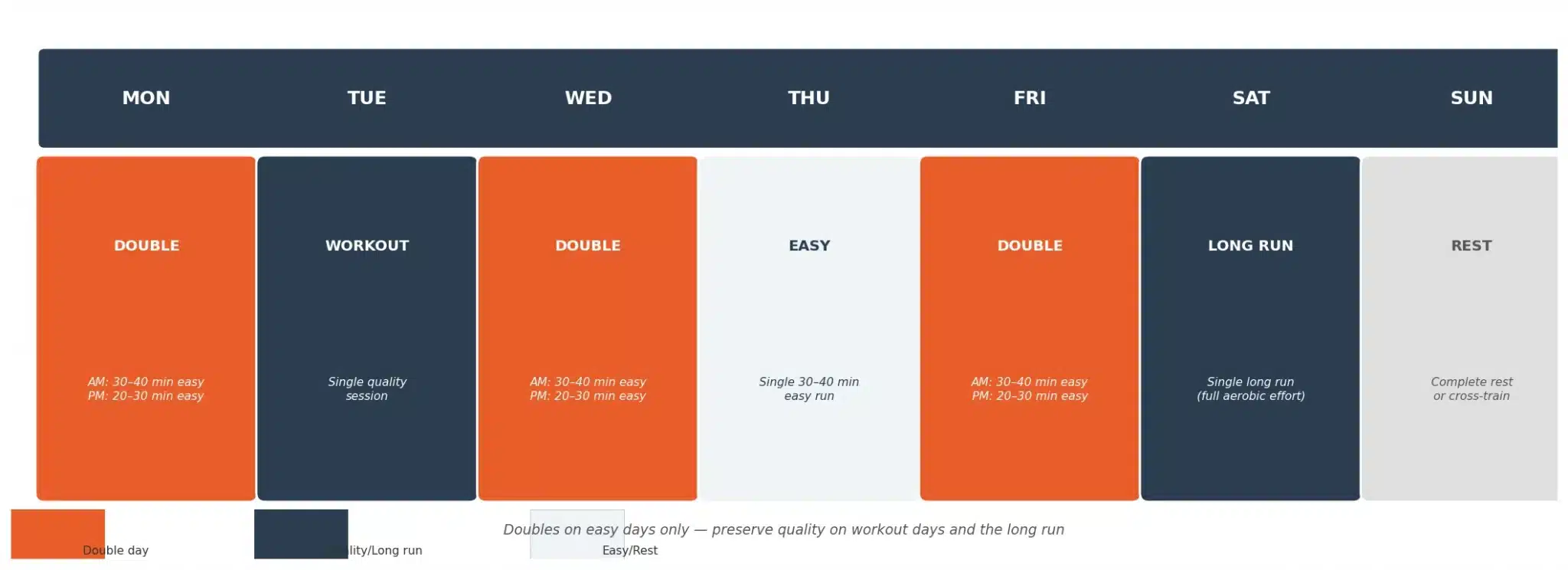
A sustainable pattern is 2–3 doubles per week, placed on your easiest training days.
Base-building weeks, when your long run and hard sessions are stable, work best.
A sample week runs easy plus easy on Monday, a hard interval workout as a single run Tuesday, easy plus easy Wednesday, a steady single run Thursday, an easy run Friday, a long run Saturday, and rest Sunday.
This structure protects hard-session intensity because both hard-day runs are single efforts with full recovery, while easy days absorb the frequency stimulus of doubles.
The first run of a double should be genuinely easy, at true recovery-run pace rather than medium easy.
That preserves glycogen for the second run, which can carry a bit more purpose while staying easy by absolute standards.
Never place both runs at high intensity.
Running a hard workout in the morning and a tempo run 6 hours later creates a training load spike that mimics a single long hard workout without adequate recovery between the efforts.
This is where doubles fail for most runners, because they treat both runs with equal intensity instead of using the frequency benefit to add easy volume.
Another guideline is to avoid doubling on the day before your weekly hard session or long run.
A double on Friday leaves your Saturday long run compromised by glycogen deficit and cumulative fatigue.
Doubling the day after a hard session instead speeds recovery, because easy running increases blood flow to fatigued muscles while keeping intensity low.
When Should You Start Running Doubles in Your Training Cycle?
Doubles belong in base-building phases, not in peak training blocks preparing for a race.
Base building, typically 8–12 weeks of consistent running without races, is when the aerobic system makes the biggest adaptations to increased frequency.
Your body is primed to accept extra stimulus without the intensity demands of a racing cycle.
Peak training phases demand high-quality hard sessions, long runs, and race-specific work.
Adding doubles during peak training dilutes the quality of those critical workouts because glycogen and recovery capacity are stretched across more sessions.
Once you’ve built aerobic capacity through doubles during base building, you can hold that fitness in peak training with a single run per day at appropriate intensities.
The exception is returning from injury or a training break, when doubles can speed re-entry into full training load without the spike risk of immediate long runs.
A runner returning from two weeks off might benefit from 3–4 weeks of doubles at low volume before resuming a traditional weekly structure.