
One of the most common misconceptions about running is that recovery and easy runs are the same type of workout.
Despite sounding very similar, they are different runs with different purposes.
And while this may sound like a “super beginner” topic, I see even the most experienced runners get the training application of these two types of runs wrong (myself included).
As you know, we’re big believers of understanding the science behind your training plan and that means understanding even the subtle differences between different types of runs.
So, in today’s article we’re going to…
- Highlight the difference between easy and recovery runs
- Get into the science behind the purpose for each type
- Outline how to apply to your training plan
- And give you specific guidelines for how to properly execute.
What is a Recovery Run?
A recovery run is a strategic, low-intensity run designed to aid your body’s recovery after a hard workout or long run.
Recovery runs generally occur the day after a particularly challenging training session, such as an interval workout, tempo run, or long run.
The primary objective is to promote blood circulation to the muscles, which helps remove metabolic waste products like lactic acid, which builds up during intense exercise.
The Purpose of Recovery Runs
Active Recovery – The main goal of a recovery run is to facilitate active recovery.
Muscles recover faster by engaging in light aerobic activity than by simply resting. The increased blood flow delivers essential nutrients and oxygen to damaged muscles, speeding up the recovery process.
Maintaining a Routine – Recovery runs allow you to maintain your training schedule, even on the days after more demanding workouts.
Getting back out on tired legs is also great for helping build mental toughness.
Mental Benefits – Recovery runs have psychological benefits, as well.
They provide a stress-free opportunity to stay active and keep your running routine intact, which can be especially useful for maintaining motivation during a long training period.
Pace and Intensity
Slow and Steady – Recovery runs are performed at a very easy pace, slower than your long-run pace.
Your aim should be to keep your heart rate below 70% of your maximum heart rate. A good rule of thumb is to run at a pace where you can easily hold a conversation without feeling winded or at a loss for breath.
Perceived Effort – On a scale of 1 to 10 (1 being an easy walk, 10 being an all-out sprint), a recovery run should feel like a 2 at most.
The focus should be on keeping the effort level minimal and your heart rate consistently low.
Duration
Short and Sweet – Recovery runs are typically short, ranging from 20 to 60 minutes.
The exact length can vary based on your experience level and overall training volume. More seasoned runners might make their recovery runs longer as long as the priority remains to keep it slow and easy.
Incorporating Recovery Runs
Timing – Recovery runs are best scheduled the day after a tough workout or long run. They help shake out the fatigue from the previous day’s workout and prepare your body for the next challenging workout.
Frequency – Depending on your training plan, you may include two or three recovery runs per week, especially during periods of high-intensity training.
They are also helpful during a taper when the focus shifts to maintaining fitness while reducing overall intensity.
What Pace Should Your Recovery Runs Be?
Recovery run pace has a specific physiological target, not just a rough estimate of “slow.”
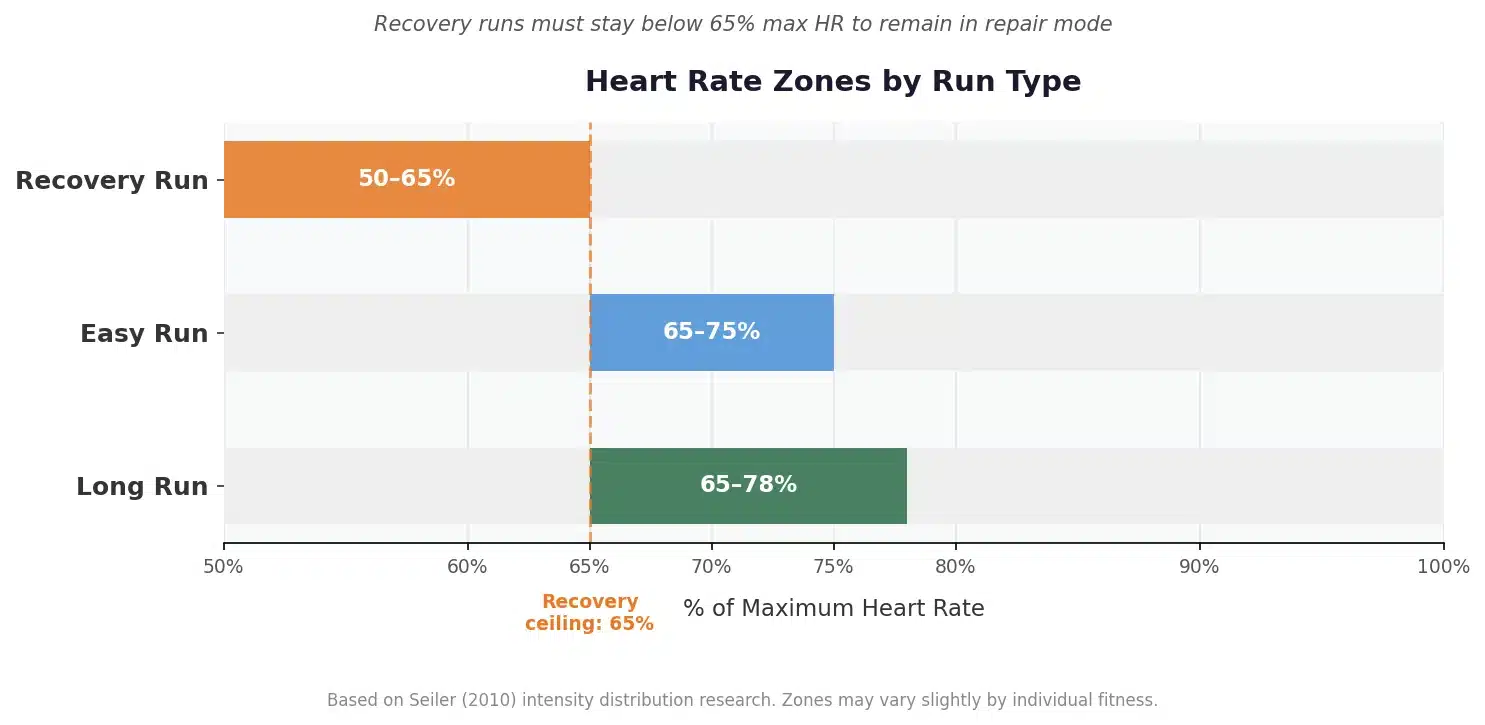
Your heart rate should stay below 65 to 70 percent of your maximum heart rate during a recovery run.
In pace terms, that typically falls 90 seconds to two minutes per mile slower than your marathon goal pace, or two to three minutes per mile slower than your 5K race pace.
If you do not train by pace or heart rate, use this rule: you should be able to speak in full, unbroken sentences without catching your breath between words.
Research on elite endurance athletes found that roughly 75 to 80 percent of training volume is completed below the first lactate threshold, the intensity at which lactate begins accumulating in the blood.

Recovery runs belong firmly below that threshold.
Running faster than this during a recovery session shifts your body from repair mode into training mode.
You are no longer recovering from yesterday’s workout.
You are adding a second training stimulus, which delays the adaptation process and increases fatigue heading into your next hard session.
A recovery run that feels “too easy” is doing its job. If it feels like a real workout, you are running it too hard.
Most runners do not have access to a lactate test, so heart rate is the most reliable proxy.
A running-specific heart rate monitor worn on the chest (not the wrist) gives the most accurate reading at very low intensities, where wrist sensors tend to overread.
If you are looking for an exact target pace based on your current race fitness, this easy and recovery run pace calculator will generate your specific training zones from your most recent race time.
RunnersConnect Bonus
Download our Heart Rate Calculator to find out what your individual heart rate zones are.
What Is An Easy Run?
An easy run is a foundational component of most run training programs. While it does share some similarities with recovery runs in terms of being low-intensity, an easy run serves a broader purpose within a training plan.
Easy runs are designed to build and maintain your aerobic base, which is essential for every long-distance runner.
They are a crucial part of the mileage that makes up most of a distance runner’s weekly mileage.
The Purpose of Easy Runs
Aerobic Development – The primary goal of an easy run is to enhance your aerobic capacity.
Running at an easy pace allows your body to efficiently utilize oxygen and produce energy, which is crucial for building endurance.
This low-intensity training helps strengthen your cardiovascular system, improve lung capacity, and increase the number of mitochondria in your muscles.
Endurance Building – Easy runs help build muscular endurance, which is the ability of your muscles to sustain long periods of activity.
By running at a comfortable pace over increasingly longer periods, you train your muscles to resist fatigue and perform more efficiently over long distances.
Recovery – Although easy runs are more challenging than recovery runs, they still serve as a recovery function, especially when scheduled between two more intense workouts.
When scheduled properly, they allow you to accumulate mileage without overstressing your body.
Pace and Intensity
Comfortable but Steady – The pace of an easy run should be comfortable enough that you can hold a conversation without difficulty but still feel like you’re putting in some effort.
They are typically run at 65-79% of your maximum heart rate. The pace will vary from runner to runner depending on factors such as fitness level, experience, and the training cycle you’re in.
Perceived Effort – On a scale of 1 to 10 (1 being an easy walk, 10 being an all-out sprint), an easy run should feel like a 3 or 4 at most. It should be more strenuous than a recovery run but still below the effort levels reached during speed work or tempo runs.
Exact Pace – For those runners who function better with exact paces to target, we’ve created this handy calculator to help you determine your easy and recovery run paces.
If you want more on the science behind these paces, check out our article on the optimal easy and long run paces here.
Duration
Variable Length – The length of an easy run can vary significantly, ranging from 30 minutes to a few hours, depending on fitness level, goals, and training plan.
Some runners might run 4-6 miles on an easy run, while others, especially those training for longer events, may go 10 miles or farther on an easy day.
Mileage Accumulation – Easy runs often comprise the bulk of a runner’s weekly mileage, contributing to overall endurance and aerobic conditioning without the stress of more strenuous efforts.
Incorporating Easy Runs
Easy runs should be a regular part of any training schedule. Most runners should include easy runs multiple times per week, particularly on days between more intense workouts like speedwork and long runs.
Of course, the exact number is going to depend on how many days per week you’re running and how many hard sessions you have scheduled throughout the week.
Just as an example, here is how a schedule might look for someone running 5-6 days per week…
Mon – Easy run
Tue – Workout
Wed – Recovery run
Thur – off or easy run
Friday – Workout or easy run
Saturday – Recovery or easy run
Sunday – Long run or easy run or off
Keep in mind that easy runs are flexible and can be adjusted based on how your body feels.
If you’re fatigued, the pace can be slowed down or the distance shortened; if you’re feeling good, the distance can be extended (within reason).
The Main Differences Between Recovery Runs and Easy Runs
Recovery runs are primarily for aiding recovery and removing waste products from the muscles. They allow you to keep your legs moving and help ensure your muscles are ready for the next hard effort.
On the other hand, easy runs are essential for building aerobic and muscular endurance and laying the groundwork for peak performance in races and more demanding training sessions.
Effectively balancing these two types of runs is critical to improving as a runner while avoiding overtraining, burnout, and injury.
How Is a Recovery Run Different From a Long Run?
Long runs are a training stress that your body has to recover from.
Recovery runs are a tool to help your body recover from the stress it already absorbed.
That distinction matters because runners who confuse the two end up running their long runs too short or their recovery runs too long.
Both errors create the same outcome: accumulated fatigue that blocks performance gains.
Here is how the three run types compare:
| Run Type | Duration | Heart Rate | Primary Purpose |
|---|---|---|---|
| Recovery Run | 20–45 min | <65% max HR | Flush fatigue, accelerate repair |
| Easy Run | 45–75 min | 65–75% max HR | Build aerobic base, accumulate mileage |
| Long Run | 75–180 min | 65–75% max HR | Build endurance, glycogen efficiency, mental toughness |
The long run and easy run share a similar heart rate zone.
What separates them is duration and intent.
An easy run is a foundational aerobic session: moderate length, comfortable effort, and consistent mileage accumulation.
A long run extends that duration far enough to create adaptations specific to endurance: improved fat oxidation, increased glycogen storage capacity, and the cardiovascular strain needed to build a bigger aerobic engine.
Studies on active recovery confirm that light movement at low intensity promotes blood flow and reduces muscle soreness markers more effectively than full rest, but only when the effort stays below the recovery-to-training threshold.
A recovery run scheduled the day after a long run keeps circulation moving through your muscles without asking those muscles to perform.
The simplest scheduling rule: long run on Sunday, recovery run on Monday, easy runs filling the rest of the week around your hard sessions.