

Your training is done.
The hard workouts are logged, the long runs are behind you, and the taper has begun.
What happens between now and the start line matters more than the average runner realizes.
Carbohydrate availability on race day is one of the most controllable variables in marathon performance, and it is almost entirely determined by what you eat in the 5 days before the gun goes off.
So, in this article you’re going to learn the research-backed practical advice on:
- How to carb load effectively in the days leading up to your race
- What to eat the day before, the night before, and the morning of the marathon
- How to use caffeine to boost performance without GI risk
- Which foods to cut in race week to protect your stomach on race day
Why Does What You Eat Before a Marathon Actually Matter?
Pre-race nutrition determines how much glycogen sits in your muscles when the gun goes off, which is the single biggest factor in how far you can hold marathon pace before fatigue forces a slowdown.
Your muscles store carbohydrate as glycogen, and that stored fuel is your primary energy source at marathon race pace.
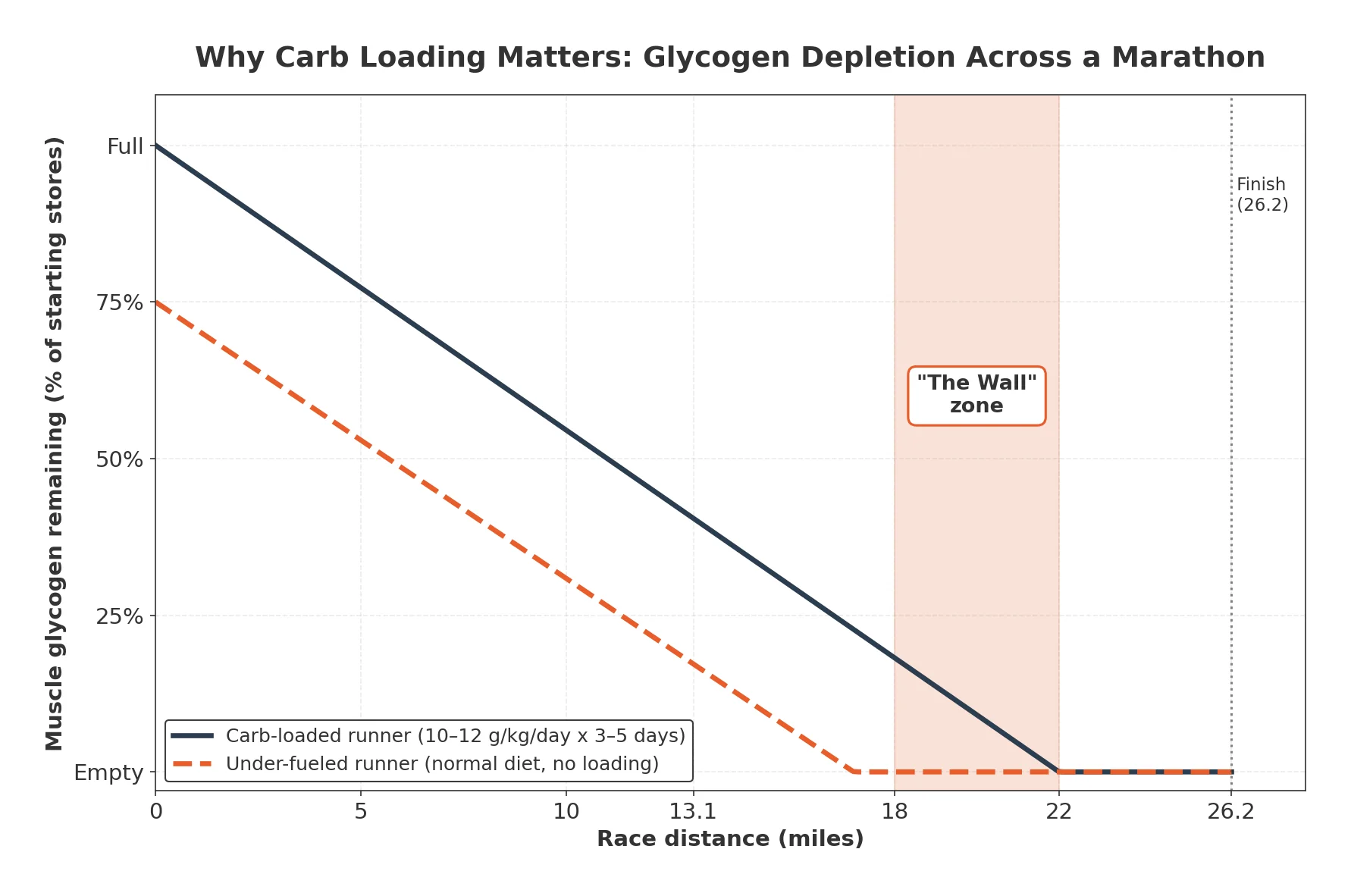
A typical runner carries enough glycogen to fuel roughly 18 to 20 miles at race pace before those stores run critically low.
That is why hitting the wall typically happens in the 18 to 22 mile range.
Carbohydrate loading in the days before a marathon extends how long you can hold marathon pace before fatigue forces a slowdown.
The goal of pre-race nutrition is simple: arrive at the start line with your glycogen tanks as full as possible.
Your glycogen stores at the start line directly determine how long you can hold marathon pace before the wall arrives.
How you fill those tanks in the final days is where free performance gets left on the table.
How Should You Adjust Your Carb Intake the Week Before a Marathon?
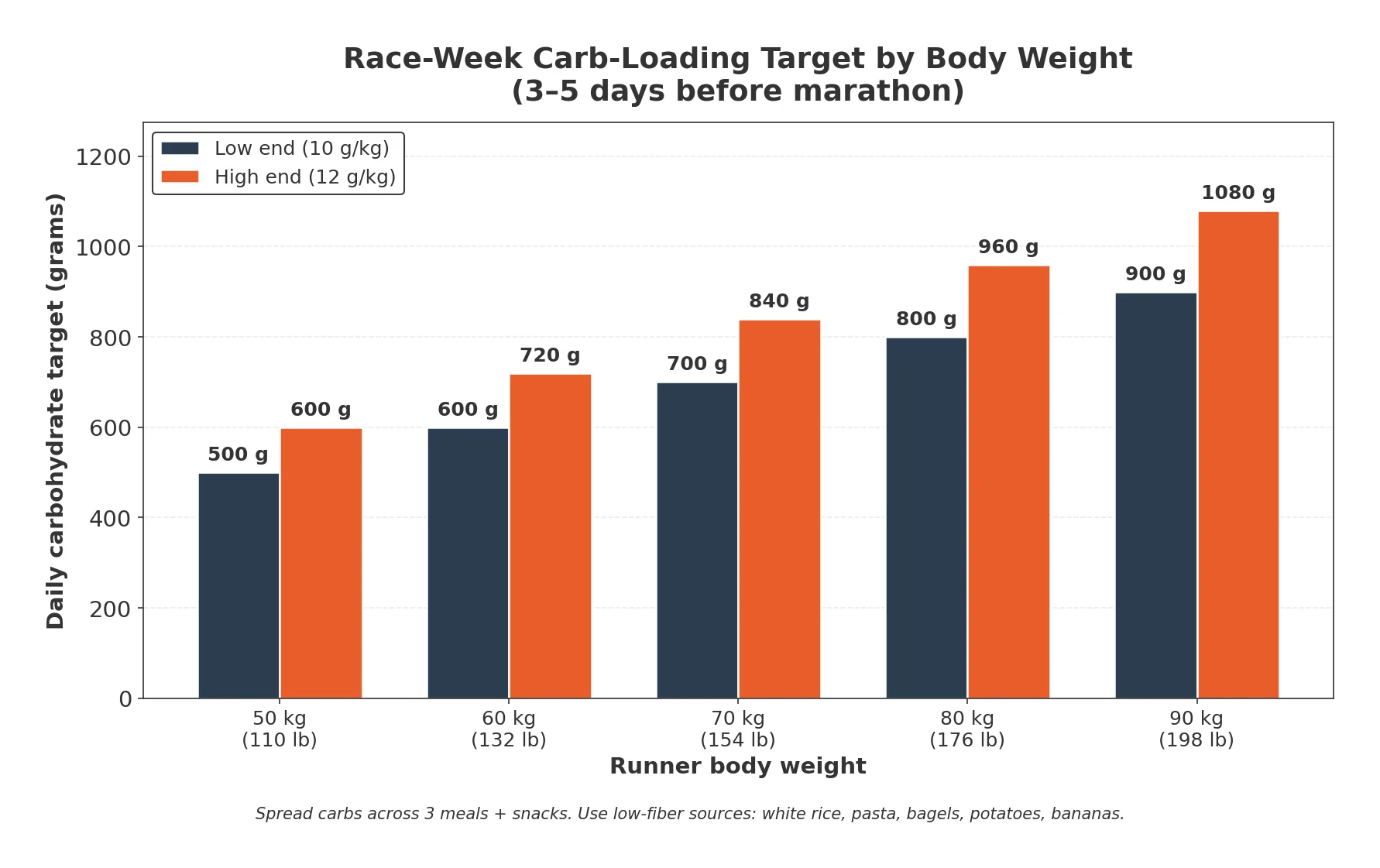
In the 3 to 5 days before a marathon, eat 10 to 12 grams of carbohydrate per kilogram of body weight every day, drawn mostly from low-fiber, easy-to-digest sources like white rice, white pasta, bagels, oatmeal, potatoes, and bananas.
Carbohydrate loading works best when you significantly increase your daily carb intake over this 3 to 5 day window.
Research has shown that carbohydrate intakes of 10 to 12 grams per kilogram of body weight per day, sustained over 36 to 48 hours before a race, are sufficient to maximize glycogen storage ahead of a marathon.
For a 70 kg (154 lb) runner, that translates to 700 to 840 grams of carbohydrate daily.
Spread across meals, that is achievable with smart food choices.
Focus on lower-fiber, high-carbohydrate foods during this window: white rice, white pasta, bagels, white bread, oatmeal, potatoes, and bananas all fit.
High-fiber whole grains, beans, and cruciferous vegetables are worth cutting during race week.
They slow gastric emptying and increase the risk of GI distress during the race itself.
Because your mileage drops sharply during the taper, you will feel like you are eating more than your training demands.
That is the point.
You are shifting carbohydrate into storage, not burning it on long runs.
For a deeper look at the protocols used by competitive runners, this guide to effective carb loading strategies covers the timing and food selection in detail.
RunnersConnect Bonus
Download your FREE Marathon Nutrition During Your Taper Guide.
The guide contains a plan of exactly what you should be eating in the 5 days to 3 hours before your race. We give specific food recommendations to make sure you are ready on race day.
What Should You Eat the Day Before a Marathon?
The day before a marathon, eat 3 carb-heavy meals at normal portion sizes spread throughout the day, keep fat and fiber low, and stop eating large meals at least 10 hours before the start.
Spreading carbohydrate across breakfast, lunch, and an early dinner stores more glycogen than trying to cram everything into a single huge pasta meal.
A simple day-before template that fits the typical race-week menu:
- Breakfast (7 to 9 a.m.): Oatmeal with banana and honey, plus a glass of orange juice
- Lunch (12 to 1 p.m.): White rice with grilled chicken, a small side of cooked carrots, and white bread on the side
- Snack (3 to 4 p.m.): Bagel with jam, or a banana with honey
- Dinner (6 to 7 p.m.): Pasta with a light tomato sauce and lean protein, plus white bread
This pattern delivers steady carbohydrate input across the day without overloading any single meal.
Avoid restaurant meals you are not familiar with, anything fried, anything spicy, and any new supplement or sports drink someone hands you at the expo.
Stay hydrated throughout the day with water and a light electrolyte drink.
If you typically have a glass of wine with dinner, skip it the night before. Alcohol disrupts sleep and impairs glycogen storage.
What Should You Eat the Night Before a Marathon?
Eat a familiar, moderate-sized high-carb dinner 10 to 12 hours before the race start, focused on pasta, rice, or potatoes with a light protein and minimal fat.
The night before your marathon should be a normal, familiar, high-carbohydrate meal.
Pasta, rice, or potatoes all work well, but the specific food matters less than two things: eat what you know agrees with your stomach, and do not overeat.
The pasta dinner often gets treated as a final fuel-loading opportunity, with portions far larger than a normal meal.
Your glycogen tanks were filled during the 3 to 5 days before the race.
The night-before meal is maintenance, not a last-minute carb surge.
A large, rich meal the night before leaves you feeling heavy and bloated at the start line.
Keep the meal moderate in size, low in fat and fiber, and light on anything that takes a long time to digest.
Finish eating at least 10 to 12 hours before the race starts.
If your race starts at 7 a.m., that means finishing dinner by 7 to 9 p.m. the night before.
What Should You Eat on Marathon Morning?
Eat 2 to 4 hours before the start, targeting 1 to 4 grams of carbohydrate per kilogram of body weight, with the meal you have practiced before your longest training runs.
The longer before the race you can eat, the more you can comfortably consume.
A meal 3 to 4 hours out allows for a proper breakfast: oatmeal with banana and honey, a bagel with peanut butter, or toast with honey and a banana all fit the profile.
Closer to 90 to 120 minutes before the start, keep it small and simple: a banana, half a bagel, or a low-fiber energy bar.
Practice your exact pre-race breakfast during your 2 or 3 longest training runs before race day, not for the first time on race morning itself.
Tolerance for solid food close to race start varies sharply between individuals.
One runner can handle a bagel 60 to 90 minutes out without any GI issues; another needs 3 full hours to feel settled.
Your long training runs are the testing ground for figuring out which type you are, not race morning itself.
Coffee is fine if you normally drink it.
Cutting caffeine before race day often triggers withdrawal headaches that can derail your pacing by mile 10.
Does Caffeine Help Before a Marathon?
Caffeine taken 60 minutes before the start at 3 to 6 mg per kilogram of body weight reliably improves marathon performance, but only for runners already accustomed to caffeine in training.
Caffeine is one of the most consistently supported performance aids in endurance running.
A 2021 international position stand confirmed that caffeine consistently improves exercise performance when consumed in doses of 3 to 6 milligrams per kilogram of body weight, taken approximately 60 minutes before exercise, with the strongest evidence coming from aerobic endurance events.
For a 70 kg runner, that means 210 to 420 mg of caffeine, roughly equivalent to 2 to 4 cups of brewed coffee.
Higher doses do not improve performance further and significantly increase the risk of anxiety, GI distress, and elevated heart rate.
If you drink coffee regularly, your standard pre-race cup likely falls within the effective dose range.
Caffeine in gel form or as a purpose-built endurance pre-workout gives more precise dosing if you want consistent timing without relying on variable brewed coffee concentrations.
That is why I recommend our partner MAS Endurance, which is formulated specifically for long-duration aerobic efforts with endurance-appropriate caffeine dosing alongside nitrates and beta-alanine for sustained fatigue delay.
If caffeine is not currently part of your routine, race morning is not the time to start.
An unfamiliar caffeine dose before a marathon carries real GI risk and can produce more harm than benefit for runners who have not trained with it.
How Much Should You Drink Before a Marathon?
Aim for 500 mL (about 17 oz) of water with your pre-race breakfast, then sip a light electrolyte drink steadily up to 30 to 60 minutes before the start, using urine color as a guide.
Pre-race hydration is about arriving at the start line normally hydrated, not hyperhydrated.
A light electrolyte drink in the hour before the gun provides sodium that helps your body retain the fluid you consume.
Check urine color as a rough guide: pale yellow means you are well hydrated, dark yellow means drink more, and completely clear means you have consumed too much.
Overhydration with plain water, not dehydration, is what causes hyponatremia, one of the most dangerous conditions in distance running.
Sip consistently rather than gulping large volumes at once in the hour before the start.
Which Foods Should You Avoid in the Week Before a Marathon?
Cut high-fiber foods, high-fat meals, alcohol, and any new product you have not practiced with on training runs starting 2 to 3 days before the race.
Race week is not the time to experiment with new foods, new supplements, or any major shift from your normal diet.
One study tracking 60 km ultramarathon runners found that 73% reported gastrointestinal complaints during the race, with 20% experiencing severe GI symptoms.
Most of that distress is preventable with smarter food choices in the final days before the race.
Cut high-fiber foods starting 2 to 3 days out.
Beans, lentils, cruciferous vegetables, raw greens, and high-fiber whole grains all increase fermentation in the gut and carry real GI risk during a 3 to 5 hour effort.
Reduce fat intake as well.
High-fat meals slow gastric emptying and may still be working through your system when the gun goes off.
Avoid alcohol the week before the race.
Alcohol impairs sleep quality and interferes with glycogen storage, two things that have a direct impact on race performance.
Skip anything unfamiliar: a supplement a training partner swears by, a new energy bar from the race expo, or a product you read about the night before your race.
If you have not practiced it during long training runs, it has no place on race day.
For a full race-day fueling strategy beyond the start line, this race-day nutrition blueprint covers on-course fueling and bonk prevention in detail.
| Timing | Daily Carb Target | Best Food Choices | What to Cut |
|---|---|---|---|
| 3 to 5 days out | 10 to 12 g/kg body weight | White rice, pasta, bagels, potatoes, bananas | High-fiber foods, alcohol, fatty meals |
| Day before | 3 carb-heavy meals at normal portions | Oatmeal, white rice, pasta, bagels, bread | Restaurant meals, fried foods, alcohol |
| Night before | Moderate meal, 10 to 12 hrs before start | Pasta, rice, bread, soup | Red meat, large portions, new foods |
| 3 to 4 hours before race | 1 to 4 g/kg body weight | Oatmeal, bagel with peanut butter, toast with honey | High fat, high fiber, dairy |
| 60 to 90 min before race | Small carb snack only | Banana, energy bar, sports gel | Heavy solids, excess caffeine |


17 Responses
Very helpful for a newbie runner like myself. Thank you!
This article hits the nail on the head. Don’t do or eat anything new, follow the time recommendations and diet suggestions and hydrate. The rest is easy if you are well trained. Enjoy your marathon.
Thank you for your input, I’m going with your advice. Sounds very logical.. This will be my first marathon.
I am running my first marathon next month and it is in the evening. Any advice on food pacing or scheduling during the day/up to 48 hours out while waiting for the start?
Great stuff, as always!
debi, did you read the article???
I have a cake-pop before every race. Perfect size, it’s light. Tastes great. Usually get it with a coffee. Has never caused me stomach issues, it works for me!
WOW! Thats impressive Kyle, but if you found what works for you, then by all means trust your body!
Thanx for the well articulated guide, for me it will work as a daily manual, nyc
Hi folks – just wondering about the obsession with manufactured synthetic energy such as Gatorade and energy gels. Is there no other, better, natural way to energise before and during race… ? Thanks.
Hi John, thanks for reaching out. Yes, there are definitely other sources that are more natural. We go into more detail on this in this post https://runnersconnect.net/running-nutrition-articles/what-to-eat-before-a-run/ As for during a race itself, you could try using raisins or fig bars as they are easy to carry. You could also use a banana or sweet potato if you have some way of transporting them. Hope this helps!
Great post. I never eat before my runs and especially my long runs. I’ve run 4 other marathons and ironically, I’ve hit the wall hard each time. Should I stick with what my body is used to – or try to eat something light 2-3 hours before the race?
Thanks!
Hi Robert, we would definitely recommend you take a look at your pre race nutrition, especially if you are struggling, it will make a huge difference (and allow you to actually enjoy….well….somewhat enjoy) your marathon. We have a marathon nutrition blueprint where we could figure out your exact needs and work with your preferences https://nutrition.runnersconnect.net but if not, you could download our free marathon fueling nutrition series at the bottom of this post or on the side. You might also appreciate this post for future reference https://runnersconnect.net/running-nutrition-articles/bonk-fatigue-cramp/ Hope this helps, and let us know what you find works for you! Start with something simple like a banana and bagel, and see what your body can handle.
I am running my first half marathon tomorrow morning and I never eat prior to my morning runs. I have done long runs of 9+miles for the past 3 weeks and find that I am tired at the end of the run. Should I eat a small meal the day of the race? If so what?
Hi Angie, hope the half went well. It would be a good idea to start eating before you run. If you would like us to send you links on what to try, let us know. Here is a link for now https://runnersconnect.net/running-nutrition-articles/what-to-eat-before-a-run/
Thank you for the help, I’m a dancer and also need a lot of endurance when competing, and this was an extremely helpful meal plan.