

You can add miles for months and still find that your 5K pace barely moves.
That happens because mileage mostly trains your heart, lungs and the slow-twitch fibers in your legs. It does far less for how quickly your brain recruits muscle and how well your legs turn each foot strike into forward speed.
That second piece is your neuromuscular fitness, and you can train it with a few short sessions a week that add almost no mileage.
Here’s what you’ll learn about neuromuscular training:
- What neuromuscular fitness is and why your easy miles don’t build it
- The 4 types of training that improve it, with a starter dose for each
- How to fit them into your week without running more
What Is Neuromuscular Fitness in Running?
It’s how well your nervous system and muscles work together to produce force quickly on every stride.
Part of it is how many muscle fibers your brain can recruit at once and how fast it fires them.
Your tendons matter too, because a stiffer Achilles stores more energy at foot strike and returns more of it when you push off.
You notice good neuromuscular fitness as better running economy, which means you use less oxygen to hold the same pace.
Research has shown that replacing about a third of endurance training with explosive strength work for 9 weeks made runners faster over 5K and improved their running economy, with no change in VO2max.

That means the runners got faster without their aerobic engine getting any bigger.
The researchers traced the gain to better neuromuscular characteristics, which showed up as improved efficiency and a higher top speed on a maximal anaerobic treadmill test.
Why Doesn’t More Mileage Improve Your Neuromuscular System?
Easy running asks your legs to repeat the same low-force stride thousands of times, so your nervous system has no reason to recruit more muscle or fire it faster.
Your muscles and nervous system adapt to the specific demand you place on them, a rule coaches call the S.A.I.D. principle, short for specific adaptations to imposed demands.
The same 9-week study showed what happens when you stick to endurance training.
The athletes who kept doing their normal endurance training got slower over 20 meters and covered less distance in a 5-jump test, even though their VO2max went up.
Endurance training alone can raise your aerobic fitness while your speed and power fade.
You need that speed and power when you change pace, climb a hill or kick to the finish.
RunnersConnect Bonus
Download your FREE Strength Progression slides.
Use these slides to easily create your own progressive strength routine and adapt your strength work to the phase of training you’re in.
How Do You Improve Your Neuromuscular System?
Short, high-force work that your easy miles never provide is what trains it.
Four types of training do this, and none of them add meaningful mileage.
1. How Do Strides Improve Neuromuscular Fitness?
Strides are 20-second runs at roughly your mile race pace, done at the end of an easy run.
At that pace your legs turn over faster and push harder against the ground than they do at easy pace, and 20 seconds is short enough that your form holds together.
Start with 4 strides after 2 easy runs a week, walking or jogging for 60 seconds between each one.
Over 4 to 6 weeks, build to 6 to 8 strides per session.
Keep your steps quick and light and your shoulders relaxed.
You should finish each stride feeling like you could have gone faster.
2. Are Hill Sprints Safer Than Flat Sprints?
Hill sprints are 8- to 10-second all-out efforts up a steep hill, and they push your nervous system to produce maximal force at a lower top speed than flat sprinting, which is why coaches treat them as a lower-risk way to sprint.
A 2013 study put 20 well-trained runners through 6 weeks of uphill interval training at a range of intensities.
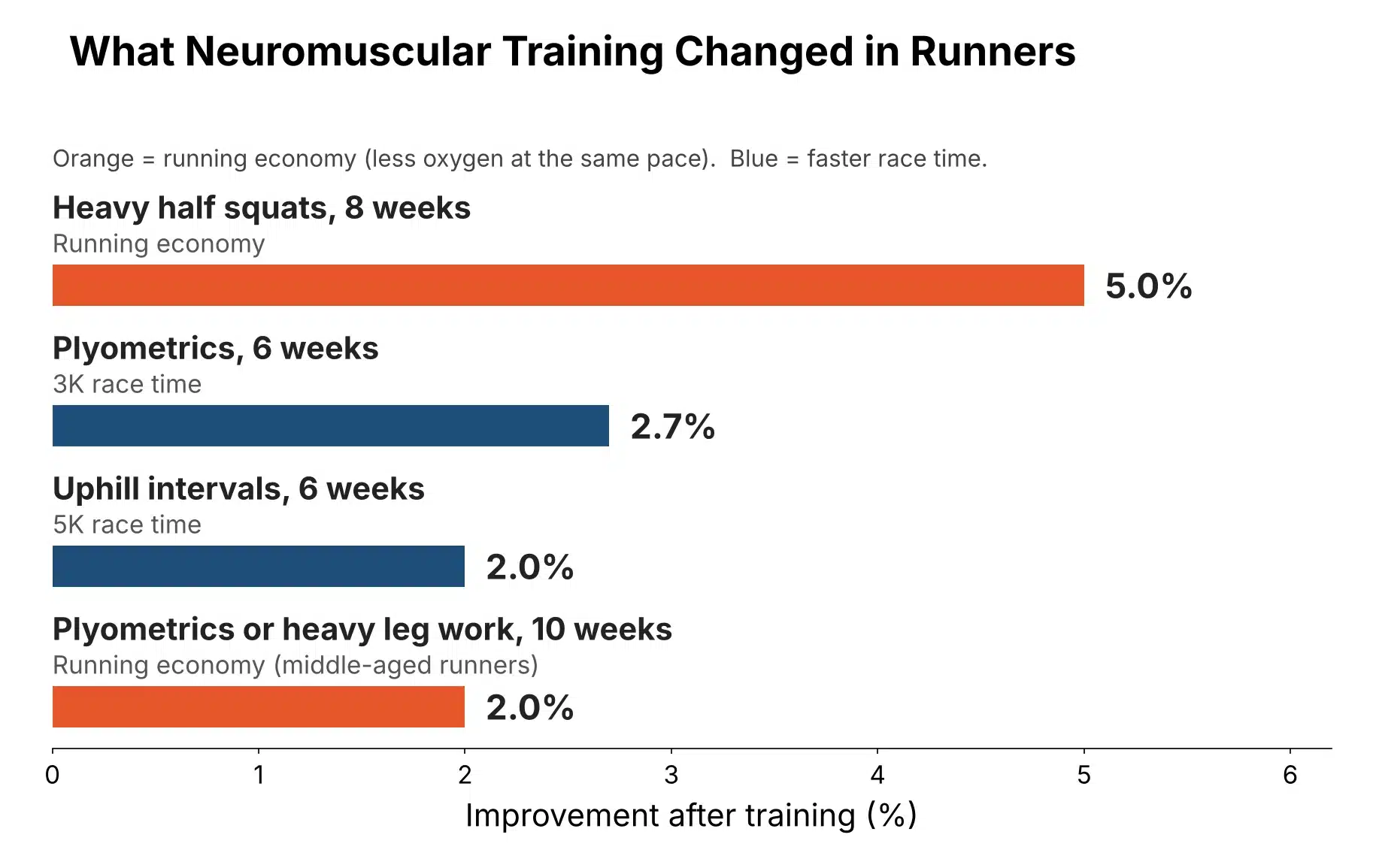
Their 5K times improved by an average of 2.0%, and the hardest hill program produced the biggest gains in running economy and in every neuromuscular measure the researchers tested.
That means the hardest hill efforts are the ones that do the most for your neuromuscular system.
The slope also takes stress off your hamstrings.
Most research points to the late swing phase as the likely moment hamstring strains happen during fast running, when the hamstring is stretched hard as it slows your lower leg before your foot strikes the ground, according to a 2019 review.
On a hill, you can’t reach your flat-ground top speed, so your leg swings through more slowly while you still push with near-maximal force.
Start with 2 sprints of 8 seconds on a hill of about 6 to 10%, walking back down for 2 to 3 minutes of full recovery between each one.
Add 1 or 2 sprints a week until you reach 8 to 10, then lengthen each sprint to 12 to 15 seconds.
Do them once a week, after an easy run or a workout warm-up. Our guide to explosive hill sprints covers how to fit them around your workouts.
3. Does Heavy Strength Training Help Distance Runners?
Heavy strength training is one of the best-researched ways to build neuromuscular strength in distance runners.
A study of well-trained runners found that 8 weeks of heavy half squats, 3 times a week, improved running economy by 5% and let them run 21% longer at their maximal aerobic speed.
The runners did 4 sets of 4 reps at the heaviest weight they could lift 4 times, and their body weight didn’t change.
Their rate of force development, a measure of how quickly they could produce force, rose by 26%.
That means heavy, low-rep lifting trains your legs to produce force faster, and in the same runners each stride took 5% less oxygen at the same pace.
Strength work also lowers your injury risk.
A 2014 analysis of injury-prevention trials across many sports found that strength training cut injuries to less than a third.
Start with 2 sessions a week of 2 or 3 lower-body lifts, such as squats, deadlifts and calf raises, using a weight you can lift 10 to 12 times.
Once your form is solid, usually after 4 to 6 weeks, move to heavier sets of 4 to 6 reps.
If you want a structured plan instead of building routines yourself, our Strength Training for Runners program has 24 routines with prescriptions by race distance.
4. Do Plyometrics Make You a More Efficient Runner?
Plyometrics are jumping exercises that train your muscles and tendons to absorb the force of each landing and release it as fast as possible.
That stretch-and-recoil action is what your calves and Achilles do on every stride.
In a 2003 study, runners who added 6 weeks of plyometrics to their normal training ran a 3K 2.7% faster.
Their lower legs also became stiffer, and the researchers believe that stiffer spring is what improved their running economy.
Everyday runners see the economy gain too, though it may not show up in race times right away.
A 2024 trial in middle-aged non-elite runners found that 10 weeks of either plyometrics or heavy leg exercises improved running economy by 2.0%.
Neither group ran a faster 5K over those 10 weeks, so give this work a full training cycle before you judge it.
Start with 2 sets of 10 pogo hops and 2 sets of 5 bounds once a week on grass or a track, before your lifting while your legs are fresh.
After 4 weeks, add box jumps or low drop jumps.
How Should You Fit Neuromuscular Training Into Your Week?
Combining 2 or more types of strength work beats relying on one.
A 2024 review of strength training studies in middle- and long-distance runners found that combining two or more strength methods, such as heavy lifting, lighter lifting or plyometrics, had a large effect on race times.
Heavy lifting on its own had a moderate effect, and plyometrics on their own had no clear effect.
Pair heavy lifting with plyometrics or lighter lifting for the biggest gains in race performance.
Your warm-up is the easiest place to start.
Before a workout or race, add 2 or 3 strides and a few drills like A-skips and high knees so your legs are used to fast, forceful movement before the hard running begins.
Put your lifting, hill sprints and plyometrics on your workout day or the day after, so your other easy days stay easy.
A week for a runner training 5 days can look like this:
| Day | Running | Neuromuscular work |
|---|---|---|
| Monday | Easy run | 4 to 6 strides |
| Tuesday | Workout | Drills and strides in the warm-up, heavy lifting after |
| Wednesday | Easy run | Hill sprints, then plyometrics |
| Thursday | Rest or cross-training | None |
| Friday | Rest | None |
| Saturday | Long run | None |
| Sunday | Easy run | 4 to 6 strides |
Here’s a recap of each method:
| Method | Starter dose | What it does |
|---|---|---|
| Strides | 4 x 20 seconds after 2 easy runs a week | Coaching staple for fast, relaxed turnover that adds almost no mileage |
| Hill sprints | 2 x 8 seconds, once a week | 6 weeks of uphill intervals improved 5K time by 2.0% |
| Heavy strength training | 2 sessions a week, building to 4 to 6 reps | 8 weeks improved running economy by 5% |
| Plyometrics | 2 x 10 pogo hops and 2 x 5 bounds once a week | 6 weeks improved 3K time by 2.7% |