

Once the fever breaks and you can get out of bed, the urge to make up for lost mileage kicks in fast.
But a fever breaks down muscle protein and raises your risk of heat illness, and both effects last after the fever is gone.
And research on athletes recovering from respiratory infections shows the flu takes longer to come back from than a cold, with amateur athletes taking longer than professionals.
So, you need a plan for when to stop running, when to start again and how fast to build back up.
In this article, you’ll learn:
- Whether you can run with the flu, and which symptoms mean you shouldn’t
- How many days athletes need before they’re back to full training
- Why running hard too soon after a fever puts you at risk
- A stage-by-stage plan for easing back into your training
Can You Run With the Flu?
Easy running is usually safe with a head cold, because the symptoms stay in your nose and throat.
In a 1998 study, people with a cold who exercised for 40 minutes every other day had symptoms that were no worse and lasted no longer than people who rested.
That’s why a few easy miles are fine when you’re running with a cold.
The flu is different because it affects your whole body, bringing a fever, muscle aches and fatigue.
A 2000 review of infections in athletes concluded that hard exercise during an infection with a fever can be dangerous and should always be avoided.
If you have a fever or body aches, don’t run until they’re gone.
How long you exercise in the first days of an infection also matters.
A 2005 study in mice infected with influenza found that 82% of the mice that ran 20 to 30 minutes a day survived, compared with 43% of the mice that didn’t exercise and 30% of the mice that ran for 2.5 hours a day.
This was in mice, and they exercised before their symptoms started, so it doesn’t tell you to run through the flu.
What it does show is that a long run in the first days of an infection carries far more risk than a short one.
How Long After the Flu Can You Run Again?
Getting back to some running after a respiratory infection takes a few days, and getting back to full training takes about a week.
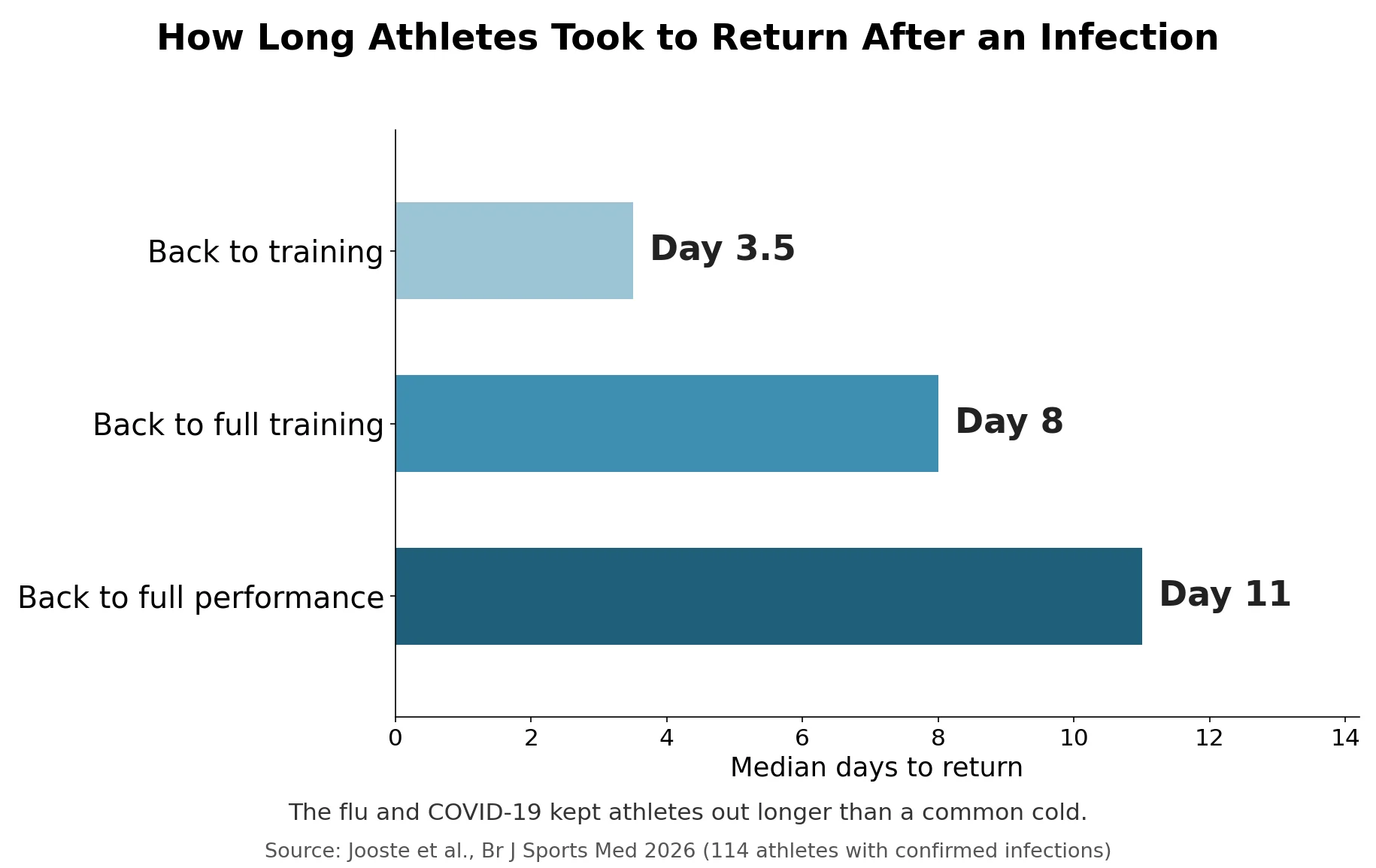
Research has shown that half of athletes with a respiratory infection were back to training within 3.5 days, back to full training by day 8 and back to full performance by day 11.

The same 2026 study found that the flu and COVID-19 kept athletes out longer than a common cold.
Amateur athletes also took longer to return than professional athletes.
That means an everyday runner coming back from the flu should expect more than a week before training and racing feel normal again.
The symptoms themselves last about a week, too.
A 2022 review of 54 studies found that respiratory illness symptoms in athletes lasted 7 days on average.
How Much Fitness Do You Lose While You’re Sick?
The fitness you lose in the first 2 weeks off is small.
In a 1992 study, distance runners who stopped training for 14 days lost about 5% of their VO2max, the most oxygen their bodies could use.
Their running economy, meaning how much energy they used at a given pace, didn’t change at all.
But their heart rate at the same running speeds was 11 beats per minute higher, and they lasted 9% less time on a treadmill test to exhaustion.
That means your first runs back will feel harder than before you got sick, and your heart rate will read higher than normal at your usual easy pace, even though most of your fitness is still there.
So, run your first week back by effort rather than by pace or heart rate.
For longer layoffs, see how long it takes to lose your running fitness.
RunnersConnect Bonus
Had to take some time off recently with an injury? Download our one-of-a-kind Performance Decline Calculator to find out what your estimated performance decline would be for any race distance.
Why Is Running Too Soon After a Fever Risky?
A fever changes how your body handles heat, fluid and muscle work, and some of those changes outlast the fever itself.
Does the Flu Raise Your Risk of Heat Stroke?
In a review of 994 heat stroke hospitalizations in the U.S. Army, researchers noted that a recent infection is a known risk factor for heat illness.
Infections were also listed as a factor in some of the 37 heat stroke deaths in that review.
Cool weather doesn’t remove the risk.
A 2006 case report described a well-trained marathoner who had a viral illness the week before his race and collapsed 10 meters (33 feet) from the finish on a 43°F (6°C) morning.
His body temperature was 105.3°F (40.7°C), and he spent 5 days in the hospital.
A virus in the week before a race can lead to heat stroke even on a cold day.
Can the Flu Affect Your Heart?
Viral infections can inflame the heart muscle, a condition called myocarditis, and it doesn’t always come with a fever.
Sudden death from myocarditis during exercise is rare.
A 2022 analysis of 15 studies found 1 sports-related sudden death from myocarditis for every 2.13 million people followed for a year.
Still, stop running and see a doctor if you notice chest pain, a racing or irregular heartbeat, or breathlessness that doesn’t match your pace in the weeks after the flu.
Why Do Your Legs Feel Weak After the Flu?
A 2014 review of fever in athletes found that a fever breaks down muscle protein, lowers strength and endurance, and increases the fluid you lose.
The 2000 review of infections in athletes adds that performance stays down after a fever because of lost muscle, poorer circulation control and slower coordination.
These take a variable amount of time to return to normal after the infection is over.
That means your easy pace may feel harder than usual for your first few runs back.
How Should You Ease Back Into Running After the Flu?
A safe return moves in stages, and you only move to the next stage when the last one felt normal.
| Stage | When to start it | What to do |
|---|---|---|
| 1. No running | You have a fever, body aches or feel wiped out | Rest, drink fluids and sleep |
| 2. Short, easy runs | Your fever is gone without medicine lowering it | Short runs at an easy, conversational effort for at least 3 days |
| 3. Normal easy mileage | Your short runs felt normal and your symptoms didn’t return | Build back toward your usual weekly mileage with no workouts |
| 4. Workouts and races | You’ve been fully recovered for at least a week | Add one workout first, then return to your normal schedule |
Wait for the fever to go away on its own. Fever-reducing medicine can hide a fever that’s still there, so judge your readiness by how you feel without it.
Keep your first 3 days back short and easy. Your muscles and fluid levels are still recovering, so an easy effort is enough to restart your training.
Hold off on hard workouts and races for at least a week. Fast running raises your body temperature far more than easy running, and a recent illness already raises your risk of heat illness.
Drink more than usual. A fever increases fluid losses, so you may start your first runs back already low on fluid.
If your symptoms come back the day after a run, drop back a stage and give it a few more days.
What Should You Remember About Running After the Flu?
Use this table to decide whether to run based on your symptoms.
| Your situation | Should you run? |
|---|---|
| Head cold, no fever | Easy running is fine |
| Fever or body aches | No running until they’re gone |
| Fever gone for the first 3 days | Short, easy runs only |
| Chest pain, racing heartbeat or unusual breathlessness | Stop and see a doctor |
| Viral illness in the week before a race | Don’t race hard, or skip the race |
| Fully recovered for a week or more | Return to workouts and races |




One Response
The worst part is even after reading this I’m still going to perform my long run, lol.