You’ve been wearing custom orthotics for five years, and lately you wonder if your feet have become dependent on them.
Every time you try running in neutral shoes, something feels unstable.
Your arches don’t feel like they work the way they used to, and you’re not sure if stopping now would leave you vulnerable to injury or if staying on them forever is the real problem.
The questions pile up around foot weakness, transition risk, and whether you’re stuck with orthotics for life.
Stability shoes raise the same concern, since they’re designed to do a similar job through the midsole instead of an insert.
So, in this article you’re going to learn the research-backed practical advice on:
- Whether orthotics actually cause foot muscle weakness over time
- What happens to your feet when you try to stop using orthotics
- How stability shoes compare to orthotics for long-term use
- Whether your arch type alone determines your injury risk
- What the evidence really says about orthotics and injury prevention
- How to decide if you should stay on orthotics forever or build your way off them
Do Orthotics Actually Weaken Your Feet Over Time?
This is the fear that keeps runners in orthotics longer than they want to be in them.
The logic seems sound: if a shoe insert supports your arch, your foot muscles should have less work to do, which means they could atrophy over time.
The research is more nuanced than that.
A 2020 study found that after 12 weeks of wearing custom-made foot orthotics, runners showed a decrease in intrinsic foot muscle size, specifically in muscles that support your arch.
That sounds like exactly what you’re worried about, but there’s a critical detail: the study also found that these changes are reversible.
The muscles didn’t disappear permanently or become damaged.
They simply adapted to a reduced workload, the same way any muscle reduces in size when it’s not being challenged.
This matters because it means the atrophy isn’t inevitable or irreversible.
If you add targeted foot strengthening exercises while wearing orthotics, you can prevent this adaptation from happening in the first place.
Intrinsic foot muscle size reduction from orthotics is reversible with strength training, not a one-way path to permanent weakness.
What Happens When You Try to Stop Using Orthotics?
This is where runners who’ve been in orthotics for years often run into trouble.
The switch from supported feet to neutral feet is biomechanically significant, and rushing it guarantees injury.
Your intrinsic foot muscles have adapted to a reduced workload over months or years.
When you suddenly ask them to stabilize your arch without help, they’re not ready.
Research on minimalist shoe transitions shows a clear pattern: runners who switch abruptly to less-supportive footwear experience a spike in bone stress injuries within the first 10-12 weeks.
The fix is a gradual transition that typically takes 6 to 12 weeks.
Here’s what that looks like in practice: alternate between orthotics and neutral shoes on different days for the first 2-3 weeks, then gradually increase the ratio (70% orthotics, 30% neutral, then 50-50, then 30-70) over 8 weeks.
During this transition, strengthen your intrinsic foot muscles 3-4 times per week with targeted exercises like short foot holds, toe yoga, and arch activation drills.
Transitioning off orthotics takes 6-12 weeks minimum, and abrupt switches cause injury spikes in the first 10-12 weeks.
RunnersConnect Bonus
Download your FREE Guide to Minimalist Running.
Giving you an easy to follow, printable guidelines for how to adjust your training, slowly add-in barefoot running, and the exact strength routine you need to get your feet healthy and strong!
Do Stability Shoes Create the Same Long-Term Effects as Orthotics?
Stability shoes get framed as a softer alternative to orthotics, the assumption being that built-in support avoids the muscle dependency trap.
The biomechanical principle is the same, though the effect is less extreme.
Stability shoes reduce the amount of pronation your foot does during running, which means your intrinsic foot muscles work less, just like with orthotics.
The difference is one of degree.
A study examining motion control shoes (the most supportive category) found they reduce injury risk by 45% compared to standard shoes, but this benefit concentrated in runners with overpronation.
For runners with neutral arches or underpronation, the shoes provided no injury advantage and may have worsened outcomes.
Long-term wear of stability shoes carries the same transition considerations as orthotics: your foot muscles adapt to reduced demand, so switching to neutral shoes later requires a gradual ramp.
The same 6-12 week transition protocol applies.
Choose between orthotics and stability shoes based on what’s practical for your lifestyle, not based on the false assumption that shoes avoid the dependency question.
How Much Does Arch Type Actually Matter for Long-Term Injury Risk?
For decades, the running shoe industry operated on a simple theory: measure your arch type, prescribe the matching shoe, prevent injuries.
It didn’t work that way.
The U.S. military conducted two massive randomized controlled trials assigning thousands of recruits to shoes based on their arch type and foot structure.
Pronators got motion control shoes, neutral foot types got neutral shoes, supinators got motion control shoes.
The result: foot type alone predicted almost nothing about injury risk across the 12-week training period.
Motion control shoes only helped runners with pronounced overpronation.
For the rest, the shoes made no difference, and in some cases, the wrong shoe type increased injury risk.
This has a direct implication for your long-term orthotics decision.
If you were prescribed orthotics or stability shoes based solely on your arch type or a gait analysis showing “excessive pronation,” it’s worth revisiting whether you actually need long-term support or whether habit and outdated advice on custom orthotics have kept you dependent on something that may not matter for your specific feet.
Arch type alone is a poor predictor of injury risk, which means a lot of long-term orthotic wearers were prescribed support they never needed.
What’s the Evidence That Foot Orthotics Prevent Long-Term Injuries?
If you’re going to stay on orthotics long-term, the payoff should be real injury prevention rather than comfort alone.
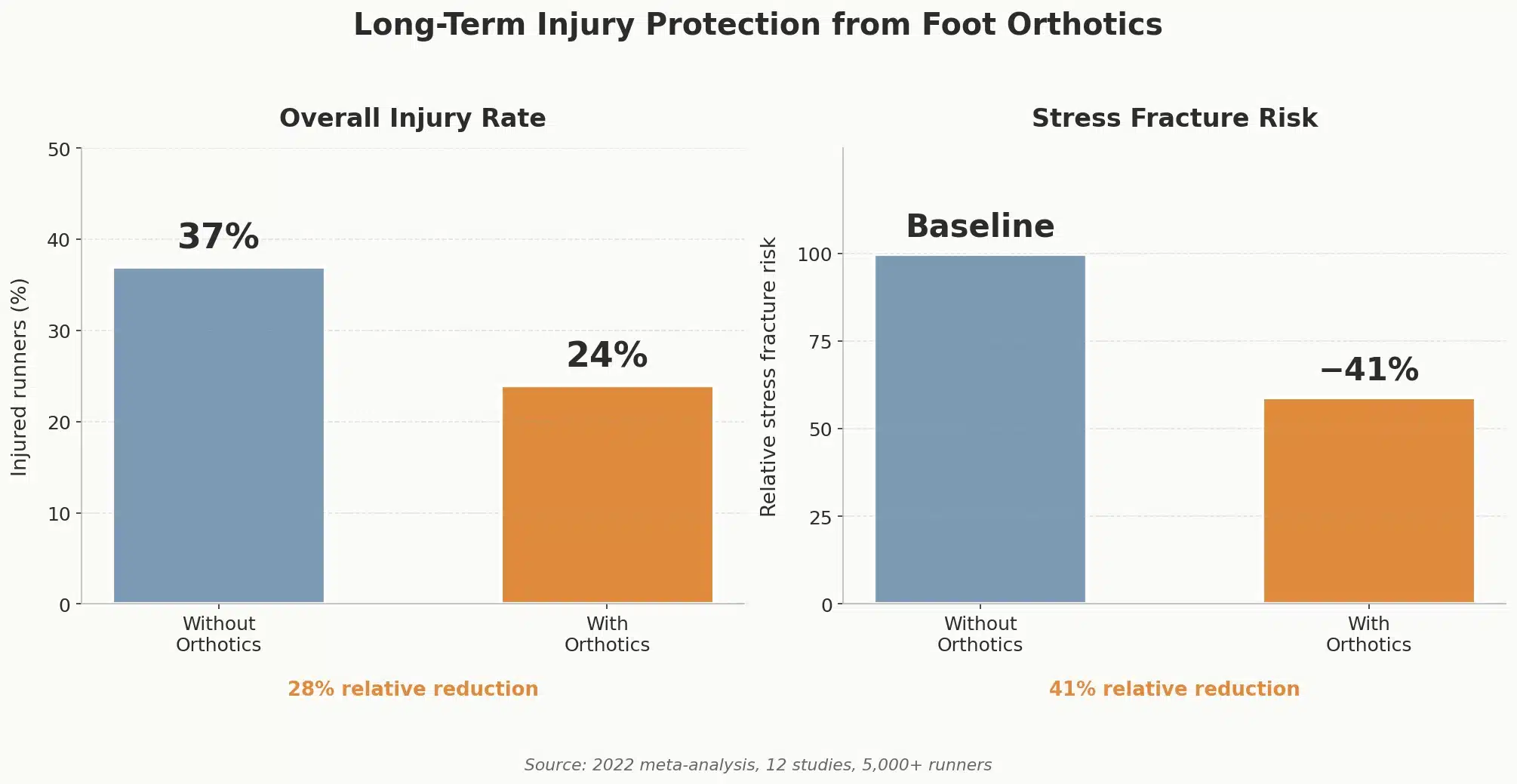
A 2022 meta-analysis analyzed 12 studies involving over 5,000 runners and found that orthotics reduced the overall injury rate by 28%.
When you isolate stress fractures specifically, the protection is stronger: orthotics cut stress fracture risk by 41%.
That’s meaningful protection, but there’s a catch: orthotics had a small negative effect on running economy, meaning your muscles work slightly harder and you burn more calories when running in them.
Over years of running, that efficiency tax adds up.
The decision to stay on orthotics long-term comes down to a personal trade-off: you get protection from certain injuries (particularly stress fractures and pronation-related issues), but you pay a small efficiency cost and accept some level of muscle adaptation.
If your injury history includes stress fractures or chronic plantar fasciitis, that protection is worth the trade-off.
If you’ve been injury-free for several years and are just wearing them out of habit, the case is weaker.
Should You Stay on Orthotics Forever, or Can You Build Your Way Off Them?
This is where the evidence and your personal goals need to align.
There’s no single right answer, but there are three evidence-backed paths.
Path one is accepting orthotics as a long-term tool, the same way you might accept that a particular shoe model works for your stride or that icing after long runs is part of your routine.
Plenty of lifelong orthotic wearers run injury-free careers and feel no shame about staying in support.
If your orthotics have eliminated chronic pain or prevent recurrent injuries, staying on them is a valid choice.
Path two is building your way off orthotics through targeted foot strengthening, which takes commitment but rebuilds your foot’s natural capacity.
Research shows that intrinsic foot muscle training significantly improves foot function and arch stability independent of external support.
This path takes 6-12 months of consistent work, starting with strength exercises while still wearing orthotics, then gradually transitioning to neutral shoes as your feet regain capacity.
The strength work comes first, the transition comes second.
Path three is a hybrid approach: continue wearing orthotics for high-mileage weeks or long runs, then rotate in neutral shoes for easy runs and strength workouts.
This gives your feet stimulus to adapt and stay strong without the all-or-nothing transition risk.
Which path you choose depends on your injury history, your goals, and your risk tolerance.
Orthotics aren’t a life sentence, and intrinsic foot muscle training can rebuild foot function enough to enable a gradual 6-12 month transition to neutral shoes.
Whichever path you choose, the underlying principle is the same: your feet need stimulus to stay strong and resilient.
If you’re on orthotics, add strength work to the mix and your muscles won’t atrophy.
If you’re transitioning off them, give yourself 6-12 weeks and prioritize foot strengthening exercises.
If you’re deciding whether to stay on them, weigh your injury history and running goals against the small efficiency cost.
Your feet are capable of more adaptation than you might think, but that adaptation only happens if you demand it.
Long-term orthotics use isn’t a trap, but it is a choice that requires active management.
Make the call deliberately so you stay on orthotics by choice instead of by inertia.