The fueling advice you’ve been following for every marathon was written for a 7:30AM gun.
Boston doesn’t start until 9:32AM for Wave 1, and closer to 10:50AM for runners in Wave 4 or 5.
That 2-to-3-hour gap doesn’t just shift your breakfast time.
It dismantles the physiological assumptions behind the entire pre-race fueling playbook.
You can’t eat your standard breakfast at 5:30AM, board a bus to Hopkinton, and expect that meal to carry you through a 10AM start line.
The glucose from that meal peaks and falls while you’re standing in a field in Hopkinton waiting for your corral to move.
Runners who don’t adapt for Boston’s late start show up either depleted from a breakfast that wore off hours ago, or bloated from panic-eating during the Village wait.
The fix requires a two-meal fueling strategy: a full race-morning breakfast as your primary fuel, a deliberate top-up window during the Athletes’ Village, and in-race nutrition that kicks in earlier than most marathon plans suggest.
So, in this article you’re going to learn the research-backed practical advice on fueling Boston’s late start.
- Why the 2-to-3-hour time shift breaks the standard pre-race nutrition model and what it means for your timing
- How to carb load correctly in the 36 to 48 hours before Boston, and why the two days before matter more than pasta night
- What your race-morning breakfast should look like and exactly when to eat it based on your wave
- What to eat and drink during the Athletes’ Village wait so you arrive at the start line topped off instead of depleted
- How much to fuel during the race and why starting at mile 5 instead of mile 10 makes a measurable difference
- When to take caffeine on race morning so the peak effect hits during the race, not in the Port-a-Potty line at the Village
Why Does Boston’s Late Start Break the Standard Pre-Race Fueling Plan?
Most marathon fueling plans are built around a 3-to-4-hour eating window before the start gun.
That window works for most races because it matches what your body needs: roughly 2 hours for a carb-heavy, low-fat meal to leave your stomach, plus another 30 to 60 minutes for those carbohydrates to finish absorbing into your bloodstream and topping off muscle glycogen.
The American College of Sports Medicine recommends consuming 1 to 4 g/kg of carbohydrates in the 3 to 4 hours before competition, giving enough time for digestion, absorption, and glycogen storage before the race begins.

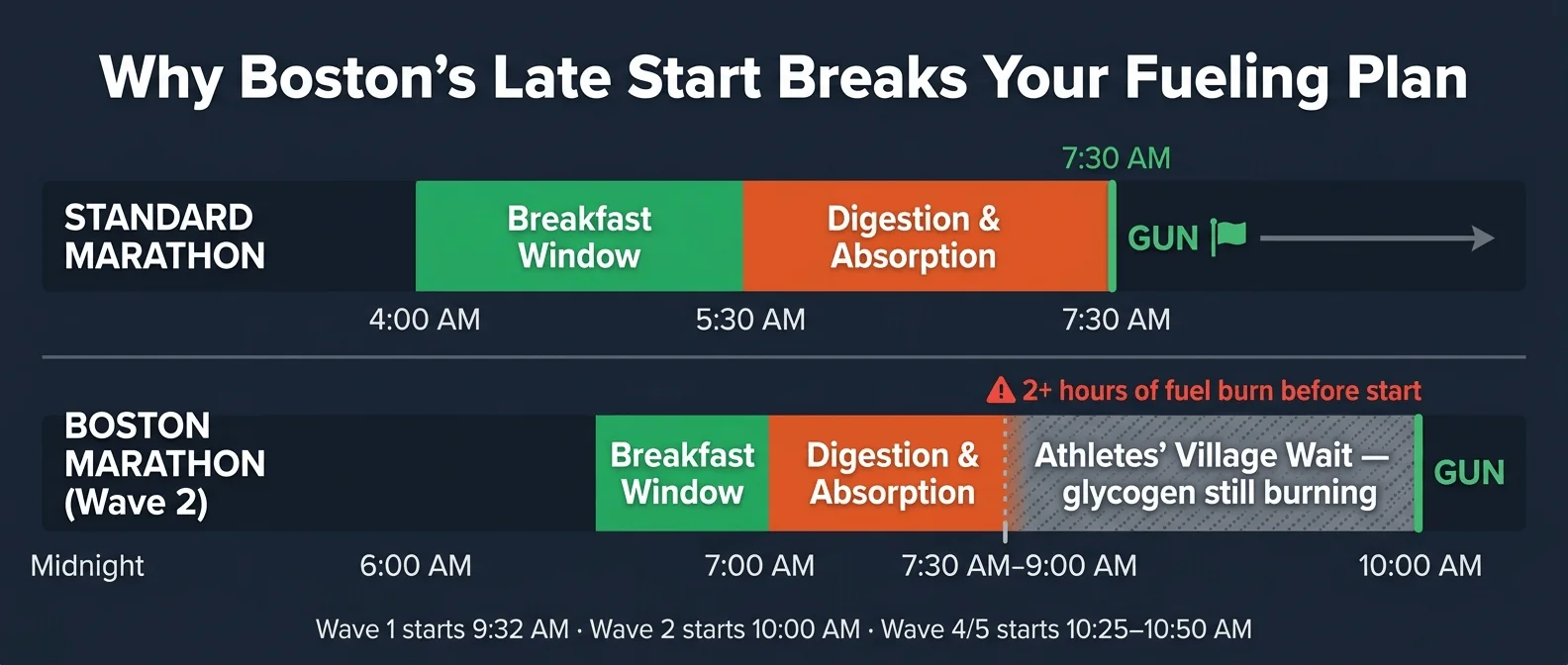
Boston’s late start breaks that window in two places.
- Your start time is already 2 to 3 hours later than most marathons: 9:32AM for Wave 1, 10:00AM for Wave 2, and up to 10:50AM for the final waves. To eat 3 to 4 hours before your gun, breakfast has to happen between 6:00 and 7:30AM.
- You spend most of that pre-race window at the Athletes’ Village in Hopkinton, a field with Port-a-Potties and bagels, not a warm hotel lobby where you can manage your energy quietly. Buses from Copley Square leave starting at 6:30AM, and most runners spend 90 minutes to 2.5 hours at the Village before their corral moves to the start.
During that wait, you’re burning carbohydrates, though not at race intensity, but enough to matter.
Standing in the cold burns energy to maintain body temperature.
Pre-race nerves elevate cortisol, which accelerates glycogen use, and the general movement of 30,000 runners toward the start line adds up over 2 hours.
By the time a Wave 2 runner crosses the start line at 10AM, a 7AM breakfast is already 3 hours old, and the Village wait has been drawing down on the glycogen that breakfast was supposed to fill.
A single pre-race meal can’t bridge that gap.
The runners who fuel well at Boston treat the Village not as dead time but as a second fueling phase with its own timing windows and specific targets.
How Should You Carb Load in the Days Before Boston?
Effective carb loading spreads carbohydrate intake steadily across the 36 to 48 hours before race day.
The version most runners do, a large bowl of spaghetti the evening before the race, is a pale imitation of what the research actually recommends.
At Boston it’s actively counterproductive: overeating the night before a late start leaves you feeling sluggish at the 8AM Village arrival and bloated when your wave finally goes off.
Research on marathon nutrition recommends carbohydrate intakes of 10 to 12 g/kg of body mass per day across the 36 to 48 hours before race day, combined with exercise tapering in the final days before the start.
For a 150-pound (68 kg) runner, that works out to roughly 680 to 816 grams of carbohydrate across two days, spread steadily across every meal and snack.
A study of 257 London Marathon competitors found that runners who consumed more than 7 g/kg of carbohydrate in the day before the race ran significantly faster overall than those who ate less, even after accounting for gender, training volume, and fitness.
The practical target is 8 to 10 g/kg in the 36 to 48 hours before your start, not a single large meal.
Steady carbohydrate intake across breakfast, lunch, dinner, and snacks over the two days before Boston does more for your glycogen stores than any single pasta dinner will.
That means Saturday’s lunch, Saturday’s dinner, Sunday’s breakfast, and Sunday’s lunch all need to be carb-focused, not just the meal you eat the night before the race.
Keep fat and fiber low across those meals to avoid digestive problems on race morning, and don’t test any new foods during the loading window.
The night-before dinner should be a normal size, familiar, and carb-forward, not a performance in excess that leaves you waking up at 4AM feeling like you ate cement.
Ready For More?
Then start our FREE Race Day Fueling email course!
You’ll learn how to calculate when you’ll bonk, how to hydrate, what foods to eat during your race, and more! From case studies to scientific research, we’ll help you learn how to best fuel for your next race.
What Should Your Race-Morning Breakfast Look Like?
Your race-morning breakfast is your primary fuel meal for Boston, and it needs to happen earlier than you’re probably used to.
For Wave 2 (10:00AM start), breakfast should be finished by 7:00AM, giving you a full 3 hours for digestion before the gun.
Buses from Copley Square to Hopkinton start running at 6:30AM and the lines move fast, so most Wave 2 runners need to be eating by 6:00 to 6:30AM at the latest.
Wave 1 runners (9:32AM start) need to eat by 5:30 to 6:00AM.
Wave 3 and 4 runners have a bit more flexibility, but the Athletes’ Village schedule, not the clock, is your real constraint.
The meal itself follows the same formula that works for any marathon, but the targets matter more here because this breakfast has to carry you through the Village wait.
Aim for 600 to 800 calories, predominantly carbohydrate, with low fat and low fiber to keep your stomach clear.
Familiar foods only: oatmeal, toast with jam, a banana, a bagel with peanut butter if you tolerate it, and a sports drink or juice to top off fluid.
This isn’t the morning to experiment with a hotel breakfast you haven’t eaten before a long run.
Only eat foods you’ve practiced before long training runs: a novel meal on race morning under pre-race stress is a GI incident waiting to happen by mile 8.
Bring your breakfast from the hotel rather than relying on what the hotel buffet provides.
Your gut has been practicing with specific foods for months, and race morning is the wrong time to switch.
What Do You Eat and Drink While Waiting at the Athletes’ Village?
The Athletes’ Village is where Boston’s fueling challenge gets specific.
Most runners arrive between 7:30 and 8:30AM and wait until their corral moves, which for Wave 2 is roughly 9:40 to 10:00AM.
That’s up to 2.5 hours of standing around after breakfast has started to clear your stomach, and your body will spend part of that time burning the glycogen you just stored.
The goal during the Village wait is to stay topped off without overfilling your stomach before a 26.2-mile effort.
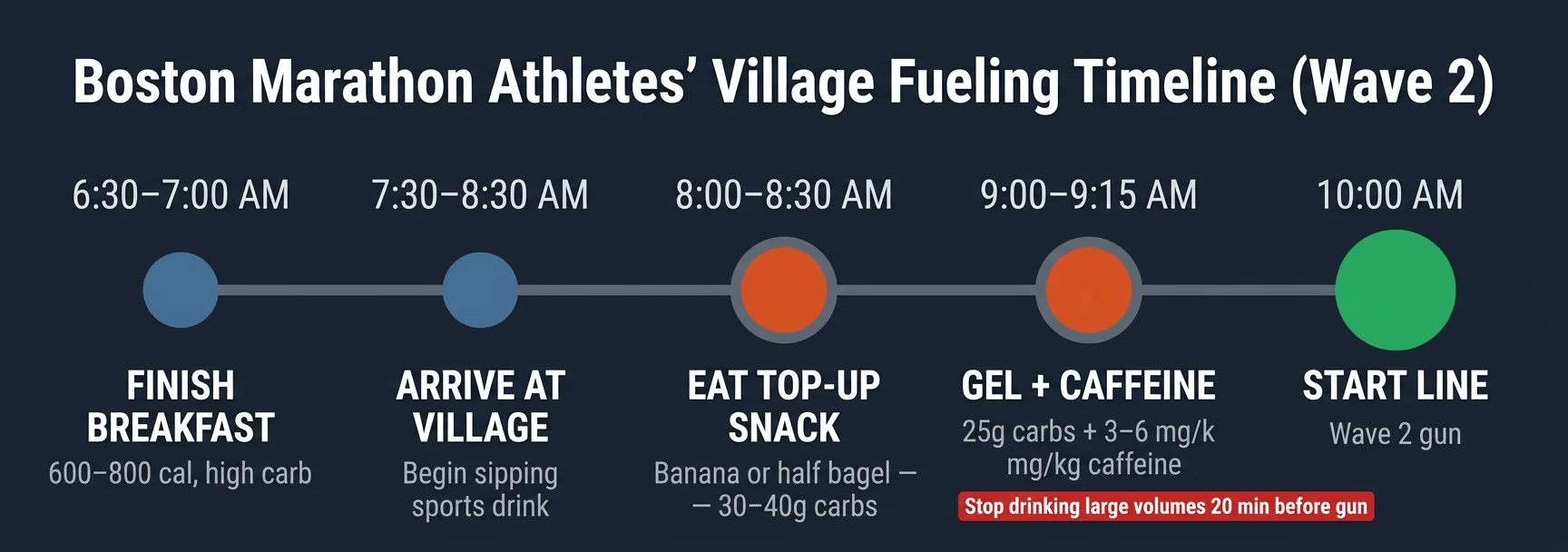
Bring a small top-up bag with the following:
- A sports drink (16–20 oz): Sip steadily from arrival through the Village wait. This manages blood sugar and hydration without requiring your stomach to process solid food on a tight timeline.
- A banana or half a bagel: Eat this around 8:00 to 8:30AM, approximately 90 minutes before your corral start. The goal is 30 to 40 grams of easily digestible carbohydrates to replace what sitting and nerves have burned.
- One gel: Take this 45 minutes before your corral start, around 9:00 to 9:15AM for Wave 2. This is your true pre-race fuel hit given the late start, and it should go down with a small amount of water, not on an empty stomach.
Stop drinking large volumes 20 minutes before the gun, with sips only from that point, so your stomach isn’t sloshing when you hit the first downhill on Route 9.
The Village also provides bananas, bagels, sports drink, and water at the food tents.
You can use the Village supplies for your banana or bagel top-up, but bring your own gel: the gels provided at the Village aren’t necessarily the same brand or formula you’ve trained with.
Bathroom timing matters here.
Port-a-Potty lines at the Village peak 30 to 45 minutes before each wave, which is exactly when most runners are also trying to eat their final gel and get into position.
Go early, before the line builds, and plan to go twice: once when you arrive, and once about an hour before your corral moves.
How Much Should You Fuel During the Race?
Your body can only absorb and oxidize carbohydrates so fast during exercise, and that ceiling determines your in-race fueling strategy.
Research on carbohydrates during endurance events recommends 30 to 60 g per hour for sustained efforts and up to 90 g per hour for events lasting more than 2.5 hours, which is the target range for marathon runners.
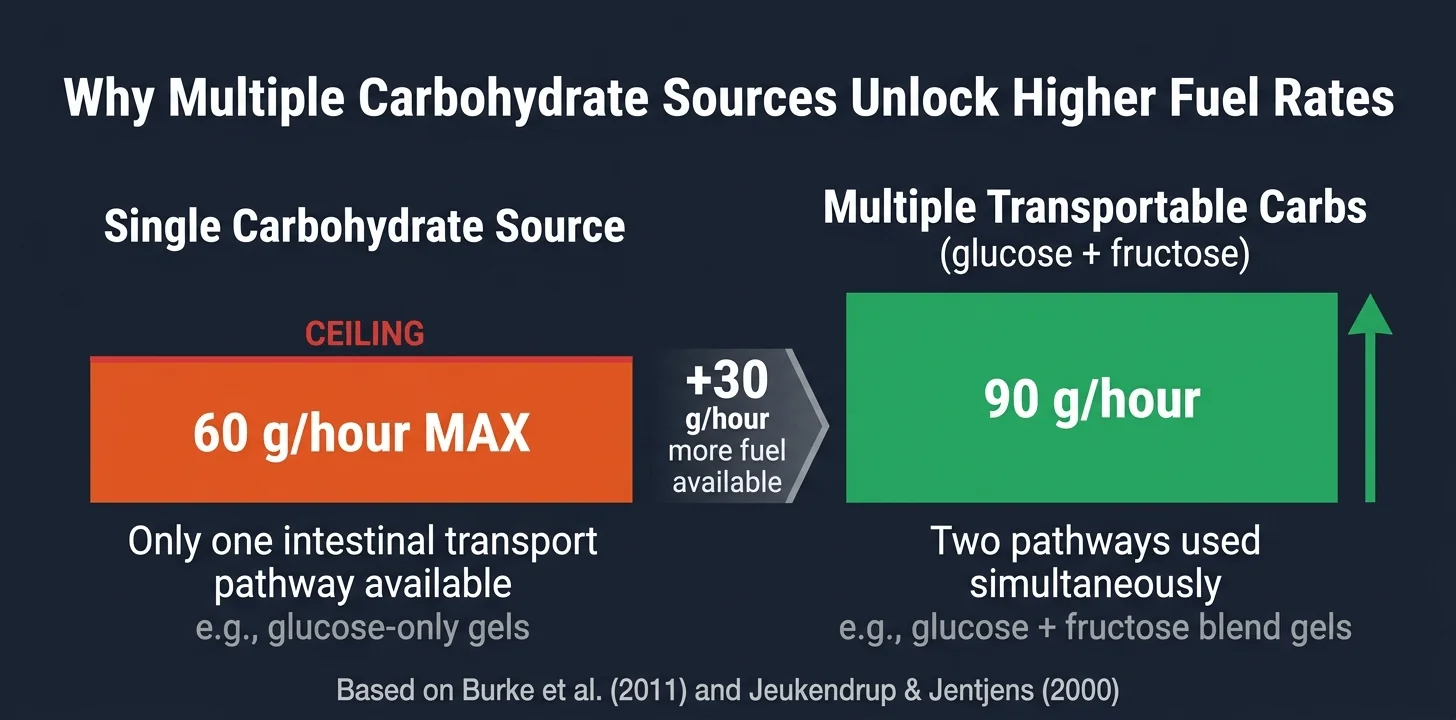
The 90 g/hr ceiling requires what researchers call multiple transportable carbohydrates: a mix of glucose and fructose sources that use different intestinal absorption pathways simultaneously.
Jeukendrup and Jentjens found that a single carbohydrate source maxes out at around 60 grams per hour because only one transport mechanism is available, regardless of how much more you consume.
Most modern race gels and sports drinks are formulated with a glucose-fructose blend specifically to bypass this limit.
A study comparing glucose-only and glucose-fructose blends found an 8% improvement in time-trial performance with the mixed-carbohydrate approach, a gap that compounds significantly over 26.2 miles.
In practice for Boston, target 60 to 90 g of carbohydrates per hour starting at mile 5, not mile 10.
Most runners defer their first gel to mile 7 or 8 because they don’t feel like they need it yet.
At Boston, with a late breakfast already 3.5 to 4 hours old by mile 7, waiting that long leaves you playing catch-up at the exact point the Newton Hills begin.
Take a gel every 25 to 30 minutes beginning at mile 5, not when you start to feel tired, because by the time fatigue registers you’re already behind on fuel.
That individual rate, meaning how many grams per hour your gut can actually handle at race pace, varies by training, gut sensitivity, and the specific products you’ve practiced with.
If you want those numbers calculated for your exact physiology and pace rather than estimated from a chart, our Marathon Nutrition Blueprint builds a personalized fueling plan with calculators for carbs per hour, hydration, electrolytes, and carb-loading macros based on your data.
Continue drinking water or sports drink at each aid station through the race and don’t stop fueling after Heartbreak Hill.
Mile 21 to 26 at Boston is where under-fueled runners fall apart, and by mile 21 it’s too late to recover from a deficit you’ve already run up.
How you distribute your effort across Boston’s course also affects how long your fuel lasts, and starting the early downhills in Hopkinton too aggressively burns through glycogen before you reach Newton, and a strong race strategy is the other half of what keeps you running through mile 26.
When Should You Take Caffeine on Race Day?
Caffeine is one of the best-supported ergogenic aids in endurance running, and the late start changes exactly when you should use it.
The International Society of Sports Nutrition 2021 position stand on caffeine confirms that doses of 3 to 6 mg/kg of body mass improve endurance performance, with aerobic exercise showing the most consistent moderate-to-large benefits, and recommends consuming caffeine approximately 60 minutes before exercise.
For a 150-pound (68 kg) runner, that works out to roughly 200 to 400 mg of caffeine, the range covered by one to two strong coffees or a dedicated caffeine pill or gel.
The timing window matters more at Boston than at most marathons because the late start creates a specific problem: if you drink coffee at 6:30AM out of habit, peak plasma caffeine levels hit around 7:30AM, well before your wave even steps onto Route 9.
The peak effect is sharp and relatively narrow, and by the time you’re running through Framingham you’ve already used most of it up.
For a 10AM wave, take caffeine at 9:00 to 9:15AM, during the final corral assembly period, not at the hotel breakfast table and not during the early Village wait.
If you use caffeinated gels during the race, factor that into your total and keep the pre-race dose on the lower end of the range.
Stacking too much caffeine in a short window, especially on a stressed nervous system at a major race, is a reliable path to a racing heart and a Port-a-Potty stop on the Ashland side of the start line.
Don’t use caffeine on race day if you haven’t trained with it, because your gut’s response to caffeine under race stress can be unpredictable.
How Does Boston’s Weather Change Your Fueling Plan?
April in Boston can mean 35°F and a headwind or 75°F and full sun, and the fueling adjustments for each scenario are dramatically different.
The Athletes’ Village has no shade and limited shelter, so both extremes hit you before the race even starts.
In a hot year, your hydration strategy needs to begin on Friday, not Sunday night.
Arriving at race weekend already mildly dehydrated, which is easy to do on a travel day without deliberate effort, puts you in a hole you can’t fully dig out of in the hours before the gun.
Increase fluid intake significantly on Friday and Saturday, and aim for electrolyte-containing drinks rather than plain water.
Also reduce alcohol and caffeine during the expo and Saturday dinner, both of which accelerate fluid loss on the day before the race.
On a hot race day, bump your in-race carbohydrate intake toward the higher end of the 60 to 90 g/hr range because heat accelerates glycogen use and your body’s demand for easily available fuel increases.
For more on managing your effort and fueling in warm conditions, the guidance on racing in the heat covers the full strategy including pace adjustment, cooling, and electrolyte loading.
In a cold year, your biggest challenge at the Village is body temperature, not dehydration.
Maintaining warmth burns carbohydrates at a real cost, and most runners dramatically underdress for the Village wait because they’re thinking about miles 1 to 26, not the 2 hours in a field beforehand.
Bring throwaway layers you can leave at the start line: an old sweatshirt, cheap gloves, garbage bag as a wind barrier.
Cold increases how much carbohydrate you burn just standing still, which means the Village top-up (banana at 8AM, gel at 9AM) is even more important in cold conditions, not optional.
Regardless of conditions, make a contingency plan for both hot and cold scenarios before you leave for Boston so the actual weather on race morning doesn’t force a last-minute strategy change that disrupts your fueling windows.
RunnersConnect Bonus
Download your FREE Marathon Nutrition During Your Taper Guide.
The guide contains a plan of exactly what you should be eating in the 5 days to 3 hours before your race. We give specific food recommendations to make sure you are ready on race day.
| Timing Window | What to Do | Target Amount |
|---|---|---|
| 2 days before (Sat + Sun) | Carb load steadily across all meals | 8–10 g/kg/day |
| Night before (Sun dinner) | Normal-sized, familiar, carb-forward meal | No overeating |
| Race morning (5:30–7:00AM) | Full breakfast: oatmeal, toast, banana, sports drink | 600–800 cal, high carb, low fat/fiber |
| Athletes’ Village (~8:00–8:30AM) | Banana or half bagel | 30–40 g carbohydrate |
| 45 min before start (~9:00–9:15AM) | One gel + small amount of water | 25 g carbohydrate |
| 60 min before start (same window) | Caffeine if you use it | 3–6 mg/kg body weight |
| During race (miles 5–26) | Gel every 25–30 minutes, water at every aid station | 60–90 g carbohydrate/hour |