
It’s the first warm week of spring, your easy run feels like a tempo, and you spend the last 2 miles breathing through your mouth because your nose is completely blocked.
The usual fix is to push through it or grab whatever allergy pill is in the cabinet, and both choices can leave you with weeks of flat, congested training.
Running with allergies is common enough that sports doctors screen Olympic teams for it, and the research gives you a clear order of operations: when to run, which medication to reach for first, and which common pills to avoid before a workout.
In this article, you’ll learn:
- How much more often asthma shows up in distance runners than in people who don’t train
- What pollen does to your sleep and your breathing on the run
- The time of day when grass pollen is lowest
- Why a nasal spray usually beats an allergy pill
- Whether daily antihistamines shrink the gains from your interval workouts
- Which allergy medicines are banned in drug-tested races
How Common Are Allergies and Asthma in Runners?
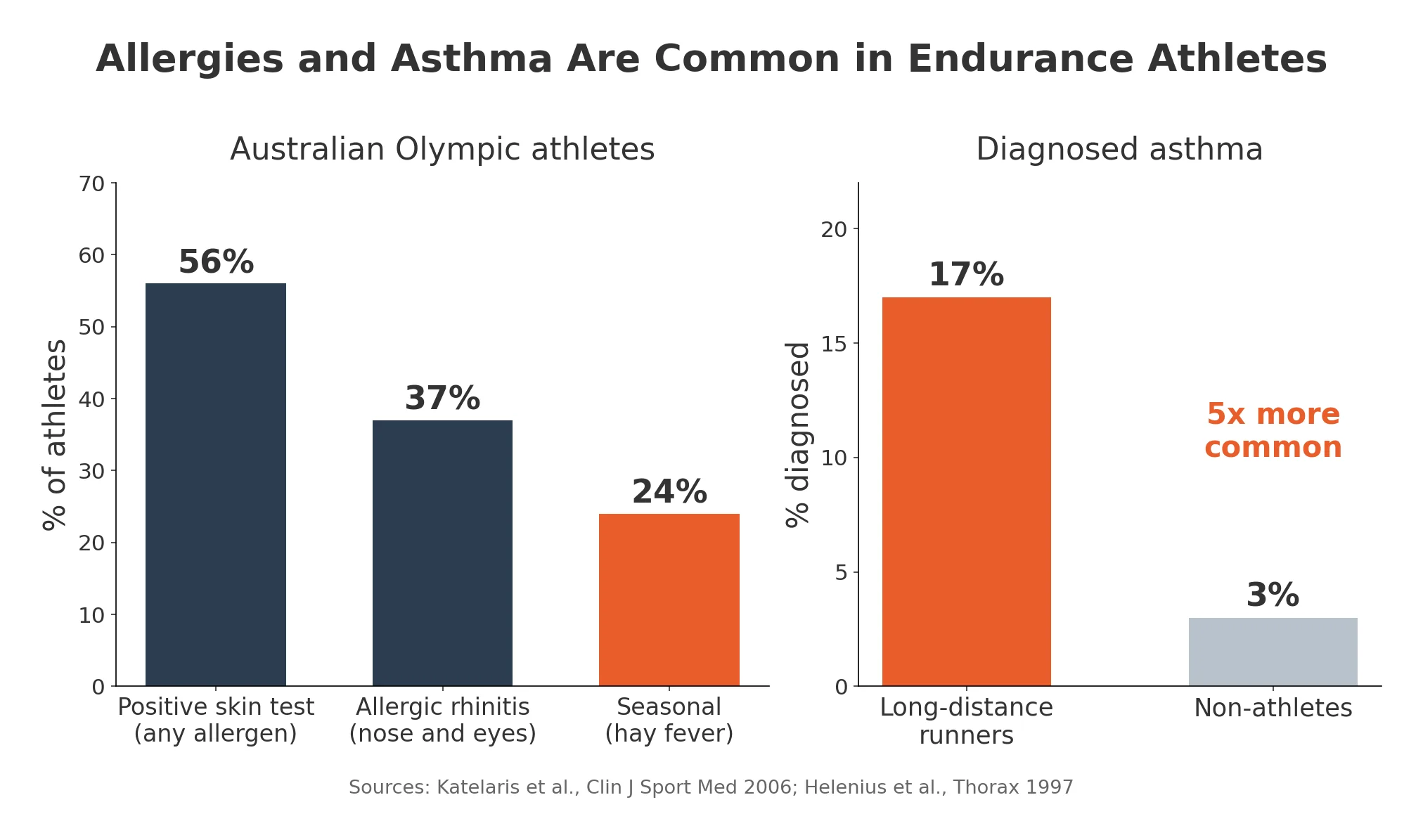
Allergies show up in more than half of elite athletes, and distance runners get asthma far more often than people who don’t train.
A screening of Australian Olympic and Paralympic athletes found that 56% tested positive on a skin-prick test for at least one allergen, and 37% had allergic rhinitis, the sneezing, congested, itchy-eyed form of allergies.
About one-third of the athletes with those nose and eye symptoms also had a history of asthma.
Research on national team track athletes found physician-diagnosed asthma in 17% of long-distance runners, compared with 3% of people the same age who didn’t train.

That means the distance runners in that study were more than 5 times as likely to have asthma as the non-athletes.
The researchers pointed to the large volume of air endurance training moves through your lungs, which brings more pollen and more cold, dry air into your airways on every run.
If you already have a wheeze or tight chest after hard efforts, read our guide to exercise-induced asthma alongside this one, because allergies and asthma often occur together.
Do Seasonal Allergies Hurt Your Running Performance?
Seasonal allergies affect your running in 2 places: your breathing on the run and your sleep between runs.
A blocked nose forces you to breathe through your mouth. Your nose normally filters and humidifies incoming air, so mouth breathing sends drier, dirtier air straight to your lungs.
A national survey of 591 patients with allergic rhinitis found that every measured part of sleep was worse in people with allergies, and people with severe symptoms slept worst of all.
That means a bad pollen week often shows up as heavy legs and poor recovery before it shows up as a runny nose on the run.
Allergic reactions also cause fatigue and mood changes that make hard sessions feel harder, according to a 2005 review on seasonal allergy in athletes.
The good news is that treatment shows up in training quality. A 2002 study of Olympic athletes with hay fever found that 8 weeks of a daily steroid nasal spray improved their symptoms, their quality of life, and their own ratings of how well they could train and compete.
Treating your allergies through pollen season protects both your sleep and your workouts.
Regular easy running can also ease your allergy symptoms. A 2026 randomized trial put young adults with year-round allergies on 8 weeks of easy treadmill walking or jogging 3 times per week, and their congestion and sneezing improved compared with a group that didn’t exercise.
When Is the Best Time to Run During Pollen Season?
Run in the morning when grass pollen is the problem, and move your hardest sessions indoors on the worst days.
A 5-year study of air samples taken every 2 hours found that grass pollen was lowest in the morning and peaked in the early evening at an urban site.
At a rural site, grass pollen peaked about 4 hours earlier, in step with the sunniest, windiest part of the day.
That means an after-work run in a city puts you outside during the daily grass pollen peak, while a morning run avoids most of it.
Use these steps to plan your week around pollen:
- Check the daily count. Local pollen forecasts from weather services and the National Allergy Bureau tell you which days are high before you lace up.
- Swap sessions within the week. On a high-count day, run your easy miles and push the interval workout to a day with a low forecast.
- Take quality indoors. A treadmill session keeps a key workout on schedule when the forecast is high all week.
- Rinse off after outdoor runs. Pollen collects on your hair and clothes, so shower and change before you sit on the couch or go to bed.
A morning easy run on a high-pollen day keeps your week on track better than skipping the day or forcing an evening workout.
RunnersConnect Bonus
Download your FREE Treadmill Guide for Runners.
The guide contains 4 treadmill specific workouts guaranteed to keep you sane and fit! You’ll learn about the In-N-Out workout, how to “run like an Egyptian” and get my favorite “green eggs and ham” workout.
What Allergy Relief Works Best for Runners?
A steroid nasal spray is the most effective first-line option for seasonal allergies, with a non-drowsy antihistamine as the backup or add-on.
A 1998 review of 16 randomized trials with 2,267 patients found that steroid nasal sprays relieved nasal blockage, runny nose, sneezing, and itch better than antihistamine pills.
People using the sprays were also about 4 times less likely to say their symptoms got worse.
Nasal steroids reduce the swelling inside your nose, which is why they help congestion more than pills do.
They take several days of daily use to reach full effect, so start them before your pollen season rather than on the morning of a long run.
If you choose a pill, pick a newer non-drowsy antihistamine such as fexofenadine (Allegra), loratadine (Claritin), or cetirizine (Zyrtec).
The older drowsy antihistamines, like diphenhydramine (Benadryl), are the ones to avoid. A European position paper on first-generation antihistamines found that they reduce REM sleep and impair learning and work efficiency, which is the opposite of what a hard training block needs.
Keep diphenhydramine (Benadryl) out of your allergy plan during training, because it sedates you and reduces the REM sleep you need between hard sessions.
| Option | Best for | What runners should know |
|---|---|---|
| Steroid nasal spray (fluticasone, budesonide) | Congestion, runny nose, sneezing | Most effective first choice. Needs several days of daily use to work fully. |
| Non-drowsy antihistamine (fexofenadine, loratadine, cetirizine) | Itchy eyes, sneezing, mild symptoms | Non-sedating at standard doses. Weaker on congestion than a spray. |
| Drowsy antihistamine (diphenhydramine) | Not recommended for training | Sedating and reduces REM sleep. |
| Decongestant pill (pseudoephedrine, the “D” versions) | Short-term blocked nose | Raises heart rate and is banned in competition above a set urine level. |
Talk to your doctor before starting any daily medication, and bring up asthma or any other prescriptions you take.
Should You Take an Antihistamine Before Running?
A normal dose of a non-drowsy antihistamine before a run is fine for your performance that day, but a high daily dose timed around hard sessions may shrink the gains in peak power and muscle capillaries you get from them.
Your body releases histamine in working muscle during and after exercise, and it helps keep extra blood flowing to that muscle for hours after you finish.
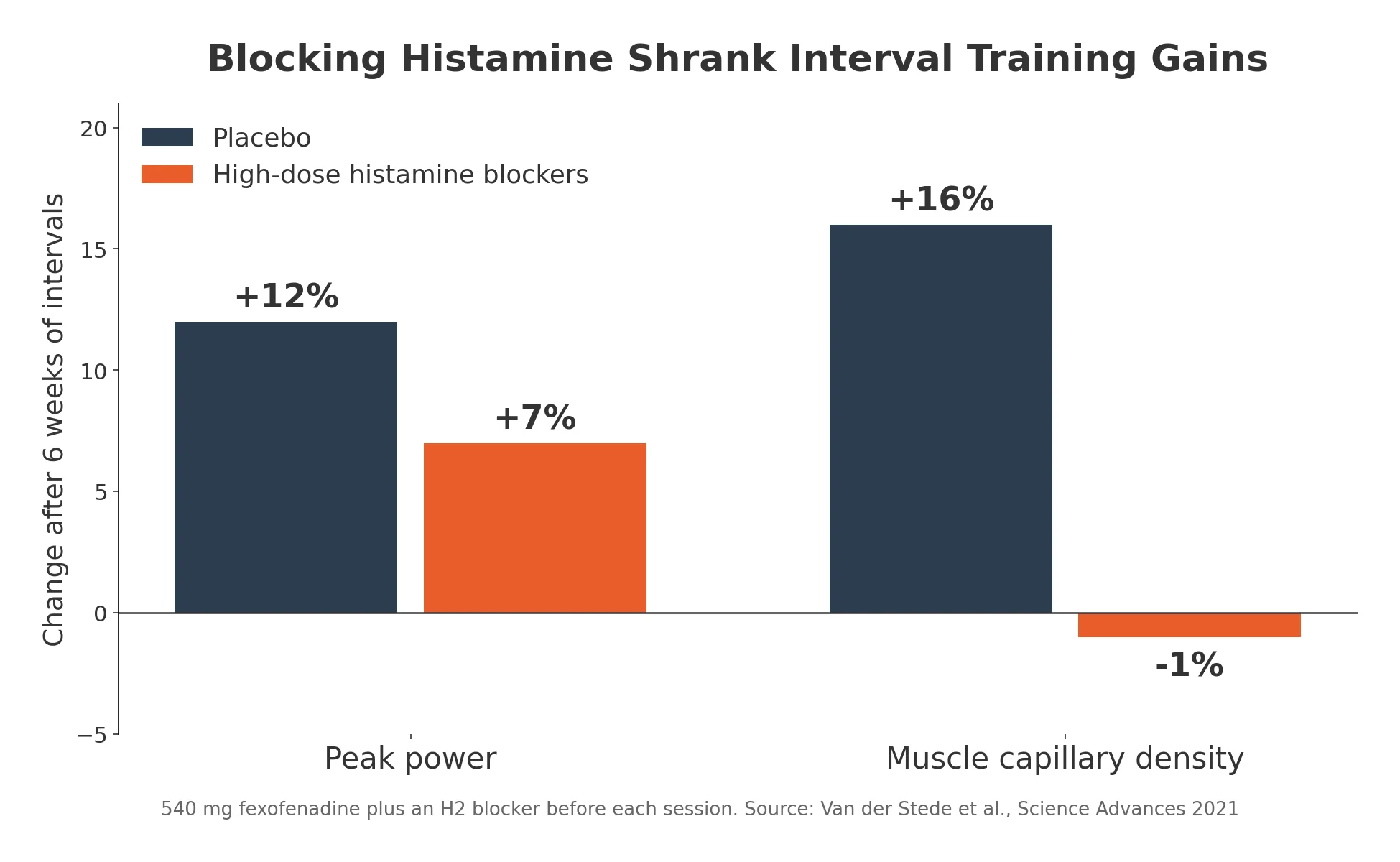
A 2021 trial found that people who blocked histamine before every interval session for 6 weeks improved their peak power by 7%, compared with 12% for people who trained on a placebo.
The group taking the blockers also added no new capillaries in their leg muscle, while the placebo group increased capillary density by 16%.
That means the extra blood flow after hard workouts looks like part of the signal your muscles use to adapt to interval training.
The dose in that trial was high, though. Each man took 540 mg of fexofenadine, 3 times the standard 180 mg daily Allegra dose, plus a second drug that blocks the stomach’s histamine receptors.
A standard dose hasn’t been tested alongside endurance training yet. A 2025 study gave men 180 mg of fexofenadine before every session of a 10-week weight training program, and they gained the same muscle size and strength as men on a placebo.
Blocking histamine didn’t slow anyone down on the day, either. A 2025 cycling test in trained adults found the same time to exhaustion, 474 seconds on the blockers and 473 seconds on a placebo.
If you need daily allergy relief through a hard training block, lean on the nasal spray first and keep antihistamine pills at the standard dose rather than doubling up on high-count days.
Which Allergy Medications Are Allowed in Drug-Tested Races?
Most allergy medicines are permitted in competition, and the main one to watch is the decongestant pseudoephedrine.
The World Anti-Doping Agency’s Prohibited List bans pseudoephedrine in competition above a urine level of 150 micrograms per milliliter, and it’s the active ingredient in the “D” versions of Allegra, Claritin, and Zyrtec.
Antihistamines aren’t on the list.
Steroid nasal sprays are permitted too, because the list only bans steroids in competition when they’re taken by mouth, by injection, or rectally.
Pseudoephedrine does little for your running anyway. A 2018 meta-analysis of placebo-controlled trials found trivial effects on time trial performance overall, with a small rise in heart rate.
If you race in events with drug testing, check every allergy product for pseudoephedrine before race week.
Student-athletes and elite masters runners get tested most often, so confirm your medications with your doctor and your governing body before the season starts.
Could Your Allergy Symptoms Be Exercise-Induced Asthma?
Coughing, wheezing, or a tight chest in the minutes after a hard effort points to your lungs rather than your nose.
Allergies and asthma share the same inflamed airway, which is why so many of the Olympic athletes with hay fever also had an asthma history.
Pollen season often makes it obvious. Your nose runs on easy days, but intervals leave you coughing for half an hour afterward.
A simple questionnaire can screen for allergies. A 2009 validation study built a short allergy questionnaire for athletes, and its best questions ask whether you sneeze or have an itchy, runny nose outside of colds and whether you already use allergy medicine.
Answering yes to either one is worth a visit to your doctor, who can test your lungs and match your treatment to what you’re allergic to.
See a doctor if hard runs leave you coughing or wheezing, because asthma needs its own treatment plan and an allergy pill won’t cover it.
Here’s a summary of the evidence on running with allergies:
| Question | What the research shows | What to do |
|---|---|---|
| How common are allergies in athletes? | 56% of Olympic athletes tested positive for an allergen | Assume allergies can affect your training |
| Are runners at higher asthma risk? | 17% of distance runners vs. 3% of non-athletes | Get tested if hard runs cause coughing or wheezing |
| When is grass pollen lowest? | Mornings, with an early-evening peak in cities | Run early and move hard sessions on high-count days |
| What treatment works best? | Steroid sprays worked better than pills in 16 trials | Start a nasal spray before your pollen season |
| Do antihistamines hurt fitness gains? | High doses cut interval gains (7% vs. 12% peak power) | Stick to the standard dose |
| What’s banned in tested races? | Pseudoephedrine, above a urine level of 150 micrograms per milliliter | Avoid “D” products before tested races |