

Running slow to race fast feels backwards.
If your goal is a marathon at 9:00 per mile (5:35/km), spending your easy days at 10:30 per mile (6:31/km) can feel like wasted training.
The instinct is to push every run closer to race pace, on the logic that harder work always builds more fitness.
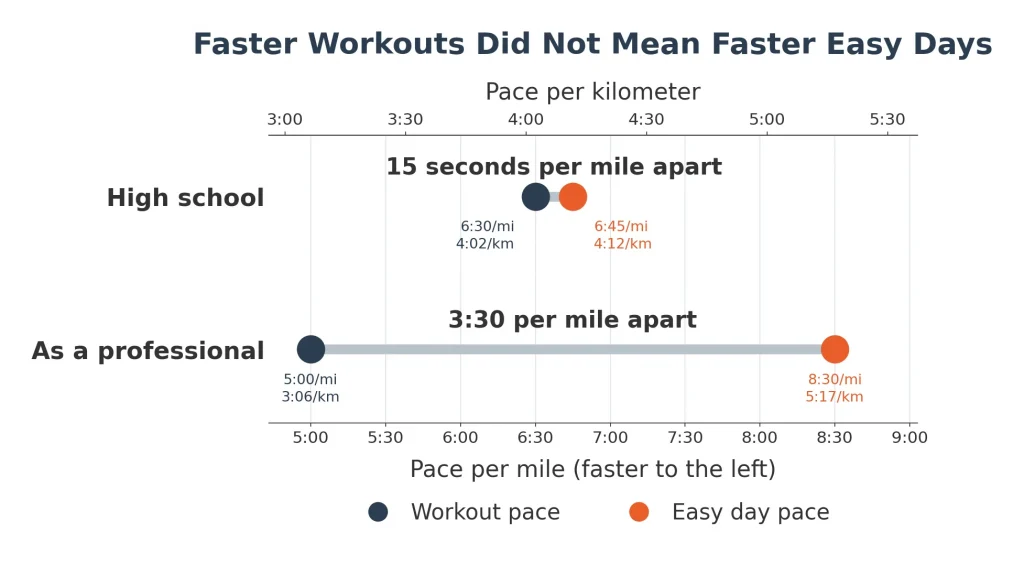
Your easy runs are where most of your race fitness is built, and running them too fast is the most common way runners stall.
This guide covers what an easy run is, the exact pace yours should be, and why slow running is what lets you race fast.
By the end, you’ll know:
- What counts as a true easy run
- The pace your easy runs should be, by feel, by heart rate, and by recent race time
- How slow is too slow, and how long each easy run should last
- Why easy mileage is the engine behind your race results
What Is an Easy Run?
An easy run is a run done at a comfortable, conversational effort you could sustain far longer than your run lasts.
Its purpose is to build aerobic fitness while keeping the physical stress low enough that you recover within a day.
You should be able to speak in full sentences the whole way.
An 8-week study of recreational runners found that a program built from 77% easy running improved 2 km race velocity by 3.5%.

The gains came from the volume of easy running, which built the aerobic fitness that supplies most of the energy in a race.
Those runners improved their race times without adding a single extra hard workout.
Your easy runs, your recovery runs, and the bulk of your long run all live at this same comfortable effort.
What Pace Should Your Easy Runs Be?
Your easy run pace is roughly 1:30 to 2:00 per mile (0:56 to 1:14/km) slower than your current 5K race pace.
The most reliable way to find it is to combine 3 checks rather than trust any one alone.
The talk test.
You should be able to hold a conversation in full sentences while you run.
When you can only get out a few words at a time, you’re running too fast for an easy day.
Heart rate.
Easy running sits at about 65 to 79% of your maximum heart rate.
If you train by heart rate, holding easy runs under roughly 75% of max keeps them aerobic.
Recent race time.
Take your pace from a recent race result and add 1:30 to 2:00 per mile (0:56 to 1:14/km).
A 25:00 5K runner races at about 8:03 per mile (5:00/km), which puts easy runs near 9:35 to 10:20 per mile (5:57 to 6:25/km).
| Recent 5K time | 5K race pace | Easy pace (min/mile) | Easy pace (min/km) |
|---|---|---|---|
| 20:00 | 6:26/mi (4:00/km) | 8:00 to 8:45 | 4:58 to 5:26 |
| 22:30 | 7:15/mi (4:30/km) | 8:45 to 9:30 | 5:26 to 5:54 |
| 25:00 | 8:03/mi (5:00/km) | 9:35 to 10:20 | 5:57 to 6:25 |
| 27:30 | 8:51/mi (5:30/km) | 10:25 to 11:10 | 6:28 to 6:56 |
| 30:00 | 9:39/mi (6:00/km) | 11:10 to 12:00 | 6:56 to 7:27 |
When the 3 checks disagree, trust your breathing over the watch.
On hills, in heat, or on a treadmill, hold the effort steady and let the pace drift slower.
If you’re newer to running, a mix of gentle jogging and walking counts as an easy run and builds the same aerobic base.
If you can’t speak in full sentences on an easy run, slow down until you can, whatever your watch says.
RunnersConnect Bonus
Download your FREE Long Run and Aerobic Pacing Calculator now.
Need help converting your race times to your optimal easy and long run pace? Download our FREE calculator and we’ll do the math for you.
How Slow Is Too Slow for Your Easy Runs?
For building aerobic fitness, an easy run is almost never too slow.
The aerobic adaptations you want respond to the time you spend running, so a slower pace still delivers them as long as you keep moving.
The real floor is your running form.
Once a pace gets so slow that your stride collapses into a shuffle, ease back up just enough to run normally.
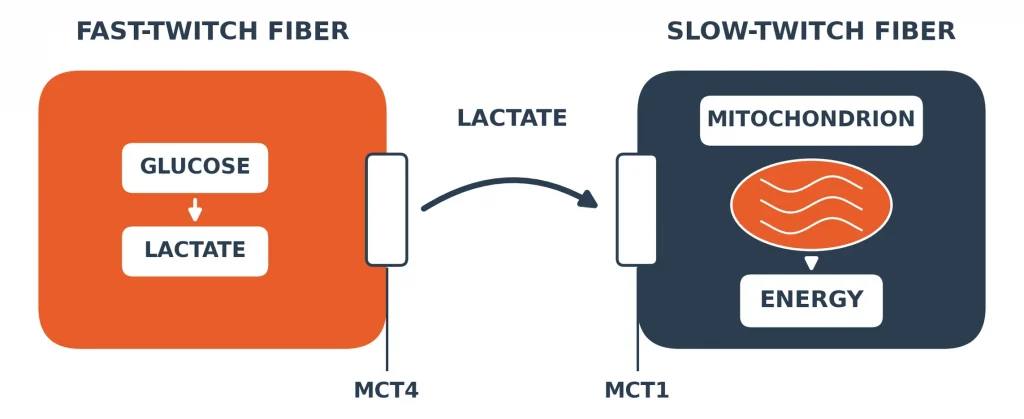
Physiologists mark the top of the easy zone at the first lactate turnpoint, where blood lactate first starts to rise above resting levels.
Staying under that point is what keeps an easy run easy, and you can go deeper in our guide to lactate threshold.
On hot days, after hard workouts, or when you’re tired, slowing your easy pace further is the right call.
How Long Should Your Easy Runs Be?
Most easy runs should last between 30 and 75 minutes.
Measuring easy runs by time instead of distance keeps the effort honest, because a slower pace shouldn’t cost you extra miles of pounding.
Your easy run distance then follows from your pace, so the same 45-minute run covers more ground as you get fitter.
Across a week, easy running should make up the large majority of your total mileage.
A systematic review of distance runners found that successful middle- and long-distance runners complete most of their weekly training at low intensity.
For a runner training 4 to 5 days a week, that usually means all but 1 or 2 sessions are easy.
If you’re building your mileage, start easy runs at 20 to 30 minutes and add time before you add pace.
Cap each easy run by time and effort rather than by an ego-driven distance target.
Why Does Running Slow Actually Make You Faster?
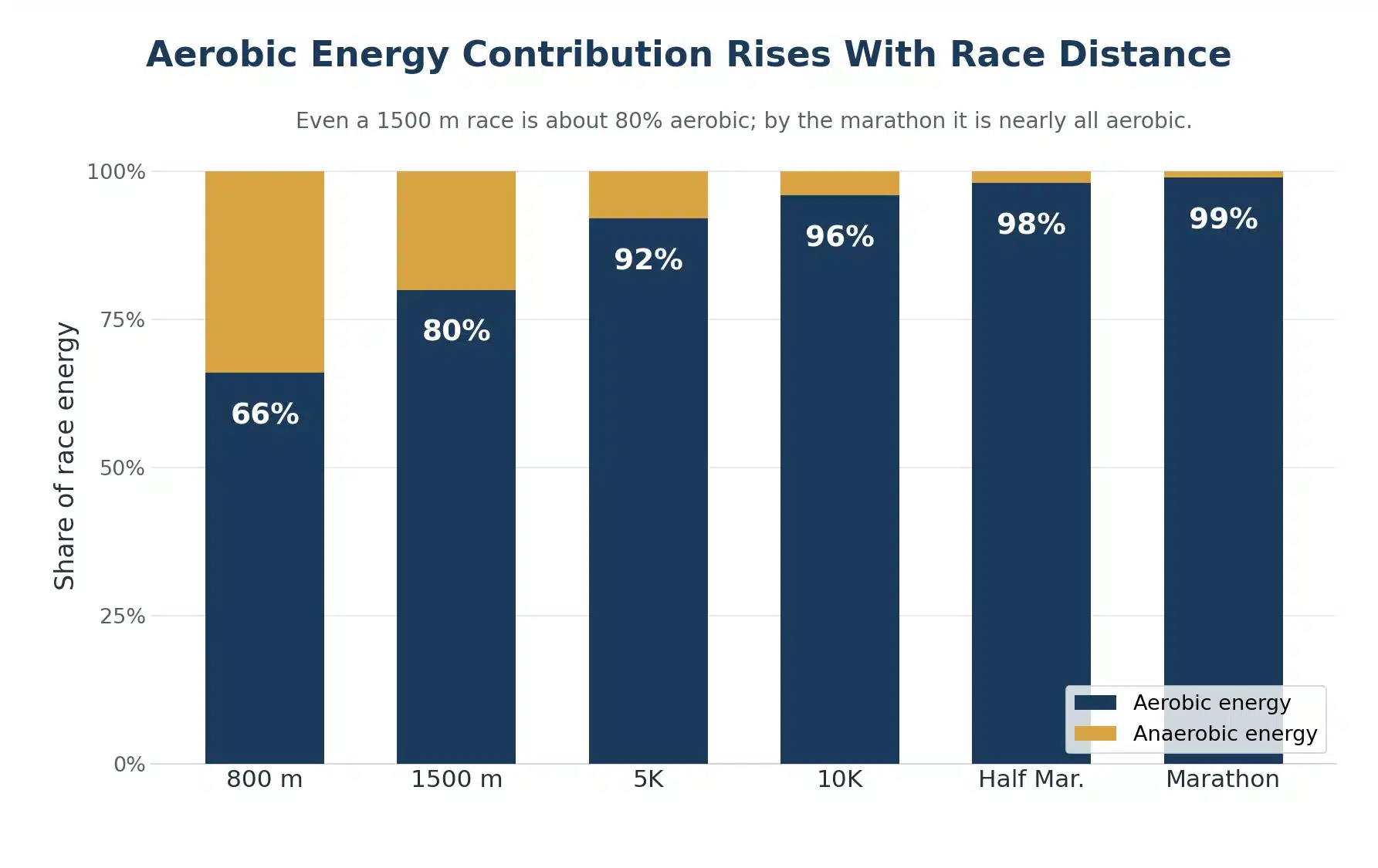
Slow running makes you faster because your aerobic system supplies over 95% of your energy at 5K and beyond.
Research on middle-distance runners found that even a 1500 m race draws about 80% of its energy from the aerobic system.
By marathon distance, almost all of your race energy comes from aerobic metabolism.
Easy running is the training that develops that aerobic system, because it lets you build capillaries and mitochondria without the fatigue that hard running carries.
At an easy effort you can accumulate the weekly volume that drives those adaptations, since the low stress lets you run more often without breaking down.
Running those same miles faster adds fatigue to each session, so you end up running less overall and gaining less aerobic fitness.
The aerobic fitness you build on easy days is what carries you through the back half of every race.


23 Responses
Wow, thankyou for this excellant article. I love to know the ‘why’, it makes me a better runner. Being an avid spokesman for running & tri, I can now use this info to help others avoid errors… My dream is to be a professional trainer (after I retire), information like this is wonderful.
I will follow your guidelines to run a BQ this year.
I’ve been doing this for over a year using a heart rate monitor. I’ve seen miracles. I don’t wear the monitor as much now, but I have a good feel for a slow run. It makes running so much more enjoyable and my races so much faster and enjoyable.
How do you know if you’re going too fast? I want to find the right balance of going, but not too fast. 🙂
I really enjoyed this article
Thanks for the article on why we need to run easy to perform at our best in distance races.
I really like the fact that you included links to research that supports the notion that slower running leads to maximum mitochondrial development.
Do you know of research papers that also support your other two points about myoglobin and capillary development?
Also, I noticed that you mentioned that slower speeds aid in the development myoglobin in Type 1 muscle fiber. What about for the Type II muscle fibers? I have a very high proportion of Type II so I need to develop those as well.
Thanks.
Great article – I was alway of the view that slow runs are mainly used for recovery and gave little benefit as they were to slow.
Question – Can cycling be a substitute to developing cardiovascular aerobic fitness as a substitute for running?
Reason I ask is that I have been running 3 days a week and have come out of injury. I am currently using the bike as a substitue for my easy runs. I find that cycling by default keeps my average heart rate around 130bpm. My cycling sessions are usually around 1.5 to 2.5hours in during twice a week.
Hi Darryl,
Yes! If you are coming back from an injury, cycling is a great way of making sure you are able to keep your cardiovascular fitness up. Its great that you make them so long, that will only benefit you, especially if you are able to bring your heart rate up. Do you have access to an Alter-G/Underwater Treadmill or an Elliptigo? As those are better able to simulate running, they are better for you as a runner. However, as long as you are still able to run 3 days a week, your body will be used to the running motion. Do you see yourself running more in the future, or is this a long term change?
Hi,
Nicole asked how to know if you are running too fast. I’ve been using Long Slow Distace training for a long time and this is how I personally do it (I’m a cyclist but the principle is the same). First of all you need to buy, steal or borrow a heart rate monitor. You then go through the pain of establishing your maxiumum heart rate (Get yourself checked out by your doctor befor attempting this). I personally define my max HR as the rate I can keep up for a minute. Mine is about 195 so I then take that times 0.65 which gives me about 125.
Now I train a few times with an HR monitor and ensure that I’m around 125. At the same time I gague my speed and also how it feels at that pace. For me, I know that if I’m averaging about 25kmh and can hold a conversation with myself or sing a bit, I’m in my LSD zone. I hardly ever use my HR monitor for these rides anymore, other than to calibrate fom time to time.
Now if all of this sounds too complex, try singing Ba ba blacksheep without having to pause for breath and you probably won’t be far off 🙂
Hope it helps.
Chris
Ps. One thing I’d like to add to the article. If you do most of your training in this zone, it also allows you to make your high intensity sessions high quality.
Hi Chris, thanks for the feedback. We are not huge fans of using heart rate monitors for your training https://runnersconnect.net/coach-corner/why-i-dont-recommend-training-by-heart-rate/ but we are glad you found something that worked for you. We definitely agree that runners should try to run by feel as often as possible. We like the ba ba blacksheep idea though, that is definitely a good gauge of if you are working too hard. This post is also helpful to learn how to slow down on easy runs https://runnersconnect.net/running-training-articles/wrong-long-run-pace/
Thanks for sharing Chris!
Thank you for the fantastic article!
One question: OK, running too fast at an easy day is not only not recommended but also can be proved unnecessary as well. What about extending the volume of an easy run? Let’s say the weather is perfect, I am chatting with a few co-runners and I do 1 or 3 miles more than suggested. Is there any bad in it? Is there any good?
Thank you in advance!
Hi Thanasis, glad you enjoyed the article. It really depends on your running volume total. If you are around 20 miles a week and you go those extra miles, you will need to back off the rest of the week, or take a day off after. It is fine to keep going with friends, as long as your total volume for the week does not go up more than 10%. Hopefully this helps!
Good article. Is there a point though where you can run too slow on your easy recovery days or on long runs? I often run my easy days and long runs with my wife. I’m just under 20 minutes for a 5K And she’s 24 minutes. I will usually run around 9:45-10:45 pace with her to make sure she isn’t going too fast on those days. Could I be losing fitness or slowing improvement by doing this? Thanks.
Hi Eric, thanks for reaching out. That should not be a problem as your PRs are not too far off one another. That pace for you should not be too slow, and will help you recover more, as long as you are still incorporating the workouts into your training at your pace. It is very good that you are supporting her, and this should help you both improve! Does this answer your question? Can we help with anything else?
Yes that answers my original question perfectly! Thank you! Since that question we’ve decided to run our first full marathon. She is trying for around 4:15:00 race time and I’m looking to go under 3:45:00. I’ve read that the long run is more of a workout during marathon training so should we still run the same paces as before or split up our paces for the long runs? She’s been consistently at 35-40 miles per week and I’ve been at 40-45. Thanks again.
I would like to know how to chart would be adjusted for older runners. I just begin running this year at 57 and my best pace was 11:21 per mile. It is hard to slow down but my second and third miles are of course longer. I suppose I average over 12 .minutes per mile and would like to figure out how to improve in a smart way. Thank you
Hi Rebecca, it does not really matter your age as such, but more your current fitness. It will all depend on what your body can handle as an individual. This pace calculator should help you determine your easy pace a little more if you have a race or hard effort to put in. Hope this helps! If you are looking for more information on masters running, we just created a new masters running page https://runnersconnect.net/masters-running/ hope you enjoy!
Thanks so much. I will be checking those out.
How do I get the calculator to work on my computer?
It’s an excel file, so download and open with any spreadsheet program
Thank you for not only laying out the concept but backing it up with solid data.
I believe in the concept of the majority of miles being slow to make you faster (especially when it comes to marathon). However I am trying to reconcile this with the Run Keeper Marathon Plans you have posted. Many other marathon plans have far less steady pace work (especially on those long run days). Yet, I know that a lack of solid pace work for those longer runs can be where you see some pretty big blowouts in say mile 21-22. I believe there is something to more steady miles (especially in the long run) but trying to find the evidence to back this and your training plans up.
When it comes to struggling at mile 21-22 in a marathon, a lot of emphasis has to be put on the pace prior to that point in the race. I think a lot of marathoners that struggle at that point will look back, post-race and say next time they’ll do more long runs, eat better, etc when the reality is often, they simply went out too hard.
Clarification/Questions re. easy pace. Just re-read Coach Jeff’s article on easy-pace running, including specifics on % of 5K pace for MAXIMUM benefit: mitochondrial, capillary, myglobin. Apparently, a good sweet spot to cover all three would be 70% of 5K pace. My current 5K pace is 10:00. That suggests ~14:15 for easy runs. However, my Plan calls for 12:20-13:05. I can, and do manage these paces, and after a couple of miles they feel comfortable, but it seems they are significantly faster than optimal and may be benefiting me less than if I were to force myself to go slower. So, should I be trying to go slower on my LRs (and short recovery runs) than the Plan’s easy pace?
Further: While it is difficult for me to run slower than 4.3 mph, which is a 13:57 pace, so still a little too fast (and over time, my body inevitably speeds up from that), I can more easily keep myself throttled back when I do walking at incline. Will the walking, since it is done with essentially the same muscles, produce virtually the same aerobic development benefits (mitochondriia, capillary, myglobin)? I realize that, running and walking-at-incline gaits being somewhat different, there will be some differences in how the musculature (muscles, tendons, ligaments) are used, so that I must do a significant amount of my work actually running. However, If I were to run the faster quality workouts, but for the LRs and the short easy recovery runs include a significant amount of walking at incline at an equivalent effort to my optimal easy run pace, would that likely serve me just as well, and perhaps better than doing all running (again, it’s more difficult to keep the running pace slow enough to hit Coach Jeff’s target)?