
Your fall marathon is somewhere between twelve and sixteen weeks out, and right now the plan on your fridge looks entirely reasonable.
The trouble arrives in week seven.
A work trip, a head cold, and a stretch of bad weather quietly remove four runs across nine days, and the plan never quite recovers its shape after that.
Twelve weeks later you slow down at mile twenty and spend the drive home wondering which gel you should have taken.
Strava’s own platform data points somewhere other than your fuel belt.
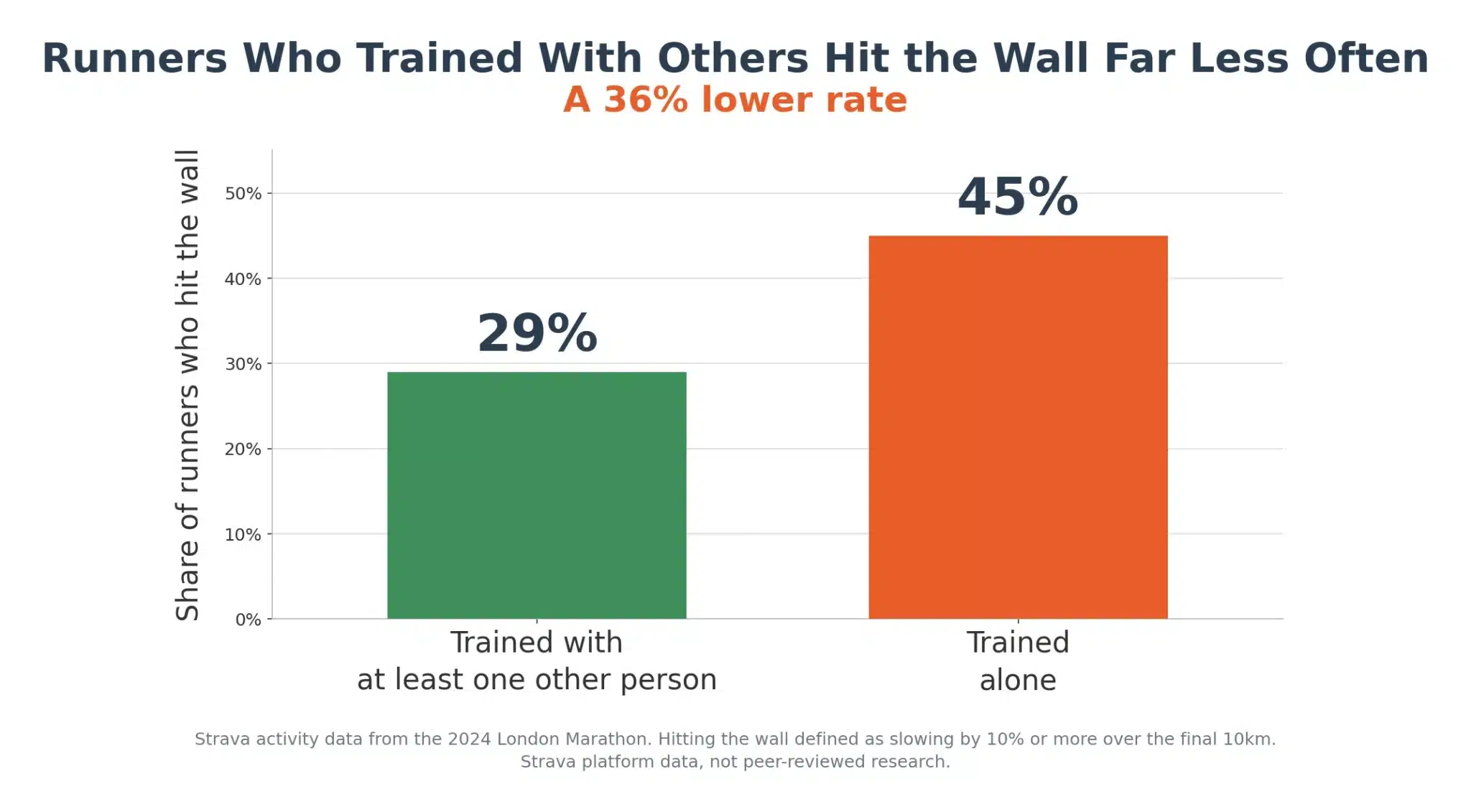
Strava looked at runners who uploaded their training for the 2024 London Marathon and counted how many hit the wall in each camp.
Among runners who trained with at least one other person, 29% hit the wall, against 45% of the runners who trained alone.
Strava’s marker for hitting the wall was slowing by 10% or more over the closing 10 kilometers of the race.
New clubs on the platform nearly quadrupled during 2025, and club members turned out to be 15% more likely to hit their goal finish time.
Strava is a technology company reporting on its own users rather than a research group, so treat those figures as a signal worth investigating rather than as proof of anything.
So, in this article you’re going to learn the research-backed practical advice on training with a group.
- Why late-race slowdowns trace back to your training block rather than your race-day fueling
- What a single interrupted week costs you in finish-time minutes
- Where the evidence for group training is genuinely strong and where it collapses
- How to tell within one session whether a group will keep you showing up in October
- Which runs belong to the group and which ones you need to protect
Why Do Runners Who Train With Others Hit the Wall Less Often?
The late-race collapse most runners call bonking behaves far more like a pacing decision than a fueling accident.
An analysis of more than four million marathon records found that 28% of men and 17% of women experience a sustained slowdown in the closing stages of the race.

That same dataset turned up a pattern no fueling explanation predicts.
Runners were markedly more likely to slow badly in the three years surrounding a personal best than in their earlier, slower years.
Being fitter made the collapse more likely, because runners near their ceiling were racing harder relative to what they could actually hold.
Research across 14 US marathons covering nearly 92,000 performances found men slowed by 15.6% in the second half against 11.7% for women, and adjusting the women’s times upward to account for the known difference in aerobic capacity reduced that gap without erasing it.
Something other than physiology is driving a meaningful share of the slowdown.
That something appears to be the decision made in the first mile.
When researchers surveyed more than 1,300 marathoners on five different psychological traits, only one predicted how much they slowed: agreeing that they had started at a pace fast enough to jeopardize holding it.
That single admission survived statistical adjustment for training volume, experience, competitiveness, and willingness to suffer.
The wall is built during your training block and detonated in your first mile, which is why runners who fix their fueling and nothing else keep hitting it.
Group training cannot reach into your race and hand you a gel at mile twenty.
What it can plausibly reach is the sixteen weeks beforehand, which is where the gap between those two Strava numbers has to come from.
What Actually Predicts Your Marathon Finish Time?
When researchers put training, body composition, experience, and race-day judgment into a single model, one input dwarfs the rest.
A study of 260 Dublin Marathon runners explained 86% of the variation in finish times, and training history was by far the strongest predictor, ahead of how realistic the goal time was and how evenly the runner paced.
Read the order of that list again, because all three of the top inputs are things you control.
Body mass index and age did not reach significance, and race-day nutrition was never entered into the model.
Training data from 119,452 runners across their final sixteen weeks showed the fastest group accumulated more than three times the volume of the slowest, with every marker of training volume tracking closely against finish time.
Time spent at moderate and hard intensities was roughly similar across ability levels, so the separation came almost entirely from easy running.
Accumulated easy volume is exactly the thing that disappears first when a block gets disrupted, since the tempo session feels too important to skip and the Tuesday recovery run does not.
This finding is old enough to have been replicated across four decades.
A study of 35 female distance runners found average daily training distance predicted marathon time better than maximal aerobic capacity did, and four separate volume measures each beat the lab test.
A meta-analysis covering 85 studies found every training variable examined predicted faster marathon times, including weekly distance, longest run, and the number of runs completed each week.
Number of runs per week is a consistency measure rather than a fitness measure, and it earns its place alongside the fitness measures as a predictor of your finish time.
| Evidence | Scale | What predicted finish time |
|---|---|---|
| Dublin Marathon regression | 260 runners | Training history first, goal realism second, pacing evenness third |
| GPS training analysis | 119,452 runners | Total volume, driven almost entirely by easy running |
| Female distance runners | 35 runners | Daily training distance, ahead of aerobic capacity |
| Training determinants meta-analysis | 85 studies | Weekly distance, longest run, and runs per week |
What Does One Missed Week of Marathon Training Cost You?
The price of a broken block has been measured, using a design that strips out almost every confound.
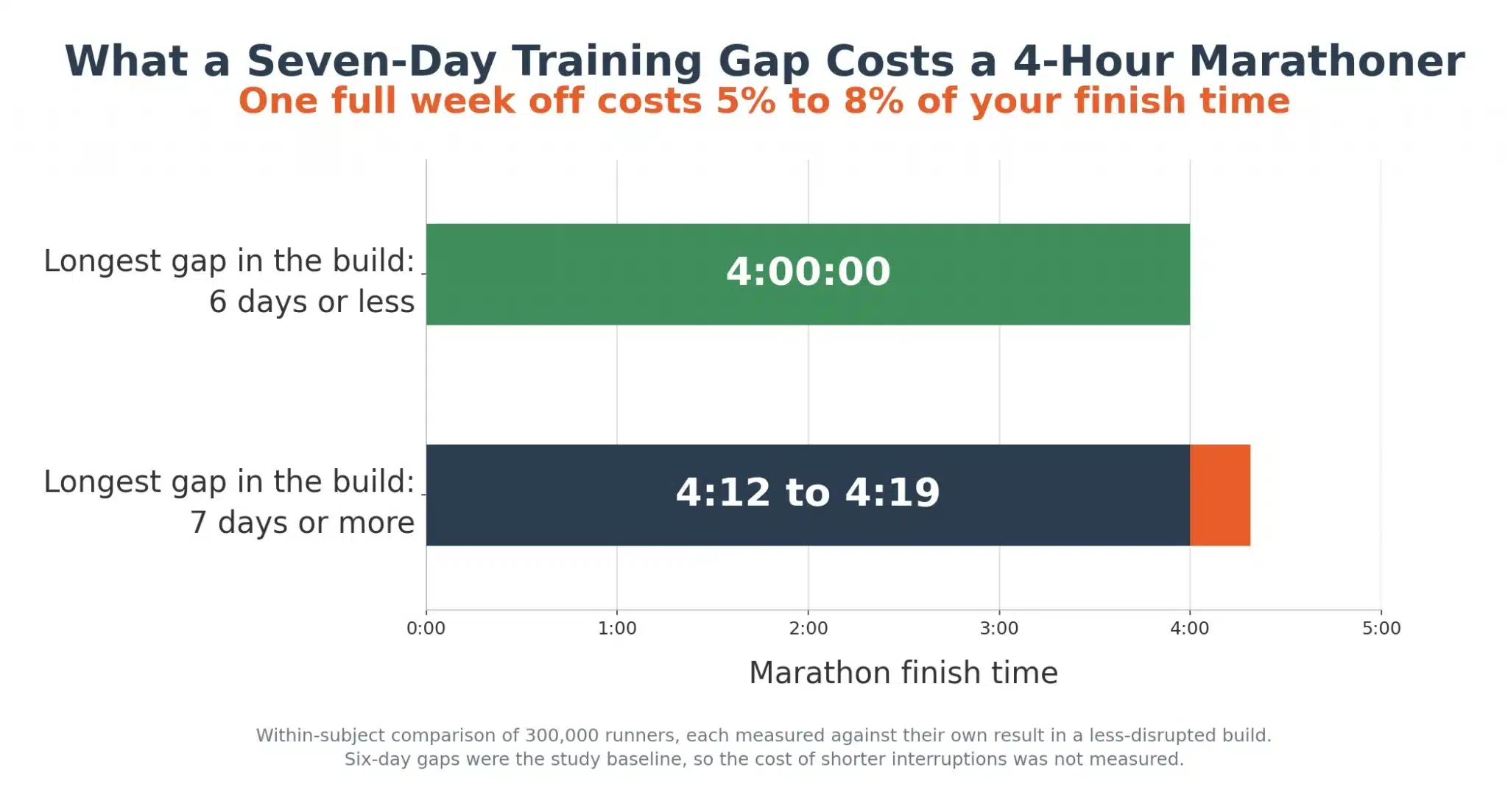
Researchers found runners who had completed one marathon after a build containing a full week of no running and another after a build whose longest gap was six days or less, then compared each runner against their own performance.
Across 15 million training activities from 300,000 runners, a training gap of seven consecutive days or longer cost the same runner 5% to 8% of their finish time.
On a four-hour marathon that works out to somewhere between 12 and 19 minutes.
Defending the seventh day of a bad week is the highest-leverage decision you will make in your entire training block.
The same work found more than half of all runners lose up to six consecutive days at some point in a build.
Those shorter gaps were the study’s baseline rather than a measured result, so the honest reading is that a full week off is expensive while the cost of a scattered few days remains unquantified.
The threshold still gives you something useful, because a handful of missed runs across a sixteen-week block is the normal experience of most marathoners and the seven-day gap is the one worth fighting hardest to avoid.
Classic detraining work tracking seven endurance athletes through complete rest found aerobic capacity fell by 7% within three weeks, while the mitochondrial enzymes that let you burn fat efficiently halved their decline within twelve days before settling well above untrained levels.
Those enzymes are the machinery that spares your carbohydrate stores at marathon pace, and the direction of travel during a layoff is unmistakable even though the athletes never dropped back to where they started.
Lose them and you burn through glycogen faster at the identical pace, which closes the loop back to mile twenty.
A review of short-term detraining describes exactly this shift, with a few weeks of inadequate training increasing reliance on carbohydrate while lowering both stored glycogen and the lactate threshold.
A runner arriving at the start line off the back of a disrupted block is pre-loaded to slow down before they swallow a single gel.
The good news is that the fix is undemanding: cut your volume hard, keep the frequency and the intensity, and protect the habit of going out at all.
Discipline in the final weeks pays similarly, since an analysis of more than 158,000 runners found a strict three-week taper was worth about five and a half minutes over a minimal one, and 64% of everyday runners taper loosely enough to leave that on the table.
Does Running With a Group Actually Make You More Consistent?
The claim that groups make people more consistent does not survive the best available evidence.
The most recent systematic review and meta-analysis, covering 71 studies and more than 22,000 people, found no significant advantage for group-based physical activity programs over individual ones when the outcome was how much people actually moved.
Group programs did come out ahead on physical function, and the authors concluded that both approaches can work.
A year-long trial of 357 sedentary adults aged 50 to 65 found twelve-month adherence was better in the two home-based training conditions than in the supervised group condition.
A Cochrane review of home and center-based programs for older adults reached the same conclusion, with its strongest single trial reporting 68% adherence at two years for home-based training against 36% for center-based.
Those populations are older and less active than you are, so read them as a warning about the mechanism rather than as a verdict on your run club.
The warning is simply that turning up somewhere with other people does not, by itself, make you consistent.
Running groups show a version of the same pattern.
A cohort study following 223,224 parkrun participants found 76% attended only a handful of times and never meaningfully returned, despite parkrun being free, weekly, social, and deliberately welcoming.
The same study found that participants at events with higher running club membership were more likely to become long-term regulars, which is the first hint at what actually separates a group that works from one that does not.
Among actual runners, a study of 1,151 non-professional athletes found training volume was the most influential factor in performance for both sexes while running-group participation did not rank among the leading social factors.
One effect does survive careful causal testing, and it works day by day rather than across a season.
Researchers analyzing a global running network used weather variation experienced by geographically distant friends as a natural experiment, which separates genuine influence from the tendency of similar people to cluster together.
Tracking 1.1 million runners over five years, they found every additional kilometer run by your friends led you to run an additional 0.3 kilometers that day.
The influence was real, causal, and specific, and it decayed over the following days.
Less active runners influenced more active ones without the reverse holding true.
Contact and cohesion drive the benefit rather than the mere presence of other bodies, which is why a group you feel no connection to will not save your training block.
The meta-analysis found the same thing inside its own data, since programs that deliberately applied group-dynamics principles outperformed ordinary classes that simply put people in a room together.
That reframes the Strava gap between 29% and 45% usefully, because the runners on the better side of it had tagged specific training partners in their activities rather than merely standing near strangers on a Saturday.
What Makes a Running Group Keep You Showing Up?
The single most useful finding in this entire literature separates having a partner from making a plan with one.
Researchers ran a six-month trial with four conditions: a partner alone, a personal action plan alone, both together, and neither.
Across 257 working adults, only the group that made specific joint plans with their partner outperformed the control at one, three, and six months, and the partner-only condition failed to beat the control on most measures.
Simply having a training partner moves almost nothing on its own, and the effect lives in the specific standing commitment you make with that person.
The clearest demonstration of what a formal commitment does comes from a behavioral weight-loss program rather than a running one.
In a trial of 166 adults, participants recruited alongside friends and given explicit social-support strategies completed the program at 95% against 76% for those recruited alone, and 66% fully maintained their weight loss at follow-up against 24%.
Choosing the right people matters as much as choosing to have people at all.
Train with runners at a similar life stage.
A three-arm trial of 627 older adults found programs built around similar-aged participants produced substantially better exercise adherence at twelve and twenty-four weeks than a standard mixed-age program.
Those programs also worked deliberately at building social connectedness, so age matching and cohesion-building come as a package rather than as separable ingredients.
Related work on newly formed exercise classes found that how similar members judged each other to be, measured shortly after the group first met, predicted whether they were still attending months later.
Favor smaller groups with people near your level.
A study of 20,191 first-time parkrun participants found return rates fell as event size rose and climbed when a higher proportion of attendees were also newcomers, while those finishing well behind the field were disproportionately unlikely to come back.
Expect the group to build shared purpose, not just shared miles.
Work on group cohesion found that attachment to the group’s shared task predicted attendance a full year out, and that deliberate team-building raised both attendance and the rate at which people returned after a break.
A trial of 338 couples found joint planning produced no overall benefit, and among pairs with a poorer relationship the person doing the joint planning became less active than those who planned alone.
Planning your training around the wrong person leaves you worse off than planning it by yourself.
Does Running With Others Make Hard Efforts Feel Easier?
The common explanation for why groups help is that company makes the work feel lighter, and the direct measurements say otherwise.
One caveat belongs up front, because this particular question has only been answered in laboratories.
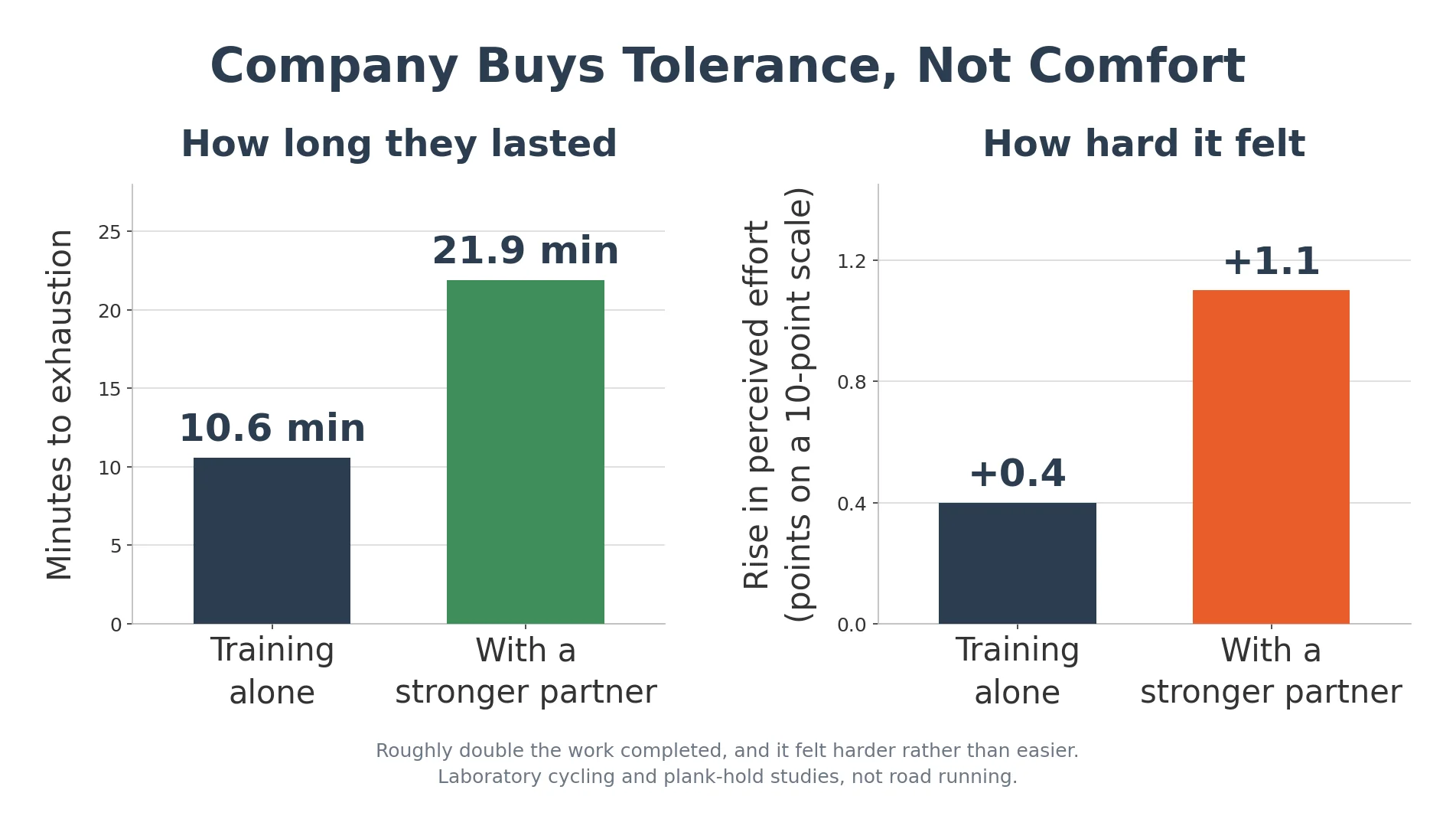
The studies below used stationary bikes, plank holds, and simulated partners on screens rather than runners on roads, so treat the direction as trustworthy and the exact numbers as indicative.
Across six separate cycling sessions, people training with a slightly stronger partner lasted 21.9 minutes before stopping, compared with 10.6 minutes for those training alone.
Roughly double the work, repeated across six sessions in a group of 58 young women, is a large effect by any standard.
A trial of 115 participants holding repeated plank efforts found perceived exertion climbed more steeply in the partnered conditions than in the solo condition, and participants rated the task as harder in the partnered condition that produced their best effort.
A study of 153 students found the same shape, with partnered participants holding their effort significantly longer while reporting higher subjective effort.
Training alongside someone buys you tolerance rather than comfort.
The same felt cost purchases more completed work.
The effect has firm limits.
A six-day study of 85 physically active adults found no partner effect at all when the outcome was exercise intensity rather than duration.
The longest trial of its kind, running six days a week for twenty-four weeks with 41 participants, found effort in the partnered conditions was not significantly different from training alone across almost every comparison.
The one exception came in the hardest interval of the hardest sessions, where a consistently stronger partner did lift effort above training alone.
Company reliably keeps you out longer, and the evidence that it makes you go harder holds only at the very sharp end of a session.
That maps neatly onto what the marathon actually asks of you, since the accumulated easy volume that separates fast marathoners from slow ones is a duration problem.
Which Runs Should You Do With the Group and Which Alone?
Group training carries one genuine cost, and it lands on the exact quality that predicts your finish time.
Easy runs done in company drift upward in pace, because the natural rhythm of a conversation with someone slightly quicker sits above your aerobic pace.
Coaches consistently see that drift land somewhere between 30 and 90 seconds per mile, which is roughly 20 to 55 seconds per kilometer.
An easy run that creeps up by that much stops being easy running and starts being moderate running that leaves you flat for the session that mattered.
Protect your easy days above everything else, because accumulated easy volume is the single quality that most separates faster marathoners from slower ones.
Pace discipline tracks performance on race day as closely as it does in training.
An analysis of 78,912 Boston Marathon finishers found 82% of sub-three-hour runners paced evenly, against 19.6% of casual participants.
Fitness explains much of that gap rather than pacing alone, and the habit of running at a pace you chose rather than one that was chosen for you is what the two groups most visibly differ on.
Letting the group set your speed is the training-week version of the same surrender.
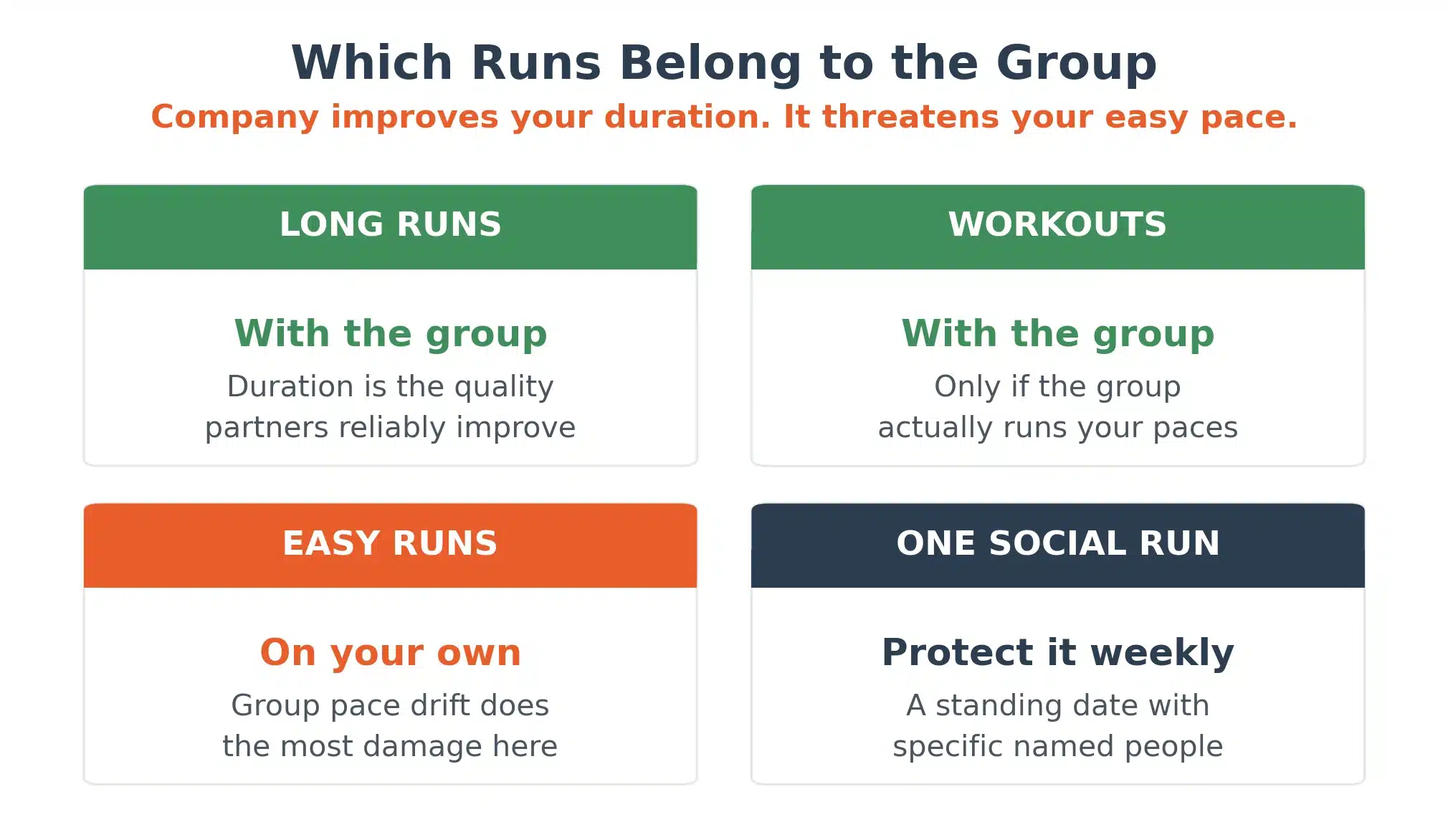
A workable allocation follows directly from what each type of run needs.
- Long runs belong with the group. Duration is the quality partners reliably improve, and a three-hour run is the session most likely to get cut short when you are alone with your own judgment.
- Hard sessions belong with the group when the group runs your paces. A track workout with runners at your level is a genuine advantage, and one with runners 45 seconds per mile quicker turns your threshold session into a race.
- Easy runs belong to you. This is where the group’s pace-dragging effect does the most damage and buys you the least, so run these alone or run them with people happy to hold a genuinely conversational pace.
- One social run a week is worth protecting regardless. The consistency effect is real, and it needs a standing appointment with specific people to exist at all.
Where you land on that allocation depends partly on whether you are wired for solo or group running, which is a separate question worth answering honestly before you commit your fall block to a club schedule.
| Factor | What the evidence shows | What to do |
|---|---|---|
| Late-race slowdown | Behaves like a pacing decision made in the first mile, and is more common near a personal best | Set a goal your training block earned, then hold an even first half |
| Training consistency | Training history dominates every other predictor of finish time | Defend the number of runs per week ahead of the quality of any single one |
| A full week off | Costs 5% to 8% of finish time compared with a build whose longest gap was six days | Cut volume during disruption, keep frequency and intensity, never stop entirely |
| Group membership alone | No significant advantage over individual programs on activity levels across 71 studies | Judge a group on connection and commitment rather than on attendance numbers |
| A specific joint plan | The only partner condition that beat the control across six months | Agree a fixed day, time, and place with named people |
| Group composition | Similar life stage and similar ability drive adherence | Choose smaller groups with runners at your level |
| Effort with company | Duration roughly doubles while perceived effort rises | Use the group for long runs, and protect easy runs from pace drift |
The Strava numbers that opened this article are pointing at something real.
Runners who train with other people complete more of their training block, and completing your training block is what keeps you from slowing down at mile twenty.
Accountability beats willpower because willpower is what you are relying on at 6am in the rain in week seven, and it is the least reliable input you have.