This month, wildfire smoke has turned the sky over much of the Northeast and Upper Midwest a strange shade of gray, and if you live there, you probably smelled it before you saw it.
More than 180 fires burning across Ontario, along with fires in Quebec and northern Minnesota, pushed smoke south in mid-July 2026.
Detroit sat in the hazardous range for days. Chicago, New York City, and Washington, D.C. all logged degraded air, and air quality alerts went up across more than a dozen states.
The question a lot of runners asked that week was simple: is it actually a problem to run in this, or are you being soft by moving the workout indoors?
Wildfire smoke is the loudest version of a problem that shows up quietly all over the country.
If you train in a big city, summer ozone can push your local air into unhealthy territory on a hot afternoon with no fire anywhere near you. Runners in valley towns deal with temperature inversions that trap pollution near the ground, and anyone downwind of farmland sees spikes during burning season.
Poor air quality is a few days or a few weeks a year for most runners, and knowing how to handle those days keeps you healthier and, it turns out, faster.
So, in this article you’re going to learn the research-backed practical advice on running in poor air quality:
- Why a hard run exposes you to far more pollution than sitting still does
- What PM2.5 and ozone actually do to your body when you breathe them
- How much dirty air can slow your race times, even at levels that look fine
- Whether the health benefits of running still outweigh the risks on bad-air days
- The exact AQI numbers where you should shorten, move indoors, or stop
- How to keep training through a smoke event without losing fitness
Why Does Bad Air Hit Runners Harder Than Everyone Else?
The reason air quality matters more to you than to a neighbor sitting on the couch comes down to how much air you move.
At rest, you breathe roughly 6 liters of air per minute.
During a hard run, that can climb past 100 liters per minute, which means you pull 10 to 20 times more air through your lungs, and every particle in that air comes with it.
Two other things change when you run hard.
You switch from breathing through your nose to breathing through your mouth, which skips the filtering that your nasal passages normally do.
You also breathe more deeply, which drives pollutants further into the small airways where your lungs exchange oxygen.
A hard effort takes in far more pollution than a walk on the same street, and it reaches deeper into your lungs at the exact moment your natural filtering is switched off.
This is the core reason exercise guidance around air quality exists at all, and why a runner needs to think about a smoky day differently than someone just walking to their car.
What’s Actually in the Air on a Bad Air Quality Day?
When people talk about bad air, two pollutants do most of the damage to runners: fine particulate matter, known as PM2.5, and ozone.
A 2023 study in Scientific Reports found these two accounted for 91% of the air quality index values in its data, so they are a fair place to focus.
PM2.5 is particulate matter smaller than 2.5 micrometers across, about 30 times thinner than a human hair.
At that size, the particles slip past the defenses in your nose and upper airway, reach the deepest part of your lungs, and can pass into your bloodstream.
Wildfire smoke is largely PM2.5, including a component called brown carbon that the smoke this month carried in heavy amounts.
Ozone is different. It forms when sunlight reacts with pollution from traffic and industry, which is why it peaks on hot, sunny afternoons and why city air often gets worse as the day goes on.
The tool that ties this together is the Air Quality Index, or AQI, which runs from 0 to 500 and is color-coded.
Green (0 to 50) is good, yellow (51 to 100) is moderate, orange (101 to 150) is unhealthy for sensitive groups, red (151 to 200) is unhealthy for everyone, purple (201 to 300) is very unhealthy, and maroon (301 and up) is hazardous.
You can pull your local number in a few seconds at AirNow.gov or almost any weather app, and that number is the input for every decision below.
How Do You Check Air Quality Before a Run?
The number that drives every decision below takes about 10 seconds to find, and where you look changes how much you can trust it.
Pull the number from AirNow.
AirNow.gov and its free app pull from EPA reference monitors and show both the current AQI and a next-day forecast, while many weather apps display a modeled estimate that can lag a fast-moving smoke plume by hours.
Read PM2.5 and ozone as separate lines.
The headline AQI is whichever pollutant is worse at that moment, so a hot and still afternoon usually reads as ozone while a smoke event reads as PM2.5.
Check the hours you will run.
Ozone builds through the afternoon and smoke moves with the wind, so the reading for your planned start time matters more than the daily average.
Fill the gaps between stations.
The nearest official monitor can sit several miles away, so on a borderline day a crowd-sensor map such as PurpleAir gives you a reading closer to your actual route.
Check the current PM2.5 and ozone for the hours you plan to run, not yesterday’s average or a monitor across town.
Does Air Pollution Actually Make You Run Slower?
Dirty air measurably slows you down, and it does it at pollution levels most runners would consider unremarkable.
A 2023 study found that raising PM2.5 exposure from about 5 to 10 micrograms per cubic meter slowed runners’ 5K times by 12.8 seconds, roughly 1.5% slower.

The study tracked 334 collegiate distance runners across 46 universities and looked at how the air in the days before a race affected their 5K times.
Ozone had a similar effect, adding about 11.5 seconds on its own.
The detail worth sitting with is that both of those exposure levels fall inside the good-to-moderate band of the AQI.
These runners were not racing through smoke. They were racing through air that looked fine, and it still cost them more than 10 seconds over 5K.
Air quality can slow your race even when the AQI reads “good,” so a flat workout on a hazy day is a plausible physiological effect, not a lack of effort.
This is the short-term cost, and it clears once the air does. The longer-term question is what repeated exposure does to your health, which is where the research gets more interesting.
RC has covered the broader picture of how outdoor air pollution affects running performance if you want the mechanism in more depth.
Is It Still Worth Running When the Air Is Polluted?
For a healthy runner, the benefits of regular exercise outweigh the risks of occasional bad air, and the research is fairly clear on this.
A 2025 analysis of 1.5 million adults found exercise still lowered the risk of early death in polluted areas, though the benefit shrank from about 30% down to 12 to 15% where long-term PM2.5 reached 25 micrograms per cubic meter or higher.
That study measured year-round exposure rather than a handful of smoky days, so it speaks more to where you live than to any single run.
The direction still matters: the dirtier the air you train in over months and years, the less your training gives back.
The EPA lands in the same place, advising that healthy people keep exercising while checking the AQI, and that older runners or anyone unusually sensitive to pollution avoid prolonged, intense efforts when air quality is poor.
On smoky days the goal is to lower your dose while keeping the training in, not to abandon your week.
What AQI Level Is Safe to Run In?
The fastest way to make a good call is to check the AQI and match the number to your run.
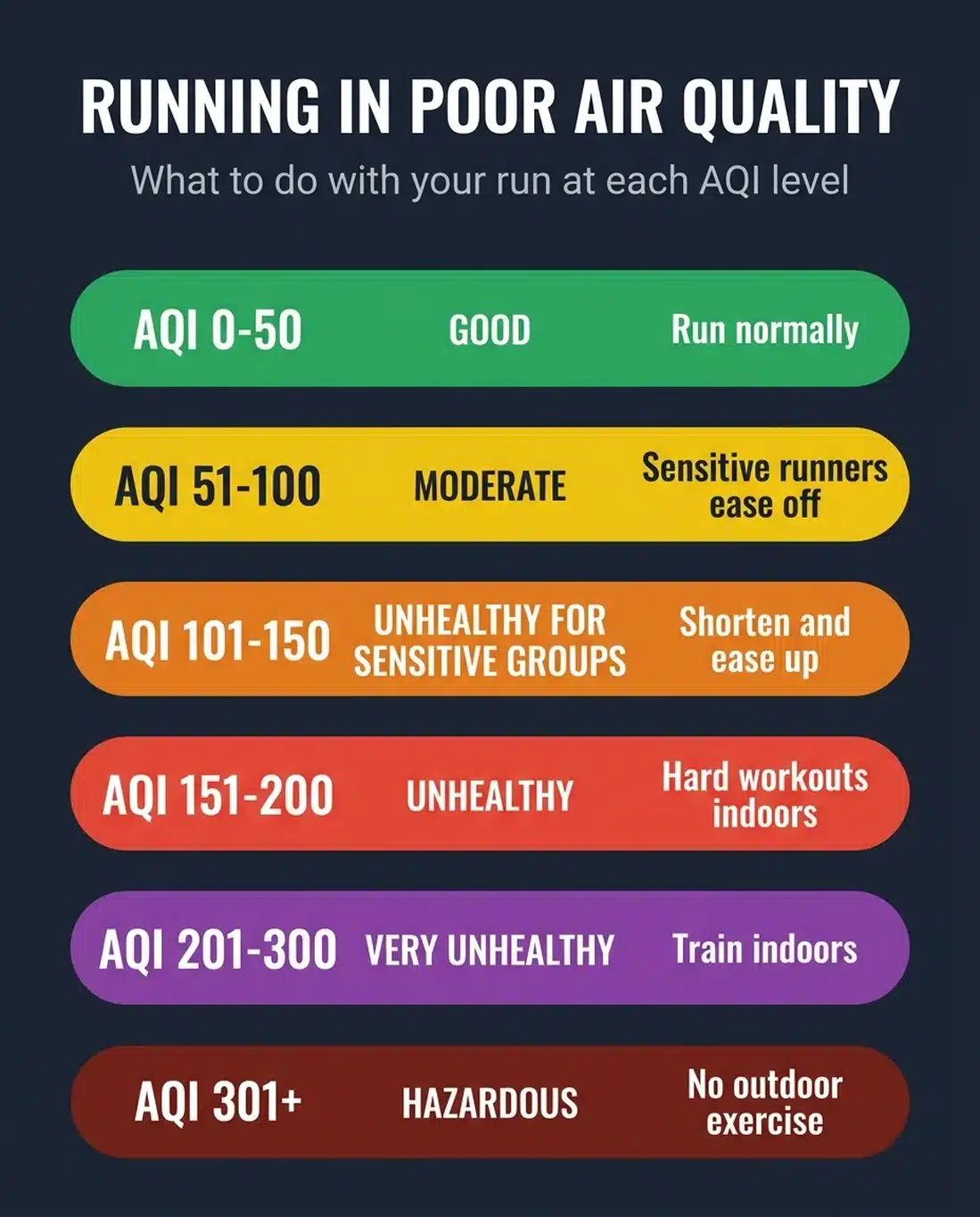
Here is a simple framework built from EPA and public health guidance.
| AQI | Category | What to do with your run |
|---|---|---|
| 0 to 50 | Good (green) | Train normally. |
| 51 to 100 | Moderate (yellow) | Fine for most runners. If you’re sensitive to air, keep hard efforts shorter and watch for coughing or chest tightness. |
| 101 to 150 | Unhealthy for sensitive groups (orange) | Healthy runners can train with adjustments: shorten the session, ease the intensity, cap hard work near 30 minutes. Sensitive runners move indoors. |
| 151 to 200 | Unhealthy (red) | Stop hard outdoor running. An easy jog may be fine for healthy adults, but move real workouts inside. |
| 201 to 300 | Very unhealthy (purple) | Train indoors. If you must be outside, wear a properly fitted N95. |
| 301 and up | Hazardous (maroon) | No outdoor exercise. Stay inside with windows closed. |
The tiers shift for sensitive groups, so an orange day that a healthy runner treats as a shortened run is an indoor day for someone with asthma or heart disease.
Once the AQI crosses into the red range, move hard workouts indoors regardless of how you feel, because the exposure outweighs the benefit at that point.
Can You Run in Wildfire Smoke?
Wildfire smoke calls for more caution than the same AQI number from ordinary city haze, because the particles in smoke do more damage.
A 2021 analysis in Nature Communications found that a rise in wildfire-specific PM2.5 raised respiratory hospital visits by up to 10%, several times the effect of the same amount of pollution from traffic or industry.
Smoke is almost entirely fine PM2.5, and during a large fire it carries brown carbon and other combustion byproducts that settle deep in your airways.
Smoke also moves fast, climbing from a moderate AQI to a hazardous one within an hour as the wind turns.
A reading you checked at breakfast tells you little about a run at noon.
Use the same AQI limits from the table above during a smoke event, and lean toward the stricter end whenever the number is still climbing.
Runners with exercise-induced asthma or other respiratory conditions should move indoors at a lower AQI than a healthy runner would.
How Do You Keep Training When the Air Is Bad?
Adjusting a run beats canceling it, and you have more levers than most runners realize.
Move the hard work indoors.
A treadmill tempo or a stationary-bike interval session gives you the training stimulus without the exposure, and it is the most reliable option on a red or purple day.
RunnersConnect Bonus
Download your FREE Treadmill Guide for Runners.
The guide contains 4 treadmill specific workouts guaranteed to keep you sane and fit! You’ll learn about the In-N-Out workout, how to “run like an Egyptian” and get my favorite “green eggs and ham” workout.
Time your outdoor runs to the air, not the clock.
Ozone builds through the day and peaks in the afternoon, so on hot, sunny days a morning run is usually the cleaner choice, though wildfire smoke is less predictable and needs an actual AQI check for the hours you plan to run.
Choose where you run.
Air near heavy traffic carries more pollution, so on a marginal day a route through a park or a quiet neighborhood beats one along a busy road.
Know the limits of a mask.
A properly fitted N95 filters most fine particles, but it makes hard breathing harder and its seal breaks down once you are sweating, so treat it as a tool for an easy outdoor effort rather than a license to run a workout in hazardous air.
Clean up the air you recover in.
Most of your day is not spent running, so keep windows closed on smoky days, set your air conditioning to recirculate, and run a HEPA purifier where you sleep, since the air quality in your bedroom affects your recovery as much as any single run.
Shorten and soften before you skip.
On an orange day, cutting a 60-minute run to 30 and dropping the intensity a notch keeps you moving while roughly halving your time in the air.
Will a Few Days Off Ruin Your Fitness?
You might worry that a few days off the roads will unravel weeks of work. It won’t.
Fitness is built over months, and the endurance base you have spent a season building does not evaporate because you ran three easy days on a treadmill or took a rest day while the smoke cleared.
The runners who actually get hurt by bad air are the ones who force a hard workout through it, then spend the next week with an irritated respiratory system feeling worse than if they had adjusted.
A shortened or indoor run protects both your lungs and your training, and a rest day during a smoke event costs you nothing you can measure.
Poor air quality is going to be part of the training year for more and more runners, and the ones who handle it well are the ones who check the number, make a small adjustment, and get back to normal the moment the air does.