You’ve been training consistently for six to eight weeks, and a run that felt hard weeks ago now feels manageable.
Your body has adapted.
But here’s where many runners get stuck: Should you increase your pace now, or wait longer?
Pushing too soon risks injury and burnout.
Waiting too long wastes your fitness gains and stalls progress.
Your body sends specific signals that indicate when it’s ready for faster running.
So, in this article you’re going to learn the research-backed practical advice on recognizing when your body is ready to run faster:
- How your heart rate reveals fitness adaptation
- Why perceived exertion matters more than pace numbers
- The one adaptation that always comes before pace improvement
- Common mistakes runners make when deciding to increase pace
- How to progress safely once you’ve confirmed readiness
How Your Heart Rate Reveals Fitness Adaptation
Your heart rate is your most objective readiness signal, and most runners overlook it entirely.
As your aerobic system adapts to training, your heart becomes more efficient.
This efficiency shows up as a lower heart rate for the same pace, the same distance, the same conditions.
Coaches have observed this pattern consistently across training levels: when a runner’s heart becomes stronger from aerobic work, it pumps more blood per beat, and the heart doesn’t have to work as hard to deliver oxygen to working muscles.
When your resting heart rate (measured first thing in the morning before getting out of bed) drops by even three to five beats per minute over four to eight weeks, your body has adapted.
The same applies to your heart rate during easy runs.
If you’re running the same route at the same perceived effort but your HR is lower, your aerobic capacity has improved.
This drop signals that your body can now tolerate a higher training load, which is exactly what you need before increasing pace.
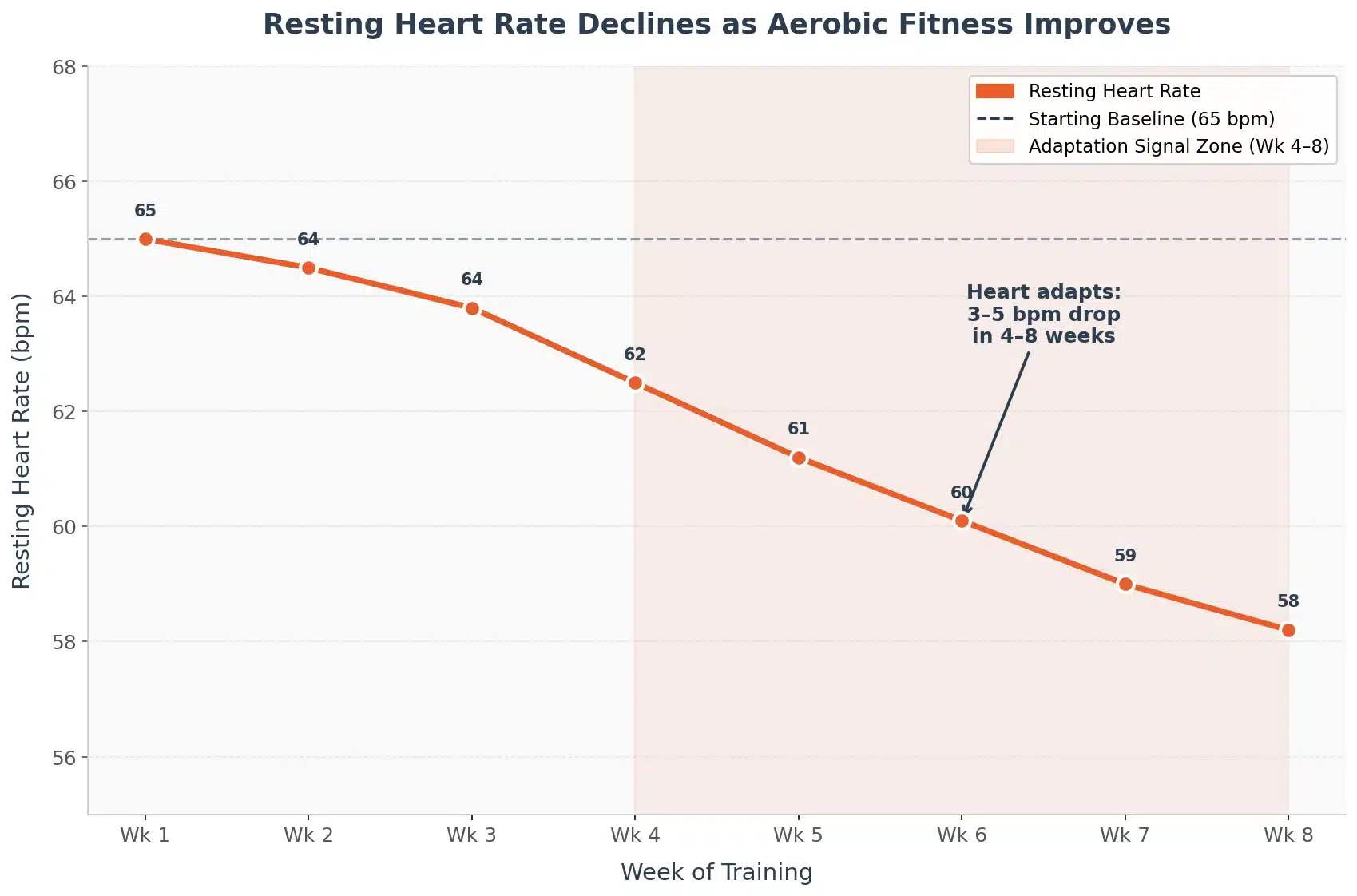
A consistent downward trend in your resting HR or easy-run HR over two weeks is your green light to increase pace.
Perceived Exertion: Your Most Reliable Signal
Your brain is the most sensitive detector of fitness adaptation, and yet most runners ignore what their body is telling them.
Perceived exertion is how hard a run feels to your central nervous system: your breathing, your muscle sensation, your mental effort.
The magic signal is this: the same pace, same course, same conditions as four weeks ago now feels noticeably easier.
You’re not breathing harder at that pace anymore.
Your legs don’t feel as heavy.
Conversation feels less strained.
That shift in perceived exertion is your primary adaptation signal.
In practice, most runners find that perceived exertion drops noticeably two to three weeks before their GPS data shows any pace improvement at the same effort level.
Most runners don’t trust this signal because it’s subjective, but that’s exactly why it works.
Your nervous system is detecting small improvements in running economy, lactate clearance, and aerobic capacity that show up as a drop in effort before any other marker does.
Heart rate data is useful, but perceived exertion comes first.
If the same run feels significantly easier without any change in conditions, your body is signaling that it’s ready to handle harder work.
Have You Built A Strong Aerobic Base?
Increasing your pace only works if your aerobic foundation is solid.
This is the readiness gate most runners skip, and it’s where pace progression falls apart.
Your aerobic base is built through four to eight weeks of consistent easy running at conversational pace, where you could talk in full sentences without gasping.
During this phase, your heart is adapting, your mitochondria are multiplying, and your capillary density is increasing.
These adaptations happen without speed work.
They happen at easy effort.
Only after this foundation solidifies can your body tolerate the neuromuscular stress of faster running.
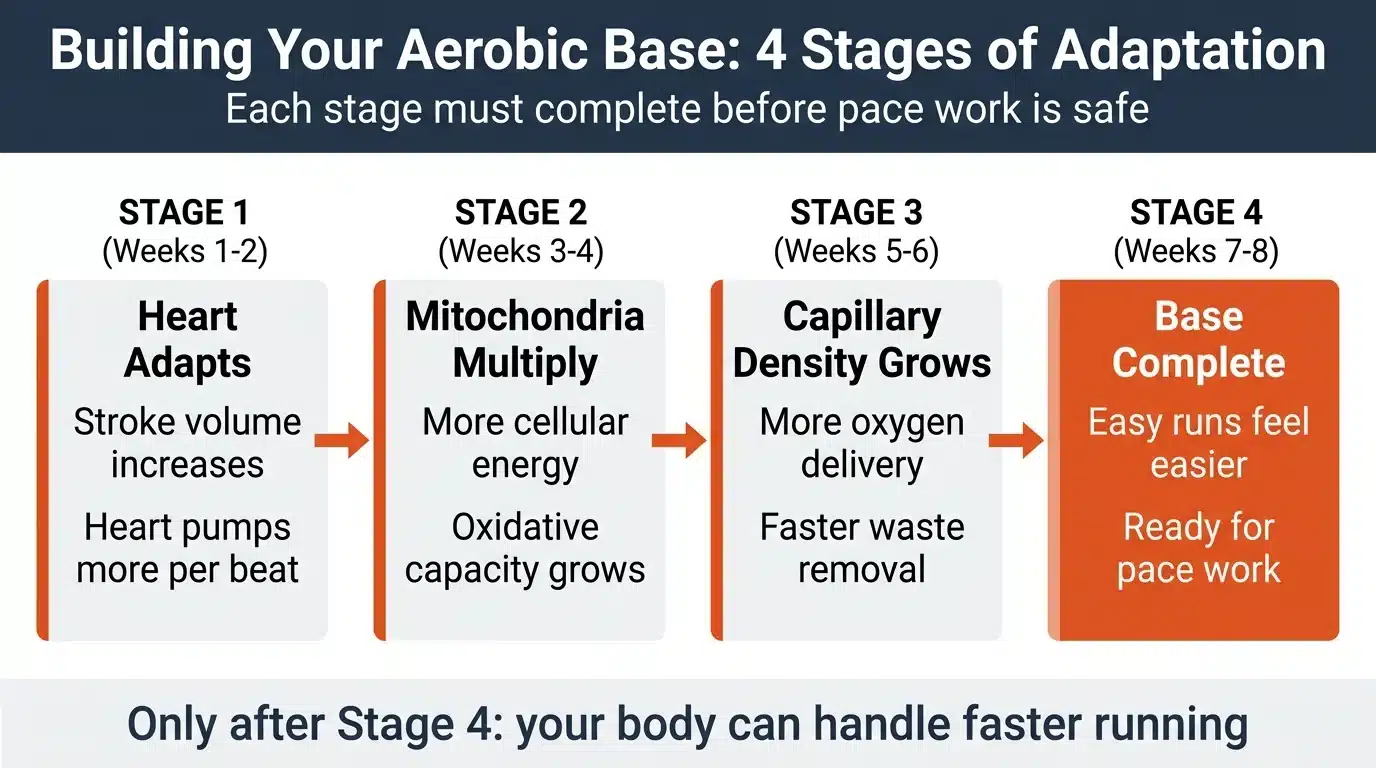
If your easy runs still feel hard, if you’re recovering slowly from moderate efforts, and your resting heart rate hasn’t dropped, your aerobic base isn’t ready yet.
Pushing pace work into this phase causes injury or stalls progress because your energy systems are still adapting to basic aerobic demands.
Hold off on increasing pace if your easy runs still feel hard or your recovery is slow after moderate efforts.
Can You Run Longer at Your Current Pace?
The intermediate readiness step between aerobic base and pace increase is extending the duration you can hold your current pace.
Duration comes before intensity in every adaptation timeline.
If you can run an 8-minute/mile pace (7:29/km) for 30 minutes, but not yet for 45 minutes at the same perceived effort, you’re still building capacity at that pace.
Once you can hold that pace for 45 to 60 minutes comfortably, your body has demonstrated it can sustain hard efforts.
Now pace progression is safe.
This happens because your lactate threshold improves, making your body more efficient at clearing lactate and producing energy at higher intensities.
Many runners skip this step and jump straight to faster speeds, which overloads the neuromuscular system before the energy systems are ready.
Extend duration at your current pace before you increase speed.
Does Your Body Recover Faster?
Recovery speed is an underrated readiness signal.
Your ability to bounce back from hard efforts reveals how much training stress your physiology can actually handle.
As your body adapts to running, your recovery capacity improves.
You need fewer days between hard efforts, your soreness decreases, and your sleep quality improves.
Track these three recovery metrics over four-week blocks.
First: Next-day muscle soreness is reduced or absent after the same effort that previously caused a two-day ache.
Second: Your sleep quality improves, with deeper sleep, fewer awakenings, and waking up feeling more rested than before training.
Third: Your resting heart rate returns to baseline faster after a hard run, usually within a day or two instead of three or more days.
All three improvements indicate that your body’s recovery systems, including your nervous system, immune function, and mitochondrial capacity, have adapted to handle more stress.
This is exactly the adaptation window when pace progression becomes sustainable.
If you need multiple days to recover from moderate effort, hold off on increasing pace until your recovery improves.
Are Your Easy Runs Naturally Getting Faster?
Gradual, natural pace improvements during easy runs are your confirmation signal that adaptation is happening.
Running economy, which is how efficiently your body moves at a given effort, improves before you consciously increase pace.
Check your training log or GPS data from four weeks ago: the pace you ran at an easy effort then, you’re running faster now at the same perceived effort.
That improvement is real adaptation, and it signals that deliberate pace increases are now safe.
You need actual data from your watch or running app to confirm this, not just a feeling that you’re faster.
When your data shows a consistent 15 to 30 seconds per mile (9 to 18 seconds per km) improvement at easy effort over four weeks, your running economy has improved enough that a controlled pace increase will work.
This natural improvement typically comes alongside the other signals: lower HR, easier perceived exertion, better recovery, and improved duration capacity.
Why Forcing Pace Too Soon Backfires
The biggest pace-progression mistake is ignoring your body’s signals and running based on arbitrary targets or your ego.
You decide it’s been six weeks, so you should be faster, and you force a new pace regardless of what your heart rate, perceived exertion, or recovery is telling you.
When you force pace before adaptation is complete, you create a mismatch: your neuromuscular system can’t handle the speed because your aerobic base or recovery capacity isn’t ready.
This triggers overuse injuries, including stress fractures, tendinitis, and knee pain, that sideline you for weeks.
It also causes form breakdown: your stride shortens, your cadence climbs, and injury risk compounds.
The irony is that runners who respect the readiness signals and increase pace gradually end up faster within the same timeframe as those who push early, because the early-pushers get injured and have to stop training.
Persistent fatigue, poor recovery, or runs that still feel hard are all signals to hold off on pace work.
How to Increase Your Pace Safely
Once you’ve confirmed that all the readiness signals are present, here’s how to increase pace without sabotaging your progress.
Start With One Effort Per Week
Add a single harder-pace run to your weekly schedule: one tempo run, one threshold run, or one interval session.
The rest of your runs stay easy.
This structured approach allows your aerobic system to absorb the new stimulus while your recovery systems handle it.
Most runners make the mistake of adding pace to multiple runs at once, which overwhelms the system and triggers injury.
Use Small, Incremental Increases
When you increase pace, do it gradually, going 6 to 12 seconds per mile (4 to 7 seconds per km) faster than your current easy pace.
This is not a big jump, but it’s a real increase that your body will feel.
Once you can sustain that pace comfortably for four weeks, increase another 6 to 12 seconds per mile.
This slow progression allows your form, your economy, and your injury-prevention mechanisms to adapt together.
Monitor Readiness Signals During Progression
As you increase pace, keep tracking the same signals that told you it was time to start: perceived exertion, heart rate, recovery speed, and resting HR.
If any of these signals flips negative, such as breathing harder than expected or recovery taking longer, back off the pace for a week and recheck.
This real-time feedback loop prevents injuries before they start.
Red Flags: When NOT to Increase Pace
Certain stop signals mean your body is not ready to handle pace progression, no matter how confident you feel.
These red flags indicate that your aerobic base, recovery capacity, or energy systems need more time to adapt.
Persistent soreness or joint pain: If you’re experiencing pain that doesn’t resolve within 24 to 48 hours, your tissues are not recovered enough to handle pace work.
Elevated resting heart rate for multiple days: If your morning resting HR is 5 to 10 beats higher than your baseline for three or more days, your nervous system is in a stressed state.
Sleep quality declining: Poor sleep, frequent awakenings, or waking unrefreshed signal that your recovery systems are overwhelmed.
Runs feel perpetually hard: If your easy runs still feel hard or your perceived exertion isn’t improving, your aerobic adaptation is incomplete.
History of injury aggravation: If you have a previous injury that’s bothering you, pace work will stress it further and can cause re-injury.
Any of these signals means stepping back to easy running, allowing recovery, and reassessing in one to two weeks.
Pace progression is a long-term process where respecting these boundaries prevents months of injury recovery.
Readiness for pace progression is determined by observable signals your body sends: lower resting heart rate, reduced perceived exertion at the same pace, and improved recovery capacity.
Timing matters because increasing pace before adaptation is complete triggers injury and stalls progress.
Your primary signal is perceived exertion: when the same run feels significantly easier, your body is signaling readiness.
Aerobic adaptation happens over four to eight weeks of easy running, followed by duration extension at your current pace.
Once your resting heart rate drops, you recover faster, and your easy runs naturally get quicker, a single structured pace increase per week is safe.
Additional signals include the ability to run longer at your current pace and improved sleep and soreness recovery.
The biggest mistake is forcing pace increases based on arbitrary timelines rather than waiting for these signals to align.
Safe progression happens through small incremental increases of 6 to 12 seconds per mile (4 to 7 seconds per km) every few weeks, while continuously monitoring the same readiness signals.