

You’re 10 days out from your 5k goal race.
Your training block has been solid.
Now the question becomes: do you keep training hard, or start pulling back?
And if you pull back, how much?
The answer isn’t obvious because 5k racing is different from marathon racing in a fundamental way. The energy systems, recovery timeline, and optimal taper window are all different.
In this article you’re going to learn the research-backed practical advice on how to taper for a 5k.
You’ll learn:
- Why 5k taper is different from marathon taper (and why it matters)
- How many days you should actually taper before a 5k
- Exactly how much to cut your mileage
- Whether you should ditch speed work or keep it
- What each day of taper week looks like
- Why your legs feel heavy and sluggish (and when it stops)
- Nutrition strategy for race week
- The optimal race-day warmup
Why Does a 5k Need a Different Taper Than a Marathon?
A 5k and a marathon might both be running races, but they’re fundamentally different physiological challenges.
A 5k is primarily a high-intensity aerobic effort lasting 15–35 minutes depending on your fitness.
Your glycogen stores are the carbs your muscles use for fuel.
For a 5k, glycogen isn’t the limiting factor.
Your central nervous system (CNS) is what gets fatigued.
A marathon is a 2–4+ hour endurance slog where fuel availability and aerobic pacing dominate.
The recovery demands are opposite, which is why the taper window is shorter for 5k.
You don’t need three weeks of recovery to replenish glycogen for 15 minutes of hard running.
You do need 7–10 days to offload accumulated fatigue, restore neuromuscular sharpness, and arrive at the starting line fresh, without feeling disconnected from your nervous system.
How Long Should You Taper for a 5k?
Research has shown that an 8 to 14 day taper is optimal for endurance athletes.
The short answer: 7–10 days is the sweet spot for most runners.
The longer answer: it depends on your total training load going in, but the research is clear on the window.
A 2023 meta-analysis of taper studies found that 8–14 days of reduced training produced the best performance improvement across endurance sports.
For 5k runners specifically, most evidence clusters around 6–10 days as optimal.
Anything shorter than 6 days doesn’t give you enough recovery. Anything longer than 14 days risks losing fitness adaptations you built during training.
If you’re racing in less than 6 days (a last-minute opportunity), don’t panic. Do a minimal taper: reduce volume by 25 to 30% and keep one speed session.
If you have 12+ days, you have flexibility. Some runners do a 10-day taper, others stretch it to 12 or 14 depending on how fatigued they feel.
How Much Should You Cut Your Training Volume Before a 5k?
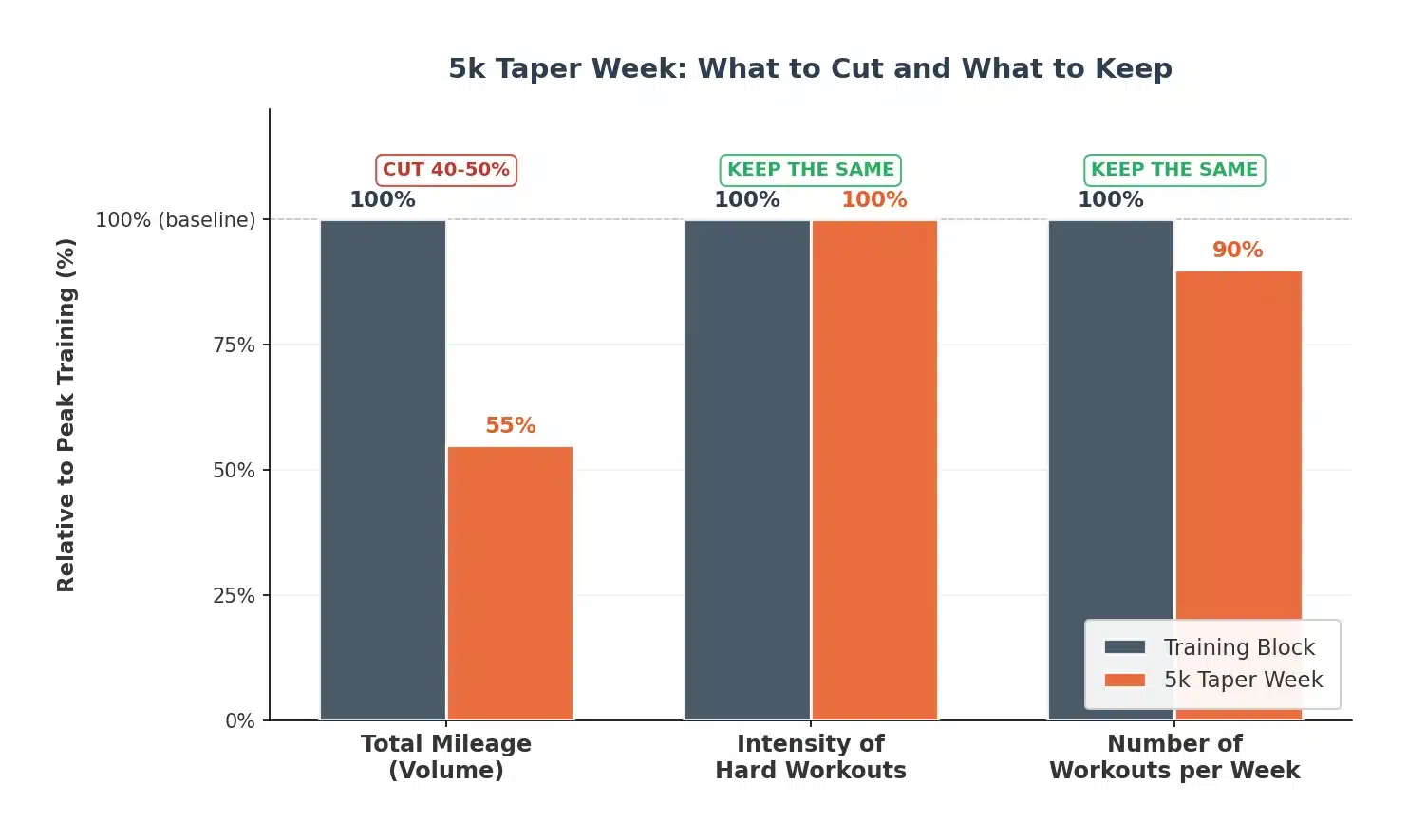
The research is consistent across distance events: cut 41–60% of your weekly volume.
For a 5k, aim for the lower end: 40 to 50% reduction. You’re not depleting muscle glycogen the way marathoners do.
If you’re running 40 miles per week in normal training, drop to 20–24 miles during taper week.
If you’re running 30 miles per week, go to 15–18 miles.
The critical part: don’t cut volume by eliminating your hard workouts.
The runners who cut too aggressively by skipping speed work are the ones who show up to race day feeling slow and disconnected.
Instead, cut the easy runs short (instead of 6 miles, do 4 miles) and keep your speed sessions, just shortened.
A 40-mile week might have two hard workouts: a tempo run and an interval session. During taper, keep both, but make them 20 to 30% shorter.
Should You Keep Doing Speed Work During 5k Taper Week?
Speed work is the single biggest lever you have to show up fast on race day.
A 2002 study on middle-distance runners found that maintaining training intensity during a taper produced better performance than reducing training frequency (doing fewer workouts).
This is the opposite of what marathon runners need.
Your 5k performance depends on neuromuscular sharpness and your ability to accelerate hard in the final kick, both of which decay if you stop doing speed work.
Easy running, no matter how much volume, doesn’t maintain those systems.
So keep one or two speed sessions during taper week, but make them shorter and less volume-intensive than normal.
Instead of 12×400m at 5k pace, do 6×400m.
Instead of a 3-mile tempo, do a 1.5-mile tempo.
The effort should feel fast and snappy, not like a grind. You should finish feeling strong.
Ideally, your last speed session happens 3–4 days before the race, giving you enough time to offload the acute fatigue without losing the activation.
Your most important workout during 5k taper week is your speed session 3 to 4 days before the race.
What Does a 5k Taper Week Look Like Day by Day?
Here’s a practical framework for a 7-day taper window (race on Sunday).
Adjust based on your individual recovery needs. Some runners do well with a 9-day taper if they’ve had a heavy training block.
| Day | Workout | Details |
| Sunday (race day -7) | Easy run | 3 miles at conversational pace |
| Monday (race day -6) | Speed session | 2 mi warmup, 6×400m at 5k pace (90 sec recovery), 1 mi cooldown |
| Tuesday (race day -5) | Easy run | 3 miles at conversational pace |
| Wednesday (race day -4) | Rest or easy | Rest day, or 2 miles very easy if you prefer movement |
| Thursday (race day -3) | Speed session | 1.5 mi warmup, 4×600m at 5k pace (2 min recovery), 1 mi cooldown |
| Friday (race day -2) | Easy run | 2 miles at conversational pace |
| Saturday (race day -1) | Shakeout or rest | 15 min easy jog + 3-4 strides, OR complete rest if you prefer |
This totals about 18 to 20 miles for the week, roughly 50% of a typical 40-mile training week.
If your normal training week is lighter, scale down proportionally (30-mile week → 15 miles of taper volume).
The speed sessions are the anchor points. The easy runs are flexible based on how your body feels.
If you’re really tired on Tuesday or Friday, drop the easy run or make it 1.5 miles instead of 3.
The workouts (Monday and Thursday) should not be skipped unless you’re genuinely injured.
The speed sessions during taper should feel fast and snappy, not like a grind.
Why Do Your Legs Feel Heavy and Sluggish During Taper?
This is the most common question coaches hear during taper week, and it’s almost always a sign your body is adapting correctly.
“Heavy legs” during reduced-volume training is primarily caused by glycogen supercompensation. Your muscles are storing extra carbohydrate in preparation for the hard effort ahead.
When your muscles hold more glycogen, they also hold more water (glycogen binds water at a 1:3 ratio), which creates that heavy, slightly sluggish feeling.
It’s not a sign you’re losing fitness.
It’s a sign your body is preparing for race day.
The feeling usually peaks 3–5 days before the race and resolves by race morning.
On race day itself, you’ll feel light, fast, and responsive. That extra water powers you through the effort.
The mistake most runners make is panicking during taper and going out for a long run to “test their fitness,” which only prolongs the heavy-leg feeling and wastes glycogen you need for race day.
Instead, trust the process: heavy legs in training week = fast legs on race day.
If you’re truly concerned that something is wrong (acute pain, injury symptoms, unusual fatigue), that’s different. General heaviness and a slow-feeling easy run are both normal and temporary.
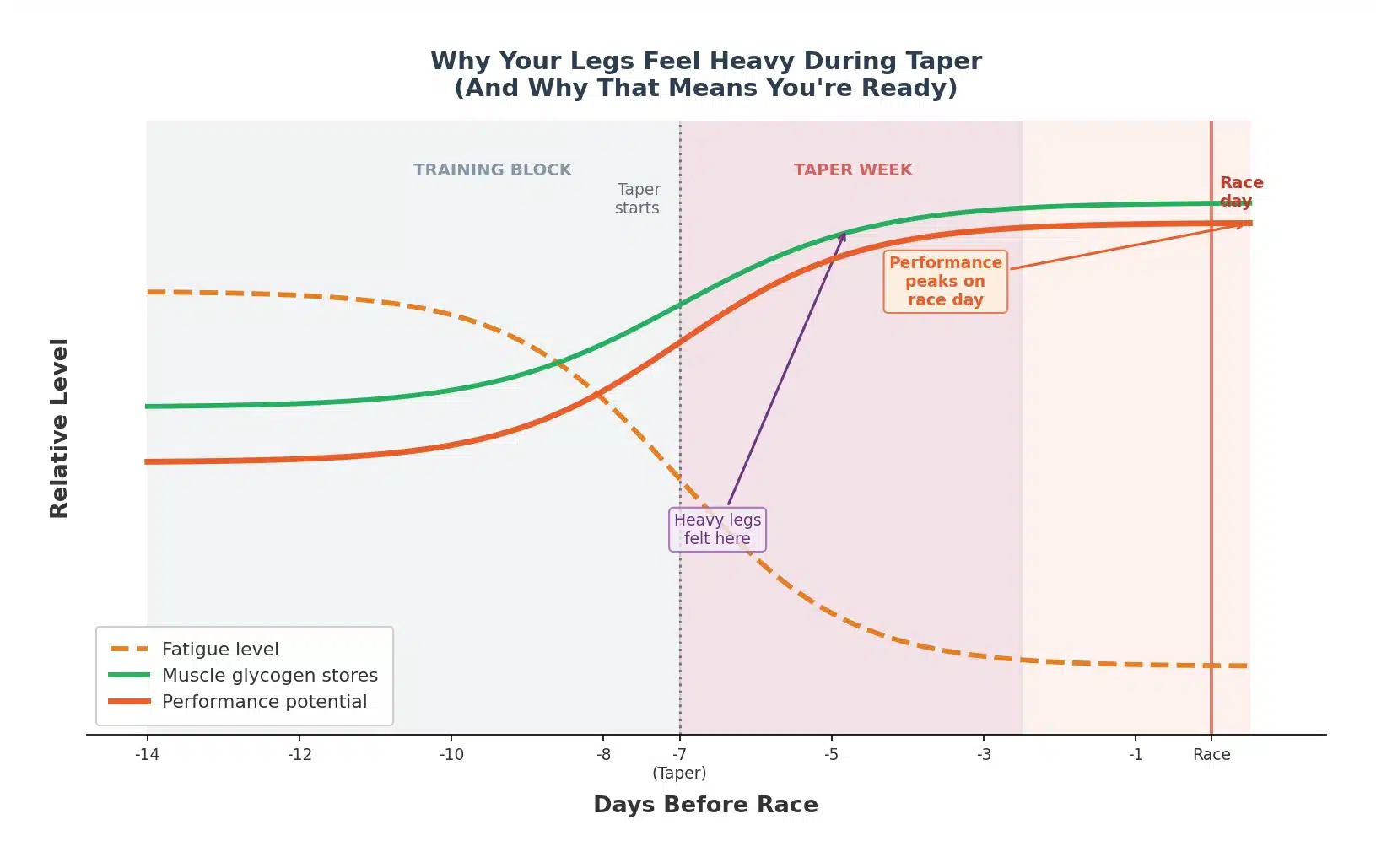
Heavy legs during taper week is a sign your body is adapting, not a sign something’s wrong.
What Should You Eat the Week Before a 5k?
The nutrition strategy for a 5k is much simpler than for a marathon, because glycogen depletion isn’t your limiting factor.
You’re not doing extreme carb-loading like you would for a 20-miler.
Eat a balanced diet with carbs, protein, and fat. Focus on two things: hydration and familiarity.
Hydration: Start eating normally salty foods and drinking steady fluids 3–5 days before the race.
Your body should feel well-hydrated, not parched, and you should be urinating regularly (pale yellow urine is a good sign).
24 hours before the race, some runners do a mild fluid load: extra water with electrolytes. This is optional if you’ve been hydrating all week.
Familiarity: Don’t experiment with new foods during race week.
Eat the same breakfast, lunch, and dinners you normally eat.
Your gut has adapted to your regular diet. A novel food (especially high-fiber or high-fat items) can cause digestive issues on race day.
Race morning itself: eat your normal pre-run meal 2–3 hours before the race (e.g., toast with peanut butter and banana, or oatmeal with berries), drink 12–16 oz of water or sports drink, and you’re set.
For a 5k, you don’t need to fuel during the race (it’s over in 15–35 minutes).
How Should You Warm Up on 5k Race Day?
The warmup is one of the most underrated levers in 5k racing, and it’s the one place where you can add 5–10 seconds to your performance with zero additional training.
A proper warmup increases muscle temperature, improves oxygen delivery to your muscles, primes your central nervous system for hard effort, and elevates your heart rate so you don’t start the race climbing from zero.
Here’s the protocol:
10 minutes: Easy jog at conversational pace (you should be able to speak in full sentences, but slightly breathlessly).
2 minutes: Walk and do dynamic leg swings: 10 forward/back swings each leg, 10 lateral swings each leg.
4–6 strides: These are short accelerations, 80–100 meters each, at 85–90% effort (not all-out sprinting, but noticeably hard).
Recover by jogging easy for 30–45 seconds between each stride.
2–3 minutes: Walk and focus on breathing: deep breaths in through the nose, out through the mouth.
Race start: You should feel warm, slightly elevated heart rate, and ready to go.
The most common warmup mistake is doing too much. Jogging for 20+ minutes burns glycogen and can leave you feeling flat at the start.
The second most common mistake is doing too little or not warming up at all, which means your legs feel heavy and slow for the first mile.
The 10–15 minute framework is backed by research and works for the vast majority of runners.
If you’re naturally a fast starter, you might do a slightly shorter warmup (8 minutes).
If you’re someone who needs gradual activation, go to 12–13 minutes.
Adjust the stride count from 4 to 6 based on how sharp you feel after the warmup.
If you feel snappy after 4 strides, stop there.
If you need more activation to feel ready, do 6.
A proper warmup adds 5 to 10 seconds of speed to your 5k performance.
Summary Table: 5k vs. Marathon Taper
| Factor | 5k Taper | Marathon Taper |
| Duration | 6 to 14 days (optimal: 7 to 10) | 14 to 21 days |
| Volume cut | 40 to 50% | 50 to 60% |
| Speed work | Maintain (reduce volume only: 12×400m → 6×400m) | Reduce or eliminate |
| Training frequency | 4 to 5 sessions per week | 2 to 3 sessions per week |
| Race-day warmup | 10 to 15 min easy + 4 to 6 strides | 15 to 20 min jog + strides |
| Carb-loading | Minimal (normal balanced diet) | Significant (3 to 4 days of elevated carbs) |
| Heavy-leg window | 3 to 5 days, resolves before race | 5 to 7 days, often persists into race |