
The night before your marathon, you face a choice that keeps most runners up: Should you run, or should you rest?
Many runners treat the day before a race like they’re already broken and need complete immobilization.
Others worry that skipping a run will cost them fitness or make their legs feel rusty.
The truth sits in the middle, and research on pre-race warm-up protocols and taper science offers clear guidance.
So, in this article you’re going to learn the research-backed practical advice on whether to run the day before a marathon and exactly how to structure that run so your legs feel ready, not tired.
- Why a short, easy run beats complete rest the day before a race
- Exactly how long and how fast to run (and why those numbers matter)
- The single biggest mistake runners make the day before a marathon
- How the protocol differs for half marathoners
- What to do if you didn’t taper properly
Why You Should Run the Day Before a Marathon (Not Rest)
Yes, you should run the day before a marathon. A short, easy run is better than complete rest for most runners.
Research has shown that light, low-intensity exercise primes the neuromuscular system without depleting glycogen or inducing fatigue.

When you run easy for 20–30 minutes the day before, you activate the muscle fibers and nervous system pathways you’ll use in the race.
This activation, sometimes called a shakeout run, tells your body that it’s ready to perform and reminds your muscles of the patterns they’ll follow tomorrow.
At the same time, easy running keeps your routine intact, which calms pre-race anxiety.
Sitting completely still for 24 hours can feel unnatural and amplify nervous jitters.
The day-before run also promotes blood flow to muscles that have been deloaded during your taper, preventing the stiffness and heaviness that complete rest can create.
Runners who run the day before report fresher legs at mile 3 of the race.
How Long Should You Run the Day Before a Marathon?
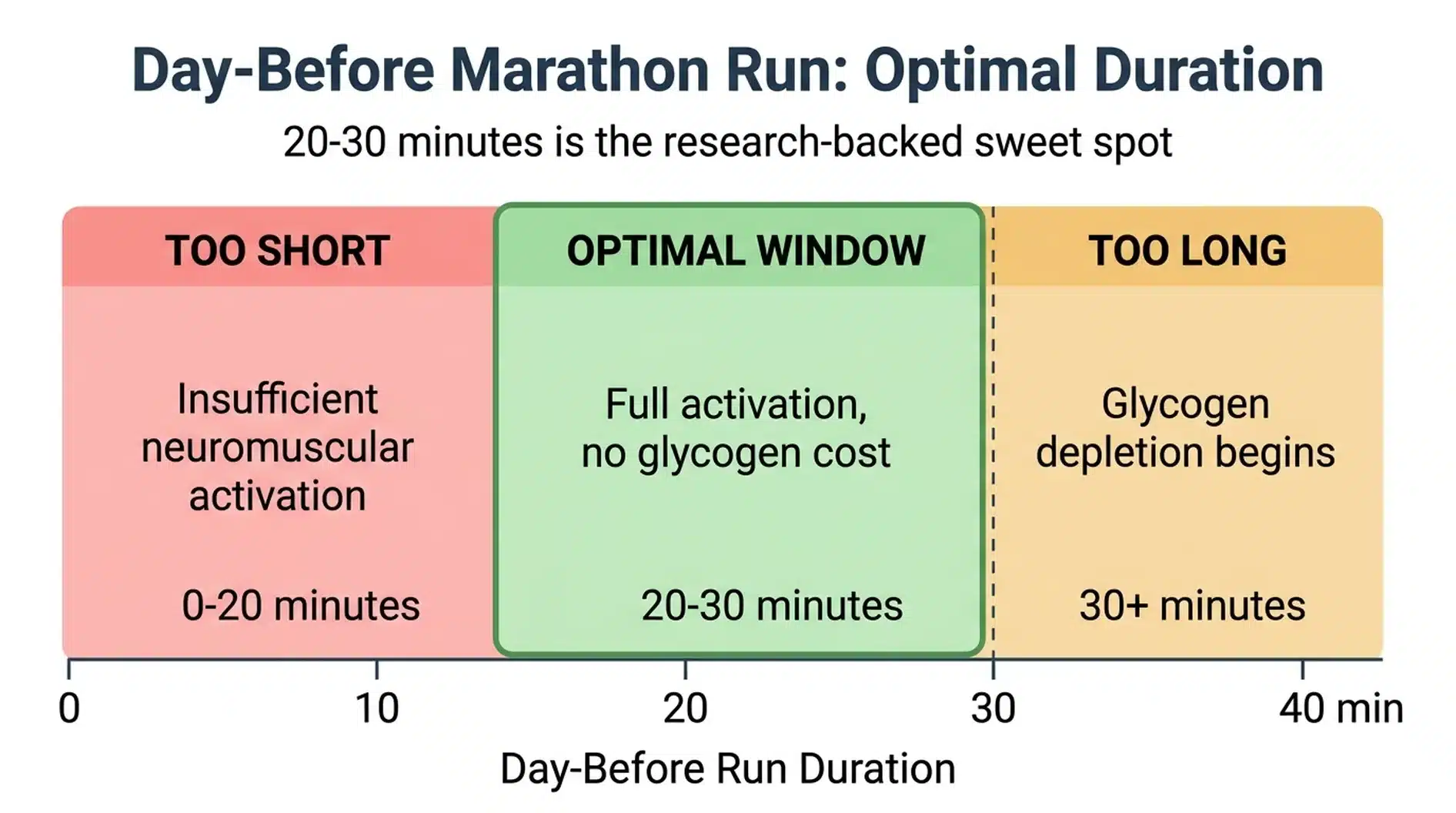
Run for 20–30 minutes at easy pace, and no longer.
This duration is the precise window where you get neuromuscular activation without depleting glycogen stores that you’ll need tomorrow.
Anything shorter than 20 minutes, say 10 or 15 minutes, doesn’t trigger enough nervous system priming.
Anything longer than 30 minutes begins to tip toward energy depletion and fatigue, defeating the purpose of the shakeout run.
The 20–30 minute window is standard across elite marathoners, recreational runners, and coaching literature.
Think of the day-before run as “activation,” not training.
You’re not trying to build fitness or work on pace. You’re waking up your muscles and your mind.
Most runners underestimate how much 30 minutes of movement does for this purpose.
What Pace Should You Run at the Day Before a Marathon?
Run at easy pace, the kind where you could hold a conversation throughout the entire run.
For most runners, this is 9:30–10:30 per mile (5:50–6:30 per kilometer).
Your easy pace may be slower, and that’s fine. The point is not hitting a target time, it’s running at a perceived effort where talking feels natural.
Never run tempo, threshold, or interval work the day before a marathon.
Hard running depletes glycogen and fatigues the central nervous system, which is the opposite of what you want 24 hours before 26.2 miles.
Running hard the day before a marathon is the #1 mistake that costs runners energy and performance on race day.
Easy pace has been the standard pre-race guidance in running coaching for decades because it works.
Your body doesn’t need intensity the day before. It needs blood flow, neural activation, and reassurance that it’s ready.
The Shakeout Run: Timing and Structure
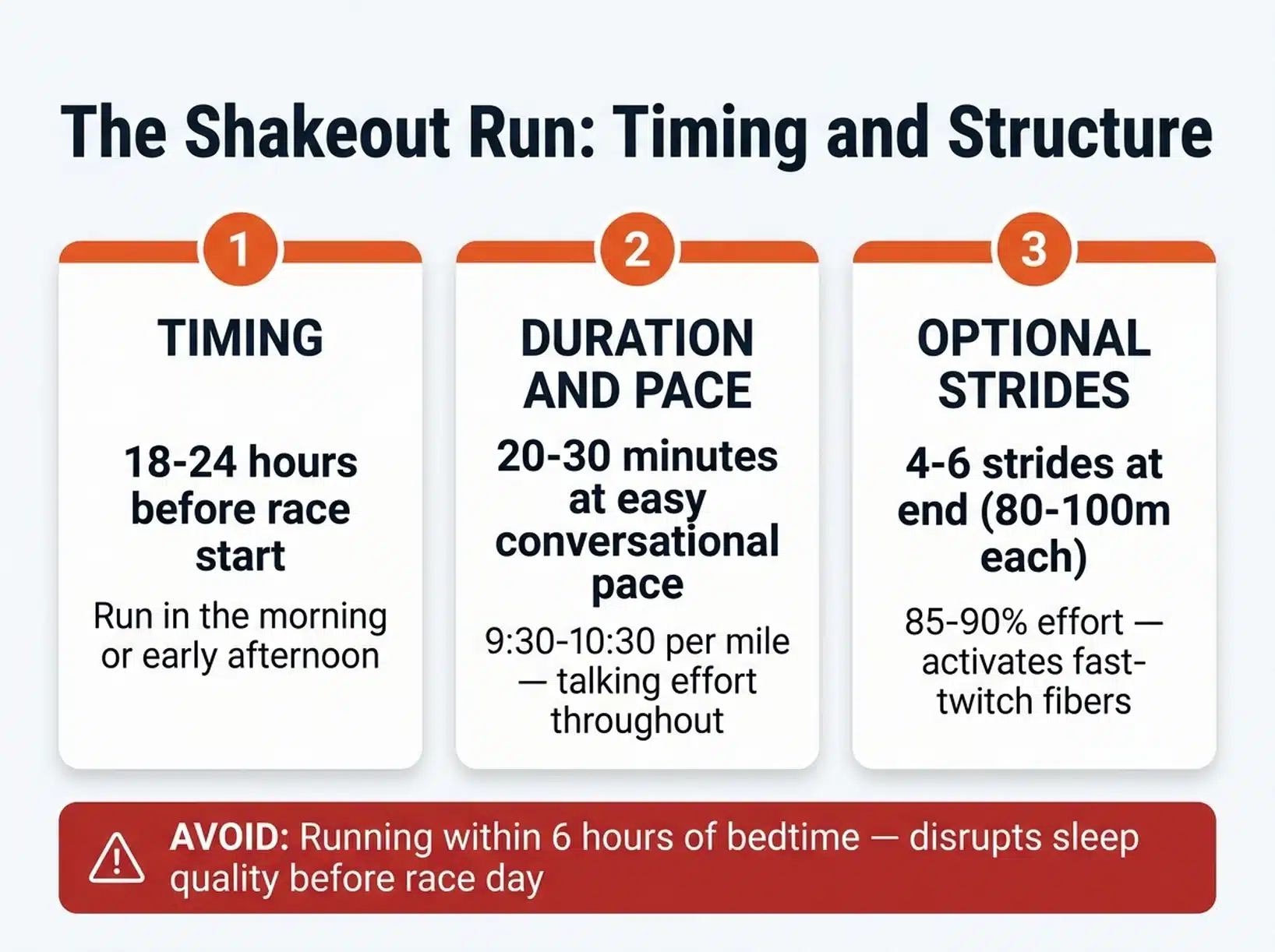
Run in the morning or early afternoon, 18–24 hours before your race starts.
If your marathon begins at 6am on Saturday, run Friday afternoon.
If it starts at 8am on Sunday, run Saturday morning.
This timing gives your body the full glycogen resynthesis window: 18 to 24 hours between the day-before run and race start.
Never run within 6 hours of bedtime the night before the race.
Running late in the evening can disrupt sleep quality and keep you wired when you need rest.
If your race logistics force a late-day run, aim for mid-afternoon and keep it to 15–20 minutes rather than the full 20–30 range.
Some runners add 4–6 short accelerations called “strides” at the end of the shakeout run.
Each stride is an 80–100 meter effort at 85–90% max pace, followed by an easy jog recovery.
Strides engage fast-twitch muscle fibers without causing fatigue and can help nervous-system activation even more than easy jogging alone.
They’re optional, but many coaches recommend them as a final “sharpening” touch.
Half Marathon vs. Full Marathon: Is the Advice Different?
The protocol is mostly the same for half marathoners, with one practical difference: you can push slightly more on the day before a half marathon because glycogen depletion is less of a concern.
A full marathon is 26.2 miles of constant effort, which means you need to preserve every bit of glycogen you can during your taper.
A half marathon is 13.1 miles. That’s hard work, but short enough that you won’t deplete glycogen stores even if you run a bit more on Friday.
In practical terms, half marathoners can safely run 25–35 minutes at easy pace the day before, whereas marathoners should stick closer to 20–30 minutes.
But the principle remains identical: easy pace, no intensity, and activation over training.
The day-before run builds confidence and readiness for both distances.
What Kills Performance the Day Before a Marathon
Long runs, tempo work, and untested gear will sabotage your race.
- Long runs. Anything over 40 minutes becomes counterproductive and depletes glycogen.
- Tempo runs or intervals. Hard work the day before ties up your central nervous system and depletes the energy you need for race day.
- New shoes or gear. This is not the day to test anything. Blisters and discomfort on race day are inevitable if you do.
- Standing for hours. If your race expo is across town, your feet may swell, making running the next day uncomfortable.
- Overhydration. Drinking excess water the day before causes swelling and bathroom urgency on race day.
- Heavy or unfamiliar food. Your stomach won’t be happy on race day if you experiment with new meals the afternoon before.
These six mistakes account for most of the preventable race-day disasters: hitting the wall, GI distress, cramping, and feet so swollen they throb at the start line.
RunnersConnect Bonus
Download your FREE Race Day Checklist now.
Make sure that you don’t forget a single detail on race day!
What if I Didn’t Taper Properly—Can the Day-Before Run Help?
The shakeout run can recover some freshness if your taper was poor, but it can’t fix a fundamentally bad buildup week.
Taper quality matters far more than the day-before run.
If you trained hard 48 hours ago, say a tempo run or a long run on Wednesday when your taper should have started, the day-before run helps clear lactate and nervous tension.
This mechanical recovery is real: light running increases blood flow and metabolic clearance.
e training buildup.
The shakeout run can sharpen whatever is there, but it can’t manufacture fitness that doesn’t exist.
The best race-day preparation is a well-executed taper starting 3 weeks out. The day-before run is final tuning, not rescue.
Why Rest Alone Isn’t Enough the Day Before a Marathon
Complete rest the day before a marathon creates its own problems: stiffness, psychological doubt, and legs that feel unresponsive at the start line.
Research on the central governor model supports that neuromuscular readiness—not just physical energy stores—determines how the body performs in the first miles of a race.
When you sit completely still for 24 hours, your muscles tighten and your nervous system loses some of the activation it had from your last training run.
Coaches call the shakeout run “sharpening” for a reason: it maintains the neuromuscular edge your body built during training.
There is also a psychological benefit that real runners consistently report: running the day before a marathon feels like doing something productive with your pre-race energy.
Anxious energy has somewhere to go, and your body reinforces the habit that made it fit in the first place.
Runners who take complete rest the day before often report feeling wooden and flat for the first 5 kilometers of the race.
Runners who