You finish your weekend long run, step in the door, and catch your reflection in the mirror.
Your face is puffy, your hands are bloated, and you feel heavier than when you left.
Your first instinct is to wonder if something went wrong with your hydration.
The physiological reality is more reassuring: your swelling is evidence that your cardiovascular system is doing exactly what it’s designed to do during sustained exercise.
So, in this article you’re going to learn the research-backed practical advice on:
- Why your body deliberately redirects blood to your skin during runs
- How vasodilation and gravity work together to puff up your face and hands
- What’s happening to your body’s fluids during long-distance runs
- When swelling crosses the line from normal adaptation to a warning sign
- How to minimize excessive swelling without overhydrating
Your body swells when you run because vasodilation redirects blood to your skin for cooling, pushing fluid into tissue spaces. The temporary puffiness in your face, hands, and feet is completely normal and resolves within 1–4 hours post-run.
Why Does Your Body Swell When Running?
Your body swells when you run because thermoregulatory vasodilation redirects blood to your skin for heat dissipation, raising capillary pressure and forcing fluid into surrounding tissue.
This fluid pooling in your face, hands, and feet reflects your cardiovascular system managing core temperature. It resolves completely within 1–4 hours post-run.
Your muscles also demand redirected blood flow, but it’s the skin-directed shift that drives the visible swelling you notice afterward.
Research has shown that thermoregulatory vasodilation can increase skin blood flow to 6 to 8 L/min during intense heat stress.
This happens because your core body temperature is rising, and your nervous system activates a thermoregulatory response to cool you down.
Your sympathetic nervous system opens the blood vessels in your skin, a process called vasodilation, to dump heat into the surrounding air and through sweat evaporation.
This active vasodilation accounts for 80 to 90 percent of the skin blood flow increase you experience during exercise, especially in heat.
Heat dissipation is non-negotiable during sustained effort, and your body prioritizes it as aggressively as it prioritizes moving your legs forward.
Why Your Face Swells Specifically During Runs
Your skin blood vessels are vasodilating everywhere across your arms, legs, torso, and face.
The reason your face swells more noticeably than other areas comes down to two converging factors.
Your face has an exceptionally high density of small blood vessels dedicated to thermoregulation.
These facial vessels respond aggressively to temperature signals, flushing with blood to radiate heat from the skin surface.
Simultaneously, gravity is pulling blood downward into whatever tissues are lowest.
When you’re running with your arms at your sides, gravity is working directly against your face and hands.
When blood vessels dilate under pressure, the increased hydrostatic pressure inside the capillaries forces fluid out of the vessel and into the surrounding tissue spaces.
This process, called capillary filtration, happens across hundreds of small facial capillaries simultaneously, pooling fluid in your cheeks, under your eyes, and in your lips.
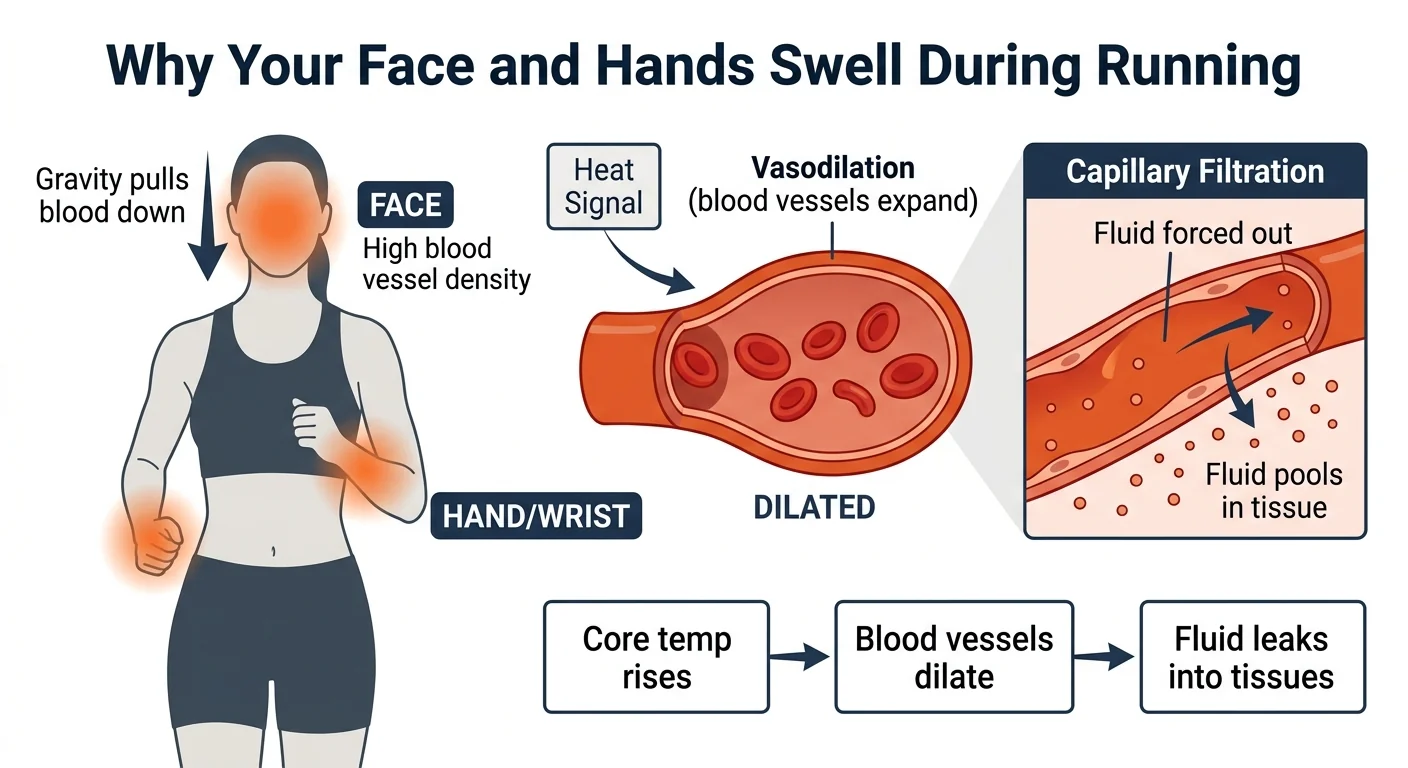
Your hands experience the same phenomenon.
Running shoe experts often recommend sizing up half a size because foot swelling during runs is so predictable that it’s become a fitting standard.
The fluid pooling in these tissues has leaked from your capillaries into the spaces between your cells.
Why Do Your Hands and Feet Swell When Running?
The same vasodilation and capillary filtration that puffs up your face during a run acts identically on your hands and feet.
Your hands hang at your sides throughout most of your stride cycle.
Gravity pulls blood toward your fingers continuously, and the elevated capillary pressure from vasodilation forces fluid out of the blood vessels and into the surrounding tissue.
The swelling concentrates in your knuckles and fingers because those tissues have the highest capillary density in the hand and face the most gravitational load.
Rings become tight within the first 30 to 60 minutes of a long run and can become impossible to remove mid-run without lubrication.
Take rings off before any run longer than 60 minutes, particularly in hot weather, when vasodilation is more aggressive and hand swelling is more pronounced.
Active arm drive moderates hand swelling to a meaningful degree.
The pumping motion of arm swing creates venous return that moves blood back up the arm, partially counteracting the gravitational pooling toward your fingers.
Runners who carry their arms low and still throughout a long effort tend to experience more pronounced hand swelling than those with compact, active arm drive.
Your feet follow the same vasodilation and capillary filtration pattern, with one additional factor.
Every foot strike adds mechanical loading pressure to the capillaries in your feet, increasing fluid filtration beyond what vasodilation alone produces.
This is why foot swelling during running is typically more pronounced than during walking at the same duration.
The repetitive impact compounds the thermoregulatory fluid shift.
What Happens to Your Fluids When You Run Long Distances
Vasodilation explains where the fluid comes from.
Your body’s total fluid balance during a marathon or long run involves a more complex set of shifts.
In the first few minutes of running, there’s a rapid shift of vascular fluid into the tissue spaces as fluid follows the pressure gradient created by capillary hydrostatic pressure.
Your plasma volume temporarily drops during this initial phase.
Your body has protective mechanisms to prevent runaway plasma loss and cardiovascular collapse.
As you continue running, osmotically active compounds accumulate in your working muscles: lactate, potassium ions, and phosphate.
These compounds draw water toward them, creating an osmotic gradient that opposes further plasma loss.
Your plasma proteins, especially albumin, are also being transported into the interstitial spaces alongside the fluid shift.
Since proteins draw water toward them through osmotic pressure, these proteins moving into the spaces around your cells continue to pull fluid outward.
Your body’s protective mechanisms engage automatically to keep plasma volume stable despite the initial fluid leak, treating this fluid shift as a normal part of running.
Your hydration state also matters.
If you arrive at the run dehydrated, your body conserves blood volume by reducing the amount of plasma that shifts into tissue spaces, which paradoxically means less swelling during dehydration.
Can Overhydration Make Swelling Worse?
Most of the swelling you experience during a run is normal, unavoidable, and harmless.
But there’s an edge case: extreme swelling that signals dangerous hyponatremia.
Exercise-associated hyponatremia (EAH) occurs when you lose too much sodium relative to the amount of fluid you consume, dropping blood sodium below 135 millimoles per liter.
The prevalence in marathon runners ranges from less than 1 to 22 percent, depending on race duration and conditions.
EAH develops when you drink excessively above your thirst cue, triggering a hormonal response that intensifies fluid retention and dilutes sodium further.
The swelling associated with EAH is different from normal exercise-induced edema.
You’ll see severe facial swelling, swollen hands and feet, weight gain of 2 to 3 percent or more during the run, and associated symptoms like nausea, headache, and vomiting.
EAH is predominantly a risk for ultra-distance athletes and marathoners running longer than 4 hours, not 5K or 10K runners.
If you experience severe facial swelling combined with rapid weight gain of more than 2 to 3 percent during a race and symptoms like nausea or headache, seek medical attention.
For most runners, the fix comes down to one thing: drink to your thirst, not to a rigid hydration schedule.
Your thirst mechanism is evolutionarily calibrated to keep you in fluid balance, and overriding it in pursuit of maximum hydration creates the conditions for hyponatremia without any benefit.
If you want more detail on the overhydration problem and how to avoid it, the article on overhydration and sodium imbalance breaks down the mechanisms and practical hydration strategy.
RunnersConnect Bonus
Download your FREE Sweat Rate Calculator now.
If you are unsure about how to calculate how much water to consume, and electrolytes to use, this will give you your exact needs.
Does Heat Make Facial Swelling Worse When You Run?
If you’ve noticed your face puffing up more during summer runs, you’re observing a real physiological amplification of the mechanisms already at work.
Heat intensifies vasodilation, which means more capillary filtration pressure and more fluid leaking into facial tissues.
During exercise in heat, your sympathetic nervous system triggers vasodilation at a lower core temperature than it would in cool conditions, and the magnitude of that vasodilation is more aggressive.
This is called heat acclimation: your nervous system learns to anticipate heat stress and opens blood vessels proactively, redirecting even more blood to your skin for cooling.
The combined effect is direct: higher skin blood flow plus higher capillary hydrostatic pressure means more fluid leaking into facial tissues.
The effect is most pronounced in the first 10 to 14 days of heat exposure, and it stabilizes after heat acclimation as the response becomes more efficient.
Practically, this means a summer race will produce more visible facial swelling than the same pace on a cool day.
To minimize swelling during hot runs, start slower than your normal pace.
Allow your cardiovascular system to stabilize before pushing harder, and step into shade during walk breaks to let your core temperature drop.
Hydration during heat still follows thirst-based guidance.
The amplified vasodilation creates swelling regardless of how much you drink, and aggressive hydration only adds the hyponatremia risk on top of normal heat-related swelling.
For a full breakdown of how to run safely in heat, the article on heat exposure and thermoregulation covers pacing, acclimatization, and heat stress dangers.
When Swelling Is Normal vs. When to Worry
Knowing the physiology helps, but you also need to know where the line is between a normal adaptation and a warning sign.
Normal exercise-induced facial and extremity swelling has predictable characteristics: mild puffiness in your eyelids, cheeks, and lips that feels soft and painless.
The swelling is symmetric: both hands swell equally, both feet swell equally.
There’s no pitting indentation that persists when you press on the swollen tissue.
Normal swelling subsides within 1 to 4 hours after you finish running, and you’ll return to your pre-run weight or slightly above it.
Weight gain from a run should not exceed 2 percent of your body weight.
If you run for 2 hours and gain more than 2 percent body weight, fluid retention has shifted beyond normal adaptation.
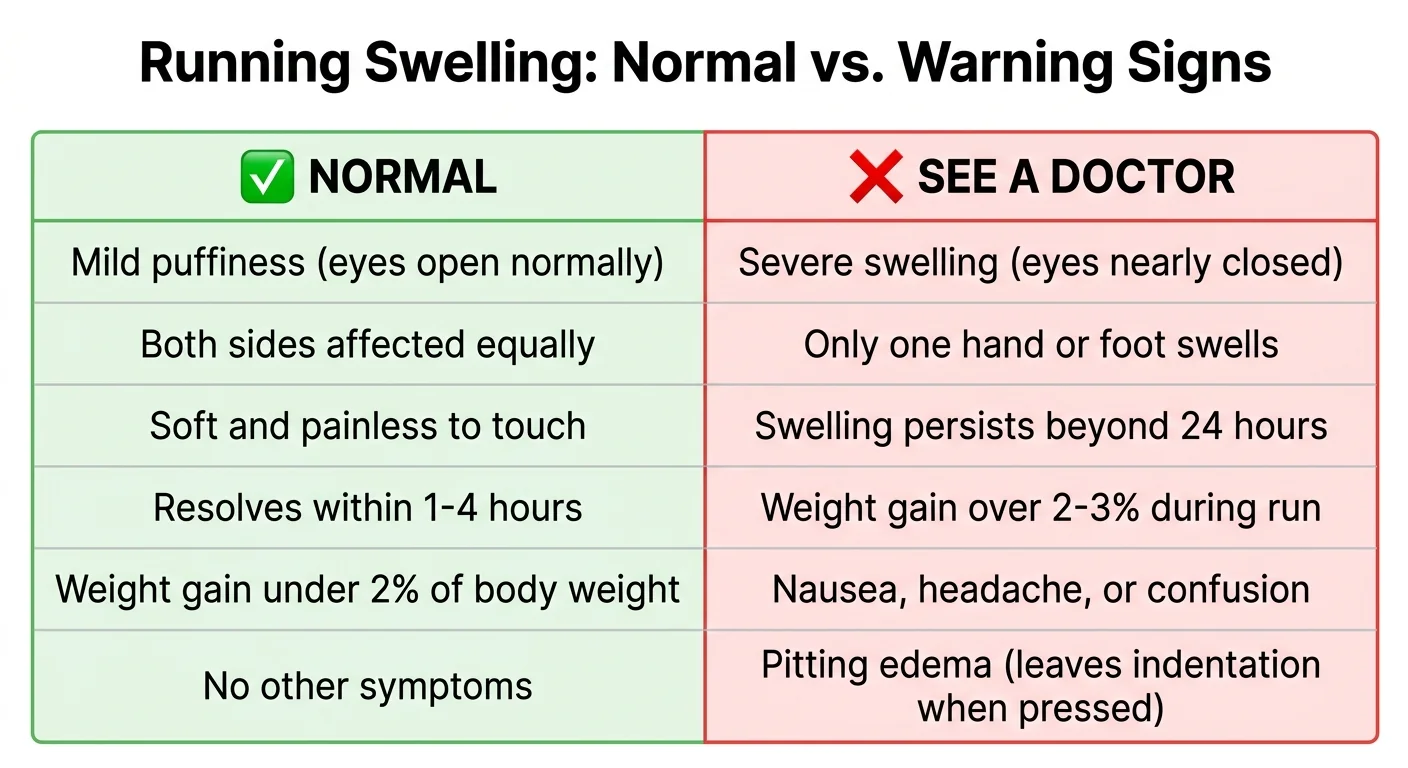
Warning signs that swelling has become concerning include:
- Severe facial swelling where your eyes are nearly closed
- Asymmetric swelling (only one hand or foot is affected)
- Swelling that persists beyond 24 hours
- Swelling paired with numbness, tingling, nausea, headache, or confusion
Severe swelling combined with rapid weight gain of more than 2 to 3 percent during or immediately after exercise and neurological symptoms warrants medical evaluation.
Pitting edema that persists beyond a few hours also suggests something beyond normal adaptation.
This should prompt a call to your doctor if it recurs across multiple runs.
RunnersConnect Bonus
Download your FREE Sweat Rate Calculator now.
If you are unsure about how to calculate how much water to consume, and electrolytes to use, this will give you your exact needs.
Most runners experiencing normal exercise-induced swelling worry for nothing.
The adaptation resolves completely overnight, and the same pattern repeats on the next long run with no residual effects.
If your swelling is mild, symmetric, painless, and resolves within a few hours, you’re witnessing your cardiovascular system performing exactly as it should during endurance exercise.
How Can You Reduce Swelling After a Run?
The most effective strategy is time.
Vasodilation reverses within 15 to 30 minutes of stopping exercise.
Most facial and extremity swelling resolves completely within 1 to 4 hours as capillary pressure drops and lymphatic drainage clears the accumulated interstitial fluid.
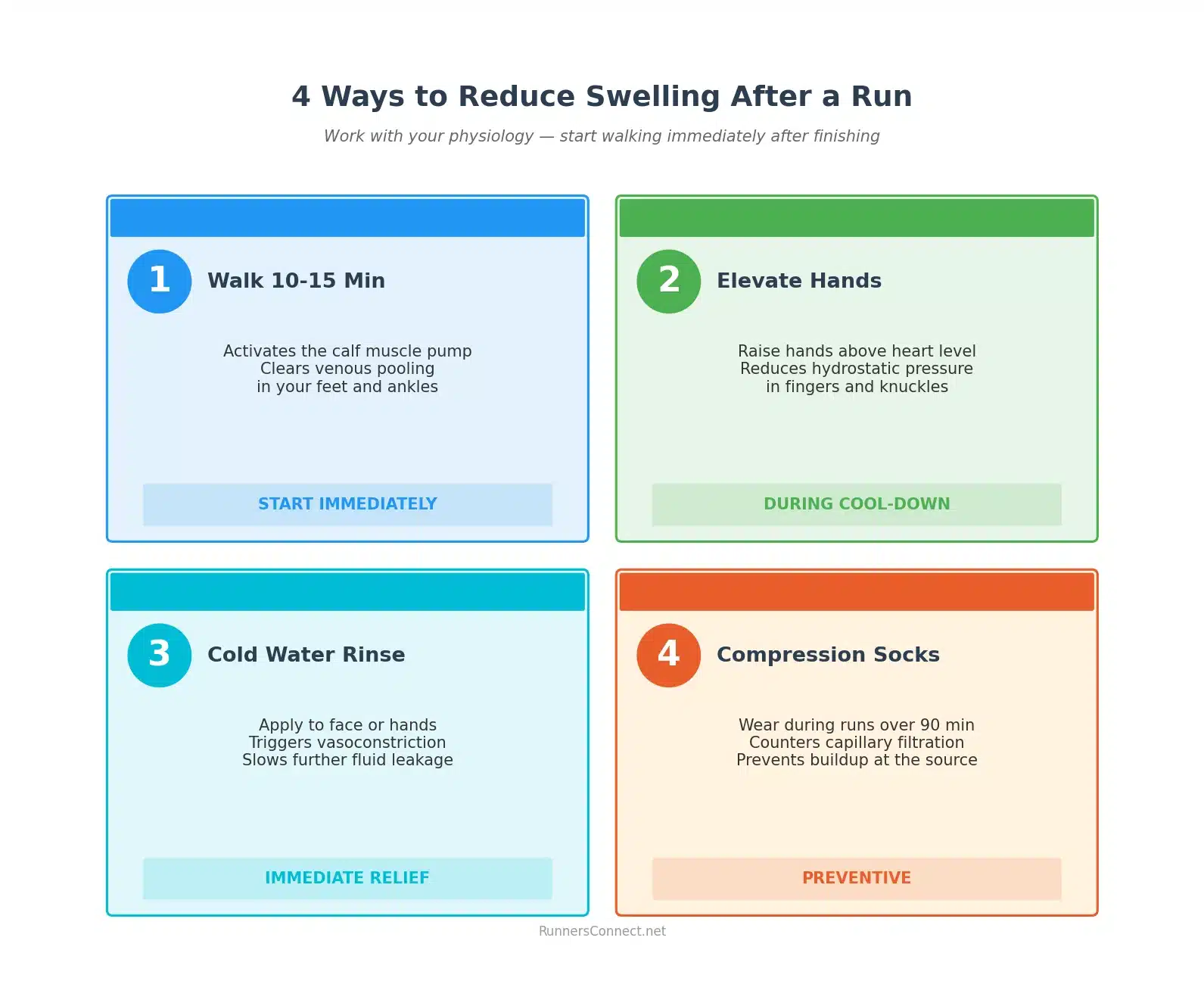
If you want to accelerate the process, four strategies work with your physiology rather than against it.
Walking for 10 to 15 minutes after finishing a long run keeps the calf muscle pump active.
Every step squeezes blood from the veins in your lower leg back toward the heart, actively clearing the venous pooling that drives foot and ankle swelling after efforts longer than 90 minutes.
Elevating your hands above heart level during a cool-down reduces the hydrostatic pressure forcing fluid into finger tissues.
For facial and eye swelling, resting in a semi-reclined position tilts your head away from gravity, speeding reabsorption by reducing capillary pressure in facial tissue.
Cold water on the affected area provides faster relief through vasoconstriction.
A cold rinse on your face or holding your hands under cool running water after a hot-weather run narrows blood vessels, reduces capillary pressure, and slows further fluid filtration into tissues.
Compression socks worn during long runs reduce venous pooling in your feet and ankles by providing external pressure that partially opposes the capillary filtration from vasodilation.
The practical application is to start wearing compression socks for runs over 90 minutes, not just for post-run recovery.
Swelling prevention during the run reduces the amount of fluid that needs to be reabsorbed afterward.