
How Long to Break In Running Shoes Before Race Day

Jeff Gaudette, MS   |

Breaking in running shoes before a race depends on mileage, not calendar time.

Research shows midsole cushioning drops significantly in the first 50-150 miles as the foam compresses and your foot adapts to the shoe’s geometry.

Most runners need 150-250 miles (roughly 3-4 weeks of training) before new shoes are ready for race day.

New shoes cause blisters because the shoe hasn’t molded to your foot yet, creating friction hotspots; synthetic socks and anti-chafing balm reduce this risk during break-in.

If you’re racing within 100 miles of purchasing shoes, use your old pair instead because the blister and injury risk with completely new shoes on race day is significant.

The safe strategy: buy shoes 4-6 weeks before your race, wear them for long runs during your training block, and lock them in for race day once you’ve logged 150-300 miles.

If you can’t break in shoes in time, race conservatively, carry blister supplies, and be honest about your finish time expectations.

You bought new running shoes three weeks before your race.

Now you’re wondering if they’ll feel the same on race day, if you’ll get blisters, if the cushioning will hold up.

The good news: your shoes can adapt faster than you think.

The bad news: timeline matters, and running in completely fresh shoes on race day carries real risk.

So, in this article you’re going to learn the research-backed practical advice on breaking in race-day shoes safely.

  • How midsole compression happens and when your feet stop noticing it
  • A realistic timeline for safe shoe break-in before your race
  • Why new shoes cause blisters and how to prevent them
  • Whether you can actually race in shoes you haven’t broken in yet
  • The strategy that works if you’re already cutting it close

How Long Does It Actually Take to Break In Running Shoes?

The standard answer is 2-4 weeks.

But that’s a calendar measure, not a physiological one.

What actually matters is mileage.

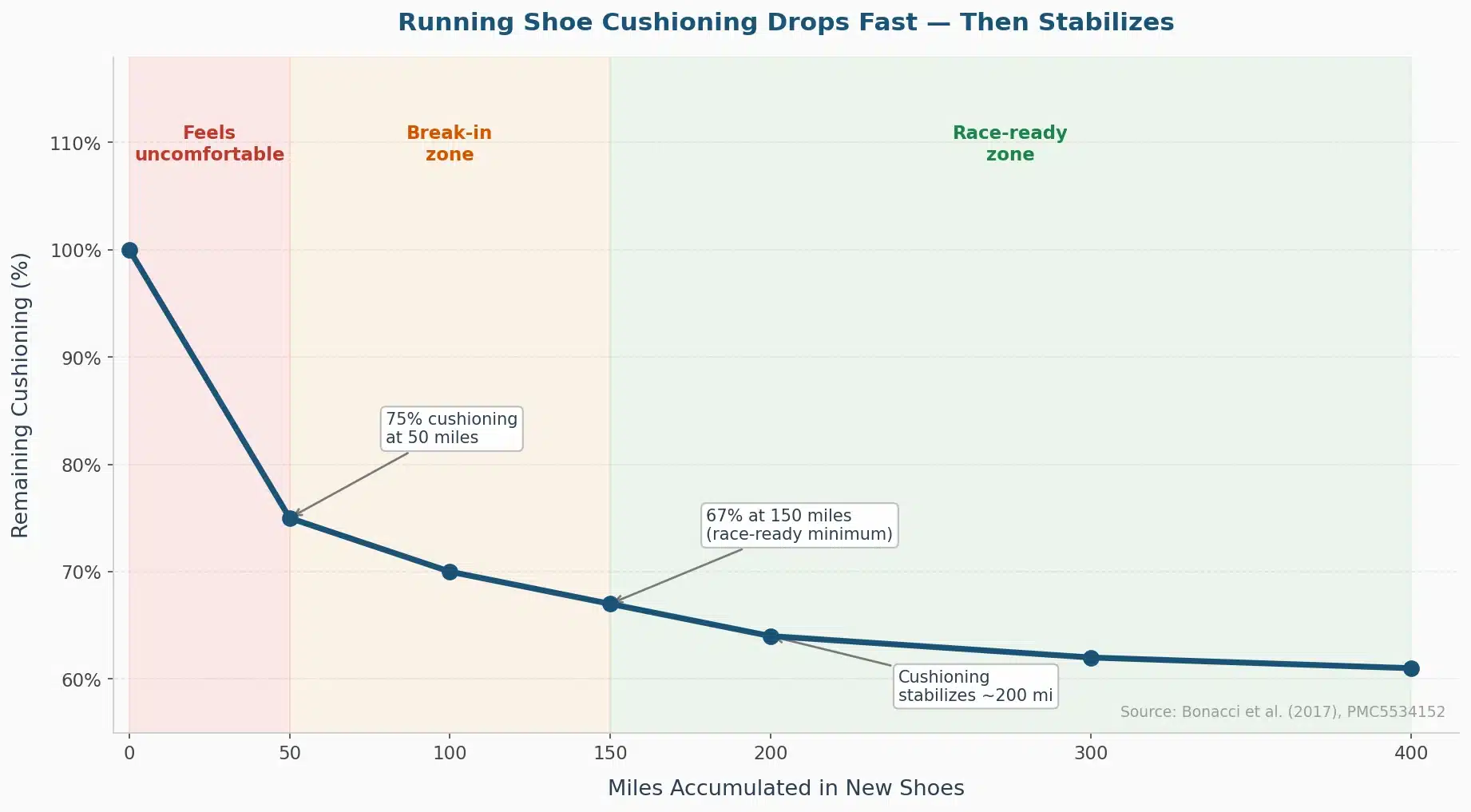
The most significant changes in how your shoe cushions your foot happen in the first 150-300 miles.

researchResearch has shown that shoe cushioning drops to 75% of its initial level after just 50 miles, then to 67% by 150 miles.

Your shoe continues to compress, but the rate of change slows dramatically after 200 miles.

For most runners, 150-250 miles before race day is the minimum safe window.

That translates to roughly 3-4 weeks if you’re logging 40-50 miles per week, or 5-6 weeks if you’re running 25-30 miles per week.

If you’re within 100 miles of race day and your shoes are completely new, the injury and blister risk rises sharply.

The timeline also depends on which shoes you wore before.

If you’re switching from shoes with a similar fit and cushioning level, adaptation is faster.

If the new shoes have a different heel height, arch support, or drop, your foot needs extra time to adjust.

What Happens Inside Your Running Shoe During Break-In?

Two things happen simultaneously when you start running in new shoes: the shoe changes, and your foot adapts.

The shoe change is physical.

The midsole foam compresses permanently under the repeated force of running.

Studies tracking cushioning degradation found that EVA and PEBA foams lose firmness predictably as you accumulate miles.

EVA midsoles (found in most standard running shoes) compress at a fairly consistent rate across runners.

PEBA midsoles (advanced foam in high-end shoes) show more variability.

Some runners see faster compression, others slower.

The lateral heel region wears faster than the medial heel because most runners with a rearfoot strike load the outer part of the heel first.

By 300-400 kilometers (186-248 miles), the shoe has settled into its worn state.

After that point, additional compression is minimal.

The second change is foot adaptation, which is neurological and mechanical.

Your foot learns the new shoe’s shape, pressure points, and flex pattern.

Your arch, heel, and toes adjust to the shoe’s geometry.

This happens faster than the physical compression.

Runners can’t reliably detect when their shoe cushioning has dropped by 20% or more, which means your feet adjust to new shoes long before the midsole has finished compressing.

Even after your shoe has lost a quarter of its cushioning, your foot still feels like it’s protecting you adequately.

This is why runners often keep shoes past their useful life without realizing it.

It also explains why break-in feels complete after 50-80 miles even though the midsole keeps changing until 200+.

research
A study on midsole recovery found that shoes absorb more energy after sitting unused for 24-48 hours between runs, as the foam partially rebounds.

This is why rotation works: alternating between two pairs during break-in gives each shoe time to recover between sessions.

Why New Running Shoes Cause Blisters During Break-In

Blisters form from friction, heat, and moisture.

New shoes create all three.

The shoe hasn’t molded to your foot yet, so pressure points don’t match your anatomy.

Your heel may slip slightly, your arch may press into an unfamiliar spot, or your toes may have unexpected contact with the shoe wall.

That friction multiplied by 5-20 miles of repetition equals a blister.

During the first 50-100 miles in new shoes, your skin is especially vulnerable because the shoe-foot relationship is still new.

Sweat makes it worse.

Wet skin is more prone to friction injury.

Long runs and hot conditions amplify the risk during break-in.

Sock material matters enormously.

Cotton retains sweat and creates a damp environment perfect for blister formation.

Synthetic blends and merino wool wick moisture away, reducing friction and heat buildup.

The right socks cut blister risk during shoe break-in by 30-50%.

Shoe fit amplifies or reduces this problem.

If your new shoes are slightly too tight or too loose, friction increases dramatically.

If they fit well, break-in is relatively comfortable.

Fit matters more than break-in time: a well-fitting shoe breaks in faster and with fewer problems.

Can You Safely Break In Shoes Just Before Race Day?

Yes, but with limitations and risk.

The real question is what’s the realistic outcome if you’re short on time.

research
A randomized trial of 848 runners found that shoes not matched to a runner’s biomechanics or running history increased injury risk significantly.

For an experienced runner switching to shoes with similar characteristics, the risk is manageable if you follow a specific approach.

The safe approach: build mileage gradually in your new shoes during training, then lock them in for race day.

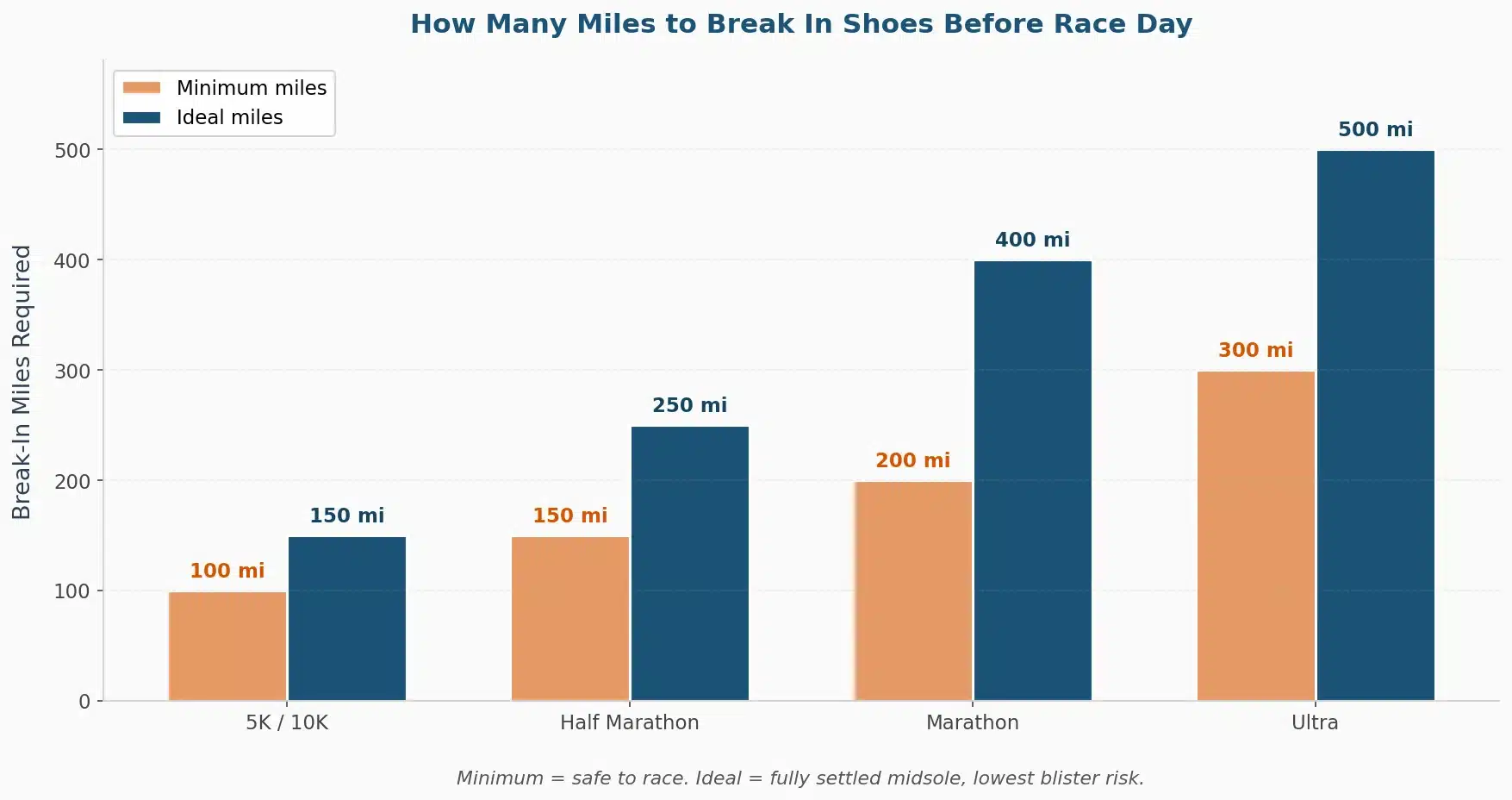
Minimum mileage before race day: 150-200 miles.

This gives your foot time to adapt and your shoe time to compress past the highest-risk zone.

Ideal mileage: 300-400 miles.

This allows the midsole to fully settle and your foot to feel completely comfortable in the shoe.

For a marathon or ultra, opt for the ideal timeline.

For a 5K or 10K, 150-200 miles may be sufficient if the shoe fit is excellent.

Start building mileage in new shoes during your training block, not your taper.

Use them for a short run first (3-5 miles) to assess fit and comfort.

Then use them for long runs as you accumulate miles.
Never save a completely new pair for race day.

The worst-case scenario: blisters that sideline you at mile 18 of a marathon, or discomfort that forces you to change your pace and strategy mid-race.

Strategy for Breaking In Race Shoes Without Getting Hurt

This is the practical timeline that works.

Step 1: Buy new shoes 4-6 weeks before race day.

This gives you a full training block to accumulate break-in miles while keeping your fitness peaked.

Step 2: Run your first 3-5 miles in the new shoes as an easy shakeout.

Don’t use them for a workout or long run yet.

You’re testing fit and feel.

Step 3: Use the new shoes for your long runs over the next 3-4 weeks.

This is where you accumulate the 150+ miles you need.

Long runs are perfect for break-in because the lower intensity lets you focus on any discomfort rather than pace.

Step 4: Keep wearing them through your taper.

Shorter, easier miles in the taper maintain the shoe feel but don’t add stress.

Your foot is now fully adapted.

Step 5: Race in shoes with 150-300+ miles on them.

The midsole is settled, your foot knows the shoe, and blister risk is low.

For blister prevention during break-in, use these tactics:

  • Synthetic or merino wool socks work better than cotton.
  • Anti-chafing balm on known hotspots before long runs
  • Shoe rotation means alternating between new race shoes and your old training shoes to give each pair 24-48 hours of rest.
  • Keep feet dry by changing socks immediately after runs and letting shoes air out fully before the next use.
  • Trim toenails short to prevent pressure inside the toe box.
  • Run on flat courses during break-in because downhill running increases friction and blister risk.

If you feel a hotspot developing during a break-in run, stop, assess it, and address it immediately rather than powering through.

Running another 3 miles on a forming blister turns a warning sign into an injury.

What If You Can’t Break In Shoes Before Race Day?

If you’re less than 100 miles or two weeks away from race day with completely new shoes, you have a problem.

Your options:

Option 1: Race in your old shoes (best choice if they’re still in decent shape).

Even if your old shoes are at 400-500 miles, they’re a known quantity.

Your foot knows them.

The blister risk is near zero.

Unless your old shoes feel genuinely worn out and uncomfortable, this is the safest play.

Option 2: Accelerate break-in over 10-14 days (medium risk).

If you must race in new shoes, run in them for every single training run between now and race day.

Log as many miles as possible, even if it’s just 50-80 miles before race day.

Use maximum blister prevention: synthetic socks, anti-chafing balm, foot powder, rest days for recovery.

Go shorter on race day if possible (5K instead of marathon) or accept higher injury and discomfort risk.

Option 3: Use a racing flat or alternate pair (if applicable).

If you have a well-fitting racing flat or a different shoe that you’ve already broken in, that’s a legitimate race alternative.

Don’t create new shoe problems by racing in something completely different.

Option 4: Go race-day tactical (acknowledgment of risk).

If you must race in new shoes with minimal break-in, run conservatively for the first 2-3 miles.

This gives your foot time to adapt to the shoe under race conditions and heat.

Carry blister supplies: tape, anti-chafing balm, or a small first aid kit.

Plan your fueling around shoe comfort: if blisters form at mile 10, you’ll struggle with gear changes and hydration.

Be honest about your realistic finish time.

Stress makes foot problems worse, and new shoes plus race pressure is a difficult combination.

The research is clear: runners adapt to their footwear, but adaptation takes time and mileage.

Two hundred miles in a shoe tells you everything you need to know about how it will feel for 26.2.

Fifty miles in a shoe tells you it fits.

It doesn’t tell you how it will feel under race fatigue.

Plan accordingly, and you’ll cross the finish line in shoes that feel like extensions of your feet, not experiments.

How many miles do I need to run in shoes before a race?

Minimum: 150-200 miles before race day. This gives your midsole time to compress through the most significant degradation phase and your foot time to adapt to the shoe’s shape. Ideal: 300-400 miles. For a 5K or 10K, 150 miles may suffice if the shoe fit is excellent. For a marathon or longer, aim for 250+ miles.

Can I run a marathon in brand new shoes?

Not safely. Running a marathon in shoes with fewer than 100 miles on them carries high risk of blisters, discomfort, and potential injury. Your foot hasn’t adapted to the shoe’s geometry, and the midsole hasn’t finished its primary compression phase. Use your old shoes instead, or delay the race if possible. If you must race in new shoes, run conservatively and carry blister supplies.

Why do new shoes feel stiff?

New midsole foam is firmer than worn foam. The shoe’s materials haven’t yet compressed under your running load, and your foot hasn’t yet adapted to the shoe’s arch support and heel height. Both the shoe and your foot need time to adjust. This stiffness usually subsides after 30-50 miles as the midsole begins to compress and your foot finds its place in the shoe.

How do I know if my shoes are broken in enough?

Look for these signs: (1) you’ve logged at least 150 miles in them, (2) they feel like they’re conforming to your foot rather than forcing your foot to adapt, (3) you’ve had no blisters during long runs, (4) the heel feels less stiff than it did initially. If you’re still getting blisters or the shoe feels uncomfortable after 100+ miles, it’s not the right shoe for you, soconsider a different pair.

What’s the fastest way to break in running shoes?

Wear them frequently and log miles during your longest runs. Wearing shoes only for easy, short runs slows break-in. Use them for your long runs and high-mileage training weeks to accumulate break-in miles quickly. Shoe rotation (alternating between two pairs) lets each pair rest while the other breaks in, and rested shoes actually absorb slightly more energy on your next run.

Do I need to break in shoes longer if I have wide feet?

Not necessarily longer, but potentially more carefully. If you have wide feet and are switching to a new shoe model or brand, the fit change may be more dramatic, requiring extra attention to pressure points and blister prevention. The break-in mileage timeline (150-250 miles) is the same, but you may want to allocate extra time to short runs to assess fit before committing to long runs.

Can I prevent blisters when breaking in new shoes?

Yes. Use synthetic or merino wool socks instead of cotton, sothey wick moisture and reduce friction. Apply anti-chafing balm to known hotspots before runs. Keep your feet dry by changing socks immediately after running and letting shoes air out fully between runs. Trim toenails short to prevent pressure in the toe box. Consider shoe rotation to give each pair 24-48 hours of rest. These tactics reduce blister risk by 30-50% during break-in.

What should I do if I get blisters during break-in?

Stop immediately, assess the blister, and address it before it worsens. If it’s just a hotspot (redness without fluid), use anti-chafing balm and tape for your next run. If a blister has formed, don’t run on it for 24-48 hours, solet it heal. When you return to running, tape the area and use double socks or blister prevention pads. If blisters keep forming in the same spot, the shoe fit is wrong for your foot; consider switching to a different model.

Jeff Gaudette, M.S. Johns Hopkins University

Jeff is the co-founder of RunnersConnect and a former Olympic Trials qualifier.

He began coaching in 2005 and has had success at all levels of coaching; high school, college, local elite, and everyday runners.

Under his tutelage, hundreds of runners have finished their first marathon and he’s helped countless runners qualify for Boston.

He's spent the last 15 years breaking down complicated training concepts into actionable advice for everyday runners. His writings and research can be found in journals, magazines and across the web.

Bonacci, Julio, et al. “Can Runners Perceive Changes in Heel Cushioning as the Shoe Ages with Increased Mileage?” Journal of Sports Sciences, vol. 35, no. 11, 2017, pp. 1078-1084, https://pmc.ncbi.nlm.nih.gov/articles/PMC5534152/

Desmonds, Dominique, et al. “Shoe Cushioning Influences the Running Injury Risk According to Body Mass: A Randomized Controlled Trial Involving 848 Recreational Runners.” American Journal of Sports Medicine, vol. 48, no. 4, 2020, pp. 901-910, https://pubmed.ncbi.nlm.nih.gov/31877062/

Fitz, Patrick, et al. “Effect of Rest Periods on Mechanical Ageing of Running Shoes.” Applied Sciences, vol. 9, no. 2, 2020, https://www.mdpi.com/2504-3900/49/1/138

Kastor, Rory. “Shoe Cushioning, Body Mass and Running Biomechanics as Risk Factors for Running Injury: A Study Protocol for a Randomised Controlled Trial.” BMJ Open, vol. 7, no. 11, 2017, https://pmc.ncbi.nlm.nih.gov/articles/PMC5724138/

Lopes, Amanda D., et al. “Can the ‘Appropriate’ Footwear Prevent Injury in Leisure-Time Running?” Sports Medicine, vol. 50, no. 5, 2020, pp. 839-851, https://pmc.ncbi.nlm.nih.gov/articles/PMC7740063/

Nigg, Benno M., et al. “Running Injury Paradigms and Their Influence on Footwear Design Features and Runner Assessment Methods: A Focused Review to Advance Evidence-Based Practice for Running Medicine Clinicians.” Frontiers in Sports and Active Living, vol. 4, 2022, pp. 815-675, https://www.frontiersin.org/journals/sports-and-active-living/articles/10.3389/fspor.2022.815675/full

Rodrigo-Carranza, Victor, et al. “Influence of Different Midsole Foam in Advanced Footwear Technology Use on Running Economy and Biomechanics in Trained Runners.” Scandinavian Journal of Medicine & Science in Sports, vol. 34, no. 4, 2024, https://onlinelibrary.wiley.com/doi/10.1111/sms.14526

Sinclair, Jonathan, et al. “Technologically Advanced Running Shoes Reduce Biomechanical Factors of Running Related Injury Risk.” Scientific Reports, vol. 15, 2025, https://www.nature.com/articles/s41598-025-03029-0

Picture of Who We Are

Who We Are

Your team of expert coaches and fellow runners dedicated to helping you train smarter, stay healthy and run faster.

We love running and want to spread our expertise and passion to inspire, motivate, and help you achieve your running goals.

Leave a Reply

Your email address will not be published. Required fields are marked *