
Cycling for Marathon Training: When It Works, When to Stop, and How Much Is Safe

Jeff Gaudette, MS   |

TL;DR: Cycling for Marathon Training

Cycling is an excellent cross-training tool for marathon prep because it builds aerobic capacity without the impact stress of running.

However, cycling cannot replicate running-specific adaptations like running economy and movement efficiency—so it complements but never replaces your key running workouts.

The cycling formula: 1 session per week, 60–90 minutes at easy intensity (Zone 2), scheduled the day after a hard run.

Total cycling should never exceed 15–20 percent of your weekly training volume.

Cycling works best in the base and build phases of marathon training (weeks 1–14).

Reduce cycling duration during peak phase (weeks 13–14), then eliminate cycling entirely 2 weeks before race day.

The taper shift is critical: your nervous system needs 10–14 days of running-only training to re-attune running efficiency before race day.

Keep all cycling at easy intensity; never do threshold or tempo cycling during marathon training.

Common mistakes include replacing too many running workouts with cycling, doing hard cycling on the same week as hard running, and cycling into taper week.

Proper bike fit is non-negotiable to avoid cycling-induced injuries that disrupt your marathon prep.

Incorporating Cycling into Marathon Training

Your marathon is 16 weeks away.

You’re supposed to run 5 days a week, but life keeps cutting into your schedule.

You’ve heard cyclists build serious aerobic fitness—some of the highest VO2 max values in all of sports.

So you wonder: Can you swap a Wednesday run for 90 minutes on the bike without losing marathon fitness?

The short answer is yes, with caveats.

Cycling can absolutely preserve and build the aerobic engine your marathon depends on.

But not all cycling counts equally, and timing matters enormously.

Swap the wrong workouts or keep cycling too long into your taper, and you’ll feel it at mile 18.

So, in this article you’re going to learn the research-backed practical advice on:

  • Why cycling builds the aerobic engine marathoners need — and what it can’t replicate
  • The exact amount of cycling to add without overtaxing your body
  • Which training phase is best for using the bike
  • When to stop cycling before your race
  • Common mistakes that derail marathon fitness

Is Cycling Good for Marathon Training?

Yes.

Cycling is one of the best low-impact ways to build aerobic capacity while sparing your running-specific muscles the impact stress of pavement.

research
Research has shown that cyclists and runners develop nearly identical VO2 max improvements from aerobic training at similar intensities.

The reason is straightforward: your cardiovascular system doesn’t distinguish between the activity sending blood to your legs.

Whether you’re running or pedaling, your heart is adapting to sustained aerobic stress.

Your stroke volume increases—the amount of blood your heart pumps per beat.

Your capillary density expands, delivering more oxygen to muscle tissue.

Your mitochondrial density increases, giving your muscles more powerhouses to generate energy aerobically.

These adaptations are exactly what marathons demand.

Seventy percent of marathon performance comes from your aerobic system’s ability to sustain effort for 3+ hours.

The other 30 percent splits between running economy (how efficiently you move) and mental toughness.

Cycling hammers that first 70 percent without the repetitive impact that accumulates when you log 40–50 miles of running per week.

A Thursday tempo run creates micro-damage in your quads, calves, and connective tissue.

A 75-minute easy bike ride at Zone 2 intensity builds the exact same aerobic adaptations without that tissue damage.

This is why cycling works as a complementary tool: it preserves your aerobic ceiling while giving joints and muscles a break.

What Running Workouts Can’t Be Replaced by Cycling?

This is the critical part most runners miss.

Cycling builds the cardiovascular engine, but running trains movement patterns and running-specific muscle recruitment that cycling simply cannot replicate.

Running economy—your efficiency at goal marathon pace—depends on neuromuscular patterns specific to running.

When you run at 6:45/mile pace, your nervous system orchestrates a precise sequence of muscle firing, joint angles, and ground contact mechanics honed by repetition.

The bike doesn’t train this.

No amount of cycling will teach your body to move efficiently at marathon pace.

research
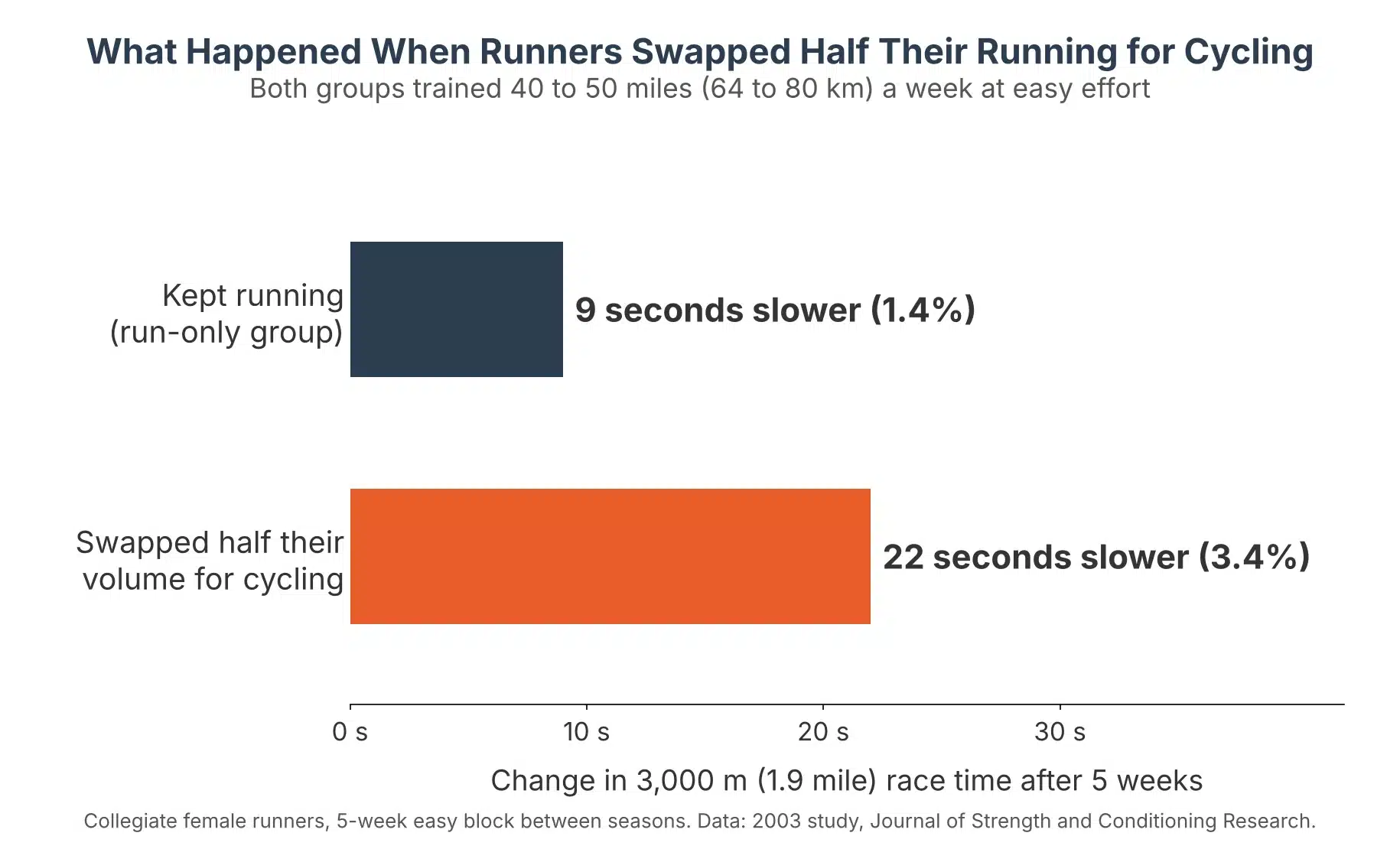
Studies show that runners who over-rely on cycling and neglect running-specific workouts lose 3–5% of their running economy—measurable at race pace.

This sounds small, but it costs 8–15 minutes in a marathon.

Running economy loss happens because:

Your legs lose the specific strength pattern for forward propulsion (cycling demands a circular pedal stroke; running requires directional power).

Your nervous system loses the muscle-firing sequencing required for efficient running mechanics.

Your tendons lose the eccentric loading adaptation—the ability to absorb impact and recoil efficiently.

Cycling is phenomenal for building aerobic capacity and recovery, but it cannot replace the running workouts that teach your body how to run efficiently.

This is why cycling is a complement to a running plan, never a replacement for your key running workouts.

How Much Cycling Should You Include in Marathon Training?

The practical rule is straightforward: one easy run can equal one moderate cycling session, but only once per week maximum.

Here’s the framework:

Frequency: 1 cycling session per week (never 2, even if you have time).

Duration: 60–90 minutes at conversational intensity—Zone 2 heart rate (roughly 130–150 bpm, depending on your fitness and age).

Intensity: You should be able to hold a conversation; RPE of 4–5 out of 10 effort.

Timing: Midweek, ideally the day after a hard running workout (long run or speed session).

Your total cycling volume should never exceed 15–20 percent of your weekly training volume.

Here’s why that ceiling matters:

Training stress is cumulative across all activities.

A hard run generates significant central nervous system fatigue and muscle damage.

Add a second hard workout (like a threshold cycling effort) within 48 hours, and your recovery system becomes overwhelmed.

Your weekly mileage stays high, but your body can’t adapt because it’s too busy repairing damage from the previous day.

This suppresses performance and increases injury risk.

The volume rule: A 40-mile running week plus 75 minutes of easy cycling is sustainable. A 50-mile running week plus 120 minutes of cycling is overtraining.

Your total weekly training volume—running miles plus cycling minutes converted to equivalent miles (roughly 1 minute of cycling = 0.5 miles)—should increase no more than 10 percent week-to-week.

When Is the Best Time to Add Cycling to Marathon Training?

Cycling fits into your marathon plan in 4 distinct phases, and using it wrong in any phase can sabotage your race.

Base Phase (Weeks 1–4): Cycling shines earliest in training.

Your body is building aerobic foundation without heavy running volume.

You can include 2 cycling sessions per week early in base phase because running volume is lower and your system isn’t yet fatigued.

By week 4, taper down to 1 cycling session per week.

Maintain 4 running sessions weekly throughout.

Build Phase (Weeks 5–12): This is where most of your marathon fitness happens.

Shift to 1 cycling session per week maximum—never more.

Timing is essential: schedule cycling for the day after your longest run or hardest speed session.

This transforms cycling into active recovery, which paradoxically speeds adaptation.

Easy cycling 24 hours after a hard run clears lactate and inflammatory markers without adding fresh damage.

Keep all cycling at Zone 2 intensity (easy, conversational).

Never do threshold or tempo cycling during build phase.

Peak Phase (Weeks 13–14): Your running volume reaches its highest point.

Continue 1 cycling session per week, but reduce duration to 45 minutes.

This is when your nervous system begins shifting priority back to running-specific adaptations.

research
Research shows that 10–14 days without the primary activity (cycling) allows neuromuscular re-adaptation to running-specific patterns.

Taper Phase (Weeks 15–16): Cycling stops almost entirely.

Your cardiovascular system is already built.

What you need now is for your neuromuscular system to re-attune to running movement and for your legs to feel fresh.

Week 15: One easy 20–30 minute spin is acceptable, nothing more.

Week 16 (race week): Zero cycling.

Run-only focus for the final 14 days before race day.

The taper rule: Most runners feel sluggish for 3–5 days after dropping cycling. This is normal. Your nervous system is re-learning running efficiency. It normalizes by day 7.

Can Cycling Help You Stay Healthy During Marathon Training?

Yes—this is one of cycling’s strongest advantages.

Running generates 2–3 times your body weight in impact forces with each footfall.

Over 60–70 miles per week for 4 months, those forces accumulate.

Knee cartilage, hip joints, and connective tissue absorb constant stress.

Cycling generates near-zero impact.

Your knees and hips move through fluid, repetitive motion without the pounding.

This allows your legs to absorb aerobic stimulus without accumulating the structural damage that running creates.

Specifically, cycling helps when:

You have minor running injuries. A tight IT band, sore calf, or mildly irritated knee can continue benefiting from aerobic training on the bike while the injury repairs.

Your joint fatigue is accumulating. During weeks 8–12 of build phase, when your running volume peaks, one cycling session per week keeps joint stress from becoming chronic.

You’re over 45. Runners who recover slower from impact benefit from distributing aerobic work across activities.

Active recovery cycling also boosts your cardiovascular adaptation.

Easy cycling 24 hours after a hard run clears lactate, reduces inflammatory markers, and actually speeds your recovery—more effectively than complete rest.

Important caveat: Cycling is not a substitute for physical therapy or true rest if you’re injured. If you have pain, see a professional.

What Should Your Cycling Workouts Look Like?

Not all cycling counts the same.

Workout structure matters as much as duration.

The Easy Ride (your bread-and-butter workout):

Duration: 60–90 minutes.

Intensity: Zone 2 (conversational pace, HR ~130–150 bpm, RPE 4–5/10).

Best timing: Midweek, ideally the day after your long run or speed session.

What it does: Builds aerobic capacity and mitochondrial density while your muscles stay in recovery mode.

The Steady-State Ride (optional, not required):

Duration: 45–60 minutes.

Intensity: Threshold or tempo (~85–90% of FTP, your functional threshold power).

When to use it: Only if you have extra training capacity that week and you’re not running hard the day before or after.

Risk: Threshold cycling can suppress running performance if overused.

What NOT to do:

Never do high-intensity intervals on the bike while training for a marathon.

Your central nervous system has a limited recovery capacity.

Hard running workouts already demand most of that capacity.

Adding hard cycling intervals leaves no room for adaptation.

Never cycle the day before a key run workout (speed session or long run).

This creates unrecovered fatigue that suppresses your running performance.

Never do long cycling workouts (>120 minutes) unless your running volume that week is unusually low.

This violates the 15–20 percent volume ceiling.

Example weekly structure during build phase:

Monday: Easy 6-mile run.

Tuesday: Speed workout (5×1 mile at 5K pace, 2-minute recoveries).

Wednesday: 75-minute easy cycling (active recovery).

Thursday: Tempo run (4 miles at marathon pace +20 seconds/mile).

Friday: Rest or easy cross-training (foam roll, yoga, 20-min easy walk).

Saturday: Long run (10–14 miles, conversational pace).

Sunday: Rest or optional 30-minute easy spin.

This structure keeps cycling in the recovery role, never competing with running workouts for nervous system resources.

How Do You Shift from Cycling Back to Running-Only Training?

As race day approaches, cycling must fade so your nervous system re-learns running efficiency.

This transition takes 2 weeks.

Week 13 (peak phase): 1 cycling session, 60 minutes, easy intensity.

Week 14 (peak phase): 1 cycling session, 45 minutes, easy intensity.

Week 15 (taper begins): 0–1 cycling sessions; if you do one, keep it to 20–30 minutes.

Week 16 (race week): Zero cycling.

Why this matters: Your neuromuscular system needs 10–14 days of primary activity (running) to fully re-attune to running-specific movement patterns.

Removing the secondary activity (cycling) 2 weeks before race day gives your nervous system time to shift all resources back to running efficiency.

In the first week after dropping cycling, your legs may feel heavy or sluggish during runs.

This is not detraining—your body is re-adapting to running-specific demands.

The sensation normalizes by day 7.

By race day, your running economy will be sharper than if you’d maintained cycling through taper.

The 48-hour rule: Do zero cross-training in the final 48 hours before your race. Run-only for the last 2 weeks of taper.

What Are the Biggest Mistakes Runners Make with Cycling?

Mistake 1: Replacing All Easy Runs with Cycling

This is the most common error.

A runner thinks: “I can do 60 minutes of cycling, which feels like 3 miles of running aerobically. That counts toward my weekly mileage.”

It counts aerobically, but not neuromuscularly.

Your body loses running-specific pacing feel, movement patterns, and leg strength in the running movement.

The rule: Cycling should never exceed 25 percent of your weekly volume.

For a 40-mile running week, that’s a maximum of 1 cycling session (45–75 minutes).

Mistake 2: Cycling Hard While Running Hard

You do a tempo run on Tuesday.

You feel strong Thursday, so you do a threshold cycling workout.

Your body now has two hard workouts in 5 days with insufficient recovery between them.

Your central nervous system becomes suppressed.

Your running performance crashes the following week.

The fix: Keep all cycling easy (Zone 2).

Never do threshold or tempo cycling during marathon training.

If you want to do hard cycling, replace a running workout entirely—don’t add it.

Mistake 3: Adding Cycling Instead of Replacing Volume

You’re already running 45 miles per week.

You add 90 minutes of cycling on Wednesday without removing a run.

Your total training volume spikes 20–25 percent in one week.

This violates the rule of 10 percent weekly increases and accelerates injury risk.

The fix: Swap, don’t add.

Replace a Wednesday easy run (5–6 miles) with a 75-minute cycling session.

Your volume stays stable; your modality shifts.

Mistake 4: Cycling Deep into Taper

You’ve cycled all season, so you keep cycling through weeks 14 and 15.

Your nervous system never fully re-attunes to running-specific movement.

By race day, your running economy is 2–3 percent lower than it would be if you’d stopped cycling 2 weeks earlier.

This costs 6–10 minutes in a marathon.

The fix: Stop cycling by week 15; zero cycling in race week.

Mistake 5: Ignoring Bike Fit

Poor bike fit creates knee pain, hip tightness, or low back stress that compounds your running training stress.

You end up with cycling-induced injuries that sabotage your marathon prep.

The fix: Get a professional bike fit, or ensure your saddle height lets your leg extend to 85–90 degrees at the bottom of the pedal stroke, your knee stays over your foot, and your back stays neutral.

Key takeaway: Bike fit doesn’t take long, costs $100–150, and prevents weeks of lost training.

Phase Duration Cycling Frequency Duration Per Session Running Volume Key Rules
Base Weeks 1–4 2x early, 1x by week 4 60–90 min easy 4 runs/week, 20–30 miles Build aerobic base; taper cycling as running ramps
Build Weeks 5–12 1x/week maximum 60–75 min easy 4–5 runs/week, 35–50 miles Schedule after hard run; keep easy only
Peak Weeks 13–14 1x/week 45 min easy 4 runs/week, 40–50 miles Begin shift back to running-specific work
Taper Weeks 15–16 0–1x in week 15 only 20–30 min if any 3 runs/week, 15–20 miles Cycling out; running-only for race week

The Bottom Line

Cycling is a powerful tool for building marathon aerobic fitness while protecting your running muscles and joints from cumulative impact damage.

But it’s a tool, not a shortcut.

Cycling can’t teach your body how to run efficiently at marathon pace.

It can’t replace the running-specific adaptations that race day demands.

What it does is let you build the aerobic engine—70 percent of marathon performance—without the joint stress of 50 miles of running per week.

Use cycling strategically: 1 session per week, kept easy, placed after your hard running workouts, and phased out entirely 2 weeks before race day.

Follow this framework and you’ll enter your marathon with full aerobic fitness and fresh running legs ready to race.

Can cycling replace running for marathon training?

Partially, but not completely. Cycling builds aerobic capacity nearly as well as running, but it cannot develop running-specific adaptations like running economy, movement efficiency, or the ability to sustain goal marathon pace. You’ll lose 3–5 percent of your running economy if you replace more than 25 percent of your running with cycling. Use cycling to supplement and recover from running workouts, never as a primary replacement for key running sessions.

How many times per week should I cycle during marathon training?

Maximum once per week. Two cycling sessions per week is acceptable only in the base phase (weeks 1–4) when running volume is low. Beyond that, 1 cycling session per week maximum prevents overtraining and preserves recovery capacity for your running workouts. More than 1 cycling session per week suppresses running performance and increases injury risk without meaningful additional benefit.

What’s the ideal length for a cycling workout for marathon training?

60–90 minutes at easy intensity (Zone 2, conversational pace). In base phase, 90 minutes is acceptable. In build phase, aim for 60–75 minutes. During peak phase, reduce to 45 minutes. In taper phase, keep it to 20–30 minutes maximum if you do cycle at all. Total cycling volume should never exceed 15–20 percent of your weekly training volume.

Is it okay to do hard cycling workouts (tempo, threshold, intervals) during marathon training?

No. Hard cycling during marathon training is counterproductive. Your central nervous system has limited recovery capacity, and marathon training already demands most of it from your running workouts. Hard cycling consumes recovery resources that should go toward running adaptation and increases injury risk. Keep all cycling easy (Zone 2) during marathon training. If you want hard cycling, replace a running workout entirely—don’t add it.

When should I stop cycling during marathon training?

Reduce cycling duration during peak phase (weeks 13–14) and eliminate it entirely by week 15. Your nervous system needs 10–14 days of running-only training to re-attune running-specific movement patterns before race day. Cyclists who maintain cycling through the final 2 weeks of taper typically run 2–3 percent slower on race day. Zero cycling in race week is essential.

Is cycling good for recovery between hard running workouts?

Yes. Easy cycling 24 hours after a hard running workout speeds recovery better than complete rest. Light cycling clears lactate, reduces inflammation, and stimulates blood flow without adding fresh muscle damage. This is called active recovery and paradoxically enhances your body’s adaptation to the hard run. Schedule your weekly cycling session for the day after your long run or speed session.

Can cycling prevent injuries during marathon training?

Yes, if used strategically. Cycling generates zero impact, while running creates 2–3 times your body weight in forces per footfall. Incorporating one easy cycling session per week distributes aerobic training across activities, reducing cumulative joint stress. However, cycling alone cannot rehabilitate injuries—if you’re injured, see a medical professional. Cycling can help protect you from injuries caused by excessive running volume.

What if I feel tired after cycling? Does that mean it’s too much?

Not necessarily. Easy cycling done at the correct intensity (Zone 2, conversational pace, RPE 4–5 out of 10) should not leave you feeling exhausted. If cycling leaves you fatigued, you’re likely cycling too hard or too long. Dial back duration to 45 minutes, drop intensity to easier Zone 2, or schedule it a day earlier/later relative to hard running. The goal is active recovery, not additional training stress.

Jeff Gaudette, M.S. Johns Hopkins University

Jeff is the co-founder of RunnersConnect and a former Olympic Trials qualifier.

He began coaching in 2005 and has had success at all levels of coaching; high school, college, local elite, and everyday runners.

Under his tutelage, hundreds of runners have finished their first marathon and he’s helped countless runners qualify for Boston.

He's spent the last 15 years breaking down complicated training concepts into actionable advice for everyday runners. His writings and research can be found in journals, magazines and across the web.

References

Bentley, D. J., et al. “Specific Aspects of Contemporary Triathlon: Implications for Physiological Analysis and Performance.” Sports Medicine, vol. 32, no. 6, 2007, pp. 345–359.

Esteve-Lanao, J., et al. “How Do Endurance Runners Actually Train? Relationship with Competition Performance.” European Journal of Applied Physiology, vol. 94, no. 4, 2005, pp. 411–417.

Mujika, I., and S. Padilla. “Detraining: Loss of Training-Induced Physiological and Performance Adaptations. Part I: Short Term Insufficient Training Stimulus.” Sports Medicine, vol. 30, no. 2, 2000, pp. 79–87.

Paavolainen, L., et al. “Explosive-Strength Training Improves 5-km Running Time by Improving Running Economy and Muscle Power.” Journal of Applied Physiology, vol. 86, no. 5, 1999, pp. 1527–1533.

Sunde, A., et al. “Maximal Strength Training Improves Cycling Economy in Competitive Cyclists.” Journal of Strength and Conditioning Research, vol. 24, no. 8, 2010, pp. 2157–2165.

Tanaka, H., and T. Swensen. “Impact of Resistance Training on Endurance Performance: A New Form of Cross Training?” Sports Medicine, vol. 25, no. 3, 1998, pp. 191–200.

Vikmoen, O., et al. “Strength Training Improves 11-m Sprint Performance Despite Reduced Quadriceps Strength After 19 Weeks of Block Periodized Competitive Volleyball.” Journal of Strength and Conditioning Research, vol. 30, no. 3, 2016, pp. 741–750.

Zamparo, P., et al. “Energy Cost of Sport-Specific Movements.” Journal of Applied Physiology, vol. 97, no. 3, 2004, pp. 1235–1242.

Picture of Who We Are

Who We Are

Your team of expert coaches and fellow runners dedicated to helping you train smarter, stay healthy and run faster.

We love running and want to spread our expertise and passion to inspire, motivate, and help you achieve your running goals.

Leave a Reply

Your email address will not be published. Required fields are marked *