
The first 15 miles of a marathon can feel controlled and almost easy.
Then the pace that felt comfortable starts to demand real effort, your stride shortens, and your splits drift even though you are working harder.
That late-race collapse has a name. Runners call it hitting the wall, and it usually strikes after the 20-mile mark.
It happens to well-trained runners and first-timers alike, and the causes behind it are physical and predictable.
The good news is that hitting the wall is largely preventable, and it comes down to how you fuel, how you pace, and how you prepare your gut and your mind for the back half.
Here’s what you’ll learn:
- What hitting the wall actually is and why it happens around mile 20
- How to fuel before and during a long run to protect your energy stores
- How to pace the first half so you have something left for the final 10K
- How to manage your gut and your mind when the miles get hard
What Does It Mean to Hit the Wall in a Marathon?
Hitting the wall is the sudden, severe drop in energy and pace that comes from running low on stored carbohydrate late in a marathon.
Research on marathon runners found that more than two-fifths of those who race the full distance hit the wall, depleting their carbohydrate reserves most often near mile 21.

Your muscles and liver store carbohydrate as glycogen, and that store is your fastest-burning fuel at marathon effort.
When glycogen runs low, your body leans harder on fat for energy, which it releases far more slowly and which forces your pace down.
A large analysis of more than 4 million race records defined the wall as a sustained slowdown in the closing miles and confirmed it typically appears after the 20-mile mark.
Why Do You Hit the Wall Around Mile 20?
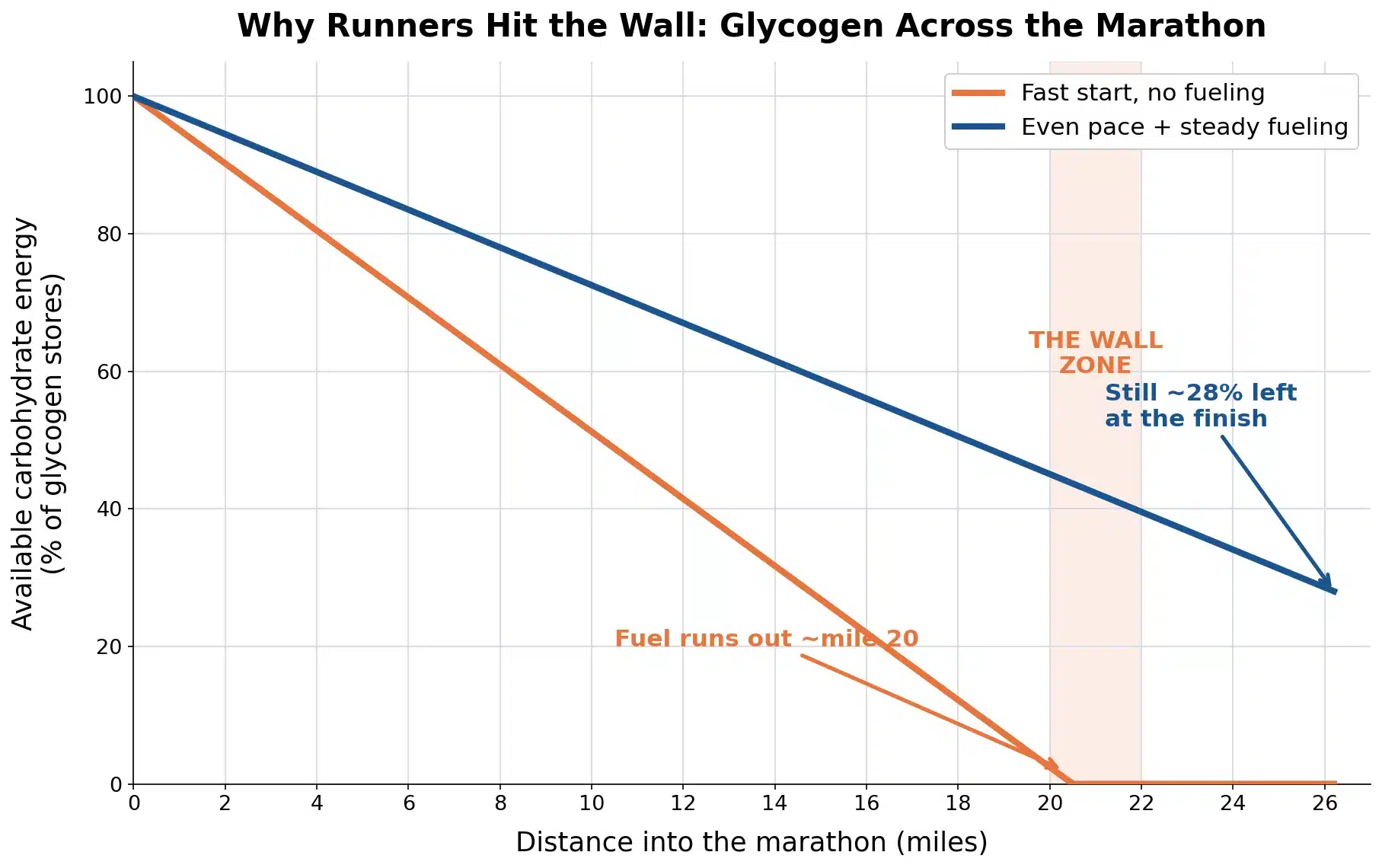
You hit the wall around mile 20 because your glycogen tank holds only enough fuel for roughly 90 to 120 minutes of running at marathon intensity.
For most runners that means the tank starts approaching empty somewhere between mile 16 and mile 20, depending on pace and body size.
Glycogen stores cover only about 90 to 120 minutes at marathon effort, which is why the crisis lands in the final 10K rather than at the start.
Glycogen is not the only system under strain in those miles.
Your heart rate drifts upward at the same pace as fluid losses build and core temperature climbs, so holding your speed costs more late in the race than it did early.
Your brain contributes too. Research on central fatigue links prolonged exercise to shifts in brain serotonin and dopamine that can raise your sense of effort before your muscles are truly out of fuel.
How Do You Fuel to Avoid Hitting the Wall?
The most common fueling mistake is starting too late, after your energy has already begun to fall.
Begin taking in carbohydrate early, within the first 30 to 45 minutes of a long run or race, and keep it steady from there.
Sports nutrition research shows a single carbohydrate source can be burned at up to about 60 grams per hour, the recommended target for runs lasting 2 to 3 hours.
Take that carbohydrate in small, frequent doses rather than one large hit, which eases the load on your gut and keeps your energy steady.
For efforts beyond about 3 hours, that same research recommends going higher, toward 90 grams per hour, using a mix of glucose and fructose so your gut can absorb it fully.
Your pre-run meal matters as much as your mid-run fuel.
Sports nutrition guidelines recommend a carbohydrate-rich meal 2 to 3 hours before a long effort, built from foods you digest easily and low in fat and fiber.
If your stomach struggles to handle fuel on the move, you can raise its tolerance with deliberate gut training in the weeks before your race.
Ready For More?
Then start our FREE Race Day Fueling email course!
You’ll learn how to calculate when you’ll bonk, how to hydrate, what foods to eat during your race, and more! From case studies to scientific research, we’ll help you learn how to best fuel for your next race.
How Should You Pace a Marathon to Avoid the Wall?
Pacing is where most runners build their own wall, by starting faster than they can hold.
An even or slightly negative split, where the second half matches or beats the first, protects the glycogen you need for the miles that decide your race.
A study of nearly 92,000 marathon performances found runners slowed in the second half by an average of 15.6% for men and 11.7% for women, a pattern driven largely by starting too fast.
Your first few miles should feel almost too easy, run about 10 to 15 seconds per mile (roughly 6 to 9 seconds per km) slower than goal pace.
Run by effort rather than the clock in that early stretch, and resist the urge to bank time while you still feel fresh.
Holding that restraint takes practice, which is why it helps to learn how to pace yourself by feel during training long before race day.
What Mental Strategies Help You Push Through the Wall?
Even with smart fueling and pacing, the final 10K of a marathon will test you.
Breaking the distance into smaller segments makes it manageable, so think of the race as four 10K blocks or six 4-mile chunks and focus only on the one you are in.
Attach a small goal to each chunk, like taking your next gel or reaching the next aid station, so your attention stays on the task instead of the discomfort.
Short instructional mantras such as “quick feet” or “strong and smooth” help hold your form together when fatigue sets in.
Directing your focus outward, to the crowd, the course, or the runners around you, tends to work better than tracking every ache when the goal is simply to keep moving.
How Do You Prevent Mid-Run Stomach Problems?
Stomach trouble ends more long runs than heavy legs do, and it has a physical cause.
During hard running your body shifts blood away from the gut toward your working muscles, which irritates the digestive system and can trigger cramping or an urgent bathroom stop.
Research on endurance athletes found that 30 to 50% experience gastrointestinal problems, most often when running hard or slightly dehydrated.
Prevention starts in the 1 to 2 days before a long run, by cutting back on high-fiber and high-fat foods that sit heavy in the gut.
On the morning of the run, eat early enough to allow a bathroom stop before you start, and keep coffee or tea to at least an hour before your first mile.
If symptoms hit mid-run, ease your pace for a few minutes, which restores some blood flow to the gut and usually settles the worst of it.
How Do You Put It All Together on Race Day?
Preventing the wall is the sum of four habits you rehearse in training and repeat on race day.
| Strategy | What to do |
|---|---|
| Fuel early and often | Start carbohydrate within 30 to 45 minutes, then 30 to 60 grams per hour in small, frequent doses. |
| Pace the first half | Run the opening miles 10 to 15 seconds per mile (6 to 9 seconds per km) slower than goal pace. |
| Segment the race | Break the marathon into 10K or 4-mile chunks and set one small goal per chunk. |
| Protect your gut | Cut fiber and fat 1 to 2 days out, eat 2 to 3 hours before, and ease off if symptoms strike. |
Practice all four in your long runs so nothing about race day is new.
Do that, and you reach mile 20 with the fuel, the pace, and the plan to run strong all the way to the finish.