

Every few years, something kicks off a debate about whether heel striking is destroying your knees, or whether switching to forefoot striking will solve all your injury problems.
The barefoot running movement made foot strike the defining question of running form.
The research since then has complicated the picture significantly.
Here’s what you actually need to know.
- The 3 types of foot strike and how to identify yours
- What research says about foot strike and injury risk (and why the answer isn’t simple)
- How speed naturally changes your foot strike pattern
- When changing your foot strike makes sense, and when it doesn’t
What Are the 3 Types of Running Foot Strike?
Your foot strike pattern describes which part of your foot contacts the ground first on each step.
Rearfoot (heel) strike: Your heel contacts the ground first, then your foot rolls forward through the midfoot and pushes off from the forefoot.
Midfoot strike: The outside edge of your entire foot contacts the ground at once, with no pronounced heel or forefoot landing.
Forefoot strike: The ball of your foot contacts the ground first, with the heel dropping down afterward.
Research has found that 75% of recreational runners heel strike, even at race pace during an elite half marathon.

Midfoot striking is the rarest pattern and the hardest to sustain, since it requires near-perfect ankle positioning throughout the gait cycle.
Elite marathoners with every foot strike pattern have won world major races.
Does Your Foot Strike Pattern Affect Injury Risk?
This is the question that launched a thousand arguments, and the honest answer is: the research is genuinely mixed.
A 2012 study from Harvard tracked injury rates in their collegiate cross-country team and found that heel strikers had injury rates 2.53 times higher than forefoot strikers over a season.
A prospective study of Harvard cross-country runners found heel strikers had 2.53 times more repetitive stress injuries than forefoot strikers at the same training load.
That number gets cited constantly. Here’s what gets left out.
The runners in that study were barefoot runners who had already selected forefoot striking.
Selection bias runs in both directions: runners with certain injury histories often self-select into forefoot striking, and studies that compare patterns within the same group show much smaller differences.
Multiple systematic reviews since 2015 have found no consistent evidence that one foot strike pattern causes fewer injuries than another when training load, running surface, and shoes are controlled for.
The injury question isn’t settled. What’s clear is that the relationship between foot strike and injury is far weaker than the barefoot running wave suggested.
Does Heel Striking Really Cause More Impact Force?
Biomechanically, yes. But the way impact force works is more complicated than it appears.
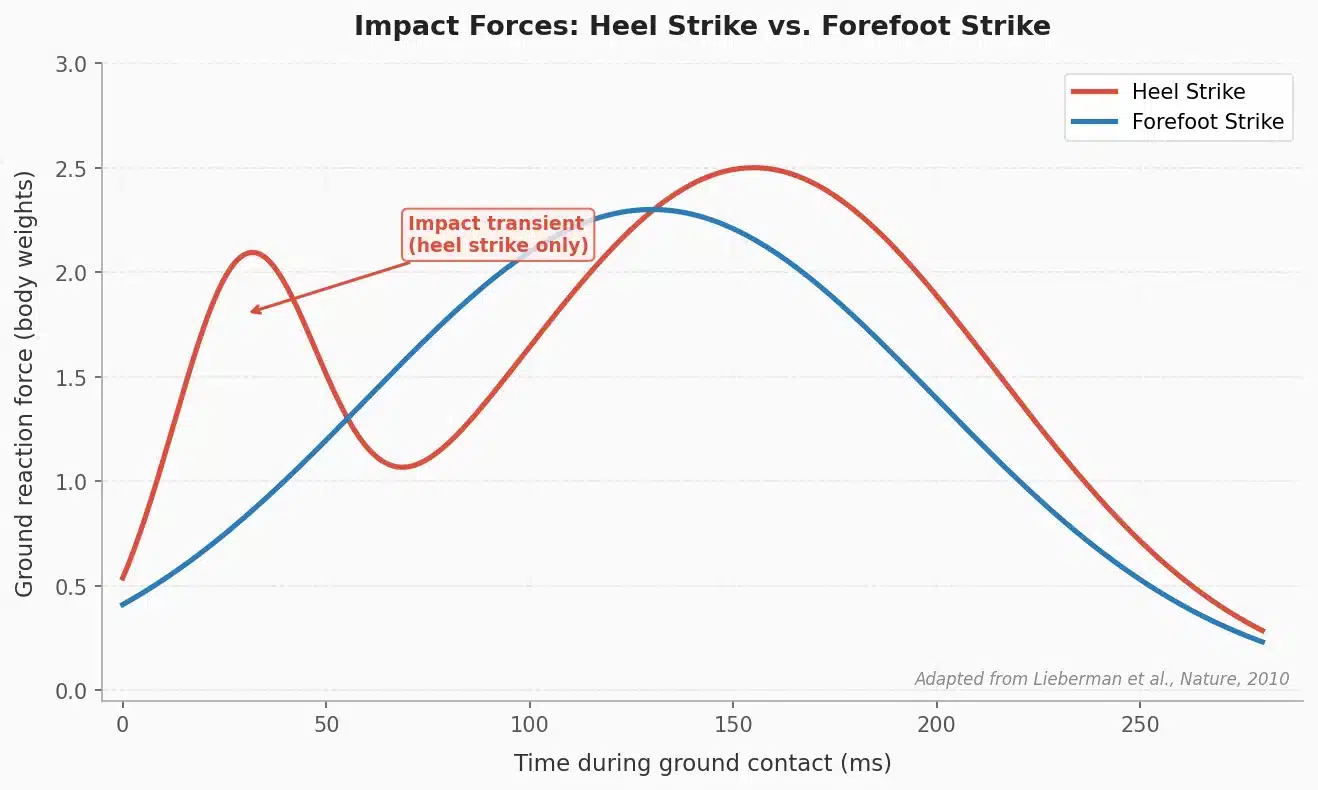
Heel striking produces a sharp, brief impact transient at the moment the heel contacts the ground.
Forefoot striking skips that initial spike because the ankle acts as a shock absorber, converting vertical force into rotational force at the ankle joint.
Research published in Nature found that habitually barefoot forefoot strikers generated impact forces 2–3 times lower than habitually shod heel strikers at the same speed.
Lower impact force sounds like a clear win. The energy has to go somewhere.
In forefoot striking, the ankle and calf absorb the forces that the heel doesn’t.
This is why runners who switch from heel to forefoot striking without a gradual transition often develop Achilles tendinopathy, calf strains, and metatarsal stress fractures. The calf and ankle aren’t conditioned for the new load distribution.
Where your foot strikes determines which structures absorb impact, not whether impact occurs.
How Does Running Speed Affect Your Foot Strike?
Your natural foot strike pattern shifts significantly with speed. This explains much of the confusion about what elite runners “do.”
At easy paces, the vast majority of runners naturally heel strike.
As pace increases, the pattern shifts toward midfoot and forefoot landing. Cadence increases, ground contact time shortens, and the foot naturally strikes closer to the center of mass.
Research tracking elite half-marathon runners at the 15km mark found that 74.9% were still heel striking at race pace, a pace most recreational runners would find extremely fast.
Sprinters forefoot strike because sprinting mechanics demand it, not because forefoot striking is inherently superior.
At your 5K race pace or marathon effort, your foot will naturally land somewhat differently than at an easy training jog. That’s exactly what it should do.
Should You Change Your Foot Strike to Reduce Injury Risk?
For most runners, the answer is no.
Deliberately changing your foot strike is one of the highest-risk form interventions available.
A prospective study following runners who switched from heel to forefoot striking found that a significant proportion developed new injuries during the transition. Stress reactions in the metatarsals and tibia were particularly common.
The loads your body is adapted to absorb shift entirely when you change your strike pattern, and tendons, bones, and connective tissue adapt far more slowly than muscles do.
There’s a better target than foot strike: cadence.
Research from the University of Wisconsin found that increasing running cadence by just 5–10% reduced loading on the hip and knee by 20–34%, without requiring any deliberate foot strike change.
A higher cadence naturally shifts your landing point closer to your center of mass, reduces overstriding, and often results in a more midfoot-ish landing, all without the injury risk of a forced transition.
If you’re dealing with a specific injury that your clinician has traced to your foot strike pattern, that’s a different conversation.
But changing foot strike to chase a performance edge or prevent unspecified future injuries is rarely worth the risk.
If you want to reduce impact forces and injury risk, increasing your cadence by 5–10% is safer and better-supported by research than changing your foot strike.
Learn more about how cadence affects injury rates in How Does Cadence Affect Injury and Performance.
RunnersConnect Bonus
Download your FREE Guide to Minimalist Running.
Giving you an easy to follow, printable guidelines for how to adjust your training, slowly add-in barefoot running, and the exact strength routine you need to get your feet healthy and strong!
When Does Changing Your Foot Strike Actually Make Sense?
There are specific scenarios where a coached transition is worth pursuing.
Recurrent forefoot or metatarsal stress fractures in a heel striker: Shifting loading off the heel and redistributing through the ankle may help, though strengthening the foot and calf simultaneously matters just as much.
Persistent Achilles or calf injuries in a forefoot striker: Moving toward a more midfoot pattern can reduce the load on those structures, particularly if the forefoot strike is aggressive (running on the toes rather than the ball of the foot).
Severe overstriding combined with heel striking: When your foot lands far in front of your center of mass, the combined braking force and impact spike is large. Increasing cadence addresses this better than a direct foot strike change, but occasionally both are needed.
In all of these cases, work with a running coach or sports physio, make the change gradually over 8–12 weeks, and reduce mileage by 30–40% during the transition.
Your tendons and bones need that runway.
For more on how heel striking and overstriding interact, see Heel Striking, Overstriding, and Cadence.
75% of recreational runners naturally heel strike, and most elite marathoners do too.
Forefoot striking reduces the initial impact spike, but transfers load to the ankle and calf, which are prone to injury if not conditioned for it.
The evidence that changing foot strike prevents injuries is weak. The evidence that a forced transition causes new injuries is stronger.
Increasing cadence by 5–10% reduces hip and knee loading by 20–34% without the injury risk of changing foot strike.
Only change your foot strike if a clinician has identified it as a specific injury cause. Do it gradually over 8–12 weeks with reduced mileage.
Citations
Hasegawa, H., Yamauchi, T., & Kraemer, W. J. (2007). Foot strike patterns of runners at the 15-km point during an elite-level half marathon. Journal of Strength and Conditioning Research, 21(3), 888–893. PMID: 17327793
Daoud, A. I., Geissler, G. J., Wang, F., Saretsky, J., Daoud, Y. A., & Lieberman, D. E. (2012). Foot strike and injury rates in endurance runners: a retrospective study. Medicine & Science in Sports & Exercise, 44(7), 1325–1334. PMID: 22622916
Lieberman, D. E., Venkadesan, M., Werbel, W. A., Daoud, A. I., D’Andrea, S., Davis, I. S., & Pitsiladis, Y. (2010). Foot strike patterns and collision forces in habitually barefoot versus shod runners. Nature, 463(7280), 531–535. PMID: 20208517
Heiderscheit, B. C., Chumanov, E. S., Michalski, M. P., Wille, C. M., & Ryan, M. B. (2011). Effects of step rate manipulation on joint mechanics during running. Medicine & Science


3 Responses
Thanks for this Jeff!
I wonder why the graphs are the opposite of Lieberman’s:
http://barefootrunning.fas.harvard.edu/2FootStrikes&RunningShoes.html
Also curious why the second graph (heel strike) shows a load up to 2000, where the forefoot strike graph only hits 1200. Should I conclude that forefoot striking reduces loading rates?
Hi Brian, thanks for the comment!
The link you sent is a comparison between heel striking in shoes and heel striking without shoes. Not sure that relates to the points in this article. Did you mean to send a different link?
As to the two graphs, you’re right, overall load/impact is higher in heel striking, but the curve of the line is slightly more gradual, perhaps suggesting while heel striking demonstrates a higher overall load, it’s less jarring. Keep in mind also that a higher loading rate doesn’t necessarily mean higher injury rate.
This is all to say that we don’t have all the answers yet. There is still a lot we don’t know about how footstrike relates to injury risk.
Oops! I sent the wrong page. Here we go:
http://barefootrunning.fas.harvard.edu/4BiomechanicsofFootStrike.html
The graphs in the video thumbnails compare heel striking to forefoot striking both in shoes and barefoot. The heel strike has a transient but the forefoot strike doesn’t.
But yeah, who knows how that translates to injury risk!