

A heating pad on a stiff calf or a hot shower before you head out the door feels like it should loosen you up for a run.
But heat from the outside reaches less of your muscle than you’d expect, and on a hot day a hot bath beforehand can cut short how long you’re able to keep going.
So, when does heat before a run help, and when should you skip it?
In this article, you’ll learn:
- How deep a heating pad or hot pack warms your muscles
- Whether a hot bath or shower can replace your warm-up
- When heat helps a stiff or sore spot, and when it makes an injury swell more
- What Icy Hot and Deep Heat rubs do before a run
How Deep Does a Heating Pad Warm Your Muscles?
A heating pad or hot pack warms your skin and the top layer of muscle underneath it, and the warming drops off with every centimeter of depth.
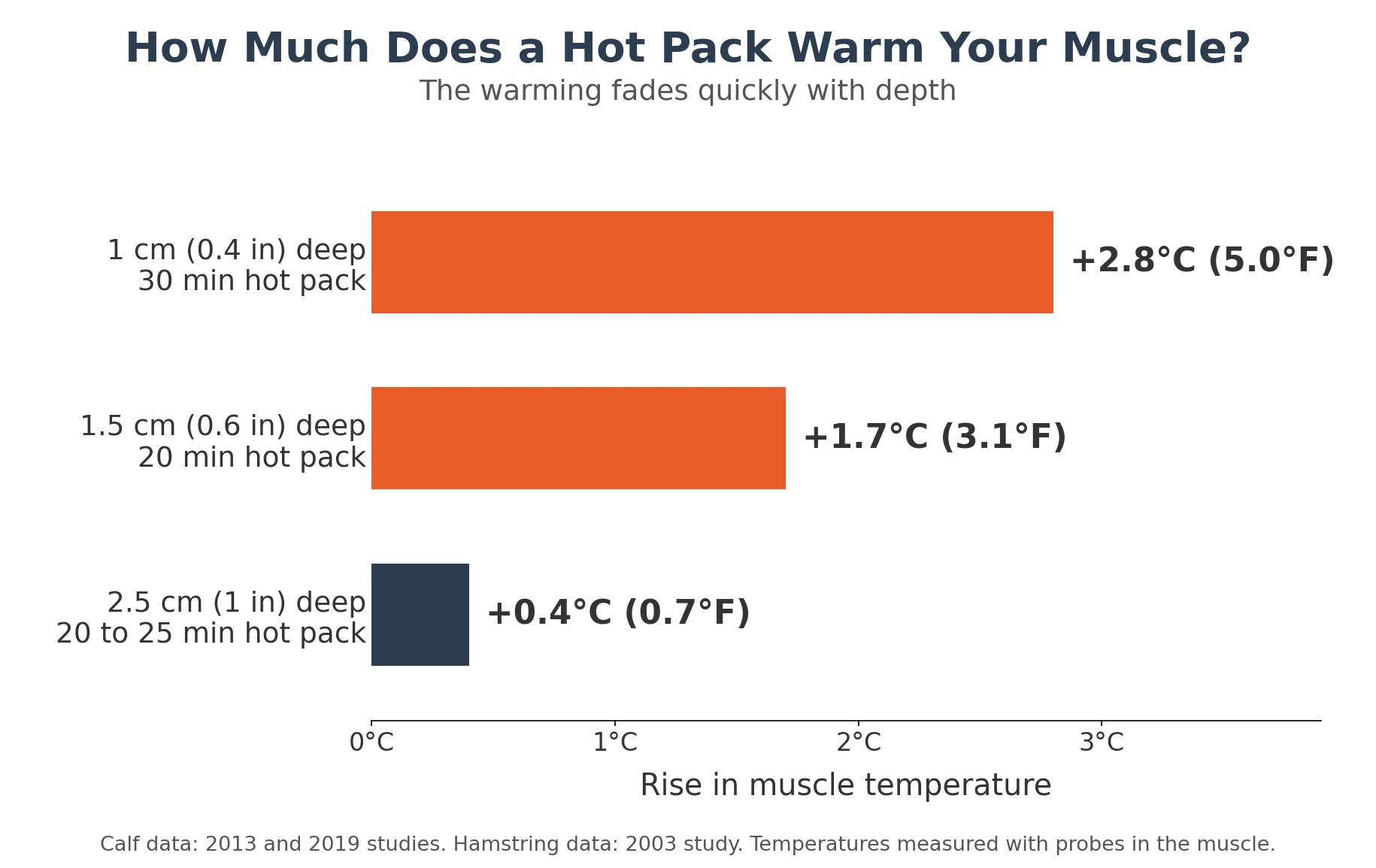
When researchers placed temperature probes in the calf, 30 minutes under a moist hot pack raised muscle temperature by 2.8°C (5.0°F) at a depth of 1 cm (0.4 in).
A second study measured 1.7°C (3.1°F) of warming at 1.5 cm (0.6 in) after 20 minutes under a hot pack.
Research on the hamstrings found that hot packs took 20 to 25 minutes to raise muscle temperature by only 0.4°C (0.7°F) at a depth of 2.5 cm (1 in), and hamstring flexibility didn’t improve.

That means a heating pad can warm a thin, close-to-the-skin area like your Achilles tendon or the arch of your foot, but it does little for big, deep muscles like your quads, hamstrings and glutes.
Can a Hot Bath or Hot Shower Replace Your Warm-Up?
A long soak in hot water can prepare your legs about as well as an active warm-up, but the soak in the research lasted far longer than a hot shower.
In a 2026 study, 27 trained cyclists either did a standard active warm-up or sat with their legs in 42°C (108°F) water for 45 minutes before a 12-minute time trial.
Their average power was 259 watts after the active warm-up and 255 watts after the hot-water soak, which the researchers found was no real difference.
Doing the soak and the active warm-up together didn’t raise power any further, and the cyclists rated the end of the time trial as harder after the soak alone than after the active warm-up.
A 5-minute hot shower hasn’t been tested this way, and it’s a small fraction of the 45-minute soak that matched a warm-up.
That means a hot bath is a backup for days you can’t move before you start, and an easy jog with a few drills gets you the same result in much less time.
For a full routine, use this guide on how to warm up before a run.
An easy jog and a few drills prepare your legs for a run in a fraction of the time a 45-minute hot soak takes.
RunnersConnect Bonus
Download our Active Stretching Maintenance Routine
It’s a PDF and video with images and descriptions of the most effective active stretches for runners.
Should You Keep Your Legs Warm Between Your Warm-Up and the Start?
Heat does its most useful job in the gap between your warm-up and the start of a race, when your muscles cool off while you wait in the corral.
A 2022 review of 7 studies looked at well-trained athletes who used passive heating to stay warm during that wait.
Peak power was higher with passive heating than without it in every one of the studies.
Overall performance also leaned in favor of staying warm, though the performance result wasn’t strong enough for the researchers to call it a clear benefit.
That means you should keep warm layers on until the last few minutes before the gun, so the warm-up you did is still working when the race starts.
Does Heat Help a Stiff or Sore Spot Before You Run?
Heat can ease a stiff or sore area before a run, as long as the soreness comes from training and not a fresh injury.
A 2005 study found that warm water at 40°C (104°F) raised blood flow in the lower legs of 24 healthy men compared with no treatment.
Research has shown that wearing a heat wrap for 4 hours before and 4 hours after hard exercise cut next-day low back muscle soreness by 47% compared with a group that didn’t use heat.
Those people were sore in the low back after back exercises, so the study doesn’t tell you how much a heat wrap helps sore calves after a long run.
It does show that heat on a muscle in the hours around a hard session can make the next day less painful.
A heating pad on its own is unlikely to make a tight hamstring more flexible, since the hamstring study in the first section found no change in flexibility after heating.
So, use a heating pad for comfort on a stiff spot, then let your warm-up do the loosening.
Should You Take a Hot Bath Before Running in Hot Weather?
Skip the hot bath, hot tub or long hot shower before a run on a hot day.
Your body can only hold so much heat before you have to slow down or stop, and starting warmer leaves you less of that room to work with.
A 1999 study found that cyclists exercising in 40°C (104°F) heat lasted 28 minutes after a hot-water soak raised their core temperature, compared with 46 minutes when they started at a normal temperature.
Every cyclist stopped at the same core temperature, about 40.1°C (104.2°F), no matter how warm they were at the start.
That means a hot bath before a summer run uses up part of the heat your body can store before the run even begins.
Cooling down first had the opposite effect, because the cyclists who started below normal temperature lasted 63 minutes.
You can use that on race day with these strategies for pre-cooling before running in the heat.
Do Icy Hot or Deep Heat Rubs Help Before a Run?
Rubs like Icy Hot and Deep Heat change how your skin feels, and the research on them shows no change in your core temperature.
Menthol is one of their main active ingredients, and it makes your skin feel cool.
A 2026 analysis of 16 studies found that menthol rubbed on the skin slightly improved exercise performance and lowered how hard the exercise felt.
The improvement showed up mostly in endurance exercise in mild weather, and it was smaller and less reliable at 30°C (86°F) or hotter.
A menthol rub can make a run feel a little easier than without it, and you still need a warm-up, since the rub works on how your skin feels.
Try any rub on a training run before you use it on race day.
When Should You Skip Heat Altogether?
Keep heat off a fresh injury, such as a sprained ankle or a pulled muscle.
Heat widens the blood vessels near your skin and sends more blood to the area, which adds to the swelling around an injury.
In a study of 30 people with sprained ankles, heat and contrast baths both increased ankle swelling on days 3 to 5 after the injury, and cold produced the smallest increase.
That means heat is a poor choice in the first few days after an injury, while swelling is still building.
If an area is swollen, warm to the touch or painful enough to change your stride, get it checked before you run on it.
When Does Heat Before a Run Help?
Here’s a quick guide to when heat helps before a run and when to skip it.
| Situation | What the research found | What to do |
|---|---|---|
| Heating pad on a big muscle | Hot packs raised temperature by 0.4°C (0.7°F) at 2.5 cm (1 in) deep | Warm up with easy running instead |
| Hot bath instead of a warm-up | A 45-minute soak at 42°C (108°F) matched an active warm-up | Use it only when you can’t move before you start |
| Waiting after your warm-up | Passive heating raised peak power in all 7 studies | Keep warm layers on until the start |
| Stiff or sore spot from training | A heat wrap cut next-day back soreness by 47% | Use heat for comfort, then warm up |
| Running in hot weather | Starting warmer cut time to exhaustion from 46 to 28 minutes | Skip hot baths and cool down first |
| Icy Hot or Deep Heat | Small performance boost, no change in core temperature | Optional, and you still need a warm-up |
| Fresh sprain or strain | Heat increased ankle swelling more than cold | Keep heat off it |