

The Tarahumara of northern Mexico run distances that sound invented, sometimes close to 100 miles across canyon trails in a single push.
Their traditional pre-run drink is chia seeds stirred into water, and the story of that drink is a big reason chia ended up in energy bars, gels, and half the smoothies at your running club.
Chia seeds do carry a real nutritional load, packing omega-3 fat, fiber, and a little protein into a very small package.
What the legend leaves out is what happens when researchers test the seeds on actual runners, and those results are more sobering than the marketing suggests.
So, in this article you’re going to learn:
- What a tablespoon of chia seeds actually gives you
- Whether chia can replace half your sports drink without hurting performance
- What happened when runners ran to exhaustion on chia seed oil
- What iskiate is and whether it’s worth drinking before a run
- What chia does for your health away from running
- How much to eat and the simplest ways to use it
What Are Chia Seeds, and Why Do Runners Care About Them?
Chia seeds come from Salvia hispanica, a flowering plant in the mint family native to central and southern Mexico.
They were a staple crop for the Aztec and Maya, valued enough to be traded as currency, and they traveled with runners and messengers as portable fuel.
The word chia comes from a Nahuatl term, and the seeds picked up the nickname “running food” for the role they played on long journeys on foot.
The Tarahumara carried that tradition into the modern era, mixing the seeds with water and lime for a drink called iskiate before covering enormous distances.
The 2009 book Born to Run put the Tarahumara and their chia drink in front of a huge running audience, and chia sales climbed in the years that followed.
That history is the entire origin of chia’s reputation among runners, which is worth remembering once you start asking what the seeds can actually do.
Chia’s endurance reputation was built on folklore for centuries before a single study tested it.
What’s Actually in a Tablespoon of Chia Seeds?
One tablespoon of chia seeds, about 12 grams, is a dense package of fiber, plant omega-3, and a little protein for only 58 calories.
Most of that fat is alpha-linolenic acid, the plant form of omega-3, and chia is one of the richest plant sources of it you can buy.
| Per 1 tbsp (12 g) | Amount |
|---|---|
| Calories | 58 |
| Omega-3 (ALA) | 2.1 g |
| Fiber | 4 g |
| Protein | 2 g |
| Carbohydrate | 5 g |
A phytochemical review in Molecules describes chia oil as roughly 60% alpha-linolenic acid, which is what gives the seeds their omega-3 headline.
Fiber is the other standout, and most of it is soluble fiber that absorbs water and forms the gel you see when chia sits in liquid.
That gel is central to almost every claim runners make about chia, from hydration to steady energy.
The protein is modest at roughly 2 grams per tablespoon, so chia supports your protein intake rather than driving it.
RunnersConnect Bonus
Download your FREE Guide where we share the Best Foods to Eat Before Running.
Can Chia Seeds Replace Half Your Sports Drink?
The most cited running study on chia asked a narrow, practical question: can you swap half your sports drink for chia and lose nothing?
A study in the Journal of Strength and Conditioning Research had six trained runners carb-load with either 100% Gatorade or a 50/50 mix of Gatorade and chia, then run for an hour and race a 10k.
Researchers found that replacing half a sports drink with chia seeds produced the same 10k performance as a full-sugar sports drink, while cutting the sugar roughly in half.

The performance came out identical, and the chia version delivered its carbohydrate with far less sugar plus a dose of omega-3 and fiber.
That is a real point in chia’s favor, with one important limit.
The trial ran only six subjects and tested carb-loading rather than mid-race fueling, so it shows chia is a reasonable partial swap, not a performance booster.
For the wider picture on your marathon fueling options, chia sits alongside gels and drinks rather than replacing them.
Do Chia Seeds Actually Improve Running Performance?
Swapping sugar is one thing, and adding chia to boost performance is a separate claim that has been tested head-on.
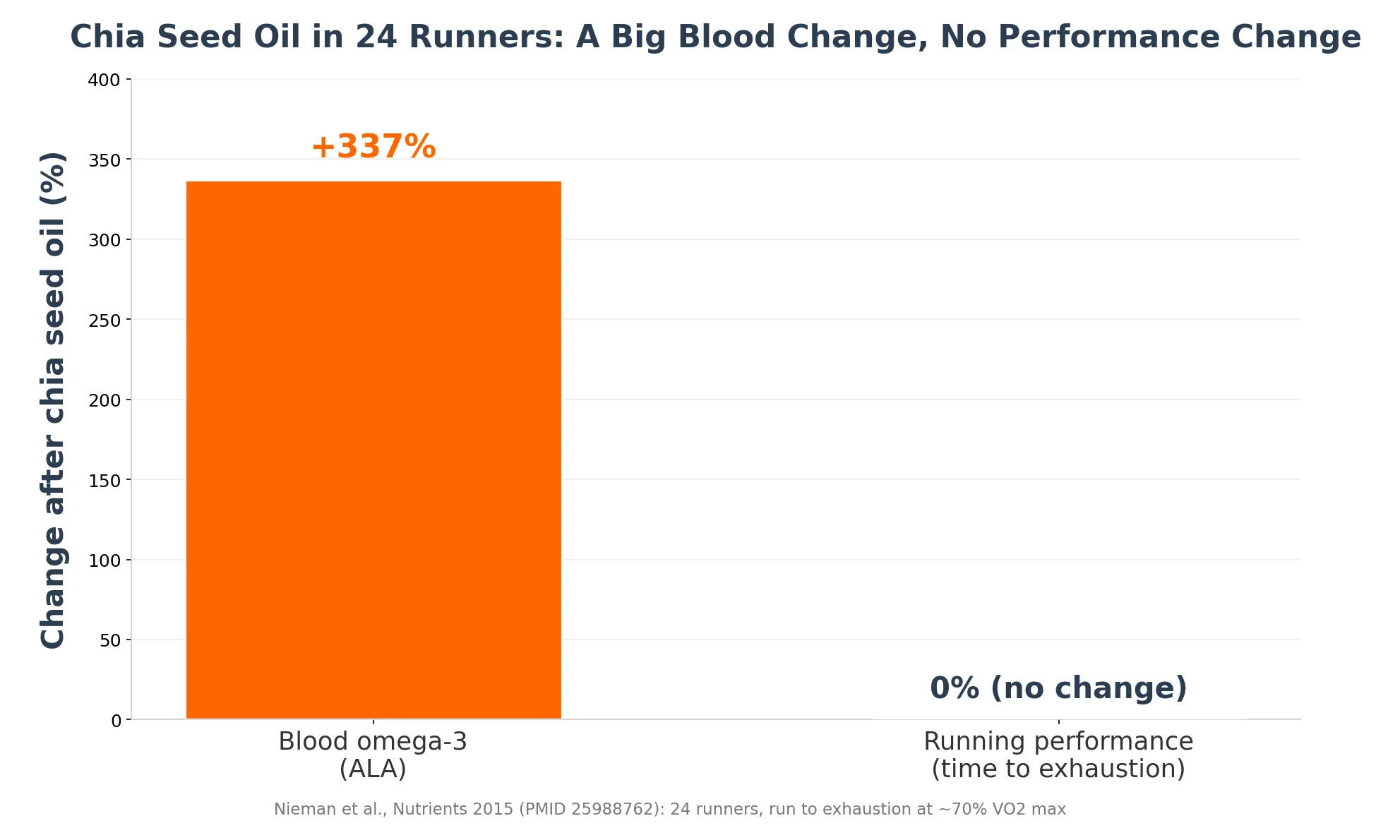
A 2015 study in the journal Nutrients gave 24 runners either flavored water or water with chia seed oil, then had them run to exhaustion at about 70% of VO2 max.
The researchers reported that chia seed oil raised runners’ blood omega-3 by 337% yet produced no improvement in time to exhaustion, effort, blood sugar, or inflammation.
The chia oil clearly got into their systems, and it changed nothing that mattered for the run.
This is the honest center of the chia question, because the seeds are nutritious and eating them will not make you faster on their own.
What Is Iskiate, and Should You Drink It Before a Run?
Iskiate, sold today as chia fresca, is the Tarahumara drink of chia seeds soaked in water with a squeeze of lime.
Left to sit, the soluble fiber pulls in water and turns the seeds into a soft gel, which is where the hydration claim comes from.
Food scientists testing chia as a sports gel base found the seeds’ gel held water and carbohydrate well enough to work as an energy gel ingredient.
The appeal for a runner is a drink that carries fluid, a little carbohydrate, and some minerals in a form that sits comfortably in the stomach.
No study shows iskiate beats plain water or a normal sports drink before a run, so treat it as a pleasant option rather than an edge.
If you like the taste and it settles well, drinking iskiate about an hour before an easy or long run is fine, and it doubles as a small dose of omega-3 and fiber.
For the bigger question of what to eat before a run, iskiate works as a light add-on rather than a meal.
Iskiate is a fine pre-run drink for hydration and a small carb hit, not a proven performance aid.
Are Chia Seeds Good for a Runner’s Overall Health?
Away from the racecourse, chia has a more convincing case built on its fiber and omega-3 content.
A 12-week trial in Diabetes Care added 37 grams of chia a day to the diets of people with type 2 diabetes and recorded lower blood pressure and reduced inflammatory markers.
The soluble fiber slows digestion and reduces the rise in blood sugar after a meal, and the omega-3 supports a healthier cholesterol profile over time.
For a runner, that means steadier energy from meals and long-term cardiovascular support rather than a raceday effect.
One claim worth dropping is weight loss.
A study in Nutrition Research gave overweight adults chia for 12 weeks and found no change in body weight or disease risk factors.
Chia is a healthy food to build into your diet, and it is not a supplement that fixes anything on its own.
Chia earns its place as a whole food for daily health, not as a shortcut to weight loss or speed.
How Should Runners Actually Eat Chia Seeds?
For everyday use, 1 to 2 tablespoons a day is a sensible amount, which covers most of the benefit without the digestive load of the 37-gram clinical doses.
Chia is nearly flavorless, so it disappears into food you already eat.
Stir it into yogurt or oatmeal, blend it into a smoothie, or soak it overnight in milk for a pudding-style breakfast.
Because the seeds absorb many times their weight in water, drink enough fluid alongside them, especially when you eat them dry.
Around running, timing matters more than the seeds themselves.
Have iskiate or a chia snack at least 60 minutes before you head out so the fiber has time to settle.
Three simple ways to work chia into a runner’s week:
Iskiate (chia fresca): Stir 1 tablespoon of chia into 10 oz of water, add lime juice and a little honey, and let it sit 5 to 10 minutes until it gels.
Overnight chia pudding: Mix 3 tablespoons of chia with 1 cup of milk, refrigerate overnight, and top with fruit for a long-run breakfast.
Recovery smoothie add-in: Blend 1 tablespoon of chia into a post-run smoothie for extra fiber and omega-3.
| What runners want from chia | Best available evidence | Verdict |
|---|---|---|
| Replace part of a sports drink | 6 trained runners, chia-Gatorade vs Gatorade | Same 10k performance, roughly half the sugar |
| Boost running performance | 24 runners, chia oil vs water, run to exhaustion | No improvement in time, effort, or fuel use |
| Pre-run hydration (iskiate) | Food-science gel testing, no runner trial | Reasonable fluid and carb carrier, no proven edge |
| Daily health | 37 g/day, type 2 diabetes, 12 weeks | Lower blood pressure and inflammation markers |
| Weight loss | Overweight adults, 12 weeks | No effect |
Chia seeds are a genuinely good food that got wrapped in a legend bigger than the evidence.
Use them for the fiber, the omega-3, and the occasional lower-sugar fuel swap, and keep your race times where they belong, in your training.

29 Responses
It should be noted that a negative side effect of chia seeds exist in the form of gastrointestinal issues. I tried adding iskiate and chia seeds to my diet, but experienced very painful gas in my belly. I mean doubling over pain in my stomach that lasted for hours. I’ve read it is a possible side effect, and I definitely experienced it. Everything affects everybody differently, and I definitely experienced this side effect.
Greg! I’m so sorry to hear you experienced GI issues when you ate chia seeds! You are absolutely correct about everyone being different, that is the tricky thing about nutrition. I don’t believe there is a single food on this planet that everyone can eat!
Your comment does bring up a great point on adding foods into your diet that you have never tried. Always add slowly, consider consuming half the suggested amount when you are first trying a food, or eat the new food only once the first week to make sure you don’t experience any negative side effects.
Some people have trouble with fiber.
Greg:
Whole chia seed affects me in a similar way. I switched to milled chia seed and it works wonders for me.
Hello, I sell Chia Seeds and do know that if you do not drink enough water while using chia seeds it will give you pain in your abdomen. This has happened to me. I did increase my water intake and have been fine since. I do not want to give up chia, it has helped me dramatically with inflammation. Don’t give up on the seed just lower your dose of chia and increase water.
thank you for your info on chia seeds.it certainly has helped me to know to lower my dose so I can continue taking it in juice every morning thanks.
The issue with stomach issues if probably related to eating too much chia and not taking in sufficient liquid. As chia is very hydrophylic it absorbs a lot of liquid. This can pull it from the stomach leading to the issues you describe.
Wayne
Exactly!
Just got Chia seeds in the mail last night. Anxious to see how my body reacts to them. Sprinkled them on dinner last night and in my oatmeal this morning. I feel faster already!
Dannis! This is great! It is always fun to add new things into our diets. Another one of my favorite Chia recipes is a
Chia Sundae!
2 Tbsp Chia Seeds
about 1/3-1/2 cup Vanilla Unsweetened Almond Coconut Milk (almond breeze) (just enough to get the seeds to gel up)
Splash of vanilla extract
Coconut flakes
Strawberry or blueberry slices
First I mix the chia seeds, milk and vanilla together and let them sit for about 10 minutes. Stirring occasionally. Once I get a pudding like texture I top with coconut flakes and berry slices. If I really want to boost the antioxidant load of the sundae, I add a few carob nibs!
This recipe is so easy and can be modified to fit anyones preferences!
I am in training for a ultra marathon 80kms my training schedule is well I am never home always running and I would like to know what to do with chia seeds I bought a packet today . The one thing I don’t want is to put on weight even thou I am very very thin please get back to me soon thank you
Thanks Abby, I didn’t know chia seeds gave endurance for running. Will have to try them.
Cynthia
In most stories on chia seeds it is being stated that the ancient Aztecs and Mayans were able to walk days and week as a messenger just on chia seeds, but it is important to note that this heavy running was mostly done on chewing coca leaves which is done until today. Nevertheless, chia seeds are truely a superfood with lots of fibers and omega 3 & 6.
My Brother ran the Comrades Marathon on chai seed. He swears by it. It was his first Comrades he had an awesome run
I have been “on chia seeds”, mixed with ground flax, for ten days now. I didn’t run a race but I always note my training times. Two days ago I ran a 17k PB and today a 6k SB. It’s amazing, My legs used to feel heavy, sluggish and suddenly I seem to have more energy.
Should you eat the chia seeds before or after workouts?
I agree with Sheila. Gone are the heavy legs during and after training. A lot more endurance from chia seeds before I run
According to research chia seeds are not bioavailable unless you grind them
I believe you are talking about Flax Seeds, not Chia. I often eat 3 tablespoons a day of Chia with no ill effects, only more energy. I will be 69 on August 15.
Hi Joe, we are talking about Chia, but this is just a general recommendation. Individuals will have different tolerances, so if it works for you, keep it up!
I have just bought some Chia seeds. Using a general recommendation of 1 table spoon per cup of water. They have a rather sweet/nutty mild flavor. I hesitate to say miracle food, but at the same time anything that has plenty of omega 3’s in it should be pretty helpful. Took some just yesterday for the first time and curiously within probably 30 minutes I felt a lot more mentally alert, have similar experiences when I eat beef heart, and got through some things with better overall energy levels. So I’m not sure exactly what will occur, but I will try it for a bit and see how it does.
Hi Adam, thanks for sharing your thoughts on Chia seeds. That is great you noticed changes so quickly. If it works for you, then it is definitely worth a try!
Been on Chia for a little bit. I have noticed that even if I don’t consume it on the day of running I tend to have better energy, I consume it about once a day with a good whole grain cereal, and can tackle a big old hill in the area I live. Some of that is doubtless based on training since I had just introduced the hill, but I have noticed a difference in recovery times between running sessions. Interesting to note that my last 5k was a month ago in a hilly are was 26:31 not great, but not bad and in a month I have run the same course 6 times roughly and the time has decreased to 24 minutes give or take a few seconds. Some of that again probably has to do with beginner ability to gain on a program, but the training has been essentially run 45 minutes one week with the course once in the same week, twice the next week and the week after run the hilly course once with an hour of jogging on an indoor track. I timed myself this past Monday and the race is Saturday. I am at about 4,865 feet. So all told I do not think Chia is some incredible food that solves all problems, but I will submit that consumption of it on a daily basis seems to have had a good effect on me and helped me recover a little faster from training than in the past. I will keep it in my diet for as long as I am able and will post again in a bit.
Hi Adam, thanks for sharing. Glad you have found the improvements, especially within recovery. Keep up the good work, and yes, please let us know how you continue to get on!
One of the benefits of chia seeds for runners involves pain management and prevention. Chia seeds have high concentration of Omega-3 fatty acids! I found more benefits: https://www.wizeapple.com/blogs/blog/benefits-of-chia-seeds-for-runners
Hi Jane, thanks for reaching out. We did actually talk about the omega-3s in this post, not sure if you missed it, but thanks for the suggestion for the other site. Some of our readers will be eager to learn more.