

Sugar has a bad reputation, and cutting back on it is one of the first things runners hear when they start eating to perform.
But the gels, chews and sports drinks you carry on a long run are mostly sugar, and one energy bar handed out in the Boston Marathon athletes’ village listed 5 different forms of it on the label.
So does sugar help when you’re running, or is it something you should avoid?
The answer depends on when you eat it and how long you run, and researchers have tested sugar before, during and after exercise.
Here’s what you’ll learn about sugar for runners:
- When sugar helps your running and when you don’t need it
- Whether eating sugar before a run causes a crash
- How many grams of sugar to take per hour on a long run, and whether candy works as well as gels
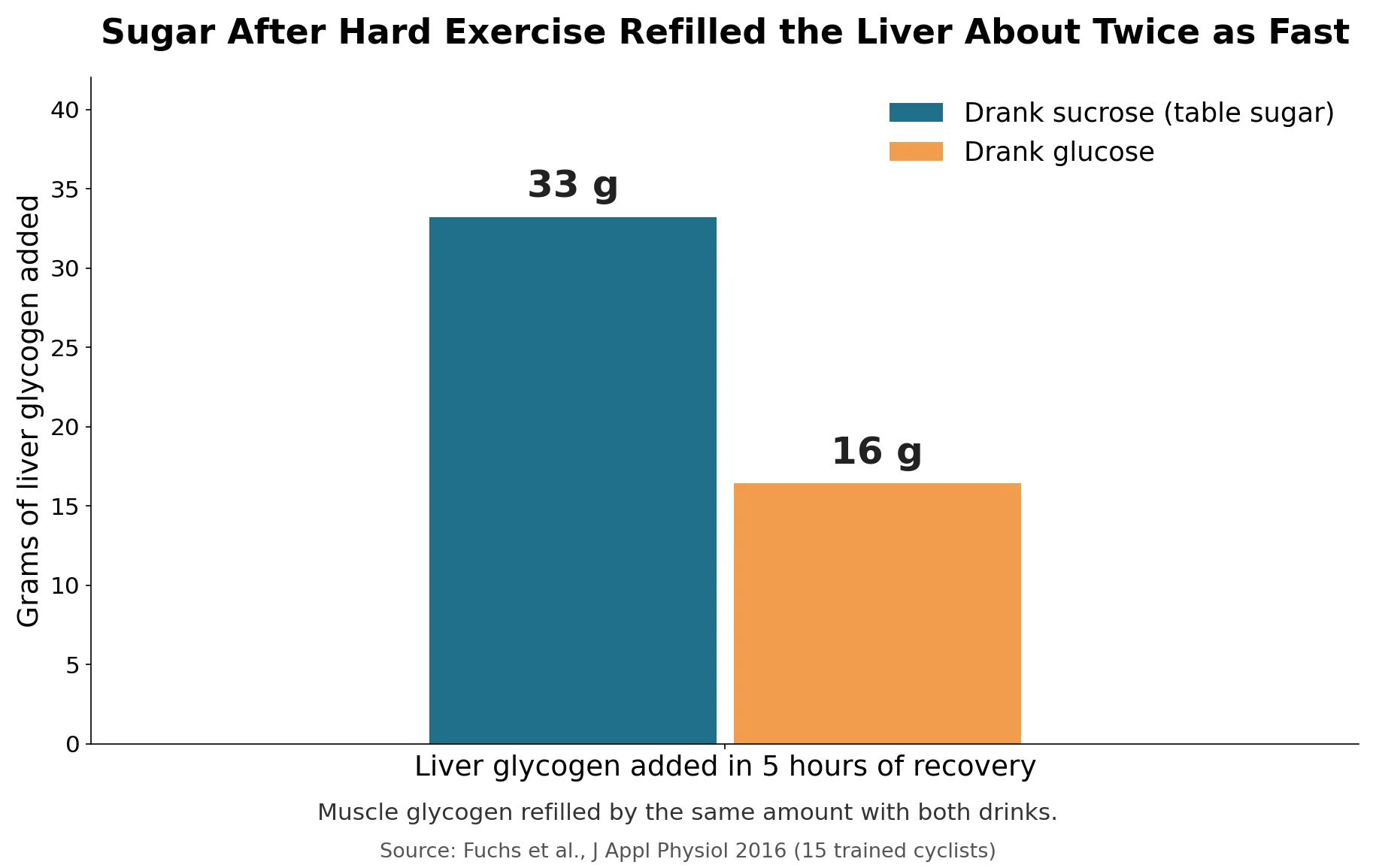
- Why table sugar after a hard workout refilled the liver about twice as fast as glucose
- How much sugar runners should eat on a normal day
Does Sugar Help When Running?
Sugar helps you run faster on runs longer than about an hour, and the benefit gets bigger the longer you run.
A 2014 systematic review pulled together 61 studies that compared taking carbohydrate during exercise with drinking only water.
Research has shown that taking carbohydrate during exercise improved performance in 82% of 61 studies compared with water, and the longer the exercise lasted, the bigger the improvement.

The reason is the glycogen stored in your muscles, which is the main fuel you burn at a hard effort.
On a long run, the sugar you take in keeps carbohydrate reaching your muscles as those glycogen stores run low.
In a 1995 study, endurance-trained runners ran 3 marathons on a treadmill, 4 weeks apart.
When they drank only water, they finished in about 194 minutes, and their speed started to drop after 10 km (6.2 miles).
When they drank a sports drink with 5.5% carbohydrate, they finished in about 190 minutes and held their speed for the whole 42.2 km (26.2 miles).
That means the 5.5% sports drink was worth about 4 minutes over a marathon, mostly by keeping the runners from slowing down.
On runs under an hour, you don’t run out of stored glycogen, so the sugar works in a different way.
In a 2004 trial, cyclists who rinsed a sugar drink around their mouth and spat it out finished a 1-hour time trial in 59.6 minutes, compared with 61.4 minutes when they rinsed with water.
They never swallowed the drink, so the 1.8-minute improvement came from the sugar touching receptors in their mouth, which researchers think signals the brain to keep the effort up.
That means on easy runs under an hour you don’t need sugar, and on a hard race of about an hour a few sips of sports drink are enough.
Is Sugar Good Before a Run?
Eating sugar in the hour before a run is fine for most runners, despite the common warning that it causes a sugar crash.
One study often cited for avoiding fast-digesting carbs before exercise is a 1991 study where 8 trained cyclists rode to exhaustion 1 hour after eating either lentils, a slowly digested food, or potatoes, a quickly digested one.
The cyclists lasted 20 minutes longer after the lentils.
Later research hasn’t held that up.
A 2017 meta-analysis of 19 studies found no clear performance benefit from eating slowly digested foods before endurance exercise instead of quickly digested ones.
A 2010 review of the pre-exercise feeding research came to the same answer.
Almost every study it looked at found performance was the same or better when athletes ate carbohydrate in the hour before exercise, so the reviewers called the advice to avoid it unfounded.
Some athletes do get shaky or lightheaded after a sugary snack before they start, even though their blood sugar rarely drops low enough to explain it.
If that’s you, test the timing and the snack on training runs, and keep what doesn’t cause symptoms for race day.
For everyone else, a banana, toast with honey or a few swallows of sports drink before a long run tops up your fuel without slowing you down.
RunnersConnect Bonus
Download your FREE Guide where we share the Best Foods to Eat Before Running.
How Much Sugar Do You Need During a Run?
How much sugar you need per hour depends on how long you’ll be running.
A 2011 consensus paper on carbohydrate for athletes set these targets:
| How long you’re running | Carbohydrate per hour | What it looks like |
|---|---|---|
| Under 1 hour | Small amounts or none | A few sips of sports drink, or water only on easy runs |
| 1 to 2.5 hours | 30 to 60 grams | 1 to 2 gels of about 25 grams, or a sports drink plus 1 gel |
| Over 2.5 hours | Up to 90 grams | Gels plus sports drink, using a glucose and fructose mix |
Gels aren’t all the same size, so check the label on the one you use and count the grams of carbohydrate in each one.
Above about 60 grams an hour, the type of sugar starts to matter.
A 2014 review found your muscles can burn a single sugar like glucose at up to about 60 grams an hour.
Above that, you need a mix of glucose and fructose, which your gut absorbs through different routes, so the extra sugar is used instead of building up in your intestine.
In a 2008 study, cyclists who drank a glucose and fructose mix during 2 hours of riding were 8% faster in the time trial that followed than when they drank glucose alone.
Table sugar is sucrose, which your gut splits into equal parts glucose and fructose, so foods made with ordinary sugar already give you both.
Does Candy Work as Well as Gels?
Candy is likely to work as running fuel as long as you take in the same grams of carbohydrate.
A 2008 trial had trained cyclists compare sports jelly beans, a gel and a sports drink, with each matched for carbohydrate, against water.
After 80 minutes of cycling, the athletes finished a 10 km (6.2-mile) time trial in 17.2 to 17.3 minutes with any of the 3 sugar sources, compared with 17.8 minutes on water.
That means sports jelly beans fueled the athletes as well as a gel, and simple candies with similar ingredients, like jelly beans and gummies, should work the same way when the grams match.
What matters most is which form your stomach handles best at race pace, and this comparison of gels, sports drinks and gummies covers what to test in training.
Whatever you use, practice taking it on long runs so your stomach is used to it before race day.
Is Sugar Good After a Run?
Sugar after a long run or hard workout refills your stored fuel, and in one study table sugar refilled the glycogen in the liver faster than glucose alone.
Your liver stores glycogen too, and it releases that glycogen as glucose to keep your blood sugar steady while you run.
A 2016 study had trained cyclists drink either sucrose, which is table sugar, or glucose for 5 hours after a ride that drained their glycogen, at a large dose of 1.5 grams per kilogram of body weight (0.7 g per lb) each hour.
The researchers found that cyclists who drank sucrose after hard exercise added about 33 grams of liver glycogen in 5 hours, about twice the 16 grams added with glucose, while muscle glycogen refilled equally with both.
That means ordinary sugar in a recovery drink or meal is a good choice when you have another run within a day, because your liver regained about twice as much glycogen as it did from glucose.
After an easy run, your normal meals refill what you used, and you don’t need extra sugar.
Is Sugar Bad for Runners?
Sugar is useful fuel during and right after long runs and hard workouts, but it still counts toward the same daily limit health guidelines set for everyone.
The World Health Organization recommends keeping free sugars, which include added sugar, honey and fruit juice, under 10% of your daily calories.
On a 2,500-calorie day, that’s about 250 calories, or roughly 60 grams of sugar.
A long run with 2 gels and a sports drink can go past that on its own, which is why the rest of your carbohydrate should come from foods like oats, rice, potatoes, fruit and bread.
This look at how sugar affects your health as a runner covers the health risks in more detail.
Save most of your sugar for your long runs, hard workouts and the hour after them, and eat the rest of your carbohydrate as whole foods.
Ready For More?
Then start our FREE Race Day Fueling email course!
You’ll learn how to calculate when you’ll bonk, how to hydrate, what foods to eat during your race, and more! From case studies to scientific research, we’ll help you learn how to best fuel for your next race.
When Should Runners Eat Sugar?
Here’s a quick guide to when sugar helps your running and how to use it:
| When | Does sugar help? | What to do |
|---|---|---|
| Easy run under 1 hour | No | Water is enough |
| Race or hard effort around 1 hour | A little | Sips of sports drink |
| In the hour before a run | Yes, for most runners | Banana, toast with honey or sports drink |
| Run of 1 to 2.5 hours | Yes | 30 to 60 grams per hour |
| Run over 2.5 hours | Yes | Up to 90 grams per hour of glucose and fructose |
| After a long or hard run | Yes | Sugar plus a normal meal, and more of it before another run within a day |
| Rest days and snacks | No | Keep free sugars under 10% of daily calories |




9 Responses
Great post! I agree that runners can completely overdue the sugar. I struggle with this, because my body is often craving the extra carbs/sugar after long runs. But I’ve learned the hard way not to fuel that way. Banana and pb is my go-to pre run fuel, or on a whole grain tortilla or bread for runs up to 13 miles. Thanks for the informative post!
Thanks Laura! Those are great go-to fuels! It is amazing how “sneaky” sugar can be! We often forget that vegetables are great pre/post run carbs too! Sometimes a sweet potato is that perfect amount of sweetness, but great source of carbs before a run!
Hi Abby,
Your post is exactly what the doctor ordered. I am startled to read the first line. 22 teaspooons of sugar for bfast is unfathomable. Is that fact accurate? I am feeling guilty of adding 1 teaspoon (measuring spoon) of table white sugar in my morning coffee. and I sometimes go for the low fat vanilla flavored yoghurt after the gym 🙂 I hope to win my private and secret battles with sugar soon.
Great post! Thanks.
Very good article. And what you have said is true: Running does not give us runners a licence to gobble up all sugar that we can. Natural sugar is a much better option for all of us than processed sugar. I can see from the table given in your article that most of the processed sugar looses the nutritional value.
generation UCAN
ask Meb
Bob, you will enjoy our podcast we did about UCAN. https://runnersconnect.net/running-nutrition-articles/ucan-marathon-nutrition-review/ Let us know your thoughts!