

You can spend 3 hours a week in the gym and still not run any faster.
That happens when the exercises you pick train your muscles in a movement running never uses.
Bicep curls, crunches, leg extensions, hamstring curls and light calf raises all feel productive, and all of them do little for your running.
The good news is that each one has a simple swap that loads the same muscles the way your stride does.
In this article, you’ll learn about choosing strength exercises for running:
- Why bicep curls and crunches barely change how you run
- What your quads, hamstrings and calves do on every stride, and which lifts match it
- The heavy lift that improved running economy by 5% in 8 weeks in trained runners, and how to add it
Why Do Some Gym Exercises Do So Little for Your Running?
Strength work carries over to your running when it trains the same muscles, in the same movement, at loads close to what your stride asks of them.
Coaches call this specificity.
A bicep curl trains your biceps to bend your elbow against a weight, and running never asks your biceps to do that.
So the strength you gain from curls stays in the gym.
The closer an exercise loads your muscles the way a running stride does, the more of its strength carries over to your running.
Each exercise below fails that test in a different way, and each one has a swap that does carry over.
Do Bicep Curls Help Your Running?
Bicep curls do almost nothing for your running, because your arms swing with little effort from the muscles that move them.
A 2009 study of people running on a treadmill found that the front and back of the shoulder muscle contracted at the same time instead of taking turns to drive the arms forward and back.
That means your arms mostly swing as a reaction to your legs and hips, so your biceps never have to pull them through.
Your arm swing can still affect how much energy you use, so keep it.
A 2014 study that had runners hold their arms still in three different positions found that running with the arms held still took 3% to 13% more energy than running with a normal arm swing, depending on how the arms were held.

That means the best thing to do for your arms is let them swing naturally, and put the time you would spend on curls into leg work.
Do Ab Crunches Make You a Faster Runner?
Crunches train your abs to curl your spine forward, and your spine stays upright for every step of a run.
When you run, your core’s job is to hold your torso steady while your legs and arms swing in opposite directions.
The evidence that stability-focused core training improves running is mixed.
A 2004 study of 18 teenage male athletes found that 6 weeks of Swiss ball core training improved their core stability scores but left their running economy, VO2max and running posture unchanged.
One 2009 study of adult runners did find faster 5,000-meter times after 6 weeks of core training.
But the runners’ landing forces and leg stability scores stayed the same, so it’s unclear what produced the improvement.
For most runners, a few minutes of side planks after a run covers the core work you need, and the rest of your strength time is best spent on your hips and legs.
If you want a full routine, this guide on how to strengthen your core for running walks through the exercises that hold your torso steady.
Get Your Strength Plan PDF & Video
Get a sample weekly plan so you can tailor your strength workouts to your race distance.
This PDF will give you a weekly calendar you can follow based on your race distance plus video links to specific strength routines you can try.
GET MY GUIDE
Are Leg Extensions and Hamstring Curls Worth Your Time?
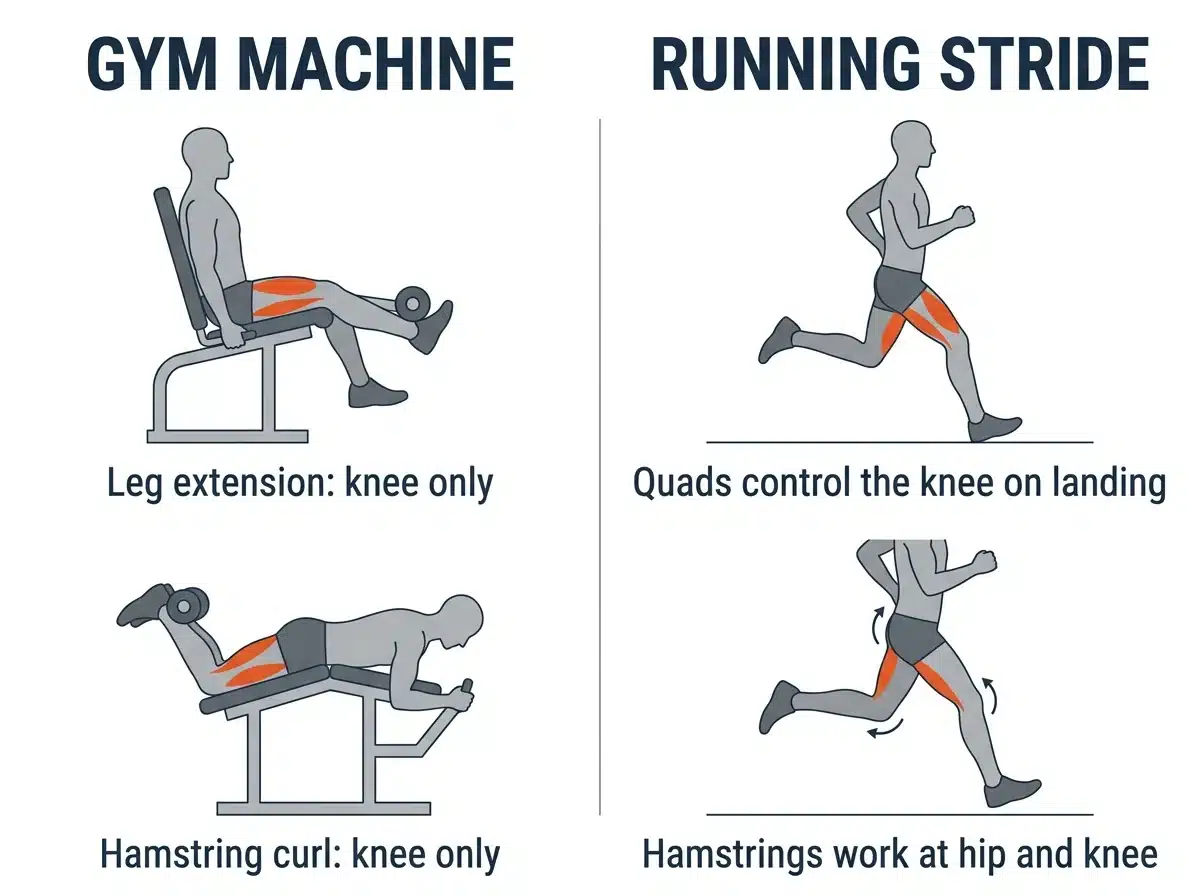
Leg extensions and hamstring curls work the right muscles in the wrong movement.
On a leg extension machine, your quads straighten your knee against a pad while you sit.
When you run, your quads do most of their work right after your foot lands, controlling how far your knee bends as your body weight comes down on it.
Your hamstrings follow a similar pattern.
A 2011 study that modeled the hamstrings of 12 people running near sprint speed found that the hamstrings lengthened under load as they slowed the swinging leg, then shortened under load from late swing through the time the foot was on the ground.
That means your hamstrings work at your hip and your knee at the same time, at least at fast speeds, while a lying hamstring curl only trains them to bend your knee with your hip pinned to a bench.
Swap leg extensions for squats and hamstring curls for Romanian deadlifts, because both lifts load your hips and knees together the way your stride does.
Do Calf Raises Help Runners?
Your calves do more of the work of holding you up while you run than any other leg muscle, so calf raises help only when they are heavy enough to match that work.
A 2012 study that modeled the leg muscles of 9 runners found that the two main calf muscles, the soleus and gastrocnemius, provided the most support force of any leg muscle at every speed up to 7 meters per second, about 3:50 per mile (2:23/km).
That covers every pace of a normal training run or distance race.
A set of bodyweight calf raises loads your calves with your body weight alone, which is far less force than they absorb on every running stride.
So hold dumbbells or use a machine, pick a weight you can lift only 6 to 12 times, and do sets with a straight knee and with a bent knee to load both calf muscles.
This article on improving calf strength and mobility shows how to test where your calves stand before you add weight.
RunnersConnect Bonus
Download our Calf Strain Injury Prevention Routine.
It’s a PDF with images and descriptions of the most effective prevention and rehab exercises for runners who suffer from calf strains.
What Strength Exercises Should Runners Do Instead?
Strength exercises that work your hips, knees and ankles together, like squats, improve running economy when you do them alongside your normal running.
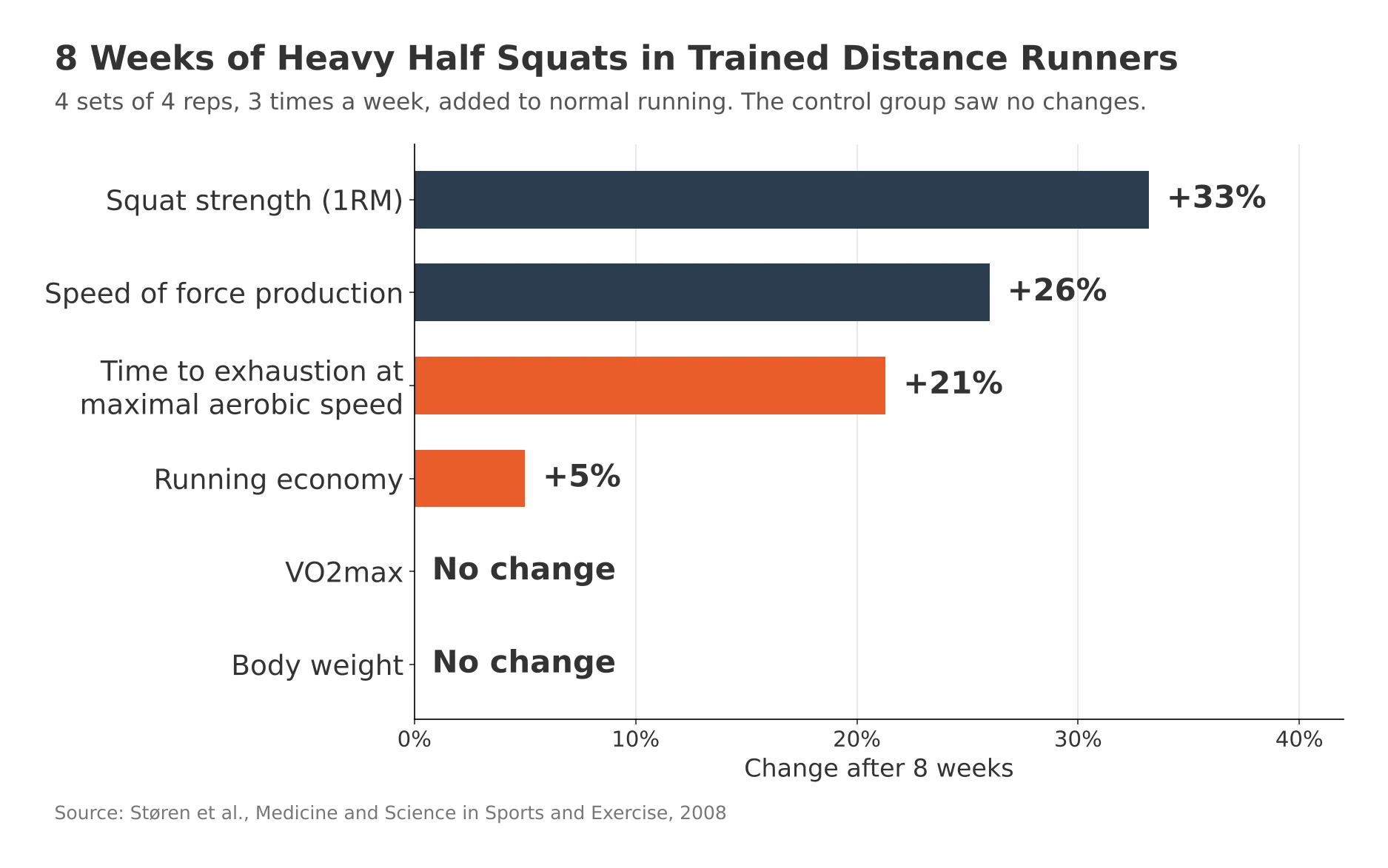
A 2008 study of 17 well-trained distance runners found that the 8 who added heavy half squats for 8 weeks improved their running economy by 5% and extended their time to exhaustion at maximal aerobic speed by 21%, with no change in body weight.
The runners did 4 sets of 4 reps, 3 times a week, on top of their normal running.
That means you can hold the same pace while using less oxygen, with no change in body weight.
A 2016 review of 5 controlled trials in 93 high-level middle- and long-distance runners found a large improvement in running economy from 2 to 3 sessions a week of mostly moderate-weight lifting and jumping for 8 to 12 weeks.
If you want a structured prescription instead of building routines yourself, our Strength Training for Runners program has 24 routines built for runners, with prescriptions by race distance.
Cross-training and gym classes you enjoy still have a place, as long as they come on top of this running-specific work.
The table below lists each exercise, why it falls short and the swap that carries over to your running:
| Exercise | Why it falls short for runners | Swap it for |
|---|---|---|
| Bicep curls | Your arms swing as a reaction to your legs, so arm strength isn’t what limits you | More leg work, with a relaxed, natural arm swing |
| Ab crunches | Running needs your core to hold your torso steady, not curl your spine | Side planks after a run |
| Leg extensions | Your quads work while controlling the knee as you land, not straightening it from a seat | Squats |
| Hamstring curls | Your hamstrings work at the hip and knee together on every stride | Romanian deadlifts |
| Bodyweight calf raises | Too light to match the force your calves handle on each step | Weighted calf raises, 6 to 12 reps, straight and bent knee |